
When Education Stops Building Nations and Starts Sorting Citizens: How Pakistan’s Schooling Model Converted Learning into a Class-Producing

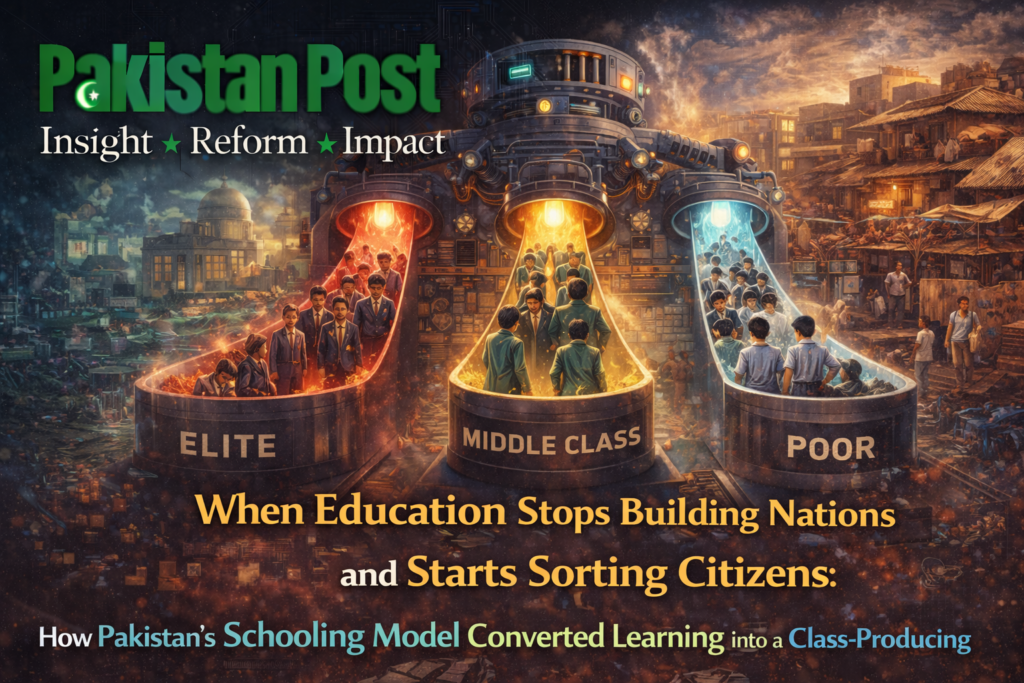
Education serves as one of the most powerful vehicles for social development and national cohesion. Historically, countries like Finland, South Korea, post-war Germany, and early China leveraged their education systems to equalize cognitive capital, prioritizing inclusivity and collective advancement over monetization. However, Pakistan has taken a divergent path, allowing economic factorsparticularly price and languageto determine the quality of education. This inversion of educational values has propagated a system that not only fails to promote excellence but actively fosters societal stratification. This article delves into the implications of this paradigm shift and offers recommendations to realign Pakistan’s educational framework toward inclusivity and national coherence.
Education has always been more than a means to gain knowledge; it’s a vehicle for constructing cohesive societies and fostering collective identities. In nations that have made significant strides in educational reform, the focus has been on ensuring equitable access to educational resources. In Finland, for instance, education is seen as a fundamental right, resulting in uniform educational quality regardless of a child’s socio-economic background. South Korea’s post-war education system was designed to democratize learning opportunities, subsequently facilitating rapid economic growth and development. In sharp contrast, Pakistan’s education system reflects an enduring legacy of class division and regional disparities. Since its inception, the Pakistani educational framework has oscillated between elitism and neglect, often prioritizing elite schools over public education, thus creating a chasm between different strata of society.
The fundamental issue plaguing Pakistan’s educational landscape is its reliance on market forces to define “quality,” with severe ramifications for national unity and social mobility. In Pakistan, the term “modern syllabus” has morphed into a marketing gimmick. Various educational institutions present themselves as progressive by adopting curriculum changes; however, these changes frequently lack substance. Instead of fostering critical thinking and creativity, many modern syllabi continue to emphasize rote memorization, preparing students for examinations rather than imparting indispensable skills necessary for navigating real-world challenges. As a result, education becomes a commodity, marketed to create a perception of value and exclusivity. This branding has contributed to an environment where educational institutions prioritize prestige over genuine learning outcomes, perpetuating a cycle of elitism.
In the quest for modernization, substantial investments have been directed toward infrastructural reformssuch as upgrading buildings, laboratories, and creating uniformity in dress codes. These improvements, while visually appealing, often overshadow the pressing need for epistemic reform in teaching methods and curricular focus. Investing in state-of-the-art facilities does little to guarantee the effectiveness of educational practices. Many public schools struggle with inadequate teaching resources and a lack of qualified educators, resulting in poor academic performance among students. The drive for physical enhancements in education has largely ignored the critical need for improving pedagogies, curriculum design, and teacher training.
Pakistan is characterized by extraordinary linguistic and cultural diversity. Sadly, many educational policies and initiatives, particularly those introduced through external funding, have failed to appreciate and address this plurality effectively. The focus on a homogenized educational framework often sidelines the unique cultural contexts of students. National curricula seldom accommodate linguistic diversity, forcing students to learn in languages that may not be their first. This undermines their ability to engage critically with the material and diminishes educational relevance. By bypassing ground realities, we breed inequality and alienation, further fracturing societal cohesion.
The confluence of these factors has engendered a system where educational attainment increasingly correlates with socio-economic status. The stratification that ensues ensures that students from affluent backgrounds have access to high-quality education, insulating them from the travails faced by their less fortunate peers. As a result, the dream of a meritocratic society fades away, replaced by a landscape where privilege and opportunity are interlaced.
Realigning Pakistan’s educational priorities toward inclusivity and national unity requires concerted efforts and strategic reforms. Establishing a unified framework for learning outcomes can help standardize educational expectations nationwide. A comprehensive, nationally accepted curriculum would ensure that all students, regardless of their socio-economic background, have equal access to quality education. This framework should prioritize critical thinking, problem-solving skills, and creativity, allowing students to navigate the complexities of modern life effectively. Educational institutions must move away from an economic model where quality is defined solely by financial investment. By creating public schools that offer high-quality education without hefty fees, we can mitigate the perception that expensive schooling equates to better future prospects. This approach can help democratize access to excellent educational resources, fostering greater equality among students. As elite educational institutions proliferate, we see a concerning trend toward credential inflationwhere the value of degrees diminishes as more students seek advanced qualifications to gain a competitive edge. Regulating public sector hiring to ensure that job qualifications focus on practical experience and competencies rather than merely prestigious degrees can help level the playing field.
The educational challenges facing Pakistan today are vast and complex. However, by re-emphasizing the core values of equity, access, and inclusivity within the education system, the nation can begin to mend the fractures exacerbated by years of stratification. Adopting comprehensive reforms that focus not only on physical infrastructure but also on pedagogical integrity and respect for cultural diversity is crucial. By doing so, Pakistan can transform education from a class-producing machine back into an egalitarian force for national unity fostering a society where every citizen has the opportunity to contribute to the nation’s progress.
A Public Service Message