
Processing Rare Earths Will Define Tomorrow’s Strategic Economic Advantage

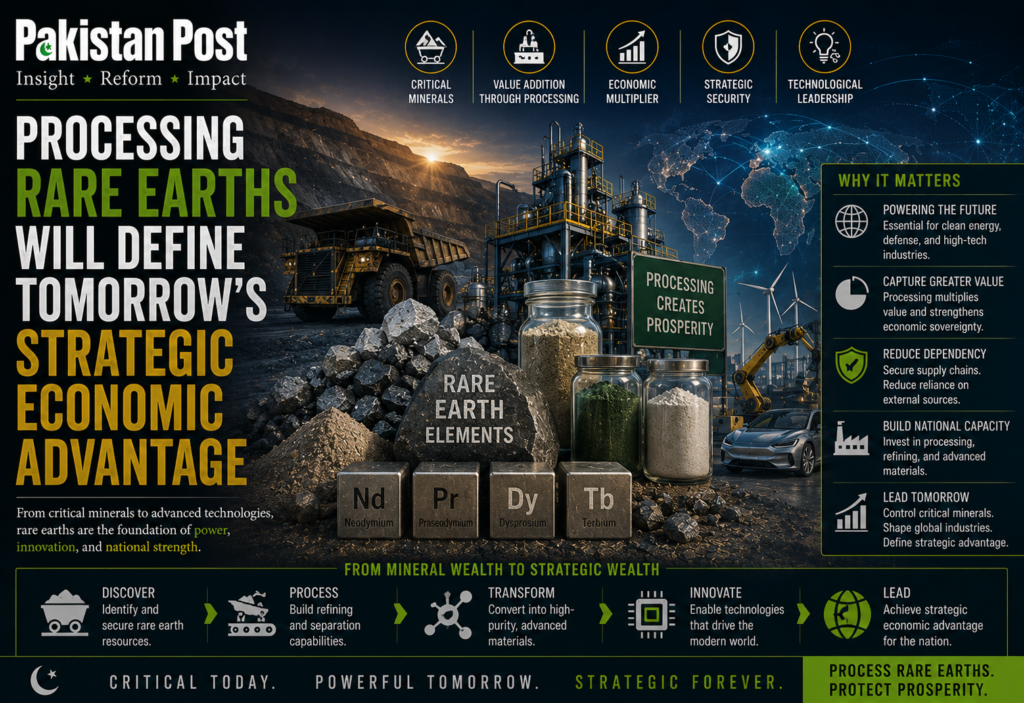
The international contest over critical minerals is undergoing a profound transformation. For much of the past two decades, strategic debate focused overwhelmingly on the geographical distribution of mineral deposits, exploration rights, mining concessions and access to untapped reserves. Governments measured competitive advantage by estimating the volume of rare earth elements beneath national territory, while investors pursued jurisdictions rich in lithium, cobalt, graphite, nickel and rare earth deposits. Today, however, the centre of gravity has decisively shifted. Competitive advantage no longer rests primarily upon ownership of mineral resources. Instead, it increasingly depends upon mastery of the industrial ecosystems that transform raw minerals into refined materials, advanced components and technologically sophisticated products. The emerging geo economic contest is therefore not about extraction alone. It is about processing capability, refining technologies, environmental compliance, industrial innovation, intellectual property, manufacturing integration and value chain control. Countries capable of processing strategic minerals possess leverage that extends far beyond mining. They influence global manufacturing, technological development, industrial resilience and national security planning simultaneously.
Modern industrial economies rely upon critical minerals at every stage of technological production. Electric vehicles require refined lithium, cobalt and nickel. Wind turbines depend upon permanent magnets produced from processed rare earth elements. Semiconductor manufacturing demands highly purified specialty materials. Aerospace industries consume advanced alloys incorporating rare earth compounds. Defence systems require sophisticated magnetic materials, precision guidance components, radar technologies and electronic warfare equipment that cannot function without refined strategic minerals. Artificial intelligence infrastructure depends upon servers, processors and data centres whose production requires highly specialised mineral inputs. Consequently, processing capability has become a strategic industrial multiplier rather than merely another manufacturing activity.
The distinction between extraction and processing represents the difference between commodity dependence and industrial sovereignty. Raw minerals possess limited strategic value until refined into materials meeting exact industrial specifications. The refinement process involves advanced chemical engineering, precision metallurgy, environmental management, specialised equipment, highly trained technical personnel and extensive research capability. Countries exporting unprocessed minerals often capture only a small fraction of the eventual economic value generated through downstream manufacturing. Conversely, nations controlling processing infrastructure accumulate technological expertise, manufacturing competitiveness, export earnings and geopolitical influence simultaneously.
This evolution reflects broader structural changes within international political economy. Industrial policy has returned as a central instrument of national strategy. Governments increasingly recognise that market mechanisms alone cannot guarantee resilient supply chains for technologies underpinning economic growth and national defence. Public investment, targeted subsidies, strategic partnerships and coordinated industrial planning have therefore become accepted instruments of economic statecraft. Critical mineral processing occupies a central position within this renewed industrial landscape because it connects natural resources with advanced manufacturing.
Processing facilities create technological ecosystems rather than isolated factories. Around major refining complexes emerge specialised engineering firms, equipment manufacturers, environmental technology providers, logistics companies, quality certification laboratories, academic research institutions and vocational training centres. Innovation spreads throughout these interconnected networks, generating industrial clusters capable of supporting increasingly sophisticated manufacturing activities. Such ecosystems attract additional investment precisely because they reduce production costs while increasing technological capability. The result is cumulative industrial competitiveness that becomes progressively more difficult for competitors to replicate.
Environmental governance has also become a defining feature of processing competitiveness. Rare earth refining and mineral separation involve chemically intensive operations requiring sophisticated waste management, emissions control and water treatment systems. Regulatory compliance therefore constitutes both a cost and a competitive advantage. Jurisdictions capable of maintaining stringent environmental standards while preserving industrial efficiency attract investors seeking stable long term operations. International manufacturers increasingly prioritise environmentally responsible supply chains because regulatory requirements within major export markets continue expanding. Sustainable processing is thus becoming an essential commercial prerequisite rather than merely a reputational consideration.
Intellectual property now plays an equally significant role. Advanced separation techniques, purification methods, metallurgical innovations and materials engineering increasingly depend upon proprietary technologies protected through patents, industrial know how and research collaboration. Control over processing technology allows countries to influence downstream manufacturing while maintaining technological leadership. Unlike mineral deposits, which are geographically fixed, processing knowledge evolves continuously through scientific research and industrial experimentation. Investment in research institutions therefore generates enduring competitive advantages extending beyond immediate commercial returns.
The growing importance of specialised manufacturing further reinforces the strategic value of processing capability. Refined minerals rarely constitute final products. Instead, they enter complex manufacturing systems producing batteries, magnets, electronic components, precision machinery and advanced defence equipment. Countries hosting processing industries naturally attract downstream manufacturers seeking secure access to essential materials. Industrial integration therefore multiplies economic value while reducing logistical vulnerabilities. Every additional stage of domestic value addition strengthens national industrial resilience.
Pakistan should interpret these developments through the broader lens of industrial transformation rather than resource extraction alone. The country possesses geological potential that continues attracting domestic and international attention. Yet the true strategic opportunity lies not simply in exporting minerals but in constructing industrial ecosystems capable of converting geological assets into technological capability. History repeatedly demonstrates that nations exporting raw materials without developing processing industries often remain vulnerable to commodity price fluctuations while foregoing substantial opportunities for technological advancement.
Developing domestic processing capability would significantly alter Pakistan’s economic trajectory. Instead of participating primarily as a supplier of unprocessed minerals, Pakistan could progressively integrate into higher value industrial activities. Such an approach requires coordinated policy extending well beyond mining regulation. Industrial strategy must encompass research investment, technical education, infrastructure development, environmental governance, investment facilitation and international technological cooperation. These components are mutually reinforcing and cannot be pursued independently.
Strategic partnerships will prove indispensable during this transition. Processing technologies require decades of accumulated expertise that cannot be replicated quickly through domestic investment alone. International collaboration with technologically advanced partners offers opportunities for knowledge transfer, joint ventures, industrial training and collaborative research. Partnerships should prioritise long term technological capability rather than short term extraction agreements. Negotiating technology sharing, local workforce development and research cooperation alongside commercial investment will strengthen Pakistan’s industrial position while avoiding excessive dependence upon external expertise.
Research institutions should become central participants within national mineral policy. Universities, engineering faculties, geological surveys and industrial laboratories must collaborate on metallurgy, materials science, chemical engineering and environmental technologies directly relevant to mineral processing. Applied research addressing industrial challenges generates innovations that improve competitiveness while cultivating domestic technical expertise. Government support for collaborative research involving academia and industry can accelerate technological learning while encouraging commercialisation of scientific discoveries.
Human capital development deserves equal priority. Processing industries require chemical engineers, metallurgists, environmental scientists, automation specialists, industrial chemists, laboratory technicians, quality assurance professionals and advanced manufacturing experts. Vocational education should therefore expand beyond traditional mining disciplines toward specialised industrial skills supporting processing operations. Scholarship programmes, technical institutes, apprenticeship systems and international academic partnerships can gradually develop the workforce necessary for technologically sophisticated industries.
Infrastructure planning must also anticipate industrial rather than extractive requirements. Processing facilities consume substantial quantities of electricity, water, transportation services and digital connectivity. Reliable power supplies remain especially critical because refining operations often require continuous production processes sensitive to interruptions. Industrial zones designed specifically for mineral processing could integrate energy infrastructure, logistics facilities, environmental management systems and research centres within coordinated development frameworks. Such clustering would reduce operating costs while encouraging industrial cooperation.
Environmental governance should not be viewed merely as regulatory compliance but as a strategic investment. International markets increasingly reward environmentally responsible production through procurement preferences, investor confidence and regulatory acceptance. Pakistan possesses an opportunity to develop processing industries incorporating modern environmental technologies from the outset rather than retrofitting outdated facilities later. Strict environmental standards, transparent monitoring systems and independent regulatory oversight would strengthen investor confidence while protecting local communities and ecological resources.
Investment incentives should similarly encourage value addition rather than simple extraction. Fiscal policies favouring downstream processing, equipment imports, research expenditure and workforce training can gradually shift commercial incentives toward industrial development. Tax structures differentiating between raw mineral exports and processed products may encourage greater domestic value creation. Financial institutions could also develop specialised financing mechanisms supporting industrial upgrading and technological innovation within the mineral sector.
Export strategy requires corresponding adjustment. Rather than measuring success solely through export volume, policymakers should prioritise export complexity and technological sophistication. Processed materials, advanced components and specialised industrial products generate significantly greater economic returns than raw commodities. Diversifying export composition also reduces vulnerability to commodity price cycles while strengthening industrial resilience. Success should therefore be evaluated according to value addition rather than extraction statistics alone.
National security considerations increasingly intersect with industrial policy in this domain. Critical mineral processing directly influences defence manufacturing, energy security, technological independence and economic resilience. Countries lacking secure access to processed strategic materials may encounter vulnerabilities during geopolitical crises, supply chain disruptions or international market volatility. Developing domestic processing capability therefore contributes to comprehensive national security by strengthening industrial self reliance while reducing external dependence.
Pakistan’s defence industrial base may eventually benefit from greater integration with domestic processing industries. Advanced materials support aerospace production, electronics manufacturing, communications technology and precision engineering relevant to modern defence capabilities. Civilian industrial investment consequently produces strategic spillover effects extending beyond purely commercial applications. Coordinated planning between economic and security institutions would ensure that industrial development supports broader national resilience objectives without compromising commercial competitiveness.
International investors increasingly evaluate political stability, regulatory predictability and institutional transparency when selecting locations for technologically sophisticated industries. Processing facilities represent long term investments requiring confidence in legal frameworks, contract enforcement and policy continuity. Pakistan should therefore prioritise regulatory consistency while reducing administrative uncertainty affecting industrial investors. Transparent licensing procedures, independent dispute resolution mechanisms and predictable taxation policies strengthen commercial confidence while encouraging sustained investment.
Regional connectivity may further enhance Pakistan’s competitive position if integrated thoughtfully into industrial planning. Transport infrastructure linking mineral producing regions with processing centres, ports and manufacturing zones can reduce logistical costs while improving export competitiveness. Digital infrastructure supporting industrial automation, supply chain management and research collaboration will become equally important as manufacturing technologies become increasingly sophisticated. Connectivity should therefore be designed around industrial ecosystems rather than transportation alone.
Financial markets must also adapt to support industrial transformation. Long term infrastructure projects, research investment and advanced manufacturing require patient capital extending beyond conventional commercial lending. Development finance institutions, sovereign investment mechanisms and public private partnerships may therefore play important roles in financing strategically significant industrial projects. Innovative financial instruments supporting technology adoption and environmental compliance could accelerate private sector participation while sharing investment risks appropriately.
Global competition within processing industries will continue intensifying. Numerous countries recognise the strategic importance of critical minerals and are implementing ambitious industrial policies accordingly. Competitive advantage will therefore depend upon speed, institutional coordination and technological adaptability rather than resource endowment alone. Pakistan cannot assume that geological potential automatically translates into industrial success. Deliberate policy implementation, sustained investment and effective governance remain indispensable.
Digital technologies present additional opportunities for competitive differentiation. Artificial intelligence, advanced automation, predictive maintenance, industrial analytics and digital quality control increasingly improve processing efficiency while reducing operational costs. Integrating digital technologies into processing facilities from their inception would enhance productivity while supporting international competitiveness. Investment in digital industrial capability therefore complements broader technological development objectives.
Supply chain resilience has become another defining priority following recent global disruptions. Manufacturers increasingly seek diversified sourcing arrangements reducing excessive concentration within individual jurisdictions. Pakistan may therefore position itself as a reliable participant within broader international supply networks by demonstrating regulatory stability, production quality and responsible environmental practices. Reliability frequently proves as valuable as production capacity when multinational firms evaluate long term sourcing relationships.
Industrial diplomacy should accompany domestic policy reforms. Economic engagement with technologically advanced economies, multilateral development institutions and international research organisations can facilitate knowledge exchange while attracting strategic investment. Diplomatic missions should increasingly support industrial cooperation, technology partnerships and research collaboration alongside traditional trade promotion activities. Commercial diplomacy focused upon processing capability would strengthen Pakistan’s international industrial profile.
The governance architecture surrounding mineral development requires careful institutional coordination. Mining ministries alone cannot manage the complexity of processing centred industrial transformation. Finance, commerce, industry, higher education, environment, energy, science and technology institutions must operate within an integrated strategic framework. Fragmented policymaking risks creating regulatory inconsistencies that discourage investment while slowing industrial development. High level coordination mechanisms would therefore improve policy coherence and implementation effectiveness.
Risk management should remain central throughout industrial planning. Commodity prices fluctuate, technological standards evolve and international regulations continue changing. Processing industries must therefore retain sufficient flexibility to adapt to shifting commercial conditions. Diversification across multiple mineral categories, investment in research capability and continuous workforce development will enhance long term resilience against market uncertainty. Strategic planning should emphasise adaptability rather than dependence upon individual commodities or technologies.
Pakistan’s opportunity ultimately extends beyond mineral economics. Developing competitive processing ecosystems would strengthen manufacturing capability, scientific research, technological innovation, environmental governance, workforce skills and international investment simultaneously. These benefits extend across multiple sectors of the national economy, creating positive spillover effects supporting broader industrial modernisation. The objective should therefore not merely be participation within global mineral markets but integration into advanced industrial value chains defining future economic competitiveness.
The international race for critical minerals is entering a new phase where geology alone determines neither prosperity nor strategic influence. Nations possessing sophisticated processing ecosystems increasingly command the greatest industrial leverage because they control the transition from natural resources to technological products. Their competitive advantage arises from knowledge, innovation, environmental responsibility, manufacturing integration and institutional capability rather than extraction alone. For Pakistan, this transformation offers a timely strategic choice. Remaining primarily an exporter of raw materials would replicate familiar patterns of limited value capture and technological dependence. Building comprehensive processing ecosystems, by contrast, would position the country within the industries shaping the next generation of global manufacturing, technological development and economic resilience. The decisive contest of the coming decades will not simply concern who owns critical minerals beneath the ground. It will concern who possesses the capability to transform those minerals into the industrial foundations of future prosperity, strategic autonomy and sustainable national power.
If you’d like, I can also adapt this into the distinctive Economist house style with denser analytical prose and more implicit policy signalling, or into a Reuters Breakingviews style with sharper market-oriented analysis while retaining the same strategic depth.
A Public Service Message