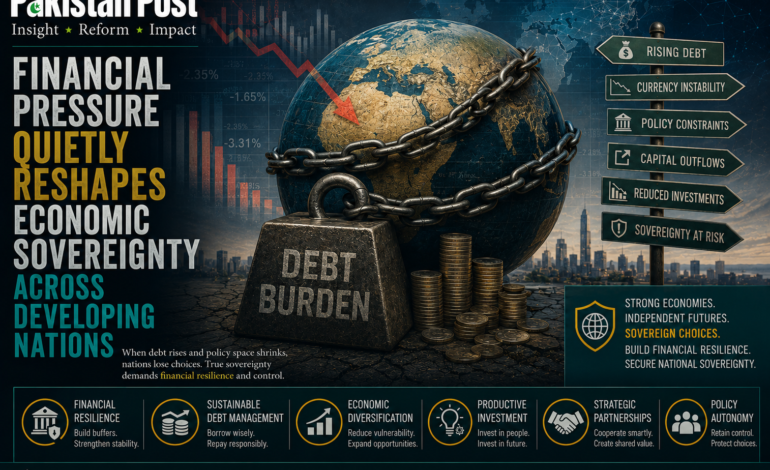
Financial Pressure Quietly Reshapes Economic Sovereignty Across Developing Nations


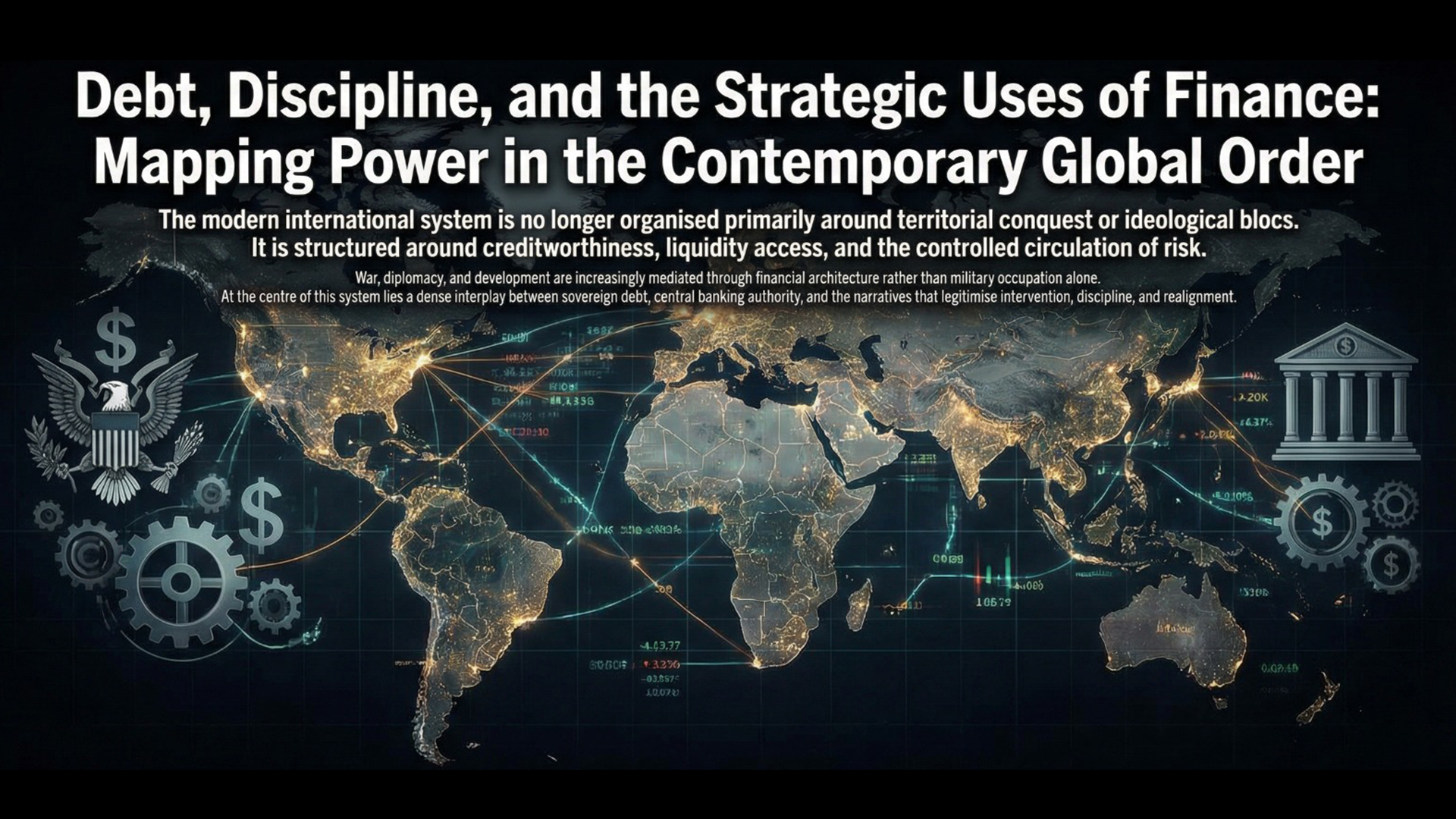
The architecture of international economic influence has undergone a profound transformation. The traditional image of sanctions, embargoes and overt economic coercion is increasingly being replaced by a sophisticated network of financial signalling mechanisms capable of shaping sovereign behaviour without the formal declaration of punitive measures. The most consequential pressure points now lie within sovereign credit assessments, correspondent banking relationships, anti money laundering compliance systems, export credit insurance, investment screening procedures, debt refinancing negotiations, reserve currency arrangements, and regulatory reputation frameworks. These instruments rarely attract headlines comparable to economic sanctions, yet their cumulative impact upon fiscal stability, investment flows, external financing and policy autonomy frequently exceeds that of conventional restrictions. Developing economies are particularly vulnerable because financial credibility has become as strategically valuable as military capability or diplomatic influence.
Financial markets no longer respond exclusively to macroeconomic indicators. They increasingly incorporate perceptions of governance quality, institutional resilience, regulatory transparency, geopolitical exposure, cyber security, sanctions compliance, environmental obligations and political predictability. A sovereign may continue to meet all external obligations while simultaneously experiencing capital outflows, higher borrowing costs and declining investor confidence if market participants perceive elevated regulatory or geopolitical risk. The result is a subtle but powerful form of economic discipline operating continuously through private institutions rather than state directed sanctions.
The modern financial system functions through interconnected confidence networks. Commercial banks evaluate sovereign exposure according to compliance standards. Insurance providers reassess country risk using evolving geopolitical indicators. Rating agencies continuously revise fiscal outlooks. Multilateral lenders incorporate governance benchmarks into financing conditions. Export credit agencies calculate political risk premiums before underwriting international transactions. Institutional investors modify portfolio allocations based upon regulatory signals. Each decision appears commercially rational in isolation, yet together they establish a comprehensive framework capable of influencing national economic behaviour without direct political intervention.
Correspondent banking relationships illustrate this transformation with exceptional clarity. International trade depends upon cross border payment networks maintained through correspondent financial institutions. When global banks reduce exposure to jurisdictions perceived as higher compliance risks, domestic financial institutions encounter rising transaction costs, delayed settlements, diminished trade financing and reduced access to international liquidity. Such “de risking” strategies have affected numerous developing economies despite the absence of formal sanctions. The consequences extend beyond banking into export competitiveness, remittance flows, investment confidence and monetary stability.
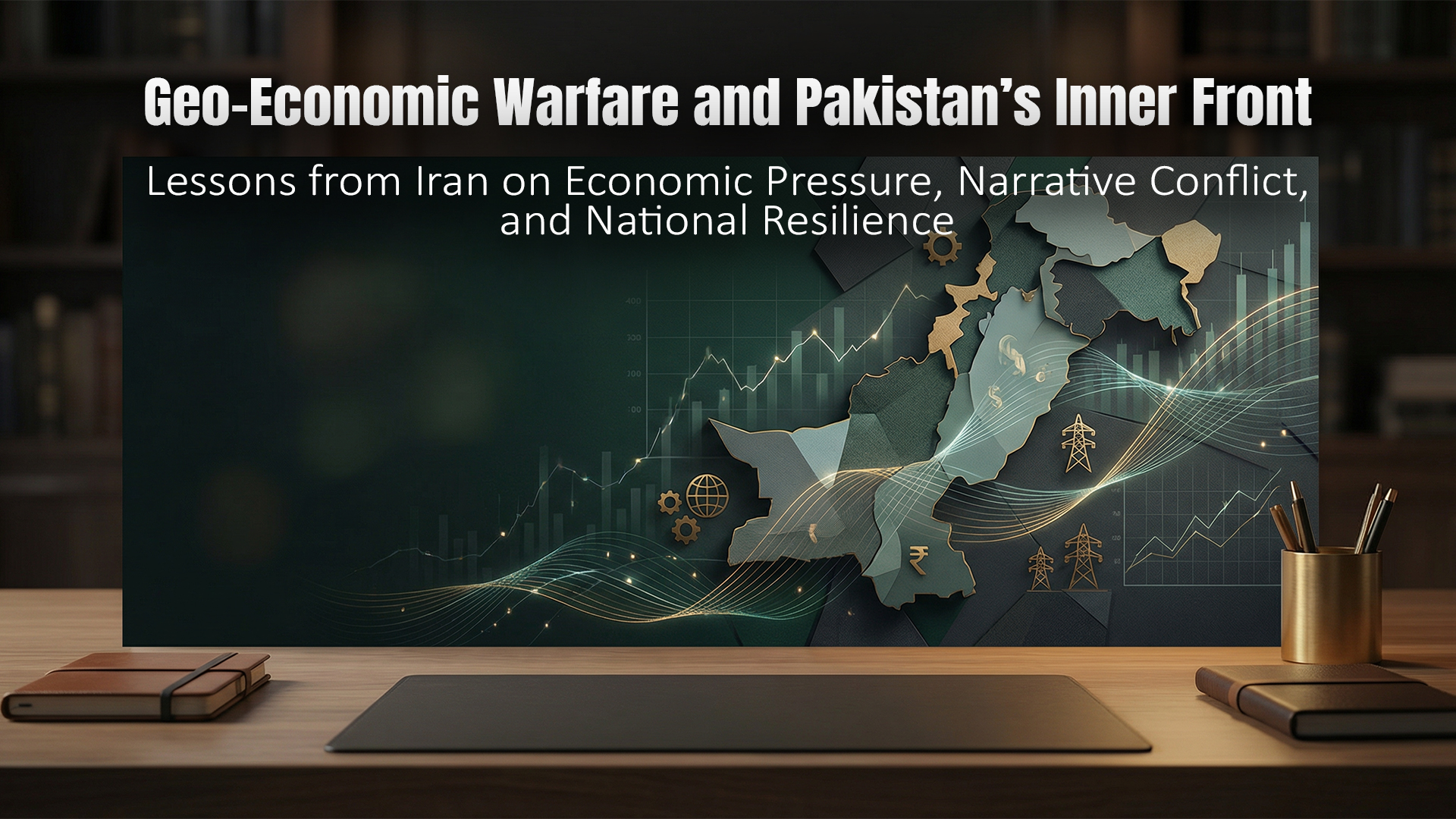
Pakistan occupies an especially sensitive position within this evolving financial environment. The economy remains dependent upon external financing, energy imports, remittance inflows and international capital market confidence while simultaneously operating within a complex regional security landscape. The interaction between domestic fiscal management and external financial perception therefore carries strategic implications extending beyond economics into national security.
The first institutional vulnerability concerns sovereign credit credibility. Credit ratings influence government borrowing costs, corporate financing conditions, infrastructure investment and foreign portfolio allocations. A downgrade rarely reflects immediate insolvency. More frequently it reflects expectations regarding fiscal sustainability, political stability, institutional capacity or external financing resilience. Markets increasingly react before formal rating adjustments occur, creating anticipatory pricing effects that raise borrowing costs even prior to official announcements.
Pakistan’s sovereign financing profile demonstrates how perception and fundamentals interact simultaneously. Elevated debt servicing requirements, recurring balance of payments pressures, exchange rate volatility and dependence upon external programme financing contribute to persistent market caution. Although periodic macroeconomic stabilisation measures improve short term indicators, investors increasingly seek evidence of institutional continuity extending beyond individual fiscal years. Sustainable credibility requires structural reforms capable of reducing cyclical vulnerabilities rather than temporary stabilisation initiatives.
Fiscal governance therefore represents a strategic security issue rather than merely a budgetary exercise. Budget credibility depends not only upon revenue collection but also upon expenditure discipline, medium term fiscal planning, contingent liability disclosure, public procurement transparency and debt sustainability frameworks. Investors reward predictability. They discount uncertainty even when underlying economic performance remains comparatively stable.
External financing strategies require similar reassessment. Excessive dependence upon short maturity borrowing exposes governments to refinancing risk precisely when global financial conditions tighten. Rising international interest rates, geopolitical uncertainty or declining investor sentiment can rapidly increase refinancing costs, creating liquidity pressures unrelated to domestic economic performance. Diversifying financing instruments across maturities, currencies and investor categories reduces exposure to concentrated market shocks.
Reserve management has similarly evolved into an instrument of strategic resilience. Foreign exchange reserves no longer serve merely as buffers against import volatility. They represent visible indicators of sovereign confidence, monetary credibility and external payment capacity. Markets continuously evaluate reserve adequacy relative to short term external obligations, import requirements and capital flow volatility. Insufficient reserve coverage increases speculative pressure against domestic currencies while reducing policy flexibility during financial stress.
Reserve composition also deserves greater strategic attention. Excessive concentration within a single reserve currency may expose economies to evolving geopolitical and financial risks. Diversification across multiple reserve assets, regional settlement mechanisms and carefully calibrated gold holdings enhances resilience without undermining market confidence. Such diversification should complement rather than replace participation within established international financial systems.
Debt refinancing conditions increasingly incorporate broader governance considerations beyond repayment capacity alone. Creditors now examine tax administration efficiency, institutional transparency, state owned enterprise liabilities, legal enforcement mechanisms and public financial management before extending favourable refinancing terms. Countries demonstrating consistent reform trajectories generally obtain superior financing conditions despite comparable macroeconomic indicators.
Pakistan therefore requires a comprehensive sovereign debt management strategy integrating maturity optimisation, liability restructuring, domestic bond market expansion and contingent risk analysis. Debt sustainability depends as much upon portfolio composition as aggregate debt levels. Extending average maturities, reducing foreign currency exposure where feasible and strengthening domestic capital markets collectively improve resilience against external financial volatility.
Insurance markets represent another underappreciated mechanism of indirect financial influence. Marine insurance, political risk insurance, export credit guarantees and investment protection products significantly affect trade competitiveness and foreign direct investment decisions. Elevated insurance premiums increase transaction costs throughout supply chains even when no formal trade restrictions exist. Perceptions regarding political stability, legal predictability, maritime security and regulatory integrity therefore directly influence commercial competitiveness.
Export oriented economies increasingly compete not only through manufacturing efficiency but also through financial reliability. Buyers prefer suppliers operating within jurisdictions offering stable insurance coverage, efficient banking relationships and predictable regulatory environments. Consequently, institutional reforms enhancing financial credibility produce measurable export advantages independent of production costs.
Investment screening regimes have likewise expanded globally. National security considerations increasingly influence cross border investment approvals across advanced economies. Strategic sectors including telecommunications, artificial intelligence, semiconductors, critical minerals, biotechnology, energy infrastructure and digital platforms encounter enhanced regulatory scrutiny. Developing economies seeking foreign investment must therefore understand evolving screening standards within destination markets while simultaneously establishing credible domestic investment governance.
Pakistan should position itself as a jurisdiction characterised by regulatory predictability rather than regulatory discretion. Transparent investment approval procedures, consistent contract enforcement, commercially independent dispute resolution and clearly articulated national security review mechanisms strengthen investor confidence while preserving legitimate strategic interests.
Compliance architecture has become another decisive determinant of financial access. Anti money laundering standards, counter terrorist financing frameworks, beneficial ownership transparency, tax information exchange and corporate governance practices increasingly influence international banking relationships. Compliance deficiencies now generate significant economic costs independent of formal sanctions.
Rather than viewing compliance exclusively as externally imposed obligations, Pakistan should recognise regulatory credibility as an economic competitiveness asset. Financial institutions operating within trusted regulatory environments obtain superior access to global banking networks, lower compliance costs and enhanced investor confidence. Compliance investment therefore produces measurable macroeconomic returns.
Digital financial infrastructure introduces additional dimensions of strategic competition. Cross border payment systems, central bank digital currency experimentation, financial technology regulation and cyber resilience increasingly shape international financial integration. Countries failing to modernise payment infrastructure risk exclusion from emerging settlement ecosystems that may gradually redefine global commerce.
Pakistan possesses significant opportunities to leverage digital financial transformation. Expanding interoperable payment systems, strengthening cyber security standards, promoting digital identity verification and enhancing financial technology supervision can simultaneously improve financial inclusion and international credibility. Digital resilience should become a central component of national economic security planning.
Regulatory reputational signalling deserves particular attention because market perceptions frequently precede measurable economic deterioration. International investors monitor judicial independence, taxation consistency, regulatory continuity, electoral stability, media transparency and policy coherence when evaluating sovereign exposure. Abrupt regulatory changes, retrospective taxation, inconsistent contract enforcement or administrative unpredictability increase perceived country risk regardless of macroeconomic performance.
Strategic communication therefore constitutes an essential element of economic diplomacy. Governments must communicate fiscal reforms, monetary policy objectives, regulatory changes and structural initiatives through credible institutional channels supported by transparent data dissemination. Market confidence depends upon information quality as much as policy substance.
Economic diplomacy itself requires modernisation. Traditional diplomatic engagement focused primarily upon political relations and trade promotion. Contemporary economic diplomacy must additionally engage sovereign wealth funds, institutional investors, multinational banks, credit rating agencies, insurance providers, export credit institutions and financial regulators. These actors increasingly shape national financing conditions irrespective of formal diplomatic relations.
Pakistan should establish integrated economic diplomacy units combining expertise from finance, commerce, foreign affairs, central banking, investment promotion and strategic communications. Such coordination enhances policy coherence while improving engagement with international financial stakeholders.
Domestic capital market development represents another strategic priority. Economies dependent predominantly upon external financing remain vulnerable to international liquidity cycles. Expanding domestic institutional investment through pension reforms, insurance sector development, corporate bond markets and municipal financing reduces reliance upon foreign capital while supporting infrastructure investment.
Financial transparency strengthens resilience by reducing information asymmetries. Comprehensive fiscal reporting, contingent liability disclosure, independent statistical institutions and internationally recognised accounting standards improve investor confidence while lowering sovereign risk premiums. Transparency should be viewed not as external conditionality but as a national economic asset.
Exchange rate policy similarly influences financial credibility. Artificial exchange rate stability unsupported by underlying fundamentals frequently encourages speculative pressures and reserve depletion. Conversely, excessively volatile exchange rates undermine business planning and investment confidence. Credible monetary frameworks combining exchange rate flexibility with inflation discipline generally strengthen long term financial resilience.
State owned enterprises constitute another significant vulnerability across developing economies. Hidden liabilities, operational inefficiencies and implicit government guarantees complicate sovereign risk assessments. Comprehensive governance reforms incorporating professional management, financial disclosure, performance benchmarking and selective restructuring reduce fiscal uncertainty while improving market confidence.
Energy sector financial sustainability remains equally critical. Circular debt accumulation, pricing distortions and inefficient subsidy structures weaken fiscal credibility while discouraging investment. Sustainable energy pricing combined with targeted social protection improves both macroeconomic stability and investor perception.
Tax administration reforms deserve strategic emphasis beyond revenue mobilisation. Predictable taxation, simplified compliance procedures, digital administration and broad based revenue collection reduce economic distortions while enhancing fiscal credibility. Investors value stable tax systems more highly than frequently changing incentive structures.
Supply chain resilience increasingly intersects with financial credibility. Countries demonstrating reliable logistics, customs efficiency, infrastructure maintenance and trade facilitation attract lower financing costs because operational risks decline. Infrastructure governance therefore contributes directly to sovereign economic reputation.
Climate finance introduces another evolving dimension. International capital increasingly differentiates between jurisdictions according to environmental governance, climate adaptation planning and sustainable finance frameworks. Developing economies capable of demonstrating credible climate resilience strategies may obtain preferential financing conditions while attracting long term institutional investment.
Pakistan possesses considerable potential within green infrastructure, renewable energy, water management and climate adaptation financing. Integrating climate resilience into national financial planning can diversify financing sources while strengthening international economic credibility.
Strategic reserve policies should extend beyond foreign exchange alone. Food security reserves, energy storage capacity, critical mineral inventories and pharmaceutical resilience reduce vulnerability during external disruptions. Economic security increasingly depends upon comprehensive resilience rather than financial indicators alone.
The establishment community should recognise financial architecture as an integral component of national security planning. Modern strategic competition increasingly targets economic vulnerabilities before military confrontation. Financial resilience therefore requires sustained coordination among economic ministries, intelligence institutions, financial regulators, central banking authorities and diplomatic services. Such coordination should remain rules based and institutionally anchored to preserve investor confidence while strengthening national preparedness.
Pakistan would benefit from establishing a National Financial Security Assessment Mechanism responsible for continuous monitoring of sovereign exposure across banking relationships, reserve adequacy, refinancing schedules, insurance costs, geopolitical financial risks, cyber threats, capital flow volatility and international regulatory developments. Early warning capabilities permit preventive policy adjustments before vulnerabilities evolve into crises.
A complementary Sovereign Risk Coordination Cell could integrate macroeconomic forecasting with geopolitical analysis, enabling policymakers to evaluate how international political developments may affect financing conditions, export markets, investment flows and reserve management. Financial intelligence should become as institutionalised as conventional strategic intelligence.
At the international level, Pakistan should pursue diversified financial partnerships without undermining engagement with established multilateral institutions. Regional development banks, bilateral currency arrangements, Islamic finance platforms, infrastructure investment partnerships and local currency settlement initiatives can collectively broaden financing options while reducing excessive dependence upon any single external channel.
Ultimately, macroeconomic credibility cannot be manufactured through communication alone. It emerges from sustained institutional discipline, predictable governance, transparent financial management and coherent strategic planning. Financial markets reward consistency more than ambitious declarations. Countries demonstrating incremental but irreversible reforms generally achieve superior financing conditions compared with those pursuing episodic stabilisation campaigns.
The defining feature of contemporary financial statecraft is its invisibility. Economic influence increasingly operates through market expectations, regulatory assessments, institutional confidence and risk pricing rather than explicit coercion. Nations that recognise this transformation early will invest in institutional resilience before external pressure materialises. Those relying upon reactive crisis management will remain vulnerable to financial shocks originating beyond their immediate control.
For Pakistan, the strategic objective should not be insulation from international finance, which is neither feasible nor desirable. The objective should instead be credible integration supported by resilient institutions, diversified financing, disciplined fiscal governance, robust regulatory standards, sophisticated economic diplomacy and continuous financial risk assessment. In the twenty first century, sovereign strength will increasingly be measured not only by territorial security or military capability but by the confidence with which global financial systems assess the credibility, resilience and institutional maturity of the state itself.
A Public Service Message