
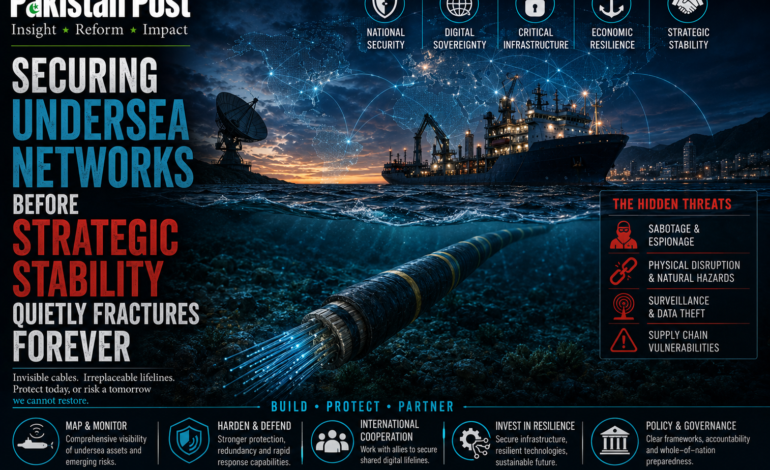
Securing Undersea Networks Before Strategic Stability Quietly Fractures Forever


The most consequential strategic contest unfolding across the world’s oceans is not taking place between aircraft carriers, submarines or missile fleets. It is unfolding thousands of metres beneath the sea, where slender fibre optic cables, power links, sensors and seabed infrastructure quietly sustain the digital economy, financial markets, intelligence cooperation, commercial shipping, defence communications and governmental continuity. Their invisibility has become their greatest vulnerability. For decades, policymakers viewed submarine cable systems primarily as commercial assets managed by telecommunications companies and international consortia. That assumption is rapidly becoming obsolete. Undersea infrastructure has evolved into strategic national infrastructure whose disruption could generate cascading effects across economic stability, military readiness, diplomatic communications and public confidence without a single missile being launched.
This transformation is forcing governments to reconsider maritime security through an entirely different operational lens. Strategic competition is no longer confined to sea lanes or naval deployments. It increasingly extends to the seabed itself. The distinction between commercial infrastructure and national security infrastructure has narrowed considerably because digital dependence has expanded faster than institutional preparedness. Every government now confronts the same uncomfortable reality. Modern states remain connected not because satellites dominate global communications but because an overwhelming proportion of international digital traffic continues to pass through submarine fibre optic cable systems crossing oceans and connecting continents. Financial clearing systems, cloud computing, diplomatic communications, military data exchanges, artificial intelligence infrastructure and industrial production all depend upon these hidden networks.
Recent international incidents involving damaged submarine cables have accelerated strategic reassessment across defence establishments. While not every disruption results from deliberate hostile activity, governments increasingly recognise that ambiguity itself constitutes a strategic challenge. Accidental anchor drags, fishing operations, geological disturbances, equipment failures and intentional sabotage may initially produce identical operational effects. Attribution therefore becomes as strategically important as restoration. Without timely technical investigation, governments may struggle to distinguish criminal activity from strategic coercion or military signalling. Such uncertainty creates opportunities for hostile actors seeking plausible deniability while imposing significant economic and political costs upon affected states.
The strategic significance of seabed infrastructure extends well beyond telecommunications. Offshore energy installations, underwater pipelines, oceanographic sensors, environmental monitoring platforms, offshore renewable energy systems, subsea data centres and future underwater autonomous platforms collectively represent an expanding ecosystem supporting national resilience. As governments pursue digital transformation, smart ports, autonomous logistics, financial digitisation and defence modernisation, dependence upon resilient underwater infrastructure will continue expanding. Protection can therefore no longer remain fragmented among commercial operators, maritime regulators and telecommunications companies. It requires integrated national planning supported by intelligence, defence, scientific institutions and commercial stakeholders operating through shared operational frameworks.
Pakistan occupies an increasingly significant geographical position within this emerging strategic environment. Its coastline provides direct access to the Arabian Sea, proximity to vital commercial shipping routes and expanding connectivity with regional digital infrastructure. The country’s growing digital economy, financial integration, cloud adoption, e governance initiatives and strategic maritime partnerships all increase dependence upon uninterrupted international connectivity. Future industrial development, technology investment, defence communications and regional commercial integration will depend upon secure and resilient undersea infrastructure capable of withstanding both natural disruptions and hostile interference.
The challenge facing Islamabad is not merely technological. It is institutional. Undersea infrastructure security intersects multiple ministries, regulatory authorities, intelligence organisations, naval commands, telecommunications operators, emergency management institutions, commercial investors and international partners. Without unified governance, responsibilities become fragmented, operational awareness declines and crisis response becomes unnecessarily slow. Modern strategic resilience therefore begins with institutional architecture before it depends upon technological sophistication.
The first operational requirement involves comprehensive national seabed awareness. Maritime security has traditionally concentrated upon monitoring activities occurring above the water surface through coastal radars, naval patrols and aerial surveillance. Underwater awareness remains comparatively underdeveloped despite its growing importance. Governments increasingly invest in integrated seabed mapping programmes combining hydrographic surveys, oceanographic research, satellite observations, autonomous underwater vehicles, remotely operated platforms and acoustic sensing technologies capable of identifying both natural changes and suspicious activity affecting critical infrastructure.
Pakistan already possesses valuable hydrographic expertise through existing maritime institutions. However, hydrographic capability should gradually evolve beyond navigational chart production toward continuous strategic seabed intelligence supporting national infrastructure protection. High resolution mapping of cable routes, seabed terrain, underwater obstacles and environmental conditions provides essential baseline information for detecting anomalies during future incidents. Such databases also support repair planning, environmental assessments and operational contingency planning during crises.
Persistent underwater surveillance represents the second operational priority. Unlike traditional maritime patrols, seabed infrastructure cannot be secured through occasional inspections. Governments increasingly employ layered surveillance architectures integrating coastal sonar networks, autonomous underwater sensors, unmanned maritime vehicles, commercial vessel reporting systems, satellite based maritime monitoring and artificial intelligence driven anomaly detection. These technologies collectively enable continuous observation without requiring prohibitively expensive permanent naval deployments across extensive maritime zones.
Artificial intelligence will increasingly become indispensable for undersea infrastructure protection because modern sensor networks generate volumes of data beyond human analytical capacity. Machine learning algorithms can identify unusual vessel behaviour, prolonged loitering near cable routes, deviations from commercial shipping patterns, unexpected underwater acoustic signatures and environmental anomalies requiring further investigation. Rather than replacing human analysts, artificial intelligence enhances decision making by prioritising suspicious activities requiring immediate operational attention.
Maritime domain awareness must also evolve beyond conventional naval concepts. Traditional maritime awareness focused primarily upon surface vessels, naval threats and commercial shipping movements. Contemporary maritime awareness requires integrating underwater infrastructure status, cable maintenance schedules, commercial repair vessel locations, weather patterns, fishing activity, offshore industrial operations and intelligence reporting into unified operational pictures accessible across relevant national institutions. Information fragmentation constitutes one of the greatest vulnerabilities during rapidly developing maritime incidents.
Commercial ownership structures introduce additional complexity requiring sophisticated regulatory responses. Most submarine cable systems are neither wholly owned nor entirely controlled by governments. Instead they operate through multinational investment consortia involving telecommunications companies, technology firms, financial investors and international infrastructure operators. Consequently, governments cannot simply assume direct operational authority during emergencies without clearly defined legal frameworks establishing emergency coordination mechanisms while respecting commercial ownership rights and international contractual obligations.
Pakistan should therefore establish formal public private partnership arrangements with cable operators before crises occur rather than negotiating emergency procedures during operational disruptions. These arrangements should define reporting obligations, information sharing protocols, joint exercises, cyber incident coordination procedures, emergency repair authorisations and secure communication channels linking commercial operators with national security institutions. Predictability strengthens resilience more effectively than improvised coordination under crisis conditions.
Repair capacity constitutes another strategic vulnerability frequently underestimated in national planning. Global submarine cable repair depends upon a relatively limited fleet of specialised vessels equipped with advanced underwater recovery systems, remotely operated vehicles and technical expertise. During simultaneous regional disruptions, competition for these scarce assets could delay restoration significantly. Governments therefore increasingly evaluate access to repair capabilities as components of national resilience rather than purely commercial services.
Pakistan should examine options for regional repair agreements, strategic contracting arrangements and logistical support facilities capable of accelerating repair operations within the northern Arabian Sea. While establishing indigenous full spectrum repair capability may not initially prove economically practical, developing specialised logistical support infrastructure, technical training programmes and emergency coordination mechanisms would substantially improve national preparedness while supporting broader regional resilience.
Legal jurisdiction across maritime zones presents equally significant operational challenges. Territorial waters, contiguous zones, exclusive economic zones and international waters each involve distinct legal authorities governing investigation, enforcement and infrastructure protection. Effective response therefore depends upon comprehensive legal preparedness clarifying institutional responsibilities before incidents occur. National legislation should address investigation authorities, evidence collection standards, emergency operational powers, environmental obligations, commercial coordination requirements and prosecution mechanisms concerning intentional damage to critical underwater infrastructure.
International legal cooperation remains equally important because submarine cable systems frequently cross multiple jurisdictions before reaching destination countries. Bilateral and multilateral agreements concerning information sharing, evidence preservation, technical cooperation and coordinated investigations should therefore become integral components of Pakistan’s broader maritime diplomacy. Strategic resilience increasingly depends upon trusted partnerships extending beyond national maritime boundaries.
The naval dimension of undersea infrastructure security deserves careful operational refinement. Naval forces cannot physically guard every kilometre of submarine cable. Instead, they must adopt intelligence driven risk management focusing surveillance resources upon critical nodes, landing stations, maritime chokepoints and areas exhibiting elevated operational risk. This approach requires close integration between naval intelligence, civilian maritime authorities, coast guards, commercial operators and scientific institutions generating comprehensive situational awareness.
Landing stations deserve particular attention because they represent physical transition points connecting global undersea infrastructure with domestic terrestrial networks. Their strategic significance exceeds their physical size. Protective measures should encompass physical security, cybersecurity integration, redundant power systems, resilient communications, emergency access controls and coordinated contingency planning involving both civilian operators and national security institutions. Physical attacks upon landing stations could generate effects comparable to disruptions occurring offshore.
Cybersecurity and physical infrastructure security have become inseparable operational domains. Modern submarine cable systems increasingly incorporate digital monitoring platforms, remote management capabilities and network operational technologies vulnerable to cyber intrusion. Compromised digital control systems could complicate restoration efforts, conceal malicious activities or generate misleading operational information during crises. Infrastructure protection therefore requires integrated cyber physical security strategies rather than isolated organisational responsibilities.
Strategic redundancy should become an explicit national planning objective. Excessive dependence upon limited connectivity routes increases systemic vulnerability regardless of individual cable protection measures. Pakistan should encourage diversified international connectivity through multiple cable landings, geographically separated routes, resilient terrestrial backhaul networks and diversified international partnerships reducing concentration risk. Redundancy does not eliminate disruption but substantially improves national recovery capacity following unforeseen incidents.
The intelligence community occupies a central role within this emerging operational landscape. Infrastructure protection increasingly depends upon early warning rather than post incident investigation alone. Intelligence collection should monitor hostile capabilities targeting maritime infrastructure, technological developments enabling covert underwater operations, emerging sabotage techniques, organised criminal activity affecting maritime infrastructure and foreign influence operations potentially exploiting infrastructure disruptions for broader strategic objectives. Intelligence assessments should routinely inform infrastructure protection planning rather than remaining confined to traditional military threat analysis.
Strategic communication also deserves institutional attention. Infrastructure disruptions often generate public uncertainty disproportionate to their technical impact. Transparent, timely and coordinated governmental communication reduces speculation, preserves market confidence and limits opportunities for hostile information campaigns exploiting uncertainty. Crisis communication planning should therefore accompany technical response planning within national contingency frameworks.
Scientific institutions possess capabilities often overlooked within national security planning. Oceanographers, marine geologists, hydrographers, marine engineers and environmental researchers generate knowledge directly supporting seabed mapping, underwater monitoring, environmental risk assessment and infrastructure resilience. Their integration into national preparedness exercises would strengthen evidence based decision making while expanding domestic technical expertise supporting long term maritime security.
Education and specialised workforce development represent longer term strategic investments. Pakistan requires expanding expertise across underwater robotics, marine engineering, oceanographic data analysis, hydrographic surveying, subsea telecommunications, maritime cybersecurity and underwater autonomous systems. Universities, naval academies and technical institutes should gradually align specialised programmes with emerging operational requirements supporting national maritime resilience.
Regional cooperation offers significant opportunities without compromising national strategic autonomy. Shared maritime awareness initiatives, technical exchanges, coordinated emergency exercises, search and recovery cooperation, hydrographic collaboration and information sharing regarding maritime anomalies could strengthen collective resilience across the northern Indian Ocean. Such cooperation enhances confidence while reducing risks associated with misinterpretation during ambiguous maritime incidents.
Private sector participation should extend beyond infrastructure ownership. Telecommunications providers, shipping companies, offshore energy operators, port authorities, insurance firms and technology companies collectively possess operational data, technical expertise and logistical resources supporting national preparedness. Government should establish permanent consultative mechanisms enabling regular operational dialogue rather than episodic engagement following emergencies.
National exercises should evolve accordingly. Tabletop simulations alone cannot adequately test complex underwater infrastructure contingencies. Operational exercises should involve naval units, coast guards, intelligence organisations, telecommunications operators, port authorities, emergency management institutions and relevant ministries responding collectively to realistic scenarios involving cable disruption, cyber intrusion, commercial coordination, media management and international diplomatic engagement. Such exercises reveal institutional weaknesses before adversaries exploit them.
Budgetary planning requires strategic discipline. Infrastructure protection should not become a collection of disconnected procurement programmes. Instead, investments should follow coherent capability development priorities integrating surveillance technologies, analytical platforms, repair coordination, workforce development, legal preparedness, scientific research and operational training within unified national planning frameworks. Capability integration frequently produces greater strategic value than isolated technological acquisitions.
Pakistan should therefore establish a National Undersea Infrastructure Security Framework operating under clearly defined governmental authority with permanent interagency coordination mechanisms linking defence institutions, maritime regulators, intelligence organisations, telecommunications authorities, scientific agencies, commercial operators and emergency management institutions. The framework should maintain continuous risk assessments, oversee national preparedness exercises, coordinate international engagement, supervise technological modernisation and provide strategic policy advice directly supporting national leadership during emerging maritime contingencies.
Complementing this framework, a dedicated National Maritime Infrastructure Fusion Centre should integrate operational intelligence, commercial reporting, hydrographic information, satellite surveillance, cyber monitoring and maritime domain awareness into continuously updated common operational pictures supporting timely governmental decision making. Such institutional integration would significantly enhance response speed while reducing information fragmentation during rapidly evolving incidents.
Strategic stability during the coming decade will increasingly depend upon infrastructure resilience as much as military deterrence. Nations capable of protecting the invisible systems sustaining their digital economies will preserve operational continuity despite growing geopolitical competition. Those neglecting underwater infrastructure will discover that strategic disruption rarely begins with dramatic military confrontation. It frequently begins silently beneath the sea, where unnoticed vulnerabilities accumulate until they suddenly become matters of national consequence. Pakistan possesses both the geographic opportunity and institutional foundation to address this challenge proactively. Success will depend not upon reacting to future disruptions but upon building integrated preparedness before invisible vulnerabilities become visible national crises.
A Public Service Message