
Pakistan Must Master Coalition Diplomacy Before Global Rules Solidify

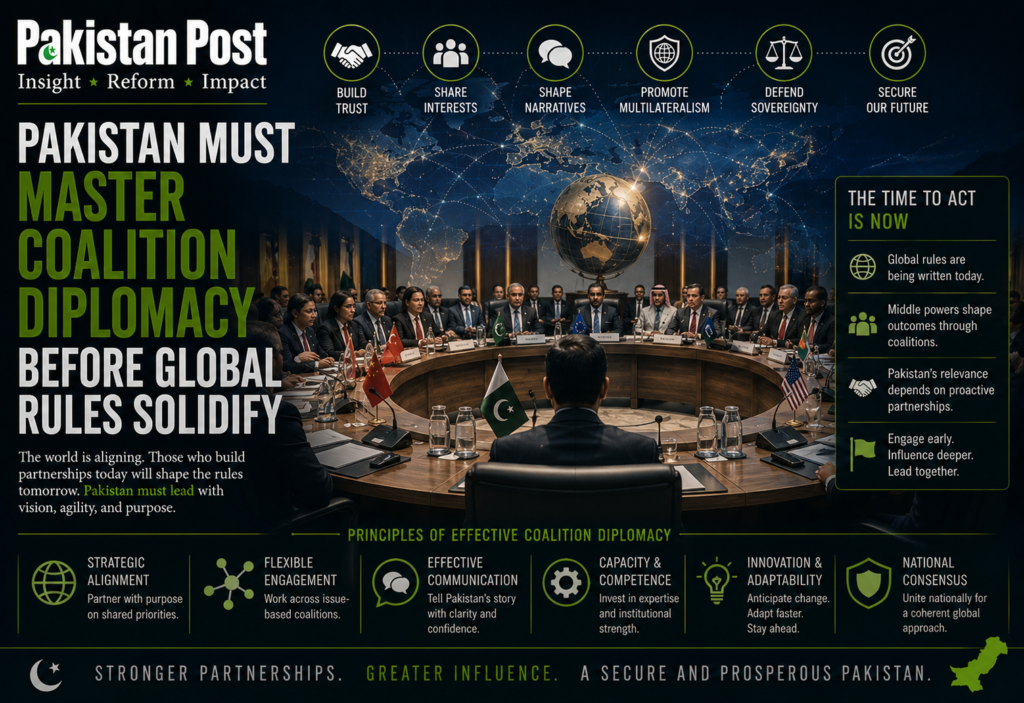
Pakistan’s future diplomatic influence will depend less on the number of bilateral relationships it maintains and more on whether it can consistently shape international negotiations that increasingly determine access to finance, technology, markets, critical infrastructure, food systems, maritime resources and regulatory standards. The most significant geopolitical shift underway is not the decline of alliances but the rise of issue specific coalitions that assemble rapidly around individual policy questions, secure negotiated outcomes and dissolve once their objectives are achieved. Governments that fail to recognise this transition risk finding themselves excluded from the rooms where the rules governing twenty first century economic and strategic competition are written.
This transformation carries immediate implications for Pakistan. The country has traditionally measured diplomatic success through summit participation, multilateral representation and bilateral engagement with major powers. Those indicators remain relevant but no longer capture where strategic influence is actually exercised. Increasingly, decisive negotiations occur inside technical working groups on artificial intelligence governance, climate finance, digital taxation, semiconductor supply chains, maritime safety, pharmaceutical regulation, cyber resilience, disaster insurance, agricultural standards and critical mineral processing. These negotiations rarely attract political headlines, yet they produce legally binding frameworks, financial eligibility criteria, investment conditions and regulatory standards that shape national competitiveness for decades.
Pakistan cannot afford to approach these negotiations with temporary delegations assembled weeks before international conferences. Competing governments prepare years in advance. They maintain permanent negotiating teams, specialised policy laboratories, legal drafting units, economic modelling capabilities and institutional memory dedicated to individual negotiation tracks. Their diplomats are supported by economists, scientists, cyber specialists, maritime lawyers, engineers, trade negotiators, financial regulators and strategic intelligence assessments. Success is therefore increasingly determined by institutional preparation rather than diplomatic rhetoric.
The country’s principal vulnerability is no longer insufficient diplomatic outreach. It is fragmented policy preparation. Different ministries often engage international partners independently, technical expertise remains dispersed across departments, and negotiation positions are frequently developed in parallel rather than through integrated national planning. International counterparts recognise these inconsistencies quickly. Fragmented representation weakens bargaining power regardless of the quality of diplomatic engagement.
The National Security Division should therefore redefine diplomacy as an instrument of national competitiveness rather than exclusively foreign policy management. Every major international negotiation affecting economic resilience, technological development, supply chain security or regulatory governance should be treated as a national strategic priority requiring coordinated preparation across government. Diplomatic missions should become operational extensions of national economic planning instead of functioning primarily as channels of political communication.
The first institutional reform should be the establishment of a National Strategic Negotiation Secretariat operating under the Prime Minister’s Office with permanent representation from the Foreign Office, Ministry of Finance, Ministry of Commerce, Ministry of Planning, Ministry of Information Technology, Ministry of Maritime Affairs, Ministry of Climate Change, Ministry of Industries, the State Bank, regulatory authorities and relevant national security institutions. This body should not replace ministerial authority. It should synchronise national positions before negotiations commence, identify policy contradictions, allocate responsibilities and ensure implementation after agreements are concluded.
Unlike conventional inter ministerial committees, the Secretariat should operate continuously. Dedicated teams should monitor approximately fifty priority international negotiation tracks simultaneously. Every negotiation should maintain an updated strategic file containing stakeholder analysis, coalition mapping, legal positions, economic implications, voting patterns, implementation risks, technological developments and intelligence assessments. Pakistan currently prepares for conferences. It must instead prepare for permanent negotiation campaigns.
Coalition diplomacy demands a fundamentally different understanding of international partnerships. A country supporting Pakistan on climate adaptation may oppose its position on digital taxation. Another state may cooperate on food security while competing aggressively on textile exports. Strategic maturity requires managing these contradictions without allowing disagreement in one sector to undermine cooperation elsewhere. Foreign policy can no longer operate through binary classifications of friends and rivals. It must become multidimensional.
This requires sophisticated coalition mapping capabilities that Pakistan presently lacks. The Foreign Office should establish a Coalition Analysis Directorate staffed by regional specialists, economists, data scientists, trade experts and political analysts tasked with identifying issue based convergence across international organisations. Their objective should not simply be monitoring diplomatic developments but predicting coalition formation before negotiations begin. Early identification of emerging voting blocs provides opportunities to influence agenda setting rather than merely reacting to established positions.
Climate finance illustrates why this capability has become indispensable. International discussions increasingly revolve around carbon accounting methodologies, resilience financing, adaptation metrics, catastrophe insurance, blended investment mechanisms and sovereign risk assessment rather than political declarations alone. Countries possessing technical expertise shape funding rules that subsequently determine which developing economies receive preferential financing. Pakistan, despite experiencing repeated climate disasters, often enters these discussions advocating financial support without simultaneously proposing detailed institutional models that could attract broad international backing.
Islamabad should establish a Climate Finance Negotiation Unit combining economists, insurance specialists, hydrologists, environmental scientists, sovereign debt experts and international lawyers. Its mandate should include developing original financing proposals rather than simply responding to frameworks designed elsewhere. Leadership in international negotiations increasingly belongs to governments capable of drafting solutions instead of identifying problems.
Food security presents another strategic opportunity. Global agricultural diplomacy now encompasses fertiliser supply resilience, water efficiency, climate resistant crops, strategic grain reserves, biotechnology regulation, phytosanitary standards and agricultural logistics. Pakistan possesses substantial agricultural capacity yet rarely positions itself as a policy entrepreneur within these negotiations. A permanent Agricultural Diplomacy Centre should integrate scientific research with international regulatory engagement, ensuring domestic agricultural priorities are represented before new international standards become established.
Maritime governance deserves significantly greater strategic attention. International negotiations increasingly concern subsea cable protection, offshore energy infrastructure, autonomous shipping, marine biodiversity, fisheries management, digital navigation systems, port decarbonisation and maritime insurance. These discussions directly affect Pakistan’s commercial connectivity, energy security and blue economy ambitions. Yet responsibility for maritime policy remains distributed across multiple institutions with limited strategic integration.
The Ministry of Maritime Affairs should lead the creation of a National Maritime Policy Coordination Cell incorporating naval planners, port authorities, customs officials, marine scientists, shipping companies, telecommunications experts and legal advisers. Every international maritime negotiation should be preceded by comprehensive national policy coordination. Maritime diplomacy is no longer confined to naval cooperation. It increasingly shapes investment, logistics, insurance and technological competitiveness.
Digital governance has emerged as perhaps the fastest moving arena of coalition diplomacy. Artificial intelligence regulation, cross border data transfers, quantum encryption, cloud infrastructure, cybersecurity standards, digital taxation and electronic commerce are increasingly governed through overlapping international frameworks. Regulatory fragmentation creates uncertainty for investors while limiting market access for domestic technology firms. Pakistan cannot participate effectively if individual ministries continue developing separate digital positions.
A National Digital Strategy Council should therefore coordinate all international digital negotiations. Membership should include regulators, cybersecurity agencies, technology ministries, financial authorities, export promotion institutions, intelligence representatives and private sector experts. Every proposed international commitment should undergo national security, economic competitiveness and technological resilience assessments before formal adoption.
Public health diplomacy has similarly evolved beyond humanitarian cooperation. Pandemic preparedness, genomic surveillance, pharmaceutical manufacturing, medical supply chains and emergency response financing have become central components of strategic competition. Countries capable of manufacturing vaccines, producing essential medicines and participating in regulatory harmonisation gained disproportionate influence during recent global health emergencies. Pakistan should integrate health diplomacy into national resilience planning by establishing permanent coordination between health authorities, industry, commerce, finance and foreign affairs.
Institutional capability depends equally upon human capital. Pakistan’s diplomatic training remains strong in political negotiation but requires substantial expansion into technical disciplines. Future diplomats should receive advanced instruction in artificial intelligence governance, climate economics, trade law, financial regulation, cyber policy, industrial standards, maritime law, intellectual property, supply chain analysis and strategic communications. Modern negotiations increasingly require multidisciplinary competence rather than traditional diplomatic protocol alone.
The Civil Services Academy and Foreign Service training institutions should establish specialised negotiation streams allowing officers to develop long term expertise in selected policy domains. Governments increasingly retain negotiators on individual files for years because technical continuity often determines bargaining success. Frequent personnel rotation weakens institutional memory and reduces negotiating credibility.
Universities and think tanks must become integral components of Pakistan’s diplomatic ecosystem. Many advanced economies routinely incorporate academic specialists into official negotiating teams because emerging policy questions frequently exceed the expertise available within government alone. Pakistan should establish a National Expert Registry enabling ministries to recruit specialists rapidly during international negotiations involving advanced technologies, environmental science, financial engineering or regulatory reform.
Strategic intelligence should also evolve accordingly. Intelligence assessments traditionally focused upon military capabilities and political developments. Contemporary diplomatic competition increasingly requires early warning regarding regulatory initiatives, industrial policies, technology restrictions, investment screening mechanisms, sanctions architecture and emerging international standards. Intelligence agencies should support diplomatic preparation by identifying future negotiation trends before they mature into formal international agendas.
Pakistan’s overseas missions require functional restructuring as well. Embassies should designate specialised officers responsible for monitoring developments in technology regulation, environmental governance, maritime affairs, food systems, health security and industrial policy. Reporting should prioritise emerging regulatory changes rather than ceremonial engagements. Diplomatic reporting must become predictive rather than descriptive.
Equally important is the development of implementation discipline. International agreements frequently fail because governments negotiate ambitious commitments without establishing domestic execution mechanisms. Every international commitment should therefore include an implementation matrix assigning ministerial responsibilities, legislative requirements, financial implications, reporting timelines and performance indicators. Successful diplomacy does not conclude with signature ceremonies. It concludes when negotiated advantages produce measurable national outcomes.
Pakistan should also expand informal diplomatic engagement. Many influential international coalitions originate through technical workshops, regulatory dialogues, academic exchanges and professional networks long before governments enter formal negotiations. The Foreign Office should support structured Track One Point Five engagements involving retired officials, industry leaders, researchers and legal experts capable of building relationships that facilitate subsequent governmental discussions.
Another priority concerns representation within international standard setting organisations. Many technical standards affecting telecommunications, artificial intelligence, pharmaceuticals, financial reporting and industrial manufacturing are developed through specialised bodies rather than high profile political institutions. Pakistan should increase secondments of technical experts into these organisations, enabling early participation in drafting processes rather than responding after standards become internationally accepted.
Financial resources should reflect these priorities. Diplomatic budgets remain disproportionately allocated towards administrative functions while specialised policy research, technical modelling, legal advisory capacity and negotiation support receive comparatively limited investment. Redirecting modest financial resources towards permanent technical capability would generate significantly greater strategic returns than expanding ceremonial diplomatic activity.
The establishment should recognise that issue based coalition diplomacy is becoming an increasingly important component of comprehensive national security. International rules governing digital infrastructure, financial systems, maritime access, food resilience, technology transfers and environmental compliance directly influence economic stability, industrial development and strategic autonomy. Negotiating these rules is therefore no longer exclusively the responsibility of diplomats. It requires coordinated national effort integrating economic planning, scientific expertise, intelligence analysis, regulatory competence and political leadership.
Pakistan possesses the geographic relevance, institutional experience and diplomatic credibility necessary to become an influential middle power within this emerging international environment. However, influence will not be secured through declarations supporting multilateralism alone. It will depend upon the country’s ability to enter every major negotiation with integrated national positions, specialised technical expertise, coalition building strategies and implementation capacity superior to competitors with comparable economic resources.
The coming decade will reward governments capable of transforming diplomacy from a protocol driven profession into an operational instrument of national power. Countries that master coalition diplomacy will increasingly shape international rules governing technology, finance, climate resilience, food systems and maritime governance. Those that continue relying upon traditional diplomatic practices will discover that strategic autonomy is gradually constrained not by military confrontation but by international standards negotiated without their meaningful participation. For Pakistan, mastering coalition diplomacy is therefore no longer an option within foreign policy. It has become an essential requirement for preserving national influence in an international system where power increasingly belongs to those who write the rules rather than those who merely accept them.
A Public Service Message