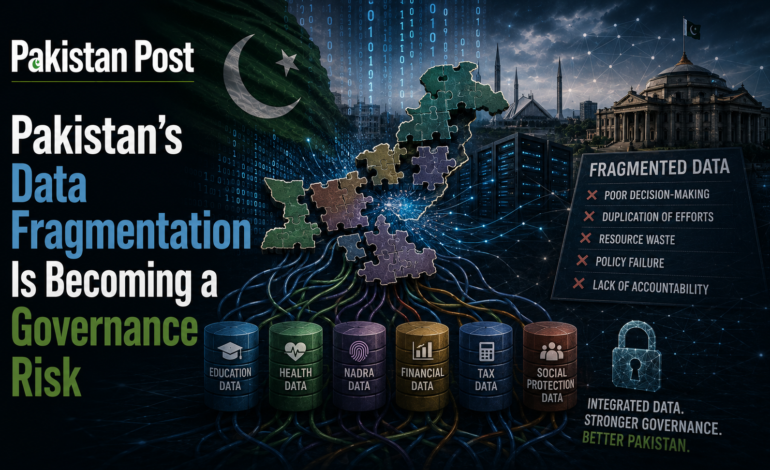
Pakistan’s Data Fragmentation Is Becoming a Governance Risk

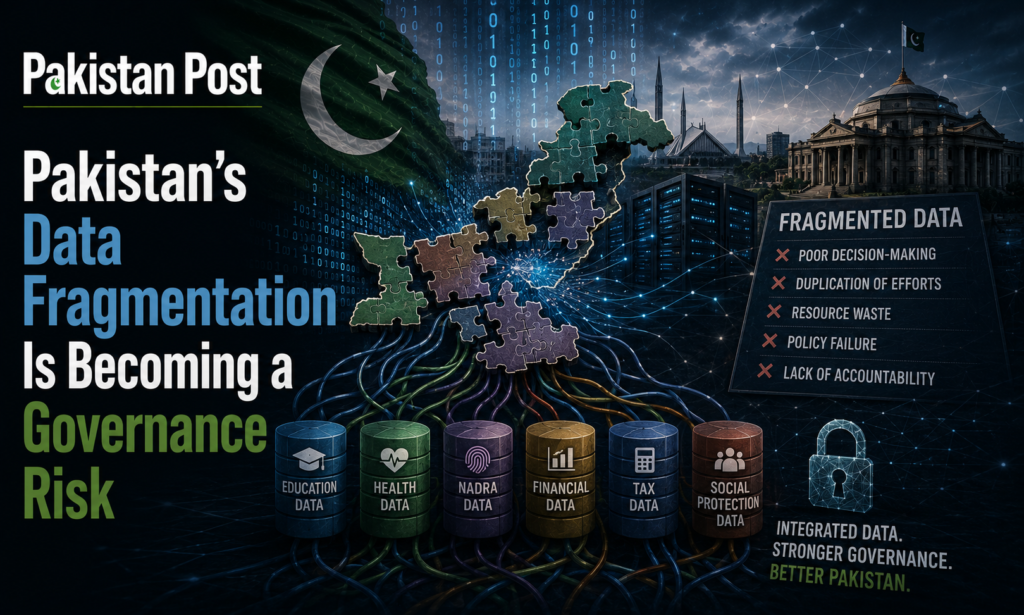
Pakistan’s public administration is increasingly dependent on information that the state cannot reliably connect. Federal ministries maintain separate registries, provinces operate their own databases, local governments retain fragmented records, and autonomous institutions frequently develop parallel information systems to satisfy immediate administrative requirements. The result is not merely technological inconvenience. It is a structural weakness in the state’s capacity to know its population, allocate resources, collect revenue, anticipate crises and evaluate whether public policy is producing measurable results.
The central problem is not the absence of data. Pakistan has accumulated enormous quantities of administrative information through taxation records, national identity registration, population statistics, health systems, education databases, land records, social protection programmes, police systems, customs platforms, utility records and disaster management mechanisms. What remains inadequate is the architecture through which these datasets can be securely interpreted and exchanged. Information exists in institutional compartments, often governed by different standards, incompatible software, inconsistent definitions and uncertain ownership. A citizen may therefore appear as several different administrative identities depending on which department is examining the record.
This fragmentation has strategic consequences. A government that cannot reconcile population records with taxation, employment, property, business ownership and social protection information is operating with an incomplete picture of its fiscal base. A health authority unable to integrate demographic information with disease surveillance, migration patterns and local service capacity cannot accurately anticipate pressure on hospitals. An education department that cannot reliably connect enrolment, attendance, teacher deployment and population movements will struggle to distinguish genuine shortages from administrative distortions. During floods, earthquakes or heat emergencies, the inability to rapidly combine population, geography, infrastructure and vulnerability data can turn an information deficit into an operational failure.
Pakistan’s constitutional structure makes this challenge more complicated. Public administration is divided across federal, provincial and local institutions, while autonomous bodies possess substantial operational independence. Data generated by one tier of government cannot simply be treated as a national asset available to every other institution without legal authority, institutional safeguards and clearly defined purposes. Any attempt to impose a centralised database from Islamabad could therefore encounter both constitutional resistance and legitimate concerns about administrative overreach.
The more credible solution is not a single giant government database. It is a federated national data architecture in which information remains under the custody of the institution legally responsible for generating and maintaining it, while authorised systems can securely exchange defined information through common standards. The distinction is important. Interoperability does not require ownership to be centralised. Pakistan needs a common information infrastructure without creating a single political or administrative point of control over the country’s entire population data.
Such an architecture would require a national data standard applicable across federal and provincial institutions. Names, addresses, geographical references, organisational identifiers, economic classifications, household categories and service indicators should be recorded according to compatible definitions. At present, different institutions can use different classifications for what is ostensibly the same population, enterprise or locality. A database can be technically connected while remaining functionally useless if the underlying variables mean different things.
The National Database and Registration Authority occupies an unusually important position in this environment because identity authentication is fundamental to many public services. Yet national identity should not become synonymous with unlimited access to every category of state information. The strategic objective should be authenticated interoperability, not unrestricted data aggregation. A ministry should be able to verify an authorised identity or retrieve a legally permissible attribute without automatically gaining access to unrelated financial, medical, educational or family information.
That distinction is especially important for national security institutions. Intelligence, law enforcement, border management and counterterrorism operations require sophisticated information fusion, but operational necessity should not become a blanket justification for indiscriminate access. Sensitive datasets require differentiated security classifications, purpose limitation and auditable access. A system designed for national resilience can become a vulnerability if thousands of officials, contractors or politically connected intermediaries can access information without meaningful traceability.
The same concern applies to commercial exploitation. Pakistan’s emerging digital economy will increase demand for public datasets, particularly from financial institutions, technology companies, insurers, telecommunications operators and artificial intelligence developers. Carefully anonymised and aggregated public information can generate economic value, improve urban planning and support research. Personally identifiable information, however, should not become an informal commercial resource simply because it is stored in a government database.
The country therefore needs a national data governance regime that separates data ownership, data custody, data access and data use. These are not interchangeable concepts. A provincial health department may remain the custodian of health records while national authorities receive approved statistical indicators for planning. A tax authority may retain detailed taxpayer information while other agencies receive only legally authorised verification results. A disaster management institution may obtain location based vulnerability indicators without receiving unnecessary personal information. Such arrangements would preserve institutional responsibility while enabling national coordination.
The architecture should also introduce immutable audit trails for sensitive transactions. Every significant access to protected information should generate a record showing which institution accessed which category of information, under what authority, for what declared purpose and at what time. Auditability is more important than merely building sophisticated cybersecurity controls because the principal threat is not always an external hacker. Internal misuse, political interference, unauthorised surveillance and informal data sharing can be equally damaging.
For policymakers, the value of interoperable data is ultimately measured through decisions rather than platforms. Pakistan does not need another collection of dashboards that display impressive numbers while leaving administrative behaviour unchanged. The objective should be a decision architecture capable of identifying discrepancies, targeting resources and measuring outcomes. If the population recorded in a district differs significantly between education, health, taxation and social protection systems, the discrepancy itself should become an administrative signal requiring investigation.
Tax administration provides one of the clearest applications. Revenue authorities face a persistent challenge in identifying economic activity that remains outside formal tax visibility. Interoperable information concerning property ownership, corporate registration, customs transactions, professional licensing, electricity consumption and other legally relevant indicators could improve risk based compliance. The purpose should not be mass surveillance of citizens. It should be the development of more intelligent verification systems that reduce arbitrary enforcement while improving the probability that significant undeclared economic activity is detected.
Social protection presents an equally important opportunity. Pakistan has built substantial institutional capacity around beneficiary identification and targeted assistance, yet household circumstances change rapidly. Migration, employment, disability, death, inflation and household composition can alter eligibility. Interoperability would permit authorised agencies to identify material changes without forcing vulnerable citizens to repeatedly prove their circumstances through cumbersome paperwork. The administrative dividend would be significant: fewer duplicate beneficiaries, fewer exclusion errors and faster responses to economic shocks.
Health policy requires a different model. Medical information is intrinsically sensitive and should receive stronger protections than ordinary administrative records. Yet public health planning cannot operate effectively without some capacity to integrate demographic, epidemiological and geographic information. The appropriate architecture would therefore distinguish between individual clinical records and controlled statistical information. Public health authorities need reliable trends and patterns more frequently than they need unrestricted access to individual identities.
Education planning similarly depends on accurate population intelligence. Pakistan has repeatedly confronted uncertainty over enrolment, dropout rates, teacher shortages, school capacity and demographic change. A federated data system could allow education departments to compare school records with verified population estimates and geographic movement without converting every educational institution into a surveillance node. The objective would be better resource allocation, not greater bureaucratic intrusion.
Disaster response may offer the strongest justification for rapid interoperability. During a major flood, earthquake or heatwave, authorities need to know where people are, which settlements are exposed, where hospitals have capacity, which roads remain functional, where food stocks are available and which communities contain particularly vulnerable populations. Waiting for separate departments to exchange spreadsheets and letters is incompatible with the tempo of modern disasters. A secure emergency data protocol should therefore allow authorised temporary access to predefined datasets, with every exceptional transaction subsequently reviewed.
The federal government should resist the temptation to construct this system as a conventional mega project dominated by procurement. Pakistan has experience with expensive information technology initiatives that produce hardware, portals and software without creating durable institutional interoperability. The architecture should instead begin with standards, legal mandates and governance protocols. Technology should implement the architecture rather than define it.
A national interoperability authority or statutory coordinating mechanism could establish technical standards, certification requirements, security protocols and minimum compliance rules while respecting the constitutional competencies of provinces. Its mandate should be deliberately narrower than that of a conventional super ministry. It should not become the owner of every database. Its function should be to ensure that systems capable of communicating with one another do so safely, lawfully and consistently.
Provincial governments would need representation in the governance structure, not merely consultation after federal standards have already been determined. The Council of Common Interests and other constitutionally recognised mechanisms could provide a framework for resolving disputes over data jurisdiction, standards and intergovernmental access. Local governments should also be incorporated because the quality of national data ultimately depends on records generated closest to citizens.
Pakistan should establish a common public service data dictionary covering essential variables and classifications. Every major government system should progressively become compliant with it. New digital projects should not receive approval unless interoperability has been incorporated into their design. Procurement rules should prohibit the creation of proprietary databases that cannot communicate with other public systems through documented standards. Vendor dependence is not merely an IT concern; it can become a sovereign governance risk when the state cannot freely migrate, audit or integrate its own information.
Data localisation and cybersecurity should also be considered from a strategic perspective. Sensitive public databases require resilient infrastructure, controlled administrative privileges, encryption, secure authentication, disaster recovery and independent security testing. Critical systems should not depend on a single data centre, vendor or geographic location. Pakistan’s experience with cyber incidents demonstrates that digital government creates a new category of national infrastructure whose failure can affect public confidence and state capacity simultaneously.
Yet technical security will remain insufficient if political incentives encourage manipulation. Data architecture must therefore be insulated from electoral engineering and partisan targeting. Changes in demographic records, beneficiary lists, property information or administrative classifications should leave traceable institutional evidence. High risk datasets should undergo periodic independent audits. Citizens should have defined mechanisms to challenge incorrect information because a digital error can become considerably more consequential when it propagates automatically across multiple institutions.
The strategic objective should be a state that sees the same citizen, enterprise, locality and public problem through compatible administrative lenses without erasing institutional boundaries. Pakistan’s federal structure does not require informational isolation. Conversely, national integration does not require bureaucratic centralisation. The policy challenge is to construct an architecture in which information can travel when the law permits it, remain protected when the law requires it and leave an accountable trail whenever it is accessed.
This is ultimately a question of state capacity. Pakistan cannot implement sophisticated fiscal policy, targeted welfare, evidence based development planning or modern disaster management while operating with disconnected administrative realities. Nor can it pursue digital government simply by placing existing paperwork behind computer screens. Digitalisation without interoperability reproduces fragmentation at higher speed.
A federated national data architecture would provide a more durable alternative. It would preserve constitutional distribution of authority while creating a common technical language for the public sector. It would strengthen taxation without normalising indiscriminate surveillance, improve social protection without exposing beneficiaries, support security institutions without eliminating oversight, and accelerate disaster response without dismantling privacy safeguards.
The establishment should view this not as an information technology reform but as an instrument of national administrative resilience. Reliable information is increasingly part of strategic power. A state that cannot reconcile its own records will struggle to anticipate economic stress, demographic pressure, climate emergencies or security threats. Pakistan’s next stage of digital governance therefore requires less emphasis on how many databases exist and greater attention to whether they can work together under law, under audit and under clearly defined public authority.
The decisive reform is not to build one database for Pakistan. It is to build one trusted architecture through which Pakistan’s many public databases can communicate without surrendering constitutional responsibility, institutional accountability or citizen privacy. That distinction could determine whether digital government becomes another layer of administrative complexity or the foundation of a more coherent state.
A Public Service Message