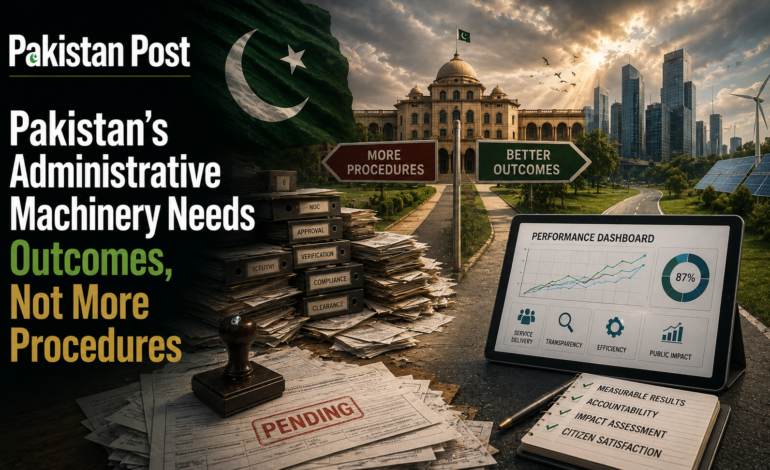
Pakistan’s Administrative Machinery Needs Outcomes, Not More Procedures


Pakistan’s administrative state has accumulated an extraordinary capacity to process paper without acquiring an equivalent capacity to demonstrate results. Files move, summaries circulate, meetings are convened, committees are constituted and approvals are recorded, yet the citizen encounters a different measure of government: whether a passport arrives on time, whether a tax dispute is resolved, whether a development scheme is completed within cost, whether a hospital functions, whether a police complaint is acted upon and whether a public service can be obtained without repeated visits to an office. The distinction is no longer semantic. It goes to the centre of Pakistan’s governance problem.
The federal government already possesses the vocabulary of performance management. Its budget architecture contains medium term performance based budgeting, output frameworks and key performance indicators, while the Finance Division continues to publish performance monitoring reports and medium term performance documents. The 2026 to 27 budget cycle includes a medium term performance based budget for 2026 to 27 through 2028 to 29. The institutional machinery therefore does not lack a conceptual entry point. The more difficult question is whether performance information actually changes administrative behaviour, resource allocation, promotion, managerial authority or public accountability.
That distinction matters because Pakistan does not primarily suffer from an absence of rules. It suffers from an accumulation of rules whose interaction can make compliance safer for an official than initiative. A bureaucrat who completes every procedural step can defend a decision through the record. An official who accelerates a project, experiments with a new delivery mechanism or removes an unnecessary approval may face greater personal exposure if the institutional system does not distinguish responsible discretion from negligence. The result is predictable. Administrative energy gravitates towards the preservation of process because process produces documentary protection, while outcomes often depend on decisions that carry greater professional and political risk.
Performance contracts could alter that equilibrium, but only if Pakistan avoids importing the label without changing the incentives beneath it. A genuine contract would establish what an administrative unit is expected to deliver, by when, with what resources, subject to which constraints and measured through which independently verifiable indicators. It would also specify what happens when targets are achieved, missed or rendered impossible by circumstances beyond managerial control. Without these elements, a performance contract becomes another form to be completed, another file to be closed and another annual report to be produced.
Pakistan should therefore treat performance contracting as an institutional reform of the state rather than a human resources exercise. The contract should sit between political priorities, budget allocations and administrative execution. A federal ministry, attached department, regulatory body or major delivery agency should receive a limited number of strategic commitments rather than an inventory of routine activities. Each commitment should identify an outcome, measurable outputs, a delivery deadline, the responsible administrative authority, the allocated resources and the principal risks. Targets should be sufficiently demanding to expose managerial weakness but sufficiently realistic to prevent systematic gaming.
The country already has an important foundation in its performance based budgeting system. The Finance Division describes performance budgeting as an approach that links public expenditure to missions, goals, objectives and measured results. Its own framework distinguishes outcomes, strategies and activities, and recognises that performance information should assist resource allocation and expenditure prioritisation. The problem is therefore less the absence of a framework than the weak connection between the framework and the daily machinery of government.
This gap is visible in the quality of some existing indicators. A government institution can report that a certain percentage of cases were processed or that directives were implemented, while the underlying question of public value remains unanswered. The federal performance budgeting documentation has, for example, framed the Prime Minister’s Office around timely processing of summaries and implementation of directives. Such measures may be administratively relevant, but they risk rewarding the movement of government business rather than the quality or consequences of the decisions produced.
A serious performance regime would reverse the hierarchy. Administrative activity should be treated as an input into delivery, not as delivery itself. The number of meetings should carry little weight. The number of files disposed of should matter only where disposal produces a meaningful institutional outcome. A ministry responsible for industrial policy should not be judged primarily by notifications issued but by investment approvals processed within predictable timelines, regulatory bottlenecks removed, export capacity expanded and private investment actually mobilised. A health department should not be celebrated for expenditure utilisation if medicine availability, maternal care, immunisation coverage and patient waiting times deteriorate. A revenue authority should not be rewarded simply for issuing notices if collections remain dependent on coercive assessments and litigation.
The most consequential reform would be to create a compact national performance architecture under which every major administrative unit has a small performance scorecard. Perhaps five to eight indicators would be sufficient for a senior ministry or department. These should combine service delivery, fiscal efficiency, implementation speed, institutional quality and citizen experience. The indicators should distinguish between outputs under direct managerial control and outcomes influenced by external conditions. This is essential because a secretary cannot be held responsible for every macroeconomic shock, but can reasonably be held responsible for procurement delays, poor internal coordination or failure to establish an implementation mechanism.
The architecture should also distinguish strategic failure from operational failure. A ministry may achieve its annual targets while pursuing a policy that is itself misguided. Performance management cannot become a substitute for political accountability or policy scrutiny. Parliament, provincial legislatures, audit institutions and relevant oversight bodies must retain authority to question whether the chosen objectives are appropriate. Performance contracts should improve execution without converting administrative metrics into an alternative source of political legitimacy.
This is where Pakistan can learn from Rwanda without attempting to replicate Rwanda’s political system. Its Imihigo performance contracts were introduced in 2006 and subsequently used across different levels of government. The model combines goal setting, measurable indicators, reporting and evaluation within a defined period. The World Bank has documented its expansion from district leadership into ministries and other administrative levels.
The lesson for Pakistan is not that a presidentially driven performance contract should simply be transplanted into Islamabad. The useful lesson is that targets acquire force when they are explicit, time bound, visible and connected to managerial accountability. Rwanda’s experience also exposes the danger. When centrally defined targets dominate local priorities, performance systems can narrow citizen participation and encourage administrators to optimise for the metric rather than the public interest.
Pakistan requires stronger safeguards precisely because its administrative structure is constitutionally more complex. The 18th Amendment transformed the distribution of responsibilities between the federation and provinces, while many critical services are delivered through provincial and local institutions. A federal performance contract cannot simply dictate provincial outcomes in areas constitutionally assigned to provinces. The appropriate model would be a tiered compact in which the federation establishes national outcomes where it has legitimate responsibility, provinces develop corresponding service standards and local administrations receive measurable delivery commitments consistent with their legal mandates.
The same principle should apply within the federal government. A secretary should not be assigned responsibility for an outcome without receiving adequate managerial authority over the resources and personnel necessary to influence it. Accountability without authority produces scapegoating. Authority without accountability produces administrative discretion without discipline. Performance governance must therefore establish a reciprocal relationship: the state defines the result, provides the means, delegates operational authority and then evaluates delivery.
This would require a change in the role of the Establishment Division as well. Personnel management should move beyond seniority, annual confidential reporting and procedural eligibility towards a more sophisticated assessment of managerial performance. Promotions to key administrative positions should incorporate evidence of delivery, institutional reform, fiscal discipline, crisis management and the ability to coordinate across departmental boundaries. Yet performance assessment should never become an instrument for political loyalty. Indicators must be predetermined, evidence based and reviewable. Senior officers need protection from arbitrary political retaliation if performance management is to command credibility inside the bureaucracy.
An independent performance evaluation function would therefore be essential. Pakistan does not need another large bureaucracy to accomplish this. A compact national delivery and evaluation unit could establish methodological standards, audit selected indicators, conduct independent verification and publish consolidated performance assessments. The Auditor General, parliamentary committees, statistical agencies, planning institutions and relevant regulatory bodies could contribute according to their mandates. Civil society, professional associations and research institutions should also have structured access to non-sensitive performance data.
Citizen experience should occupy a larger place in this system. A government can technically meet a target while citizens experience deterioration in service quality. Digital feedback, complaint-resolution statistics, independent satisfaction surveys, transaction-time measurements and geospatial service monitoring can provide a second layer of evidence. This would be particularly valuable for high-volume public services such as identity documentation, taxation, licensing, land administration, health, education and social protection.
Digitalisation can make such a system considerably more difficult to manipulate. A performance dashboard linked to administrative databases could monitor procurement milestones, budget releases, project completion, service transactions and unresolved complaints in near real time. Satellite imagery can verify certain infrastructure outputs. Geotagged photographs can establish project progress. Digital payment records can help connect expenditure with delivery. Automated anomaly detection can identify institutions reporting implausibly high completion rates or unusually rapid expenditure. Technology, however, should verify performance rather than manufacture it. A poorly designed digital dashboard can merely accelerate the production of misleading numbers.
Fiscal discipline should be embedded in every contract. Pakistan cannot afford a performance regime that rewards ministries for spending their allocations regardless of value. A department that delivers the same public outcome at lower recurrent cost should be recognised differently from one that consumes its entire budget. At the same time, under-spending should not automatically be interpreted as efficiency. An agency that fails to spend because it cannot implement its mandate has not demonstrated fiscal prudence. The relevant measure is value generated per unit of public expenditure, adjusted for the nature of the service and the constraints confronting the institution.
Procurement deserves particular attention. Many public projects fail not because the policy objective is wrong but because procurement, land acquisition, approvals, inter-agency coordination and contract management consume years. Performance contracts should therefore include implementation clocks for major projects. Responsibility should attach to identifiable stages, with escalation mechanisms when delays exceed predefined thresholds. This would transform delay from an accepted administrative condition into a measurable governance failure.
The reform should also confront the politics of targets. Ministries may deliberately choose conservative indicators that are easy to achieve. Departments may shift difficult cases elsewhere. Officials may prioritise visible projects over essential but less politically attractive maintenance. Agencies may report outputs that cannot be independently verified. Such gaming is not an argument against performance management. It is an argument for designing indicators around outcomes, triangulating evidence and periodically revising metrics.
A credible system would therefore use a balanced scorecard rather than a single numerical ranking. Institutional performance could combine service delivery, implementation speed, fiscal efficiency, regulatory quality, citizen experience and strategic policy execution. No individual indicator should determine promotion or dismissal. Nor should every failure trigger punishment. Public administration operates under uncertainty. Natural disasters, judicial intervention, financing interruptions, security conditions and political decisions can materially alter an agency’s operating environment. A review mechanism should allow targets to be adjusted transparently when circumstances genuinely change.
The establishment’s strategic concern should be equally clear. A performance based state is not necessarily a weaker state. Properly constructed, it can strengthen the state by making its command structure more predictable, its institutions more resilient and its policy execution more credible. In national security, economic resilience, disaster management, border administration, energy security and critical infrastructure, the state often requires rapid coordination across ministries that were designed to operate in separate administrative compartments. Performance contracts can create shared objectives without dissolving institutional mandates.
The real strategic value lies in converting coordination from an informal virtue into an accountable obligation. A national objective such as energy security may require finance, petroleum, power, planning, commerce, foreign affairs and provincial institutions to act simultaneously. If each department is judged only on its own procedural workload, no institution owns the aggregate result. A cross government performance compact could identify the national objective, allocate responsibilities and establish a joint delivery timetable. This would make bureaucratic fragmentation visible rather than allowing it to disappear between jurisdictions.
Pakistan should begin with a controlled pilot rather than attempt immediate administrative transformation. A small group of ministries with measurable delivery responsibilities could enter annual performance compacts covering selected high impact functions. Their targets should be publicly disclosed, quarterly implementation should be reviewed and annual performance should be independently assessed. Successful indicators could then be refined before the model expands to other departments and, where constitutionally appropriate, to provincial and local administrations.
The objective is not to abolish procedure. A state without procedure is vulnerable to arbitrariness, corruption and personalised decision making. Rules protect public money, due process and institutional continuity. The challenge is to establish a hierarchy in which procedures serve outcomes rather than become substitutes for them. The most effective administrative state is neither one that moves every file rapidly nor one that measures every official action. It is one capable of demonstrating that public authority, public money and public time have produced a defensible public result.
Pakistan’s administrative machinery does not need another campaign of slogans about efficiency. It needs a different contract between authority and performance. Ministries should know what they are expected to deliver. Officials should possess enough authority to deliver it. Budgets should reveal the resources committed to the task. Citizens should be able to see whether promises were fulfilled. Independent institutions should be able to test the evidence. Political executives should accept responsibility for setting priorities, while administrators should be judged on execution within their lawful mandate.
That would move governance from the culture of completed files towards the discipline of completed objectives. The reform is demanding because it removes the comfort of ambiguity from both political leadership and bureaucracy. But that is precisely why it matters. In a fiscally constrained, demographically young and strategically exposed Pakistan, the state can no longer measure administrative success by how much business it processes. Its legitimacy increasingly depends on what that business accomplishes.
A Public Service Message