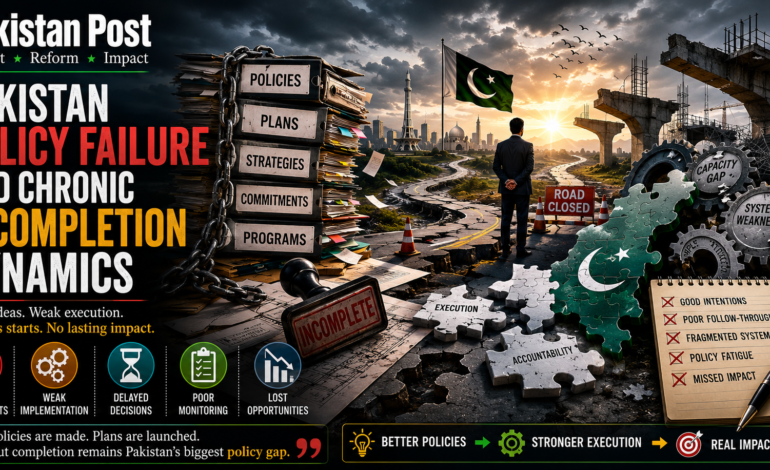
Pakistan Policy Failure and Chronic Incompletion Dynamics

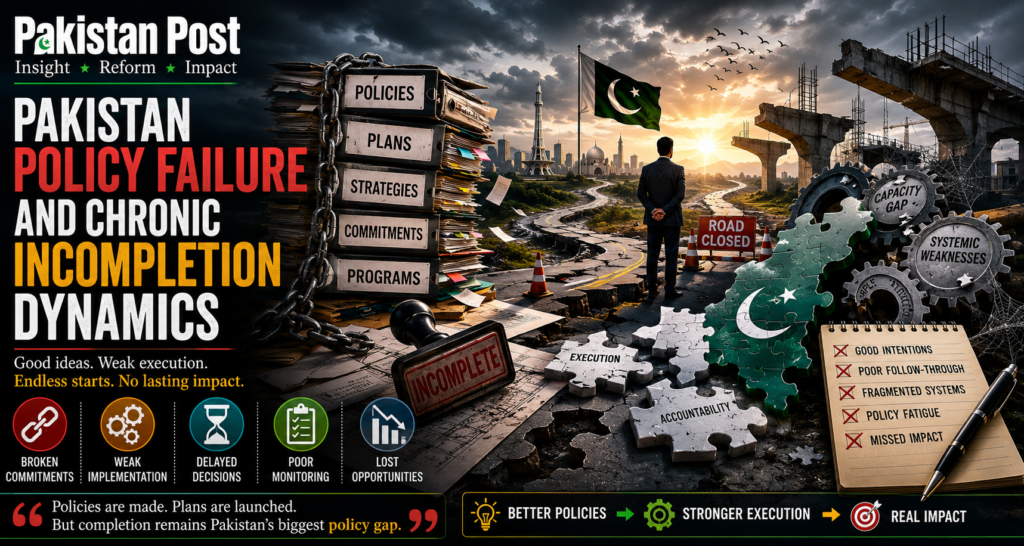
Pakistan’s governance discourse has long revolved around a familiar complaint: there is no shortage of policy, only a shortage of implementation. Yet this framing, repeated across administrations and reform cycles, now risks obscuring a deeper structural condition. The problem is no longer simply that policies are not executed. It is that policy itself has become a recurring but incomplete gesture of the state, initiated with visibility but rarely carried through to institutional consolidation.
In this sense, Pakistan does not suffer from a policy vacuum. It suffers from a policy metabolism that is chronically interrupted. Plans are drafted, committees are formed, donor-supported frameworks are announced, and reform roadmaps are published. Yet between initiation and completion, momentum dissipates. The state repeatedly begins governing projects without building the systems required to finish them.
This condition produces a paradox. On paper, Pakistan appears to be continuously reforming. In practice, it is frequently restarting.
The most visible manifestation of this pattern lies in fiscal, administrative, and sectoral reforms that follow a predictable lifecycle. A policy is announced under fiscal pressure or external conditionality. A task force or steering committee is established. Initial enthusiasm produces early documentation, pilot programs, or digital platforms. Then, political attention shifts, bureaucratic rotations occur, or institutional resistance intensifies. Implementation slows, reporting becomes irregular, and the reform gradually loses coherence. Eventually, it is either quietly absorbed into existing structures or replaced by a new reform cycle that begins the process again.
The result is not absence of reform, but fragmentation of reform continuity.
This chronic incompletion is not accidental. It is structurally embedded in the way governance operates. One of the most significant drivers is the absence of institutional insulation for policy processes. In many cases, reforms are not protected from political turnover, administrative reshuffling, or jurisdictional contestation. As a result, they remain vulnerable to disruption at multiple points in the execution chain.
Another driver is the weak linkage between policy design and implementation machinery. Policies are often formulated at the centre, sometimes with technical sophistication, but without equivalent investment in downstream execution systems. Ministries may design frameworks, but provinces and districts are left to interpret and operationalise them without adequate capacity transfer, budget alignment, or data integration. This creates a gap between policy intent and administrative reality that widens over time.
A further constraint lies in the fragmentation of authority. Pakistan’s governance system distributes responsibility across federal, provincial, and local tiers, but does not always integrate accountability across them. This creates what can be described as distributed responsibility without consolidated accountability. When implementation fails, responsibility is diffused. When success occurs, credit is contested. In both cases, incentives for sustained execution remain weak.
The chronic incompletion problem is particularly visible in digitisation initiatives. Over the past decade, multiple efforts have been launched to modernise public service delivery through digital platforms. Yet many of these systems remain partially implemented, unevenly adopted, or poorly integrated with existing bureaucratic workflows. In some cases, digital systems operate in parallel with paper-based processes rather than replacing them. This duality increases administrative burden rather than reducing it.
The core issue is not technological capability. It is institutional alignment. Digitisation requires standardisation of processes, interoperability of databases, and reconfiguration of authority structures. Without these, technology becomes an overlay rather than a transformation. Pakistan’s experience shows that digitisation without institutional redesign produces fragmentation rather than integration.
Taxation reform presents a similar pattern. Successive governments have announced measures to broaden the tax base, improve compliance, and reduce leakage. Yet enforcement remains uneven due to political economy constraints, provincial-federal coordination gaps, and limited integration between financial intelligence systems and revenue authorities. The result is partial reform that improves visibility but not necessarily outcomes.
Energy sector reform is another long-standing example of chronic incompletion. Structural issues such as circular debt, tariff distortions, and institutional inefficiencies have been repeatedly identified and addressed through policy proposals. However, implementation has been constrained by overlapping regulatory jurisdictions, contractual rigidities, and fiscal constraints. Reforms are initiated but rarely reach full structural resolution, leading to recurring crises that necessitate further reform cycles.
Education and health sectors exhibit similar dynamics at a different scale. Policy frameworks exist, donor-supported initiatives are active, and provincial plans are periodically updated. Yet delivery outcomes remain uneven due to weak monitoring systems, capacity constraints at district levels, and discontinuities in political prioritisation. The gap between policy articulation and classroom or clinic reality remains persistent.
At the core of these sectoral patterns lies a systemic issue: the absence of what may be termed completion infrastructure. Completion infrastructure refers to the institutional, legal, financial, and technological mechanisms that ensure policies move from initiation to sustained execution. In Pakistan, such infrastructure remains underdeveloped or fragmented.
One critical missing component is enforceable implementation timelines. Policies are often launched without binding schedules for completion or clearly defined consequences for delay. This reduces pressure on implementing agencies and allows reforms to stretch indefinitely without resolution. In contrast, systems with stronger execution cultures embed timelines into legal or administrative frameworks, making delay itself a measurable governance failure.
Another missing component is independent monitoring. While oversight bodies exist, their ability to track real-time implementation across ministries and provinces is limited. Reporting is often retrospective rather than operational. This means problems are identified after delays have already occurred, rather than during the implementation process when corrective action is still possible.
A third missing element is performance-linked financing. Budget allocations are rarely tied in a strict manner to delivery outcomes. Funds may be released based on procedural compliance rather than measurable performance indicators. This weakens incentives for timely execution and reduces accountability for results.
The media and political environment further complicates completion dynamics. Policy announcements are often treated as political milestones rather than starting points of implementation. This creates a visibility bias in governance, where the act of announcing reform is rewarded more than the process of completing it. Over time, this distorts administrative incentives, encouraging symbolic governance over substantive delivery.
Bureaucratic turnover intensifies this problem. Frequent transfers of senior officials disrupt institutional continuity. Incoming administrators often recalibrate priorities, reinterpret ongoing reforms, or initiate parallel initiatives. This creates a discontinuous governance environment in which institutional memory is weak and policy coherence is difficult to sustain.
Legal contestation adds another layer of interruption. Policies, particularly those involving regulatory or fiscal change, are frequently subject to litigation or judicial review. While legal oversight is essential, prolonged uncertainty can delay implementation and reduce administrative confidence in pursuing bold reforms.
Centre-province relations remain a structural constraint. Many reforms require coordination across federal and provincial governments, yet institutional mechanisms for sustained intergovernmental alignment remain limited. Fiscal decentralisation without full coordination capacity produces divergence in implementation standards across regions.
In this environment, policy does not die; it drifts. It moves from high priority reform to partial implementation to institutional fatigue. Eventually, it becomes part of the administrative background, referenced in reports but not actively pursued.
This drift is particularly dangerous because it creates the appearance of continuity. Governments can point to ongoing reforms, committees, and frameworks as evidence of progress. Yet the underlying reality may be that very few initiatives reach full structural completion. This creates a credibility gap between state narrative and state performance.
Over time, chronic incompletion produces second-order governance effects. Public trust declines as repeated announcements fail to translate into visible change. Administrative morale weakens as frontline implementers operate in environments where goals shift before completion. External partners become cautious as reform commitments appear inconsistent.
Most critically, the state begins to accumulate unfinished governance projects. Each incomplete reform adds to institutional complexity without reducing underlying problems. Instead of simplifying governance, the system becomes more layered, more fragmented, and more difficult to navigate.
The strategic risk is that Pakistan may evolve into a state of perpetual partial reform, where transformation is always underway but never consolidated. In such a condition, governance capacity is not measured by policy generation but by policy completion rates. And on that metric, the gap between ambition and execution remains substantial.
Addressing this condition requires moving beyond rhetorical appeals to political will. The challenge is not motivation but mechanism. What is needed is an architecture of completion.
Such an architecture would include legally mandated implementation timelines, cross-ministerial delivery units with enforcement authority, integrated data systems for real-time monitoring, and budgeting frameworks that tie funding to measurable outcomes. It would also require stabilising institutional leadership for critical reform programs to ensure continuity beyond political cycles.
Equally important is the creation of feedback loops that allow policy to be adjusted during implementation rather than abandoned or restarted. Adaptive governance systems recognise that execution is not linear but iterative. They allow correction without collapse.
Ultimately, the question is not whether Pakistan can design policy. It is whether it can complete it. In a strategic environment defined by accelerating complexity, incomplete governance is no longer a transitional inconvenience. It is a structural vulnerability.
Pakistan’s future governance challenge will therefore be defined less by the abundance of policy and more by the capacity to finish what it begins.
A Public Service Message \