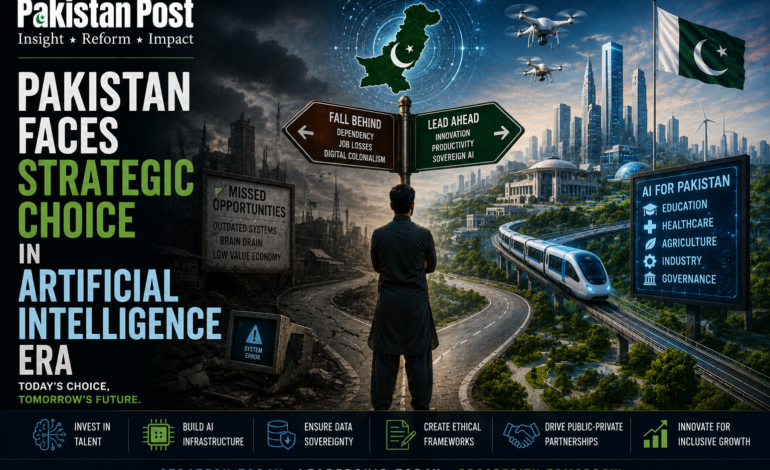
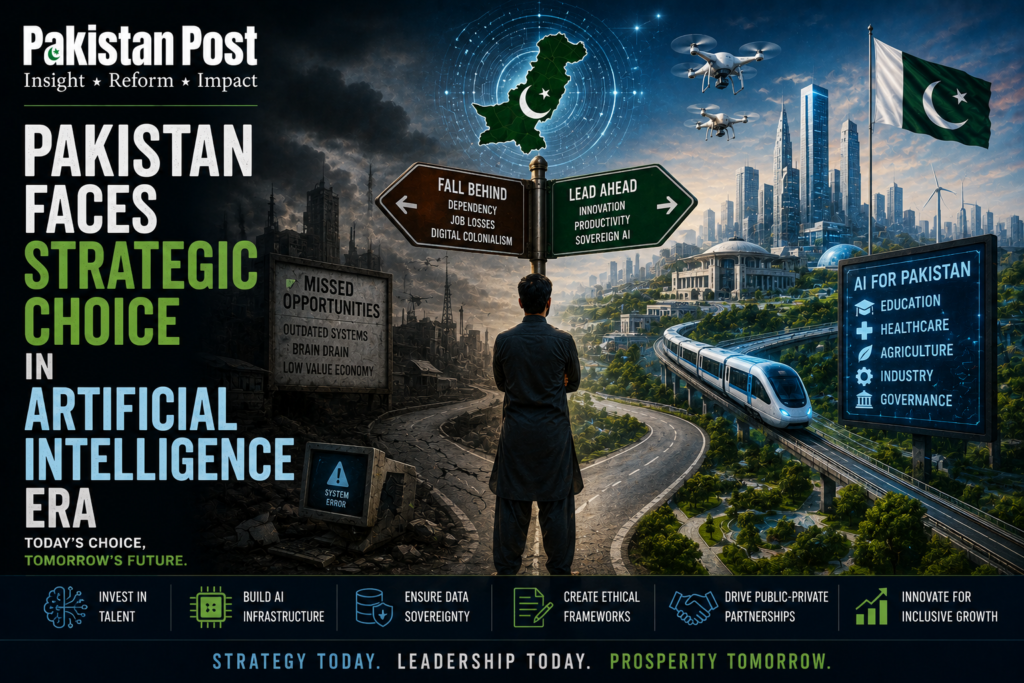
Pakistan Faces Strategic Choice in Artificial Intelligence Era

Artificial intelligence is no longer a peripheral technology discussion in Pakistan’s policy circles. It has become a structural question about sovereignty, state capacity, and the future of governance itself. Yet much of the national discourse still treats AI as an extension of the digital economy, framed around freelancing markets, startup incubators, and youth employment. These are real and important dimensions, but they sit at the surface of a far deeper transformation in which control over data, compute infrastructure, algorithms, and standards is becoming as decisive as control over territory, energy, or currency.
For Pakistan, the central issue is not whether it will adopt artificial intelligence. That is already happening through imported platforms, foreign cloud services, global social media ecosystems, and externally developed enterprise systems embedded across banking, telecom, defence logistics, taxation, and public administration. The real question is whether Pakistan will shape the conditions under which AI operates inside its borders, or whether it will remain a downstream consumer of systems designed, trained, and governed elsewhere.
In the emerging global order, AI sovereignty is not defined by autarky or technological isolation. It is defined by institutional depth. A state possesses AI sovereignty when it can meaningfully govern its data assets, regulate algorithmic decision making, ensure secure and locally relevant language models, negotiate equitable cloud and compute partnerships, and maintain visibility over how automated systems influence public life. Without these capacities, sovereignty becomes procedural rather than substantive, and governance becomes dependent on external logic embedded in code.
Pakistan enters this moment with structural constraints. Its digital infrastructure is uneven, its data ecosystems are fragmented across ministries, and its regulatory environment is still evolving. Cloud dependency is largely external, with critical systems hosted on foreign infrastructure. Domestic research capacity in advanced machine learning remains limited in scale. More importantly, institutional awareness of AI as a strategic domain is still developing within policymaking circles, often dispersed across IT ministries, planning commissions, and sectoral regulators without a unified doctrine.
This fragmentation creates a strategic vulnerability. AI systems do not operate as standalone tools. They embed themselves into decision chains, gradually shaping how states classify citizens, allocate resources, detect fraud, assess risk, and respond to security threats. Once embedded, these systems become difficult to displace, especially when they are integrated into procurement contracts, vendor ecosystems, and international partnerships. The dependency therefore becomes path dependent, reinforcing itself over time.
One of the most immediate areas of concern is data governance. Pakistan generates vast volumes of data through telecom usage, banking transactions, identity systems, health records, and welfare distribution platforms. However, this data is not yet consolidated into a coherent national data architecture. In many cases, it remains siloed within institutions or managed by third party vendors. Without unified standards for interoperability, encryption, anonymisation, and access control, the state’s ability to leverage data for domestic AI development remains limited.
A second dimension is compute sovereignty. Advanced AI systems require high performance computing infrastructure, including GPU clusters, data centres, and reliable energy supply chains. Pakistan’s current compute capacity is insufficient to support large scale indigenous model training at competitive levels. As a result, reliance on external cloud providers is increasing. This introduces not only economic dependency but also jurisdictional exposure, as data residency, cross border data flows, and compliance frameworks become subject to foreign regulatory regimes.
Language is another critical frontier. Pakistan’s linguistic diversity, including Urdu, Punjabi, Sindhi, Pashto, and Balochi, is underrepresented in global AI training datasets. This creates a risk that AI systems deployed within Pakistan will be structurally biased toward foreign linguistic and cultural contexts. The result is not merely inconvenience but a deeper epistemic dependence in which citizens interact with systems that do not fully understand their linguistic reality. Developing robust local language models is therefore not a cultural luxury but a strategic necessity.
Education pipelines form the long term determinant of whether AI sovereignty is achievable. At present, Pakistan produces a growing number of IT graduates, but advanced specialisation in machine learning, data engineering, computational linguistics, and AI safety remains limited. More critically, there is a gap between academic training and institutional deployment. Research outputs are not consistently translated into public sector systems or domestic industrial applications. Without bridging this gap, talent will continue to flow into external markets, reinforcing dependency rather than reducing it.
The public sector procurement system represents another structural bottleneck. AI systems are often acquired through vendor driven contracts that prioritise short term deployment over long term capacity building. This results in black box systems that are operationally efficient but institutionally opaque. Once deployed, such systems become difficult to audit or modify, locking public institutions into proprietary ecosystems. A sovereign AI strategy would require procurement reform that mandates transparency, interoperability, and local capacity transfer as contractual obligations.
Defence and internal security implications are particularly significant. AI enabled surveillance, predictive policing, and data fusion systems are already being integrated into security architectures globally. For Pakistan, the adoption of such systems without domestic oversight capabilities raises concerns about operational autonomy and strategic resilience. In high sensitivity environments, reliance on external AI systems could introduce risks related to data leakage, algorithmic bias, or external interference. This necessitates a calibrated approach in which security applications of AI are subject to strict domestic control frameworks.
Misinformation and cognitive security represent another domain of vulnerability. AI generated content, deepfakes, and automated influence operations are increasingly shaping public discourse. In politically sensitive environments, this can amplify instability or erode trust in institutions. Pakistan’s regulatory response remains in early stages, focused primarily on content moderation rather than systemic information integrity. A more comprehensive approach would integrate AI detection systems, media literacy programs, and platform accountability mechanisms into a unified information security doctrine.
The international dimension further complicates Pakistan’s AI trajectory. Chinese digital ecosystems, including cloud services, surveillance technologies, and smart city infrastructure, are increasingly embedded in regional connectivity projects. Gulf states are simultaneously investing in AI driven governance models and sovereign cloud infrastructure. Western technology firms continue to dominate foundational model development and enterprise AI services. Pakistan therefore faces a multi vector dependency landscape in which different external partners shape different layers of its digital stack.
This creates both opportunity and constraint. Strategic partnerships can accelerate capacity building, infrastructure deployment, and knowledge transfer. However, without a coherent national AI doctrine, such partnerships risk becoming asymmetric, locking Pakistan into externally defined architectures. The challenge is not to reject external ecosystems, but to ensure that engagement is structured around domestic control of critical layers, particularly data governance, identity systems, and public sector AI applications.
Institutional readiness remains the central variable. At present, AI governance in Pakistan is distributed across multiple bodies without a unified strategic command structure. An effective approach would require the establishment of a dedicated national AI authority with cross ministerial mandate, integrating IT, planning, defence, education, and regulatory institutions. This authority would not function as a bureaucratic layer alone but as a strategic coordination platform for AI policy, infrastructure, and ethics.
Regulatory frameworks also require modernization. Existing digital regulations are primarily designed for data protection and cybercrime prevention, rather than algorithmic governance. New legal structures are needed to define accountability for automated decision making, establish audit rights for public sector AI systems, and regulate high risk applications in finance, health, and security. Without such frameworks, AI deployment will outpace institutional oversight.
The economic implications are equally significant. AI will reshape labour markets, particularly in services, outsourcing, and routine cognitive tasks. Pakistan’s comparative advantage in low cost digital labour may erode over time as automation increases. However, new opportunities may emerge in AI maintenance, localisation, data annotation, and regional model training. Capturing these opportunities will require deliberate industrial policy rather than passive market adjustment.
A sovereign AI strategy for Pakistan would therefore rest on several operational pillars. First, the development of a national data architecture that consolidates public sector datasets under interoperable standards while ensuring privacy and security. Second, investment in domestic compute infrastructure, potentially through public private partnerships, with clear rules on data residency and access. Third, creation of local language AI models to ensure cultural and linguistic inclusion. Fourth, procurement reform mandating transparency, auditability, and local capacity transfer in all AI related contracts. Fifth, establishment of a national AI regulatory framework addressing algorithmic accountability and high risk use cases. Sixth, sustained investment in advanced technical education and research translation mechanisms linking universities to state institutions.
Implementation, however, is the decisive challenge. Pakistan’s institutional environment has historically struggled with policy continuity, inter agency coordination, and execution discipline. AI governance will require a higher level of administrative integration than previous digital reforms. It will also require sustained political attention, as the incentives for short term deployment often outweigh the benefits of long term capacity building.
There is also a cultural dimension to this transformation. AI systems do not merely process information; they shape how information is interpreted. In multilingual, politically complex societies, this raises questions about narrative control, epistemic diversity, and institutional trust. If AI systems become the primary interface between citizens and the state, then the design of those systems becomes a matter of governance legitimacy.
Pakistan therefore stands at a strategic inflection point. It can continue to engage AI as an imported utility layered onto existing structures, or it can treat it as a foundational domain of sovereignty requiring institutional redesign. The difference between these two paths will not be visible immediately. It will accumulate gradually through dependency patterns, procurement decisions, infrastructure choices, and regulatory gaps.
In the short term, consumption of external AI systems is unavoidable. In the medium term, dependency can still be managed. In the long term, however, absence of strategic action will translate into structural loss of autonomy in key governance functions. The window for shaping outcomes remains open, but it is narrowing as global AI ecosystems consolidate.
Pakistan’s challenge is therefore not technological alone. It is institutional, strategic, and constitutional in character. Artificial intelligence is not simply another sector of the economy. It is becoming the operating system of governance. Whether Pakistan writes any part of that operating system, or merely runs it, will define its sovereignty in the decades ahead.
A Public Service Message