Pakistan Risks Automated Inequality Through Digital State

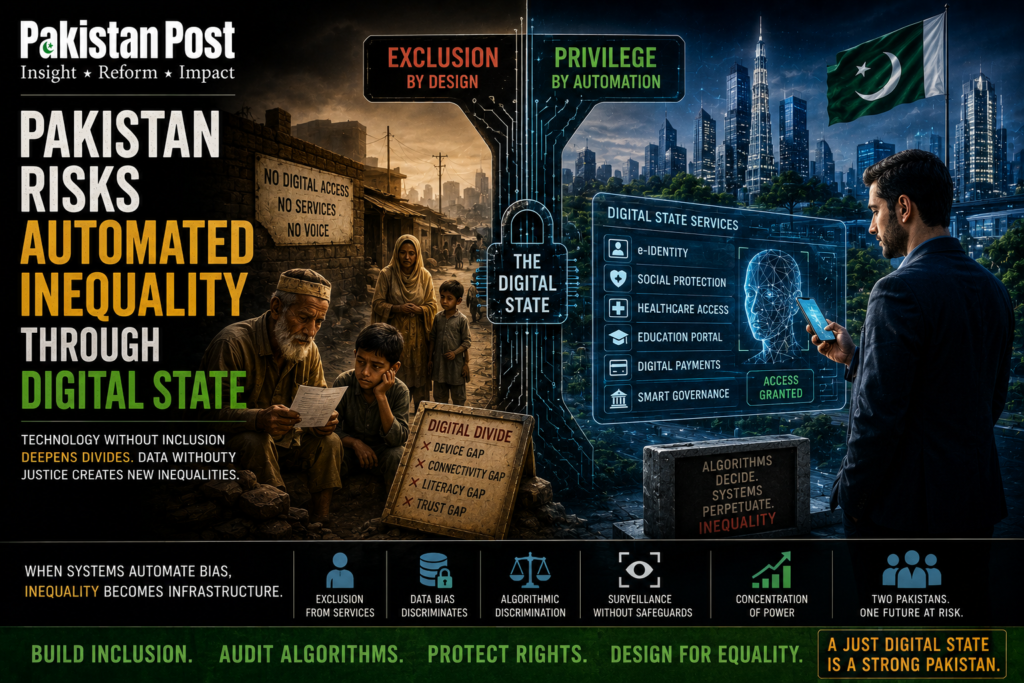
Pakistan’s digital governance agenda is accelerating at a pace that often exceeds its institutional capacity to regulate, audit, or even fully comprehend the systems being deployed. From biometric identity verification to algorithmic welfare distribution, from tax automation to predictive policing experiments, the state is steadily embedding digital infrastructures into the core of public administration. Yet beneath the efficiency narrative lies a more complex question: whether digitisation is reinforcing state capacity, or quietly restructuring inequality into automated form.
The central promise of digital government is administrative rationalisation. By replacing manual processes with data driven systems, states seek to reduce leakage, improve targeting, and expand service delivery. In Pakistan, this promise is particularly attractive given long standing governance constraints, including fragmented records, weak tax compliance, and uneven service delivery across provinces. Digital identity systems, mobile banking integration, and database consolidation are therefore often presented as corrective tools for structural inefficiency.
However, digitisation is not neutral. It reorganises power through technical systems that determine who is visible to the state, who is legible to welfare programs, and who is excluded by design or error. In environments where digital literacy is uneven and infrastructure gaps persist, the transition to automated governance can produce new forms of exclusion that are less visible, more systematic, and harder to contest than traditional administrative failure.
The most foundational layer of Pakistan’s digital state is its identity infrastructure. Biometric verification systems have become central to access across financial services, telecommunications, social welfare programs, and border management. These systems are designed to ensure authenticity and reduce fraud. Yet biometric systems also introduce a new dependency: the assumption that identity can be perfectly captured through data.
In practice, biometric systems are vulnerable to error, mismatch, and exclusion, particularly for populations with worn fingerprints, documentation gaps, or rural connectivity limitations. Once identity becomes the gateway to all services, even minor system errors can translate into total administrative exclusion. A failed verification is no longer a bureaucratic delay; it becomes a structural denial of access.
Welfare delivery illustrates this tension most clearly. Digital cash transfer systems and database driven subsidy programs are often celebrated for improving targeting efficiency. But the logic of targeting requires classification, and classification requires exclusion. The more precise the system becomes, the more categories it creates for eligibility and ineligibility. In contexts where data is incomplete or outdated, this precision can become illusory, producing exclusion errors that are not visible in aggregate statistics but are deeply felt at the household level.
Tax administration presents a parallel dynamic. Digital tax systems aim to broaden the tax base by integrating banking records, property data, and transaction histories. This integration increases state visibility over economic activity, but it also introduces new asymmetries. Individuals and small businesses operating in informal or semi formal economies may find themselves disproportionately affected by automated risk scoring systems that do not fully capture local economic realities. In such cases, algorithmic classification can harden existing economic inequalities into procedural outcomes.
Policing and internal security systems add another layer of complexity. Predictive analytics, surveillance feeds, and data fusion platforms are increasingly used globally to enhance situational awareness and operational efficiency. In Pakistan, the adoption of such systems raises important questions about oversight, proportionality, and error correction. When security decisions are informed by algorithmic risk assessments, the threshold for intervention can shift from evidence based suspicion to probabilistic inference. Without strong legal safeguards, this can blur the boundary between prevention and preemption.
Health systems are also undergoing digitisation through electronic medical records, vaccination databases, and hospital management platforms. These systems can significantly improve continuity of care and resource allocation. However, they also depend on data completeness and interoperability across institutions. In fragmented health systems, patients may find that their medical history is distributed across incompatible platforms, reducing rather than improving clinical coherence. In rural areas, digital health records may not fully capture offline treatment pathways, creating gaps in official health data that affect future service eligibility and planning.
At the centre of all these systems lies the question of data integrity. Digital governance assumes that data is accurate, updated, and universally accessible across institutions. Yet in practice, data ecosystems in Pakistan remain uneven. Errors in one database can cascade into multiple systems, producing administrative knock on effects that are difficult to trace. Once data is treated as authoritative, correcting it becomes procedurally complex, requiring institutional coordination that is often slow or fragmented.
The political economy of digitisation also matters. Digital systems are frequently implemented through public private partnerships, vendor contracts, and international development projects. While these arrangements bring technical expertise and capital, they also introduce external dependencies into core governance functions. When critical administrative systems are designed, maintained, or updated by external vendors, questions arise about ownership, accountability, and long term sustainability.
Another emerging concern is the concentration of administrative power within digital infrastructures. As more decisions are automated or semi automated, discretion shifts from frontline bureaucrats to system designers, data managers, and platform administrators. This reconfiguration of authority is often invisible but significant. It creates a new class of technical intermediaries who shape policy outcomes through system design choices that are not always subject to democratic oversight.
Digital exclusion is not limited to technological failure. It is also shaped by literacy, language, and geography. Citizens with limited digital literacy may struggle to navigate online portals, biometric authentication systems, or mobile based verification processes. In regions with weak connectivity, access to digital services becomes inconsistent, reinforcing spatial inequality. Language barriers further compound exclusion when systems are designed primarily in dominant administrative languages rather than local linguistic contexts.
The risk is not simply that some citizens are left behind. It is that exclusion becomes normalised within system logic itself. In analogue systems, exclusion is often visible and contestable. In digital systems, exclusion can appear as a technical outcome rather than a political decision. A failed verification, a missing record, or an algorithmic denial may be treated as procedural correctness rather than administrative failure.
International experience suggests that digital states often evolve through phases. The first phase is digitisation of records. The second is integration of databases. The third is automation of decision making. Pakistan is currently transitioning between the first and second phases, with early experiments in the third. This transitional stage is particularly sensitive, because institutional safeguards often lag behind technological deployment.
The ethical dimension of digital governance is therefore not secondary; it is foundational. Questions of consent, transparency, appeal mechanisms, and data protection are not abstract legal concerns but practical governance requirements. Without clear mechanisms for citizens to challenge digital decisions, administrative authority becomes asymmetrically concentrated in systems that are difficult to interrogate.
A further structural issue is auditability. Many digital systems operate as black boxes from the perspective of frontline institutions. Even when public agencies deploy these systems, they may lack full visibility into how outputs are generated. This creates a governance gap in which accountability is diffused between vendors, data scientists, and administrative units. In such environments, responsibility becomes difficult to locate when errors occur.
The fiscal implications of digitisation are also significant. While digital systems are often justified on the basis of cost efficiency, they require sustained investment in infrastructure, maintenance, cybersecurity, and workforce training. Without long term budgetary planning, systems may degrade over time, leading to partial functionality that is neither fully digital nor fully analogue. This hybrid state can be more inefficient than either system alone.
Despite these risks, the potential benefits of digital governance remain substantial. Properly designed systems can improve transparency, reduce discretionary abuse, and expand service coverage. The challenge lies not in rejecting digitisation, but in embedding safeguards that ensure inclusion, accountability, and adaptability.
A more balanced digital governance framework for Pakistan would require several operational reforms. First, the establishment of legally enforceable digital rights, including the right to explanation, correction of data, and appeal against automated decisions. Second, mandatory human oversight in high impact decisions relating to welfare, policing, taxation, and identity verification. Third, independent audit mechanisms for algorithmic systems deployed in the public sector. Fourth, investment in digital literacy programs targeted at rural and marginalised populations. Fifth, interoperability standards across all government databases to reduce fragmentation and duplication. Sixth, clear data governance frameworks defining ownership, storage, and access protocols.
Institutionally, Pakistan would benefit from a central digital governance authority with regulatory and technical oversight functions, separate from implementation bodies. This separation is critical to avoid conflicts of interest between system deployment and system regulation. Without such institutional differentiation, the same entities that build digital systems also end up regulating them, weakening accountability.
The broader strategic question is whether digitisation will reinforce existing inequalities or help reconfigure them. Technology does not determine this outcome on its own. Institutional design, legal safeguards, and political priorities shape how digital systems operate in practice. In weak governance environments, digitisation can inadvertently crystallise inequality into code, making it more durable and less visible.
Pakistan’s digital transformation is therefore not simply a modernization project. It is a governance reconstitution exercise. The state is not only digitising services; it is redefining the interface between citizens and authority. If this transformation proceeds without robust ethical and institutional grounding, the result may be a more efficient state that is also more rigid, less forgiving, and more exclusionary.
The future of digital governance in Pakistan will ultimately be judged not by the speed of deployment, but by the fairness of access, the transparency of systems, and the ability of citizens to remain visible to the state without becoming trapped by it.
A Public Service Message