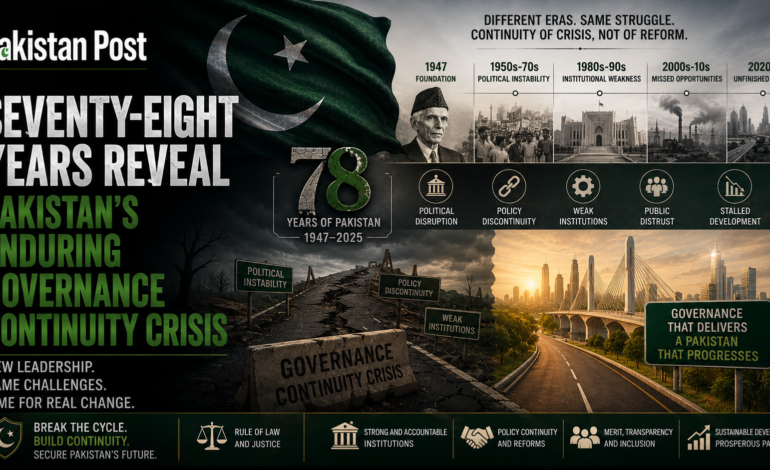
Seventy-Eight Years Reveal Pakistan’s Enduring Governance Continuity Crisis

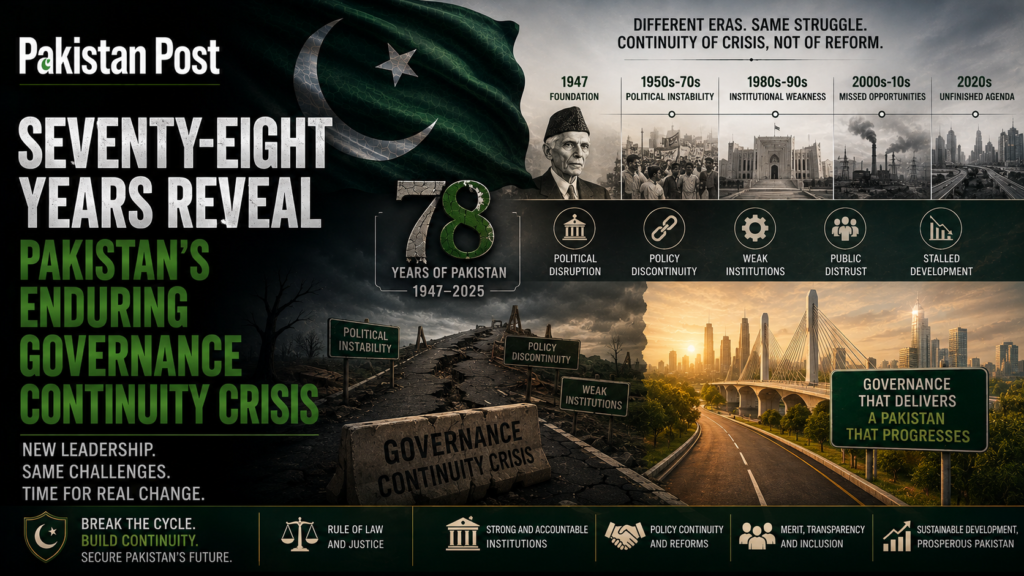
Seventy-eight years after independence, Pakistan continues to confront a paradox that increasingly attracts the attention of policymakers, strategic planners and international observers. The state has demonstrated remarkable endurance despite wars, constitutional breakdowns, economic crises, terrorism, natural disasters and repeated political transitions. Yet resilience has not translated into governance continuity. Governments change, constitutions survive, elections recur and reform commissions periodically emerge, but institutional performance repeatedly returns to familiar patterns of administrative interruption, policy discontinuity and implementation fatigue. The central question confronting Pakistan is therefore no longer whether democracy, bureaucracy or constitutionalism individually require improvement. The more fundamental inquiry concerns whether the country’s institutional architecture itself systematically generates instability regardless of which political leadership occupies office.
The debate has frequently concentrated upon personalities. Prime ministers are criticised for administrative weakness, presidents for constitutional overreach, bureaucrats for procedural inertia, judges for judicial activism and political parties for organisational deficiencies. Such explanations contain elements of truth but collectively obscure a more consequential reality. Political systems are designed to produce predictable incentives. When instability consistently emerges across multiple decades, multiple constitutions, multiple parties and multiple generations of leadership, structural diagnosis becomes considerably more persuasive than leadership centred explanations.
Pakistan has experienced parliamentary democracy, presidential experimentation, military administrations, caretaker governments, coalition arrangements, constitutional restoration and repeated electoral transitions. Each phase promised institutional correction, yet governance continuity remained elusive. Development priorities shifted with electoral cycles. Administrative leadership experienced frequent replacement. Regulatory frameworks evolved without sustained implementation. Long term planning repeatedly surrendered to immediate political calculations. The consequence has been institutional volatility rather than institutional evolution.
The constitutional framework itself provides an instructive illustration. Pakistan possesses an elaborate constitutional order defining executive authority, legislative responsibility, judicial independence and provincial autonomy. Successive constitutional amendments have attempted to address historical imbalances, particularly regarding parliamentary sovereignty and federal decentralisation. Nevertheless, constitutional implementation has often remained selective rather than systematic. Formal legal provisions have frequently been interpreted through prevailing political circumstances rather than embedded institutional conventions.
Stable constitutional systems depend less upon written provisions than upon predictable behavioural norms. Mature democracies cultivate unwritten expectations governing restraint, consultation, institutional respect and procedural continuity. Pakistan’s constitutional experience demonstrates comparatively weaker development of these informal conventions. Consequently, constitutional disputes often migrate toward judicial interpretation or political negotiation instead of being resolved through established parliamentary practice.
This recurring dependence upon extraordinary institutional arbitration generates uncertainty extending beyond immediate political competition. Investors delay long term commitments. Civil servants hesitate before implementing controversial decisions. Provincial administrations postpone coordination initiatives. International partners adopt cautious engagement strategies. Governance thereby becomes increasingly reactive rather than strategically directed.
Electoral politics further reinforces short term institutional incentives. Democratic competition naturally encourages governments to pursue visible achievements within limited electoral timeframes. However, when political continuity itself remains uncertain, incentives increasingly favour immediate distributive outcomes over institutional investment. Infrastructure announcements receive greater attention than administrative reform. Subsidies generate more immediate political returns than regulatory modernisation. Short horizon political calculations gradually displace investments whose benefits may only materialise under future governments.
Such dynamics weaken policy credibility across successive administrations. Development strategies frequently undergo revision following electoral transition. Regulatory priorities shift according to ministerial preferences. Administrative appointments become associated with changing political alignments. Long term national projects therefore confront repeated interruptions irrespective of their technical merit.
Coalition politics compounds these structural pressures. Coalition governments represent legitimate democratic outcomes within fragmented political systems. Nevertheless, fragmented parliamentary environments often prioritise political survival over institutional consolidation. Cabinet portfolios become instruments of coalition management. Legislative agendas increasingly reflect negotiation among coalition partners rather than coherent strategic planning. Ministerial turnover accelerates administrative uncertainty. Bureaucratic leadership correspondingly adapts toward procedural caution instead of policy innovation.
The cumulative consequence extends beyond governmental instability. Public institutions gradually internalise expectations that policy direction remains temporary. Administrative organisations become skilled at waiting for political transition rather than executing long term implementation strategies. Institutional memory consequently weakens as continuity yields to periodic organisational recalibration.
Political party institutionalisation represents another structural constraint receiving comparatively limited attention. Durable governance generally requires political parties functioning as permanent policy institutions rather than primarily electoral organisations. Effective parties cultivate internal research capacity, leadership succession mechanisms, policy expertise and ideological coherence extending beyond individual personalities.
Pakistan’s party landscape continues to exhibit considerable electoral vitality but comparatively uneven institutional development. Leadership centralisation often limits organisational adaptation. Policy platforms occasionally evolve more rapidly than institutional learning. Candidate selection may prioritise electoral calculations over policy expertise. Parliamentary performance correspondingly becomes influenced by political mobilisation rather than legislative specialisation.
Legislatures consequently struggle to perform their broader constitutional responsibilities. Modern parliaments increasingly function not merely as law making institutions but as centres of policy scrutiny, regulatory oversight, fiscal accountability and strategic debate. Parliamentary committee systems require technical expertise, continuity and institutional independence. Frequent political polarisation diminishes opportunities for sustained legislative examination of complex national challenges including technological regulation, fiscal sustainability, national security governance and administrative modernisation.
The resulting legislative underperformance expands executive discretion while reducing institutional accountability. Executive branches increasingly rely upon ordinances, administrative directives and emergency procedures rather than comprehensive legislative deliberation. Such practices may address immediate governance requirements but gradually weaken parliamentary institutional capacity.
Administrative discontinuity presents perhaps the most consequential constraint upon governance continuity. Civil services constitute the permanent operating mechanism of modern states. Political leadership establishes priorities, yet bureaucratic institutions convert policy into operational reality. Stable governance therefore depends upon professional administrative continuity surviving electoral transition.
Pakistan’s administrative system possesses considerable technical capability and historical institutional experience. Nevertheless, frequent transfers, leadership rotation, overlapping jurisdictions and evolving reporting structures complicate long term implementation. Senior administrators often manage limited tenure before reassignment. Organisational learning becomes fragmented. Institutional accountability weakens because responsibility disperses across successive office holders.
Development programmes extending beyond several years encounter repeated administrative recalibration. Policy ownership declines as officials anticipate organisational transfer before project completion. Risk avoidance increasingly replaces administrative initiative. Innovation correspondingly diminishes because institutional incentives reward procedural compliance more consistently than implementation effectiveness.
Fiscal governance introduces another structural challenge. Pakistan’s federal structure has progressively expanded provincial authority, particularly following constitutional decentralisation initiatives. Yet fiscal relationships continue to generate administrative complexity. Revenue generation remains comparatively concentrated while expenditure responsibilities increasingly disperse across multiple governmental levels.
This imbalance complicates strategic planning. Provinces depend significantly upon federal fiscal transfers while simultaneously managing expanding service delivery obligations. Local governments often confront uncertain financial autonomy. National development priorities therefore require intricate intergovernmental negotiation before implementation begins. Administrative coordination consequently consumes institutional energy that might otherwise support policy execution.
Federal provincial coordination extends beyond fiscal management into broader governance architecture. Modern policy challenges rarely conform neatly to constitutional jurisdictions. Climate adaptation, water security, public health, digital governance, agricultural productivity and urban resilience require integrated decision making across governmental levels.
Institutional fragmentation frequently impedes such coordination. Ministries pursue sector specific priorities. Provincial departments operate according to local political considerations. Regulatory agencies maintain independent mandates. Information sharing remains inconsistent. Policy coherence becomes difficult because organisational incentives reward departmental autonomy more strongly than collaborative governance.
Urban governance illustrates these broader structural dynamics. Pakistan’s rapidly expanding metropolitan centres increasingly shape national productivity, investment attraction and social stability. Yet urban administration often involves overlapping municipal authorities, provincial departments, development agencies and regulatory organisations possessing partially intersecting responsibilities.
Institutional overlap generates planning inconsistency. Infrastructure investment proceeds without integrated transport planning. Housing expansion outpaces municipal services. Environmental regulation competes with industrial development objectives. Administrative fragmentation thereby transforms urbanisation from economic opportunity into governance challenge.
Judicial uncertainty similarly influences institutional continuity. Independent judiciaries constitute indispensable foundations of constitutional governance. However, governance stability also requires predictable legal interpretation and regulatory certainty. Businesses, investors, administrators and citizens collectively depend upon confidence that institutional rules will remain reasonably stable across political transition.
When constitutional disputes increasingly migrate toward judicial resolution, courts inevitably assume broader governance significance. While judicial intervention may resolve immediate constitutional disagreement, frequent reliance upon litigation for political questions can inadvertently encourage institutional actors to pursue legal contestation rather than negotiated political compromise. Governance thereby acquires additional layers of procedural uncertainty.
Implementation culture perhaps represents the least discussed yet most decisive institutional variable. Pakistan has produced numerous reform commissions, policy frameworks, development visions and strategic roadmaps. Technical recommendations frequently display considerable sophistication. The persistent difficulty lies not primarily within policy formulation but within sustained execution.
Implementation requires organisational discipline extending across electoral cycles, ministerial transitions and administrative restructuring. Successful implementation cultures reward continuity, institutional learning and measurable performance. Conversely, environments characterised by frequent organisational change often prioritise policy announcement over operational delivery.
This distinction explains why comparable policy frameworks produce substantially different outcomes across countries. Institutions matter not simply because they formulate strategy but because they sustain execution despite political competition.
International experience provides valuable comparative perspective. Germany demonstrates how coalition politics can coexist with institutional continuity through highly professional civil services, strong parliamentary committees and consensus oriented federal coordination. Governments change, yet administrative execution remains remarkably consistent because institutional norms constrain abrupt policy reversal.
Singapore illustrates another model emphasising administrative professionalism, long term planning and performance evaluation integrated across governmental structures. Political stability certainly contributed to institutional development, but equally important has been systematic investment in bureaucratic capability and implementation discipline.
South Korea transformed governance capacity through incremental institutional reform rather than revolutionary redesign. Independent regulatory institutions, professional economic planning and administrative meritocracy enabled successive governments to maintain strategic industrial priorities despite vigorous political competition.
The Nordic democracies similarly demonstrate that coalition governments need not inevitably generate policy instability. Strong committee systems, transparent fiscal rules, evidence based legislation and deeply institutionalised public administration preserve governance continuity across changing electoral outcomes.
These international experiences suggest that institutional resilience emerges less from constitutional perfection than from organisational predictability. Political competition continues, yet administrative execution remains insulated from excessive volatility.
Pakistan’s strategic environment further elevates the urgency of governance continuity. Regional geopolitical competition increasingly intersects with technological transformation, climate pressures, demographic expansion, energy transition and global economic fragmentation. National competitiveness consequently depends less upon episodic policy innovation than upon sustained institutional execution.
Strategic infrastructure, digital transformation, defence industrial development, maritime logistics, water security, artificial intelligence regulation and advanced manufacturing require planning horizons extending well beyond single electoral terms. Institutional discontinuity therefore increasingly carries strategic rather than merely administrative consequences.
Policy consistency has become a component of national security. International investors evaluate regulatory stability before committing long term capital. Strategic partners assess implementation reliability before expanding technological cooperation. Defence modernisation depends upon predictable procurement planning. Human capital development requires educational reforms sustained across decades rather than parliamentary cycles.
Establishment institutions have correspondingly acquired expanding interest in governance effectiveness because national resilience increasingly derives from integrated state capacity rather than isolated sectoral performance. Security itself has become multidimensional, encompassing fiscal sustainability, technological competitiveness, institutional legitimacy and administrative effectiveness alongside traditional defence preparedness.
Pakistan therefore confronts an institutional rather than ideological challenge. Sustainable governance cannot emerge solely through changing governments, electoral outcomes or constitutional amendments unless organisational incentives simultaneously encourage continuity.
Structural reform should begin with strengthening parliamentary institutional capacity. Committee systems require permanent technical secretariats, independent research capability and mandatory post legislative policy evaluation. Legislative oversight should increasingly focus upon implementation outcomes rather than exclusively political contestation. Parliament must evolve into a continuous policy institution rather than primarily an electoral arena.
Administrative reform should establish protected implementation units managing nationally designated strategic programmes across electoral cycles. Senior civil service appointments associated with these programmes should incorporate minimum tenure guarantees linked to measurable institutional performance rather than changing political circumstances. Performance evaluation should reward execution quality, interagency coordination and long term project completion.
Fiscal governance requires strengthened medium term expenditure frameworks jointly negotiated among federal and provincial governments. National development priorities should operate within legally recognised multiyear financing commitments reducing uncertainty surrounding strategic infrastructure, education, healthcare and technological investment.
Intergovernmental coordination deserves comprehensive institutional redesign. A permanent National Coordination Secretariat integrating federal ministries, provincial governments and specialised regulatory agencies could support evidence-based policy harmonisation across complex national challenges including water governance, climate resilience, food security, digital regulation and urban planning. Such mechanisms should emphasise operational coordination rather than constitutional centralisation.
Political parties themselves require deeper institutional maturation. Internal policy institutes, structured leadership development, transparent candidate selection and evidence-based manifesto preparation would strengthen parliamentary quality while reducing excessive dependence upon personalised political mobilisation. Democratic competition becomes more productive when parties compete through policy capability alongside electoral organisation.
Judicial governance would benefit from expanded constitutional dialogue mechanisms encouraging negotiated institutional resolution before litigation escalates into constitutional confrontation. Predictability rather than institutional activism should remain the guiding principle supporting governance continuity.
National policy planning should increasingly incorporate statutory continuity provisions protecting designated long term strategic programmes from abrupt administrative reversal. Independent evaluation bodies reporting to Parliament could periodically assess implementation progress irrespective of governing coalition. Such arrangements would reinforce accountability while preserving democratic oversight.
Digital governance offers additional opportunity for institutional continuity. Integrated national policy dashboards, interoperable administrative databases, performance analytics and transparent implementation monitoring can reduce dependence upon individual office holders by embedding institutional knowledge within permanent digital systems. Administrative memory should increasingly reside within institutional architecture rather than personal networks.
Pakistan’s next stage of constitutional evolution should therefore prioritise institutional incentives instead of institutional symbolism. Constitutional endurance ultimately depends upon operational credibility. Citizens judge governance less through legal sophistication than through reliable public services, predictable regulation, administrative fairness and sustained national development.
The country’s institutional history demonstrates remarkable endurance but inconsistent continuity. The distinction is increasingly significant. States may survive prolonged instability, yet sustained prosperity requires governance systems capable of preserving strategic direction despite democratic competition. Pakistan possesses the constitutional foundations, administrative experience and professional expertise necessary for such transformation. The remaining challenge lies in redesigning institutional incentives so that continuity becomes the normal product of governance rather than an exceptional achievement. Only then will political competition strengthen rather than repeatedly interrupt the long term national project, allowing constitutional democracy, administrative professionalism and strategic statecraft to operate as mutually reinforcing pillars of an increasingly confident and resilient republic.
A Public Service Message