Audit Warnings Rarely Become Reform in Pakistan

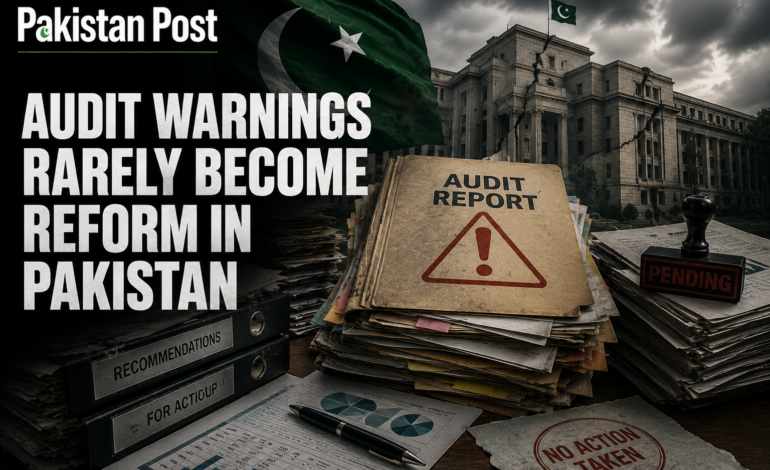
Pakistan does not suffer from a shortage of warnings about public money. It has an extensive institutional machinery for discovering financial irregularities, documenting procurement weaknesses, identifying unauthorised expenditure and exposing administrative failures. The Auditor General of Pakistan continues to produce federal, provincial, sectoral, performance, special and information systems audit reports, while the Public Accounts Committee examines audit observations and issues directions to ministries and departments. The problem is more consequential than detection. Pakistan has struggled to convert the discovery of institutional weakness into a reliable sequence of correction, recovery, managerial accountability and permanent reform. The state can identify a defect without necessarily changing the system that produced it.
That distinction matters because an audit observation is not merely an accounting disagreement. Repeated procurement deviations, unexplained expenditure, weak internal controls, delayed recoveries, noncompetitive contracting, deficient record keeping and ineffective project supervision can become indicators of a deeper administrative condition. When the same type of irregularity appears repeatedly across financial years or institutions, the issue ceases to be an isolated compliance failure. It becomes evidence that the machinery of government has not learned from its own experience.
Pakistan’s audit architecture is therefore confronting a problem of institutional transmission. Information is being generated, but accountability does not always travel with it. An observation may move from an audit team to a Departmental Accounts Committee, from there towards the Public Accounts Committee, and eventually into a directive requiring recovery, explanation or corrective action. Yet the passage from one institutional node to another can be slow, fragmented and dependent on administrative follow up. The existence of an audit trail does not automatically create a reform trail.
The scale and longevity of this problem are visible in the architecture itself. The National Assembly maintains records of Public Accounts Committee reports extending across decades and also publishes implementation material concerning earlier PAC directives. Its current committee structure continues to examine appropriation accounts and audit reports from multiple financial years, including matters dating back many years. This is not evidence that parliamentary oversight is irrelevant. It demonstrates something more important: parliamentary scrutiny can identify and revisit problems, but without a strong closure mechanism the accountability process can accumulate historical liabilities faster than it resolves them.
The Auditor General’s contemporary reporting system is considerably broader than the traditional image of checking vouchers. Its published material includes performance audits, special audits, forensic audits, information systems audits and reports covering public sector enterprises, power, railways, revenue, telecommunications, infrastructure and provincial institutions. The office has also introduced updated project and entity audit templates and publishes an annual audit plan. This expansion is strategically important. Modern public finance cannot be protected merely by asking whether a payment was authorised. The state must know whether the expenditure produced the intended public value, whether procurement created competitive outcomes, whether digital systems prevented manipulation and whether managerial controls remained effective after the contract was awarded.
The central weakness lies between finding and consequence.
An audit observation normally begins as an institutional fact finding exercise. The audited entity receives an opportunity to respond. Departmental mechanisms examine the objection. The matter can then proceed to parliamentary scrutiny. Depending on the nature of the observation, the eventual response may involve clarification, settlement, recovery, disciplinary proceedings, criminal investigation or a change in procedure. These are different remedies, but Pakistan’s administrative system can treat them as if they were interchangeable. A written explanation may resolve an observation procedurally without resolving the underlying weakness. A recovery may restore money without correcting the procurement control that allowed the loss. A disciplinary proceeding may penalise an official without changing a flawed delegation of authority. A PAC directive may demand action without possessing a sufficiently integrated mechanism for tracking whether the institution has actually changed.
This is why the traditional concept of audit compliance is too narrow for Pakistan’s present governance requirements.
The objective should not be to reduce the number of outstanding audit paragraphs merely because an institution wants a cleaner compliance position. The objective should be to reduce the recurrence of the underlying failure. A procurement irregularity should therefore trigger a question beyond recovery: why did the procurement system permit the irregularity? If a project repeatedly incurs cost escalation, the inquiry should not end with identifying the official who approved a disputed payment. It should examine whether project design, contract management, technical certification, financial delegation and monitoring incentives created predictable conditions for escalation.
This requires a closed loop in public accountability.
Every material audit finding should receive a unique institutional identifier that remains attached to it from the moment of detection until formal closure. That identifier should record the nature and financial magnitude of the finding, the responsible principal accounting officer, the relevant department, the proposed remedy, the amount requiring recovery, the legal or administrative route being followed, the deadline for action and the institution responsible for verification. Closure should require evidence, not correspondence.
Such a system would alter the incentive structure of public administration. At present, bureaucratic attention can be disproportionately concentrated on producing a reply to audit rather than eliminating the condition that generated the audit objection. A digital accountability register would make the distinction visible. A department could not simply upload a response and classify a matter as addressed. It would have to demonstrate recovery, corrective action, procedural revision or a formally reasoned finding that no further action was legally warranted.
The Public Finance Management Act already contains building blocks for such an architecture. It preserves the accountability of principal accounting officers even where financial powers are delegated and provides for chief internal auditors under the supervision of principal accounting officers. The legislation also establishes an internal audit policy board responsible for policy, standards, manuals and monitoring the effectiveness of internal audit functions across government institutions. The policy challenge is therefore not to construct an entirely new accountability universe. It is to connect existing institutions so that internal audit, external audit, finance, procurement, departmental management and parliamentary oversight operate as parts of one control system.
The missing connection with budgeting is particularly important.
An audit finding should influence future resource decisions where the underlying institutional weakness remains unresolved. If a ministry repeatedly fails to implement procurement controls, its future procurement authority should be subject to enhanced scrutiny. If a public entity repeatedly accumulates recoverable losses, its financial autonomy and management performance should be reviewed. If a development project repeatedly produces cost overruns because of weak contract management, the approving authority should require strengthened project controls before additional allocations are released.
This does not mean converting the budget into a punitive instrument. It means making public expenditure conditional upon demonstrable institutional learning. A government that discovers a serious control failure but continues to finance the same operating model without modification is effectively treating audit as an archival exercise.
Procurement presents an even stronger case for integration. Pakistan’s procurement system already generates large volumes of documentary information, but procurement compliance should not terminate when a contract is awarded. The audit cycle needs to extend through contract execution, variations, extensions, payments, physical completion, asset utilisation and post completion performance. A contract awarded competitively can still become uneconomic through repeated variations or weak supervision. The relevant accountability question is therefore not simply whether procurement rules were followed at the tender stage, but whether the state received the value promised by the contract.
The same principle should apply to recoveries. Recovery should be treated as a managed financial process rather than a rhetorical instruction. Every recoverable amount should carry a responsible institution, a legally permissible recovery route, a deadline and a status classification. Amounts disputed in court, amounts under departmental inquiry and amounts acknowledged but unpaid should not sit together under a generic label of pending. The state needs to know whether money is genuinely unrecoverable, legally contested, administratively delayed or simply neglected.
The Public Accounts Committee remains indispensable in this architecture, but parliamentary oversight should move towards a stronger implementation function. The National Assembly’s own records show that PAC implementation and monitoring have been recognised as distinct concerns. That distinction should now become operational. PAC proceedings should increasingly be supported by a professional implementation secretariat capable of maintaining a live register of directives, verifying departmental evidence and escalating prolonged noncompliance.
Such a mechanism would also protect the committee from becoming overloaded with matters that can be resolved administratively. Parliament should concentrate its political and constitutional authority on material, systemic and recurrent failures. Routine compliance should be digitally monitored and professionally verified. Matters involving major financial exposure, national infrastructure, strategic procurement, public sector enterprises, revenue leakage, energy losses or repeated institutional failure should receive enhanced parliamentary attention.
For strategic institutions, the principle requires additional caution. Not every audit finding can be managed through indiscriminate public disclosure. Defence procurement, intelligence related expenditure, critical infrastructure, sensitive communications and certain national security programmes may contain information whose publication could compromise operational security. That does not justify immunity from audit. It requires controlled accountability. Sensitive findings can be reviewed through appropriately cleared mechanisms, secure audit channels and restricted parliamentary oversight while preserving financial integrity. National security should protect legitimate secrets, not create a general exemption from fiduciary responsibility.
The distinction between secrecy and opacity is vital for state resilience. A capable security establishment needs reliable financial controls because procurement inefficiency, weak inventory management, inflated costs and poor contract governance eventually become security vulnerabilities. Strategic autonomy is expensive. Waste in strategic expenditure reduces the resources available for actual capability.
Pakistan should also rethink the managerial consequences of recurrent audit failures. Administrative accountability should distinguish between an honest error, a procedural lapse, negligence, deliberate misconduct and structural dysfunction. A system that punishes every technical mistake indiscriminately can produce defensive bureaucracy, delayed decisions and excessive file movement. Conversely, a system that treats persistent control failures as harmless procedural matters creates moral hazard. The answer is calibrated accountability based on evidence, materiality, recurrence, intent and managerial responsibility.
The principal accounting officer should therefore become the central node of institutional response. Delegation can distribute authority, but it should not dissolve responsibility. Where an audit finding reveals a systemic deficiency, the responsible senior management should be required to produce a corrective action plan rather than merely transmit the observation to subordinate officials. The plan should specify changes in controls, timelines, responsible units and measurable indicators.
An independent follow up assessment should then test whether the reform occurred.
This is where Pakistan can make the greatest conceptual shift. Audit should become a source of administrative intelligence. Patterns across thousands of observations could reveal where the state is structurally vulnerable: procurement categories with recurrent anomalies, departments with persistent delays, entities with repeated revenue leakage, projects with chronic cost escalation, systems vulnerable to unauthorised access, or regulations routinely bypassed because they no longer fit operational realities.
The Auditor General’s growing use of specialised audit approaches provides a foundation for such analysis. Its recent publication record includes information systems, forensic, performance and special audits, alongside conventional financial audits. The next step should be analytical aggregation. Instead of treating every observation as an isolated paragraph, the audit system should identify recurring patterns across ministries, provinces, projects and public enterprises.
That would allow the state to move from audit compliance to control intelligence.
A national audit risk dashboard could classify material findings according to financial exposure, recurrence, systemic significance, strategic sensitivity and implementation status. High risk findings would receive accelerated follow up. Recurrent findings would trigger institutional control reviews. Large financial exposures would be linked to the budget process. Procurement related findings would feed into procurement policy. Digital control failures would be communicated to information security authorities. Governance failures in public enterprises would enter ownership and management reviews.
The ultimate measure of audit effectiveness should therefore not be the volume of objections raised. It should be the percentage of material findings that are resolved within defined periods, the amount of public money recovered or protected, the number of systemic controls redesigned, and the recurrence rate of comparable failures.
This would change the political meaning of audit. It would cease to be an annual confrontation between auditors and administrators and become an institutional learning mechanism for the state.
Pakistan’s fiscal constraints make this reform more urgent than ever. A government managing limited fiscal space cannot afford a public sector in which financial warnings accumulate while managerial systems remain unchanged. Every rupee lost through procurement weakness, delayed recovery, poor contract management or ineffective oversight carries an opportunity cost in debt servicing, infrastructure, human development and national security.
The country already possesses many of the necessary institutions. The Auditor General has constitutional standing and an expanding technical mandate. The Public Accounts Committee provides parliamentary scrutiny. Principal accounting officers carry managerial responsibility. The Public Finance Management Act provides for internal audit architecture. Finance and procurement institutions possess substantial administrative data. What remains inadequate is the connective tissue between them.
Pakistan therefore needs an accountability chain that does not terminate when an audit report is published or a committee issues a directive. Detection must produce assignment. Assignment must produce action. Action must produce evidence. Evidence must produce verification. Verification must produce closure or escalation. Where the same failure returns, the state should treat recurrence itself as an accountability event.
That is the difference between an audit system that records the past and an administrative system capable of changing the future. For Pakistan, the strategic objective should not be more audit reports. It should be fewer repeated failures, faster recovery of public resources, stronger managerial controls and institutions capable of learning before the next audit discovers the same weakness again.
A Public Service Message