Pakistan Needs A National System To Authenticate Synthetic Information

The strategic problem posed by synthetic media is no longer whether Pakistan can distinguish an authentic recording from an artificial one. The more consequential question is whether the state, media institutions and society can establish what is credible quickly enough for verification to matter. Artificial intelligence has compressed the production of convincing falsehoods from a specialist operation into an accessible capability. A fabricated voice can now imitate a senior official, a manipulated video can place a military commander at an event that never occurred, and an entirely generated political statement can circulate through thousands of accounts before an institution has even established that the underlying material is false. In a crisis, the speed of fabrication can exceed the speed of institutional verification by an order of magnitude.
For Pakistan, this creates a national resilience problem with direct implications for strategic stability. The country operates in an information environment already characterised by intense political contestation, rapid mobile penetration, encrypted communications, partisan digital ecosystems and a public accustomed to receiving breaking developments through social platforms. A synthetic recording released during a military confrontation, an election, a financial shock or a diplomatic dispute would not need to remain online for long to produce consequences. Screenshots, television broadcasts, private messaging groups and secondary reports can preserve and amplify material even after the original post disappears. The operational challenge is therefore not simply content removal. It is establishing authenticity, communicating the finding with institutional credibility and preventing uncertainty from becoming a policy variable.
This distinction matters for the national security establishment. Conventional information operations have generally been understood through the categories of propaganda, psychological operations, disinformation and influence activity. Synthetic media alters the technical foundation of those activities. It allows an adversary, political actor, criminal network or opportunistic individual to manufacture apparent evidence rather than merely construct a persuasive narrative around genuine events. The evidentiary chain itself becomes contestable. A real photograph can be dismissed as fabricated. A genuine speech can be selectively reconstructed. A nonexistent military movement can be presented through apparently authentic satellite imagery. A fabricated telephone conversation can be attributed to senior officials. Once citizens begin assuming that any inconvenient evidence might be artificial, information disorder becomes more sophisticated than the circulation of false material alone.
Pakistan’s exposure is particularly acute during periods of military tension. A fabricated statement attributed to a defence official could imply an escalation that never occurred. A synthetic video showing an alleged attack could trigger public mobilisation before military authorities have completed their assessment. A forged audio recording could suggest that political or security institutions have reached an undisclosed agreement. During a border incident, the distinction between an authentic battlefield image and an artificially generated scene can become strategically significant. The danger lies not only in believing false information but also in refusing to believe genuine information because synthetic media has weakened confidence in visual and auditory evidence.
The same vulnerability extends to elections. Political competition increasingly takes place through highly personalised digital communication, where emotional immediacy often carries greater influence than documentary verification. A fabricated confession, an artificial speech, an altered campaign video or a synthetic voice attributed to a candidate can circulate within hours. By the time a party, election authority or media organisation establishes the material’s provenance, the political effect may already have been achieved. The objective of an information operation does not necessarily have to be persuasion. It may simply be confusion, voter demoralisation, reputational damage or the creation of competing versions of reality.
Financial markets introduce another dimension. A synthetic announcement apparently issued by the State Bank of Pakistan, the Ministry of Finance, a major commercial bank or a listed corporation could affect currency expectations, equity prices or depositor behaviour before formal clarification reaches the market. False information concerning interest rates, foreign-exchange restrictions, sovereign financing, bank liquidity or a major corporate transaction could produce self-reinforcing reactions. In such circumstances, information authentication becomes part of financial stability architecture. The ability to establish that a statement is fraudulent within minutes may be as important as the technical capacity to remove the original content.
Diplomacy is equally exposed. A fabricated statement attributed to a foreign leader, ambassador or Pakistani official can generate an unnecessary diplomatic response. A synthetic recording could be designed to create the appearance of an insult, threat or policy reversal. During negotiations, plausible fabrications can be used to test reactions, complicate confidence-building measures or provoke public pressure on governments. The strategic value of synthetic media therefore lies partly in its deniability. An adversary does not have to claim responsibility. It can allow competing explanations to circulate while diplomatic institutions absorb the cost.
Pakistan’s existing institutional architecture is not designed around this problem. Cybersecurity capabilities, media regulation, law enforcement, public information structures and intelligence organisations possess different mandates, technical capacities and operating cultures. Newsrooms have developed verification practices, but many remain dependent on manual source checking, reverse-image searches, geolocation and consultation with official contacts. These techniques remain valuable, but they are insufficient against increasingly sophisticated generative systems. A national response cannot therefore be constructed merely by asking journalists to become better at detecting manipulated material.
The country needs an information-authentication capability with a clear division between authentication and censorship. That distinction should be treated as foundational. A system established ostensibly to identify synthetic media could easily become a mechanism for suppressing legitimate criticism, inconvenient reporting or politically contentious material. Such an outcome would damage the very credibility that the system is intended to protect. Authentication should establish provenance and evidentiary confidence, not determine whether a political opinion is acceptable. A journalist must remain free to publish allegations, interpretations and criticism, subject to law, while institutions should possess the technical means to distinguish genuine evidence from fabricated evidence.
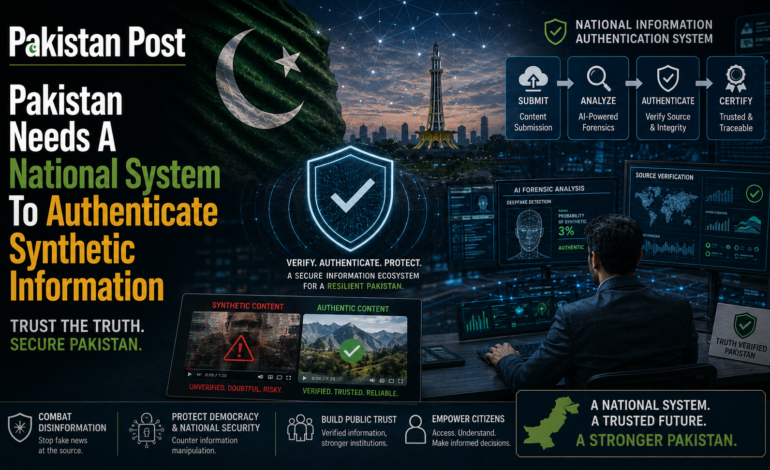
A national protocol could begin with a common evidentiary taxonomy. Material should be categorised according to provenance, technical integrity, corroboration, manipulation indicators and confidence level. A recording could be assessed as verified authentic, probably authentic, unverifiable, probably manipulated or demonstrably synthetic. Such classifications would be more useful than simplistic declarations of “real” or “fake”, particularly when forensic evidence remains incomplete. Authentication should also record what is known about the original file, its metadata, its chain of custody, its publication history and the methods used to examine it.
Digital provenance standards should become part of public-sector communication. Government institutions, military public-affairs structures, election authorities, central financial institutions and diplomatic missions should adopt cryptographically verifiable methods for issuing high-consequence audiovisual material. Official statements, emergency announcements, speeches and critical imagery should carry machine-readable provenance credentials wherever technically feasible. This would not make official information automatically truthful, but it would establish a stronger basis for determining whether a file actually originated from the institution claiming responsibility for it.
News organisations require comparable capabilities. Major television networks, newspapers, digital publications and wire services should maintain dedicated verification desks capable of examining suspicious audiovisual material. Smaller organisations could access a shared national forensic service rather than maintaining expensive laboratories independently. Universities with expertise in computer science, digital forensics, linguistics and media studies could participate through accredited research laboratories. This would create an ecosystem in which verification expertise is distributed rather than concentrated within the government.
Technology companies should be incorporated into the architecture through defined crisis protocols. Platforms possess technical information unavailable to ordinary users, including upload histories, account behaviour, coordinated activity indicators and other signals that can assist authentication. Cooperation should not mean allowing public authorities unrestricted access to private communications or creating a blanket mechanism for content suppression. It should mean establishing legally bounded channels through which credible institutions can request preservation, provenance information, technical assessment and rapid escalation when material presents an immediate risk to public safety or national security.
The state also needs a rapid communication doctrine. Authentication that takes six hours may be technically impressive but strategically inadequate if false material has already shaped public behaviour. During information emergencies, designated institutions should be able to issue preliminary assessments without waiting for every forensic question to be resolved. The language should distinguish certainty from probability. “No evidence supports the authenticity of this recording” is more defensible than prematurely declaring every suspicious file fabricated. Such disciplined communication can prevent official credibility from being damaged by subsequent corrections.
An interagency information emergency cell could provide this function. It should bring together cyber authorities, relevant intelligence and security institutions, public communication officials, election authorities where appropriate, financial regulators during market-sensitive events, media representatives, technical experts and accredited academic specialists. Its mandate should be narrow. It should authenticate information, coordinate factual responses and identify material posing an immediate national risk. It should not become a permanent political monitoring mechanism.
The military dimension deserves particular attention. Pakistan’s strategic environment requires information operations to be considered alongside conventional deterrence, cyber defence and crisis communication. A fabricated military incident can alter perceptions of intent even when no physical action has occurred. The armed forces therefore require standing procedures for rapid authentication of battlefield imagery, command statements and operational claims. Public communication should remain consistent with operational security. The objective is not to disclose sensitive information but to establish enough verifiable fact to prevent fabricated material from filling an information vacuum.
International cooperation will also become unavoidable. Synthetic media frequently crosses jurisdictions, while the technical infrastructure used to generate and distribute it may be located outside Pakistan. Islamabad should therefore develop channels with foreign cyber agencies, technology companies, international fact-checking networks and standards bodies concerned with digital provenance. Cooperation should focus on technical evidence, attribution standards and emergency coordination rather than political alignment over contested narratives.
Pakistan should also invest in detection research, but detection alone should not become the centrepiece of policy. Generative technology will continue to improve, and no detector can be assumed permanently reliable. The stronger strategy is layered verification. Provenance, cryptographic signatures, source authentication, independent corroboration, forensic analysis, behavioural indicators and institutional confirmation should reinforce one another. The principle should be simple: when synthetic systems become capable of manufacturing evidence, societies need systems capable of establishing evidence about evidence.
Legislation should follow this technical architecture rather than precede it blindly. Broad criminalisation of “fake news” risks conflating malicious fabrication with error, satire, political criticism and legitimate journalism. The legal framework should instead concentrate on harmful conduct, including deliberate fabrication intended to cause public disorder, financial manipulation, impersonation of public officials, interference with electoral processes, incitement to violence and malicious exploitation of synthetic identity. Evidentiary standards should remain clear enough to withstand judicial scrutiny.
The establishment should also recognise an uncomfortable strategic reality. Synthetic media will not be used only against the state. Domestic actors may employ it against one another, and institutions may themselves become targets of suspicion. A credible authentication framework must therefore be institutionally neutral enough to survive political transitions. If citizens believe that an authentication verdict simply reflects the preference of whichever government is in office, the system will fail precisely when it is most needed.
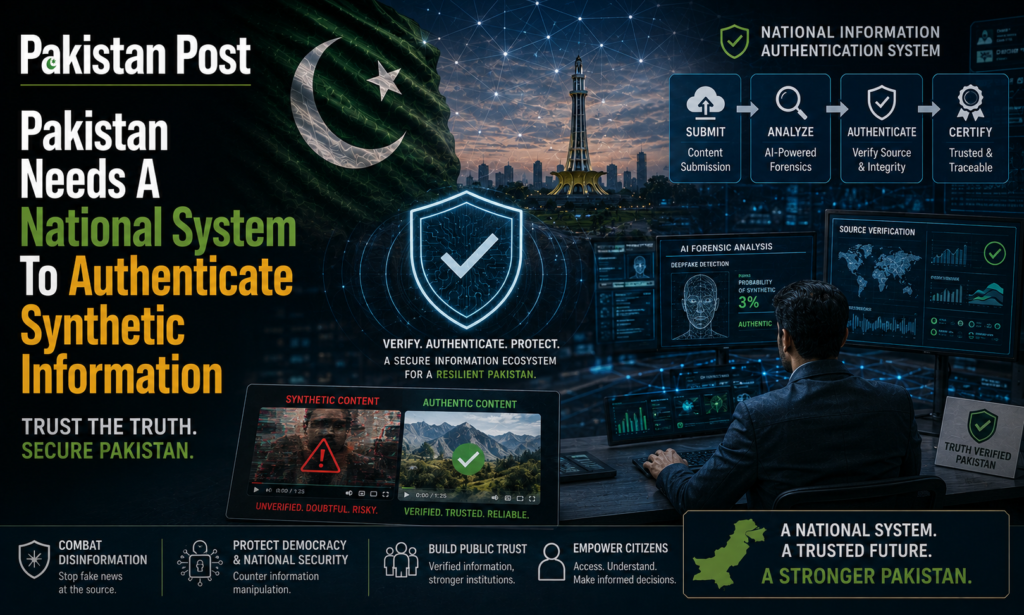
The most effective national protocol would consequently operate on three levels. The first would establish technical provenance and forensic verification. The second would create institutional coordination for rapid assessment. The third would provide transparent public communication capable of explaining why a piece of material has been classified in a particular way. These layers should be supported by independent oversight, documented procedures and auditable decisions.
Pakistan should not wait for a synthetic crisis to discover whether its information institutions can function under pressure. A fabricated military announcement, a forged election recording or an artificial financial statement will eventually test the country’s response architecture. The strategic advantage will belong to the state that can establish facts before uncertainty becomes momentum.
The objective should not be to create an information environment in which citizens trust every official statement. Democratic resilience requires the opposite: citizens should retain the ability to question institutions while possessing reliable mechanisms for determining whether the evidence presented to them is genuine. National security therefore depends not upon controlling information but upon preserving the conditions under which authentic information can compete successfully with manufactured evidence.
For Pakistan, the next stage of information security should consequently move beyond conventional cyber defence. The country needs an institutional capability for evidentiary integrity. Media organisations should have access to forensic expertise. Public institutions should issue verifiable digital communications. Technology platforms should maintain structured emergency channels. Universities should become partners in authentication research. Cyber authorities should coordinate technical assessments. Security institutions should integrate synthetic-media risks into crisis planning. Regulators should protect the distinction between verification and censorship.
The decisive resource in an information emergency will not be the volume of content a state can remove. It will be the speed, credibility and methodological integrity with which it can establish what happened. In an environment where artificial intelligence can manufacture convincing evidence at industrial scale, Pakistan’s strategic resilience will increasingly depend on an institutional capacity to authenticate reality before fabricated reality acquires political consequences.
A Public Service Message