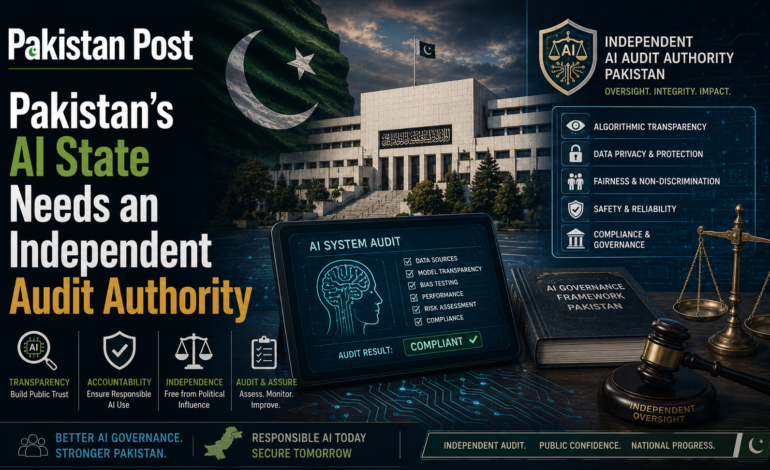
Pakistan’s AI State Needs an Independent Audit Authority


Artificial intelligence is moving from the laboratory into the machinery of the Pakistani state, and the central policy question is no longer whether government should use algorithms. It is who remains accountable when an algorithm influences a tax assessment, flags a financial transaction, identifies a welfare beneficiary, prioritises a police intervention, evaluates an immigration application or determines whether a citizen receives a public service. Pakistan has entered this phase with considerable institutional momentum. The Digital Nation Pakistan Act 2025 established the Pakistan Digital Authority as the apex institution for digital governance, data and AI regulation, while the Islamabad AI Declaration adopted in February 2026 explicitly placed human accountability, sovereignty and responsible AI at the centre of national policy.
That institutional architecture is important, but it leaves a harder question unresolved. An authority that promotes digital transformation cannot automatically be assumed to be the final arbiter of whether the systems being deployed are safe, lawful, accurate or institutionally appropriate. The Pakistani state now needs an algorithmic accountability regime capable of examining the technology before it becomes embedded in administrative decisions. The distinction matters because an erroneous conventional form can usually be corrected by an officer. An automated system can reproduce the same error across hundreds of thousands of citizens before anyone recognises the pattern.
This is where AI governance becomes a matter of state capacity rather than technological fashion. Pakistan’s public administration already operates through extensive databases, identity records, tax information, financial intelligence, education records, social protection registries, policing systems, immigration files and regulatory databases. Artificial intelligence can connect these datasets, identify anomalies and accelerate decisions at a scale that traditional bureaucracy cannot match. It can also amplify weaknesses already present in government data. If historical records contain regional disparities, gender distortions, incomplete registrations, outdated classifications or inconsistent enforcement, an algorithm trained on those records may convert administrative bias into a systematic computational outcome.
The danger is therefore not confined to sophisticated generative AI. A relatively simple risk scoring model can have more consequential effects than an impressive language model if it determines who receives an inspection, who is selected for investigation or whose application is subjected to enhanced scrutiny. The public will rarely know that a decision was algorithmically influenced unless disclosure is mandatory. Officials themselves may not fully understand the statistical model purchased from a contractor, particularly when proprietary software is supplied as a finished product and the underlying training data, feature selection, weighting methodology and error profile remain commercially protected.
That creates an accountability gap. Government cannot outsource responsibility to a vendor merely because the software is privately developed. Nor should a civil servant be permitted to argue that an adverse decision was produced by a machine and therefore cannot be challenged. In a constitutional state, responsibility follows the exercise of public power. The machine may calculate, classify or recommend, but the state remains answerable for the consequence.
Pakistan should therefore establish a public sector Algorithmic Assurance and Audit regime under the broader digital governance architecture. The Pakistan Digital Authority is already positioned to develop national standards and regulatory coordination, and its mandate includes data and AI governance. The missing component is an operational audit mechanism with sufficient technical independence to challenge deploying agencies, vendors and even politically important programmes.
Such an arrangement should not become another bureaucratic clearance layer. Its purpose should be proportionality. Not every algorithm deserves the same regulatory burden. Automated spelling correction in an official document, electricity demand forecasting or routine inventory optimisation presents a fundamentally different risk from an algorithm that recommends whether a citizen should receive social protection, whether a taxpayer should face investigation or whether a person should be subjected to enhanced security screening.
Pakistan should classify government AI applications according to impact rather than technological sophistication. Low risk systems could operate under departmental controls, standard cybersecurity requirements and periodic performance checks. Moderate risk systems should require documented model governance, data quality assessments, procurement safeguards and periodic independent validation. High impact systems should face mandatory pre deployment algorithmic impact assessments, independent technical audits, human review requirements, explainability standards, incident reporting and an enforceable mechanism through which affected citizens can challenge decisions.
The definition of high impact should be deliberately broad enough to capture the state’s coercive and distributive powers. Taxation, policing, criminal justice, immigration, welfare eligibility, employment in public institutions, education admissions, licensing, financial surveillance, credit linked government programmes and national security related screening should receive enhanced scrutiny. A system that can restrict liberty, determine access to essential public benefits, impose financial burdens or materially alter a person’s legal or economic position should not be allowed to operate merely because its procurement file has been approved.
Algorithmic impact assessment should become the equivalent of an environmental impact assessment for digital government. Before deployment, the responsible institution should identify the purpose of the system, the legal authority for its use, the categories of people affected, the datasets involved, the source and provenance of those datasets, foreseeable failure modes, expected accuracy, false positive and false negative rates, cybersecurity vulnerabilities and potential discriminatory effects. The assessment should also establish who owns the model, who operates it, who can modify it, who receives its outputs and who is responsible when the system fails.
Data provenance deserves particular attention. A state algorithm is only as credible as the chain of evidence supporting its inputs. Government agencies should maintain machine readable records showing where critical datasets originated, when they were collected, how they were cleaned, which transformations were applied and which officials or contractors authorised changes. Where datasets are merged, the linkage methodology should be documented. Where historical records are incomplete, that limitation should be recorded rather than concealed behind a numerical output.
This is especially important for Pakistan because public databases have not evolved through a single national architecture. Ministries, provinces, autonomous bodies and law enforcement institutions have historically maintained different systems, standards and administrative practices. The Digital Nation Pakistan Act was designed partly to address precisely this fragmentation by establishing a framework for interoperable digital governance and public infrastructure. But interoperability without governance can turn fragmented information into an integrated mechanism for error propagation. Connecting databases is not equivalent to making their contents reliable.
The same principle applies to procurement. Ministries should no longer purchase AI as an opaque software package whose technical characteristics are effectively determined by the supplier. Public procurement rules should require vendors to disclose model documentation, intended use, training data categories, known limitations, validation results, cybersecurity controls, update procedures and material changes between software versions. Contracts should contain audit rights allowing authorised government auditors to inspect relevant technical documentation and test system behaviour. Where national security or legitimate commercial confidentiality restricts public disclosure, information should still be available to a cleared independent audit authority.
Vendor contracts should also prohibit unilateral model modification in high impact systems without notification and revalidation. An algorithm that performed acceptably during procurement may behave differently after a model update, data refresh or change in threshold settings. Government departments therefore need version control, model registers and immutable audit logs. Every consequential automated recommendation should be traceable to the version of the model, relevant data inputs, decision threshold and human intervention that produced the outcome.
Human oversight must also be more substantive than a ceremonial approval button. A senior official who merely clicks approve on an algorithmically generated recommendation is not exercising meaningful judgment. For high impact decisions, the responsible officer should have authority to question, override and suspend the system. Officers must be trained sufficiently to understand confidence scores, uncertainty, false positives, data limitations and circumstances in which automated recommendations should not be relied upon.
There should also be a statutory right to explanation, calibrated to the nature of the decision. Citizens need not be given proprietary source code, but they should be told when an automated system materially influenced a decision, what general factors were considered, what evidence was relied upon and how the decision can be challenged. The objective is not technological transparency for its own sake. It is administrative justice. A person denied a benefit or subjected to an investigation must have enough information to contest the decision meaningfully.
Appeals should never terminate at the algorithm. A citizen should be able to request human reconsideration, particularly where the consequences are substantial. The reviewing official should have access to the relevant decision record and should not be institutionally compelled to defend the original automated recommendation. Independent review becomes especially important where algorithms affect groups that may already be poorly represented in administrative data.
For policing and national security, the architecture requires additional discipline. AI can improve intelligence fusion, surveillance analysis, anomaly detection and resource allocation, but national security cannot become a blanket exemption from algorithmic accountability. Certain technical details may legitimately remain classified, yet the existence of governance rules, authorised purposes, retention periods, access controls, audit mechanisms and human command responsibility should not be secret. Strategic secrecy and institutional impunity are not the same thing.
The security establishment also has a particular interest in preventing algorithmic dependence. A state that relies heavily on foreign models, cloud infrastructure, proprietary chips or external data services may acquire efficiency while simultaneously creating strategic exposure. AI procurement should therefore distinguish between commercial convenience and sovereign capability. Critical applications should be evaluated for supply chain dependence, foreign jurisdiction exposure, data exfiltration risks, model availability during geopolitical disruption and the possibility of vendor lock in. Pakistan’s own AI policy architecture has already emphasised sovereignty and domestic capability, making algorithmic assurance a natural extension of that strategic position
The audit institution itself should therefore possess a hybrid composition. It should combine machine learning specialists, statisticians, cybersecurity professionals, procurement experts, administrative lawyers, data protection specialists and officials familiar with national security requirements. Its mandate should include technical validation, institutional audit and post deployment monitoring. It should be empowered to order remediation, require additional safeguards and, where a high impact system presents unacceptable risk, recommend suspension.
Parliamentary oversight should complement technical regulation. An annual public sector AI register should disclose which ministries use high impact automated systems, the purpose of each system, the responsible institution, broad categories of data involved, audit status and whether material incidents have occurred. Sensitive national security applications could be reported through an appropriate classified oversight mechanism. This would create a national inventory of algorithmic power rather than allowing hundreds of disconnected deployments to develop beyond institutional visibility.
Independent evaluation should continue after deployment. Accuracy at launch is not sufficient. Population behaviour changes, datasets drift, government policies evolve and models degrade. A system that initially produces acceptable outcomes can develop systematic errors as the underlying population changes. High impact systems should therefore undergo periodic revalidation, with performance measured separately across relevant geographic, demographic and socioeconomic groups where lawful and statistically appropriate.
Pakistan should also establish an algorithmic incident reporting system. If an automated system produces a significant wrongful classification, exposes sensitive data, generates systematic discriminatory outcomes or materially disrupts public services, the incident should be recorded, investigated and corrected. Lessons should feed back into procurement standards so that failures in one department become institutional learning rather than isolated administrative embarrassment.
The international direction is already clear. The United States National Institute of Standards and Technology has developed the AI Risk Management Framework around governance, mapping, measurement and management, with an emphasis on operationalising trustworthy AI throughout its lifecycle. (NIST) Pakistan does not need to reproduce foreign regulatory models mechanically. It should adapt the underlying discipline to its own constitutional structure, administrative capacity, security environment and development priorities.
The central principle should be simple. AI must remain an instrument of government rather than becoming an unaccountable layer of government. Automation can reduce discretion, but it can also conceal discretion inside data selection, model design, threshold setting and procurement decisions. The state must therefore govern not only the final decision but the entire chain through which an algorithm acquires authority.
For policymakers, the immediate task is not to slow digital transformation. It is to prevent transformation from outrunning accountability. Pakistan’s digital state is already acquiring the institutional foundations to coordinate data and AI governance. The Digital Nation Pakistan Act created the legal architecture, the Pakistan Digital Authority has assumed a central supervisory role, and the Islamabad AI Declaration has placed human accountability within the country’s formal AI position. The next step should be an enforceable assurance layer that determines which systems can be deployed, under what conditions and with whose responsibility.
The most consequential question will ultimately be less technical than constitutional. When a machine recommends that a citizen should pay more tax, receive less assistance, face greater scrutiny or lose access to a public service, who answers for the decision? Pakistan should ensure that the answer is never the machine, never the vendor and never an anonymous database. It must remain a clearly identified public authority operating within law, subject to audit, capable of correction and ultimately accountable to the state institutions whose legitimacy it exercises.
That is the foundation of a credible AI state. Efficiency may justify automation, but only accountability can justify authority.
A Public Service Message