Pakistan’s Youth Employment Gap Is Becoming a Strategic Risk

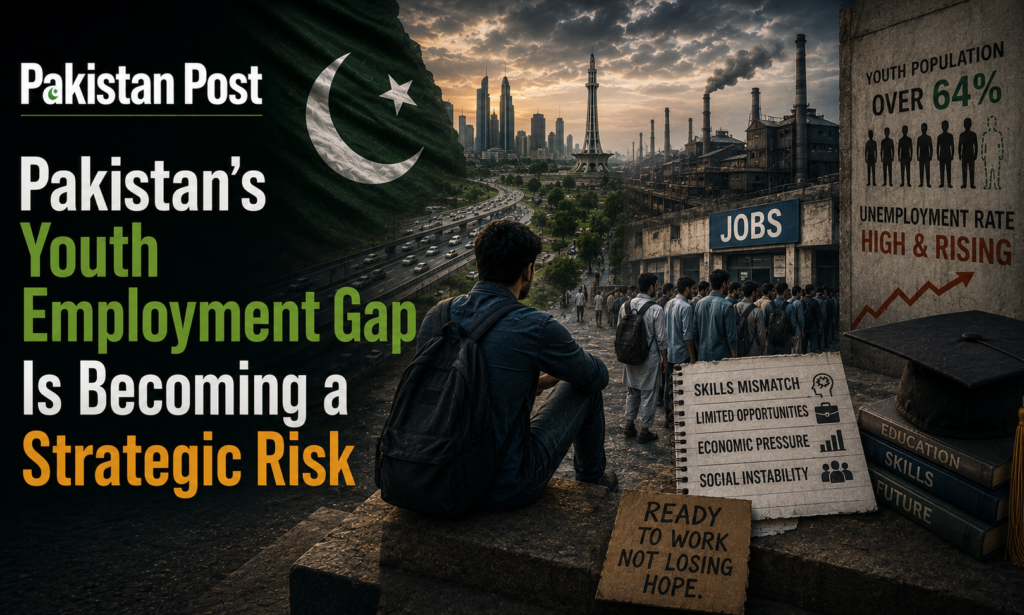
Pakistan’s demographic structure is creating an economic opportunity that the labour market is not yet equipped to absorb. A large and growing working age population should, under normal circumstances, enlarge the productive base, deepen domestic demand, strengthen household incomes and expand the taxpaying middle class. Instead, the country is confronting a more complicated proposition. Economic activity is producing work, but too much of that work remains informal, insecure, low productivity or disconnected from the technological capabilities required by an increasingly digital economy. The central policy problem is therefore not simply unemployment. It is the quality, durability and strategic relevance of employment being generated for a generation entering adulthood with expectations shaped by global labour markets.
This distinction matters for economic management and national stability. A young population becomes an asset only when education, skills, capital formation and employment institutions move sufficiently quickly to convert demographic expansion into productive capacity. Where that conversion fails, demographic strength can become a fiscal, social and security liability. Young people who remain outside stable employment for prolonged periods do not merely lose income. They accumulate weaker professional experience, become less attached to formal institutions, delay household formation, seek migration opportunities or move into precarious economic activities that provide immediate income without creating durable human capital.
Pakistan’s employment challenge is particularly difficult because headline economic growth can conceal substantial labour market fragility. Agriculture still absorbs a large share of workers despite relatively low productivity. Industry has not expanded with the consistency required to provide mass formal employment. Services are growing, but much of the expansion is concentrated in retail, transport, personal services, construction and other activities where informality remains pervasive. Digital platforms have opened new avenues for earning, yet platform work frequently operates without predictable incomes, social insurance, collective representation or a clear pathway towards professional advancement. The result is an economy capable of generating livelihoods without generating enough careers.
That distinction should become central to employment policy. A job that produces income for a few months cannot automatically be treated as equivalent to a stable position that develops skills, creates pension or insurance rights and increases future earning capacity. Public employment programmes often report beneficiaries trained, participants enrolled or individuals placed into short term opportunities. Such indicators may demonstrate administrative activity without establishing whether the intervention changed a person’s economic trajectory. The relevant question for policymakers is what happened six, twelve and twenty four months after training. Did the participant secure employment? Did earnings rise? Did the person remain employed? Did the acquired skill correspond to an employer requirement? Did the employer consider the certification credible?
Without these measurements, employment policy risks becoming an accounting exercise in which expenditure and enrolment are easier to demonstrate than economic transformation.
The education system presents a parallel problem. Pakistan has expanded university access considerably, but the labour market has not expanded professional occupations at a comparable pace. Graduates therefore enter an economy in which credentials can exceed occupational demand. Employers frequently report difficulty finding workers with practical technical capabilities, communication skills, digital competence, problem solving capacity and workplace discipline, while graduates complain that available vacancies do not match their qualifications. Both positions can be simultaneously correct. The problem is not necessarily that universities produce too many graduates. It is that the education system and productive economy are operating with insufficient information exchange.
A national employment framework should therefore begin with labour demand rather than training supply. Public authorities should identify occupations where domestic employers are demonstrably unable to recruit adequate numbers of qualified workers and where future investment is expected to create sustained demand. These could include advanced manufacturing, information technology, software services, logistics, renewable energy, precision agriculture, construction technologies, healthcare support, industrial maintenance, financial technology and selected export oriented services. The list should not become another bureaucratic catalogue. It should be continuously revised through employer vacancies, wage movements, investment announcements, export data, occupational forecasts and regional industrial requirements.
Such a system would change the purpose of vocational education. Training institutions would no longer be rewarded primarily for filling classrooms. Their performance would depend increasingly on employment outcomes. Certification should be employer linked, competency based and portable across provinces. An individual trained in industrial electrical maintenance, for example, should possess a credential whose value is recognisable to employers beyond the institution that issued it. Pakistan needs a labour market in which skills can travel with workers.
The state also needs better intelligence on where jobs are emerging. Employment demand is not evenly distributed across the country. Industrial clusters, ports, technology centres, agricultural processing zones, construction corridors and urban service economies generate different occupational requirements. A centralised policy designed around national averages can therefore misallocate resources. Provincial and district level employment observatories could combine data from employers, universities, technical training providers, chambers of commerce, tax authorities and labour departments to identify local shortages and future demand.
This would also address a longstanding weakness in public investment. Governments frequently announce employment initiatives after budgets have been allocated, rather than designing programmes around clearly demonstrated economic demand. A more credible approach would reverse the sequence. Employers should articulate occupational requirements, public agencies should determine where training capacity is missing, and funding should follow verified demand. Training providers that repeatedly produce graduates who cannot secure relevant employment should lose preferential access to public financing.
Female employment requires a particularly different policy response. Pakistan cannot fully exploit its demographic potential while a substantial portion of its educated female population remains outside paid economic activity. The constraint is not merely the availability of vacancies. Transport insecurity, workplace harassment, inadequate childcare, social expectations, weak enforcement of labour protections and the concentration of jobs far from residential areas all affect participation. Digital work can reduce some geographical barriers, but home based employment should not become a euphemism for poorly paid and unprotected labour.
A serious female employment strategy should therefore combine safe mobility, childcare infrastructure, workplace enforcement, flexible working arrangements and digital access. Public procurement and corporate reporting can be used to encourage employers to disclose female recruitment, retention and advancement rates. The objective should not be to produce impressive participation statistics without examining job quality. A woman moving from unpaid domestic work into an unstable, underpaid activity without social protection has experienced an economic change, but not necessarily the kind of structural transformation policymakers should celebrate.
Overseas migration complicates the picture further. Pakistan’s workers have long used international labour markets as an economic outlet, and remittances provide essential foreign exchange. Yet migration policy remains too often focused on documentation and worker deployment rather than national skills strategy. Pakistan should identify occupations with persistent demand in Gulf, European and Asian markets and align domestic certification with internationally recognised standards. Language preparation, occupational licensing, digital credentials and verified recruitment channels could increase worker bargaining power and reduce dependence on intermediaries.
The strategic objective should not be to discourage migration. It should be to convert migration into a higher productivity national asset. A worker leaving Pakistan with an internationally recognised technical qualification and several years of experience can generate substantially greater household income and potentially return with capital, expertise and international networks. A worker leaving through an informal recruitment channel for low skilled employment remains vulnerable to exploitation and contributes less to long term human capital accumulation.
The expansion of platform based work requires equally careful treatment. Ride hailing, delivery services, online freelancing and digital marketplaces have demonstrated that young Pakistanis can enter income generating activities with limited formal infrastructure. This flexibility is valuable, particularly where conventional employers are unable to absorb new entrants. Yet the platform economy cannot become a statistical refuge for underemployment. Counting every registered driver, rider or freelancer as an employed worker can obscure unstable hours, fluctuating earnings and the absence of social insurance.
Pakistan should develop a basic social protection architecture for platform workers without destroying the flexibility that makes such work attractive. Portable accident coverage, contributory pensions, transparent algorithmic rules, dispute resolution mechanisms and simplified tax registration could provide a foundation. Digital workers should also be able to build portable records of verified skills, completed assignments and professional experience. A credible digital work identity could gradually transform fragmented gig activity into a recognisable employment history.
Technology itself should become part of the employment infrastructure. Pakistan requires a national digital employment platform that does more than advertise vacancies. It should connect educational records, verified skills, occupational certifications, vacancies, apprenticeships, internships and migration opportunities while protecting personal data. Artificial intelligence could assist with occupational matching, but automated systems should not become opaque gatekeepers. Human oversight, auditable criteria and grievance mechanisms would be necessary where employment decisions affect livelihoods.
Such infrastructure could also help address a persistent information deficit. Policymakers currently have incomplete visibility over transitions from education into work. A graduate may move through university, internships, informal employment, migration preparation and multiple short term jobs without appearing in a coherent national employment dataset. An integrated system could track transitions while preserving appropriate privacy protections. Success would then be measurable in terms of sustained employment, earnings progression and occupational mobility rather than participation alone.
The fiscal implications are significant. Employment policy cannot be treated as a collection of disconnected youth schemes financed through annual allocations. Repeated training programmes without outcome measurement generate expenditure without sufficient institutional learning. Public financing should increasingly be linked to verified results, including sustained employment, wage progression, employer satisfaction and retention. Independent evaluation should be routine rather than exceptional.
There is also a security dimension that deserves greater attention. Persistent economic exclusion among young people does not automatically translate into political instability or criminality, and policymakers should avoid simplistic assumptions. Yet prolonged underemployment can increase susceptibility to illicit economies, extremist recruitment, political manipulation and irregular migration when legitimate pathways to advancement appear inaccessible. Employment policy therefore belongs within the broader architecture of national resilience. Economic inclusion strengthens the legitimacy of institutions by giving citizens a tangible stake in lawful economic activity.
The establishment’s strategic interest should consequently extend beyond conventional labour statistics. A resilient employment system improves social stability, expands the formal tax base, strengthens human capital, reduces vulnerability to illicit networks and improves Pakistan’s ability to compete for international investment. Defence and national security planning increasingly depend on technological capabilities that are developed within civilian ecosystems. Cybersecurity, artificial intelligence, aerospace engineering, telecommunications, advanced manufacturing and data science cannot be sustained exclusively through state institutions. They require a broad national pool of technically competent workers.
This is where employment policy intersects with industrial policy. Investors do not merely seek tax concessions or inexpensive labour. They seek reliable electricity, predictable regulation, logistics, skilled technicians, engineers, software professionals and managers capable of operating complex production systems. If Pakistan wants to attract higher value investment, it must demonstrate that the labour market can supply the capabilities those industries require. Employment policy should therefore be incorporated into investment promotion rather than treated as a separate social sector.
A national employment framework should ultimately establish a small number of measurable outcomes. The proportion of young people moving from education into relevant employment should be tracked. Employer verified certification should replace attendance based training indicators. Employment retention after six and twelve months should become a core performance measure. Wage progression should be monitored. Female participation should be assessed alongside job quality and retention. Overseas workers should be classified according to occupational skill and destination demand. Platform workers should be visible within labour statistics without being artificially equated with conventional full time employment.
Pakistan does not have the luxury of treating its youth bulge as a demographic statistic. The coming decade will determine whether a large working age population becomes a source of productivity and state capacity or an accumulation of unrealised economic potential. The policy choice is not between government employment and private employment, nor between university education and vocational training. The real choice is between a fragmented system that measures activity and an integrated system that measures economic transitions.
The country needs an employment architecture capable of seeing the entire journey from classroom to workplace, from informal activity to formalisation, from domestic skills to international certification and from temporary income to sustainable productivity. That requires labour market intelligence, employer participation, portable credentials, digital infrastructure, targeted female employment measures, disciplined migration policy and rigorous evaluation of public programmes. Above all, it requires government to stop treating employment as the residual outcome of economic growth.
Growth that produces too few productive jobs will eventually confront the limits of its own social legitimacy. Pakistan’s demographic opportunity can still be converted into an economic advantage, but only if employment becomes a measurable national capability rather than a hopeful byproduct of expansion. The decisive test will not be how many young people enter training centres or register on employment portals. It will be how many emerge with durable skills, credible incomes, productive careers and a reason to believe that the formal economy has a place for them.
A Public Service Message