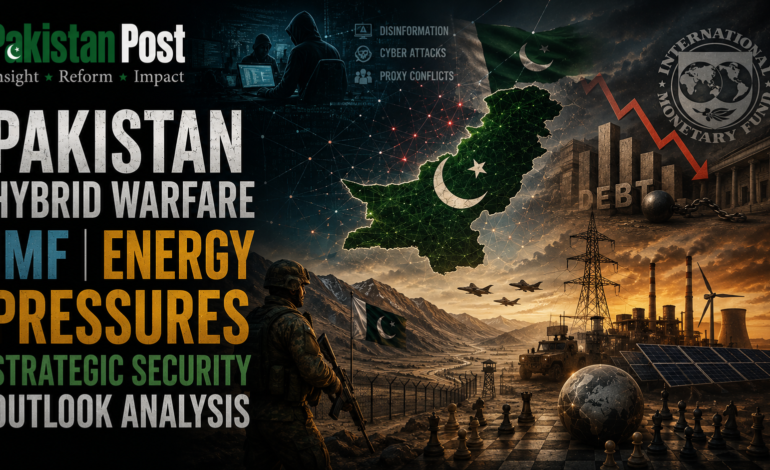
Pakistan Hybrid Warfare IMF Energy Pressures Strategic Security Outlook Analysis

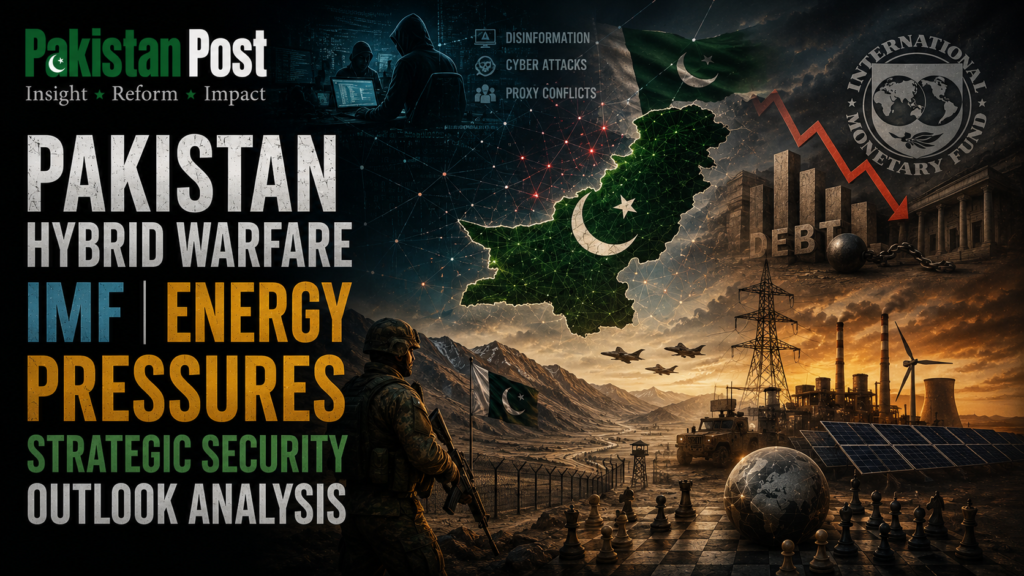
In the contemporary global order, the distinction between economic governance and strategic security has begun to dissolve into a single continuum of coercion, compliance, and contestation. For Pakistan, this convergence is not an abstract theoretical proposition but a lived structural condition, where fiscal negotiations with multilateral institutions, particularly the International Monetary Fund, intersect with escalating regional security pressures and an increasingly complex hybrid warfare environment. What once existed as separate domains of finance, diplomacy, and defence is now an integrated theatre of influence, where policy instruments such as energy taxation, subsidy withdrawal, carbon-linked fiscal adjustments, and tariff rationalisation are not merely economic choices but components of a broader geopolitical architecture.
The current phase of IMF engagement, shaped by recurrent balance of payment crises, has placed Pakistan within a framework of conditionalities that extend deeply into domestic energy pricing structures. Energy taxation, fuel adjustment levies, and electricity tariff restructuring are framed within macroeconomic stabilisation logic, yet their strategic implications are far more extensive. These measures are increasingly aligned with global climate governance regimes, including UN-linked sustainability agendas that encourage carbon pricing mechanisms and fossil fuel subsidy rationalisation. While presented as technical fiscal corrections, they effectively restructure the political economy of energy consumption, industrial competitiveness, and household welfare.
The hidden risk lies not in the existence of reform itself, but in its asymmetric absorption within an already strained socio-economic system. Energy taxation, when implemented in a fragile demand environment, becomes a multiplier of inflationary pressure, industrial slowdown, and public discontent. In Pakistan’s case, where energy dependency is structurally high and the elasticity of substitution remains low, such fiscal tightening generates second-order effects that extend into governance stability and internal cohesion. These effects are often under-acknowledged within technocratic frameworks that prioritise macro indicators over socio-political absorption capacity.
Simultaneously, Pakistan’s strategic environment is increasingly defined by hybrid threat vectors that operate across informational, economic, and psychological domains. Traditional military deterrence remains relevant along both eastern and western borders, yet the operational grammar of conflict has expanded into digital influence operations, narrative engineering, economic leverage, and institutional fatigue. Hybrid warfare no longer requires kinetic escalation; it requires the gradual erosion of trust in state capacity, policy coherence, and institutional legitimacy. In this environment, economic adjustment programs, when externally negotiated and domestically unpopular, become vulnerable to narrative weaponisation.
The convergence of IMF-driven fiscal restructuring and hybrid information operations creates a sensitive vulnerability corridor. External and internal actors can frame energy price adjustments not as macroeconomic necessities but as evidence of sovereignty erosion or governance failure. In digitally saturated societies, such framing does not require empirical depth; it requires emotional resonance. Consequently, economic policy becomes a narrative battleground, where legitimacy is contested as intensely as liquidity.
At the same time, global energy transitions advocated under climate governance frameworks introduce additional layers of complexity. The push toward carbon taxation, emissions regulation, and fossil fuel disincentivisation is structurally aligned with long-term environmental objectives, yet for developing economies with limited renewable infrastructure, these measures impose transitional shocks. Pakistan finds itself in a position where compliance with global environmental regimes is economically desirable in the long run but structurally disruptive in the short term. This temporal mismatch generates what may be described as a transition vulnerability gap.
Within this gap, strategic risks accumulate quietly. Industrial competitiveness declines under rising input costs. Export sectors face margin compression. Household energy insecurity increases reliance on informal coping mechanisms. Fiscal space remains constrained due to debt servicing obligations. These dynamics do not manifest as immediate crises but as cumulative stressors that gradually weaken state capacity. The danger lies precisely in their incremental nature, which resists conventional crisis detection frameworks.
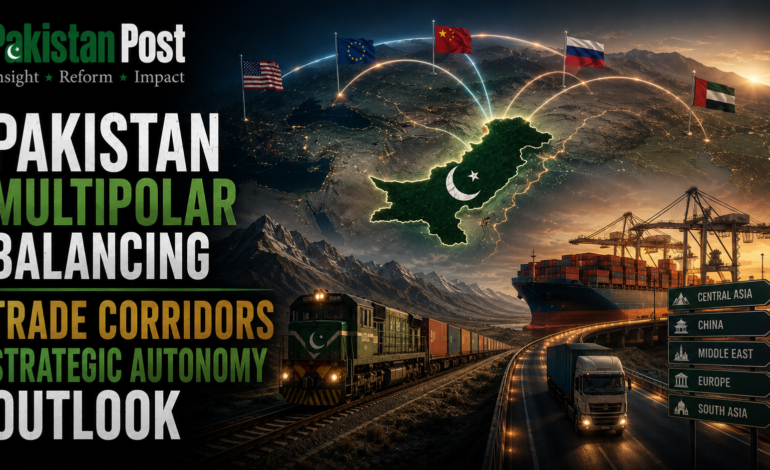
Moreover, the intersection of energy taxation and social stability cannot be analytically separated from Pakistan’s broader geopolitical positioning. In a multipolar world where economic corridors, infrastructure financing, and trade routes are instruments of strategic influence, energy pricing becomes indirectly linked to external alignment pressures. Investment inflows, particularly in energy and infrastructure sectors, are often contingent upon regulatory predictability and tariff rationalisation. Thus, domestic energy policy becomes embedded within external strategic expectations, further narrowing policy autonomy.
The hidden strategic risk is therefore dual layered. On one level, Pakistan faces fiscal compulsion through multilateral engagement that necessitates energy sector reform. On another level, it faces narrative contestation through hybrid influence operations that exploit the socio-political consequences of those reforms. The interaction of these two layers produces a condition of constrained sovereignty, where policy space exists but is continuously negotiated under external and internal pressures.
In such a context, the adequacy of traditional security paradigms becomes increasingly questionable. Security cannot be confined to border integrity or military readiness alone. It must now encompass economic resilience, fiscal sovereignty, information integrity, and institutional credibility. The concept of national security is being quietly redefined from territorial defence to systemic stability under conditions of persistent external pressure.
Pakistan’s strategic establishment is thus confronted with a multidimensional challenge. The first dimension is fiscal realism, which requires engagement with IMF frameworks and global financial institutions to stabilise macroeconomic indicators. The second dimension is social resilience, which requires managing the domestic impact of energy pricing reforms without triggering systemic discontent. The third dimension is informational sovereignty, which requires countering narrative distortions that may emerge from both external actors and internal political contestation. The fourth dimension is geopolitical balance, which requires maintaining diversified partnerships in a fragmented global order.
These dimensions do not operate sequentially; they operate simultaneously. This simultaneity is what defines the contemporary strategic condition.
Within this environment, policy responses must move beyond reactive stabilisation toward anticipatory resilience. Energy taxation frameworks, for example, cannot be implemented solely as revenue instruments. They must be embedded within a broader social protection architecture that cushions vulnerable populations and prevents economic adjustment from translating into political volatility. Similarly, IMF conditionalities must be negotiated not merely in terms of fiscal targets but in terms of implementation sequencing that accounts for domestic absorption capacity.
There is also a need to recognise that hybrid warfare does not only target military or political institutions; it targets economic policy credibility. When energy prices rise, the informational ecosystem often becomes the first site of contestation. In such scenarios, delayed or fragmented communication from state institutions can exacerbate perception gaps, allowing misinformation to fill the narrative vacuum. Strategic communication, therefore, is not a secondary function but a core element of economic governance.
At the institutional level, Pakistan requires an integrated analytical mechanism that links fiscal policy design with security impact assessment. Energy taxation decisions should be evaluated not only through macroeconomic models but also through socio-political risk matrices and narrative vulnerability assessments. This requires cross-sector coordination between finance authorities, energy regulators, security institutions, and communication agencies.
Another hidden risk lies in the temporal mismatch between reform benefits and political cycles. IMF-supported reforms often yield macroeconomic stabilisation in the medium term, yet their costs are immediate and visible. This asymmetry creates political pressure that can destabilise reform continuity. Without institutional mechanisms that ensure policy consistency beyond electoral or administrative cycles, reform fatigue becomes inevitable.
The global context further complicates this equation. As major economies increasingly adopt protectionist energy policies and climate-linked trade barriers, developing states face a tightening external environment. Carbon border adjustment mechanisms and green compliance requirements may gradually function as non-tariff barriers affecting export competitiveness. For Pakistan, this implies that energy taxation is not merely a domestic fiscal issue but a determinant of external market access.
In strategic terms, the fusion of economic conditionality, climate governance, and hybrid informational pressure represents a new form of structural influence. It does not rely on direct coercion but on system-level constraints that shape policy options from within. The challenge for Pakistan is not to resist these forces in isolation but to adapt to them while preserving internal stability and strategic autonomy.
The policy trajectory therefore must rest on three interlinked imperatives. First, sequencing of energy reforms must be calibrated to avoid systemic shock. Second, communication strategy must be proactive, transparent, and institutionally coordinated to prevent narrative exploitation. Third, economic diversification must be accelerated to reduce structural dependency on energy-intensive growth models.
Ultimately, the central question is not whether Pakistan should engage with IMF frameworks or global energy transitions, but how it can do so without compromising internal cohesion and strategic autonomy. The answer lies in recognising that in the current global environment, economic policy is no longer neutral. It is strategic by design, contested by default, and consequential by nature.
In this evolving landscape, the most significant risks are not always visible in fiscal reports or security briefings. They reside in the interstices between economic adjustment and social perception, between global compliance and domestic legitimacy, and between technical reform and narrative interpretation. It is within these interstices that modern statecraft will be tested most severely.
A Publlic Service Message