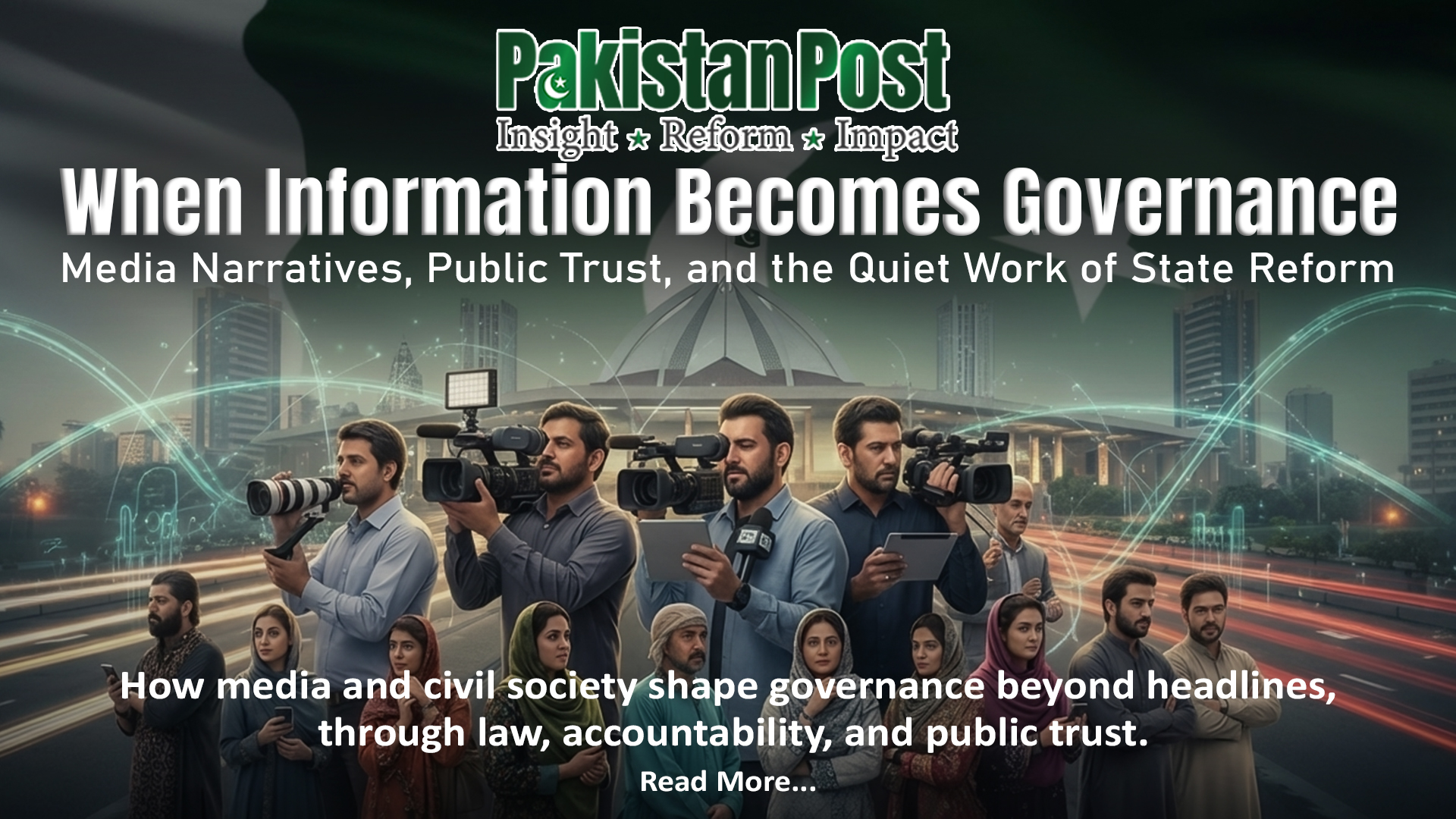

Governance Journalism Beyond Pakistan’s Political News Cycle


Pakistan’s media landscape has entered a period of profound institutional transition. The country’s news organisations have expanded their technological capabilities, accelerated digital publishing cycles and diversified multimedia distribution, yet one structural characteristic continues to dominate editorial priorities. Political confrontation remains the principal currency of daily news production, frequently eclipsing sustained examination of governance performance, institutional effectiveness and public policy outcomes. Parliamentary exchanges, party rivalries, judicial hearings involving political figures, cabinet speculation and electoral calculations routinely receive continuous coverage, while equally consequential developments in education standards, fiscal administration, agricultural productivity, healthcare delivery, environmental resilience and municipal governance often appear intermittently before disappearing from editorial attention.
This imbalance reflects neither editorial negligence nor public indifference alone. Rather, it represents the cumulative consequence of commercial incentives, newsroom routines, audience measurement systems, ownership structures and competitive pressures that collectively reward immediate political conflict over slower institutional reporting. Pakistan’s democratic evolution increasingly depends not merely upon political transparency but upon governance transparency. Citizens require continuous understanding of how public institutions perform, how national resources are allocated, whether reforms produce measurable outcomes and which administrative decisions shape economic and social development beyond electoral cycles.
The distinction between political journalism and governance journalism deserves careful consideration. Political journalism primarily examines competition for authority. Governance journalism evaluates the exercise of authority after power has been obtained. Democracies require both functions, yet imbalance between them can distort public understanding. A government should neither be judged exclusively through political popularity nor insulated from institutional scrutiny. Its effectiveness ultimately depends upon administrative competence, fiscal discipline, implementation capacity and measurable public outcomes rather than rhetorical confrontation.
Pakistan’s contemporary media economy naturally favours stories possessing immediate emotional intensity. Political disputes generate predictable audience engagement because personalities simplify complex issues into recognisable narratives. Television debates benefit from confrontation. Digital platforms reward rapid reactions. Social media algorithms amplify controversy more efficiently than detailed analysis of procurement reforms or irrigation management. Consequently, editorial planning frequently privileges political spectacle because commercial metrics reward audience retention measured in minutes rather than institutional understanding accumulated across months.
Governance reporting, by contrast, demands sustained investment. It requires specialised reporters capable of interpreting budget documents, procurement regulations, healthcare indicators, educational assessments, environmental datasets, judicial performance statistics and regulatory frameworks. Such expertise develops gradually and rarely produces immediate commercial returns. Many news organisations consequently assign governance responsibilities to general assignment reporters already covering multiple unrelated beats, reducing opportunities for continuous institutional scrutiny.
The implications extend well beyond journalism itself. Governments increasingly operate through complex administrative systems where implementation quality determines national performance. Ministries formulate policies whose consequences emerge over several years rather than several news cycles. Infrastructure projects, tax reforms, digital governance initiatives, agricultural modernisation programmes, industrial policies and climate adaptation strategies require persistent observation if citizens are to understand whether announced objectives translate into measurable improvements.
Pakistan’s fiscal environment illustrates this challenge vividly. Annual budgets receive intense coverage during presentation week. Political reactions dominate headlines. Parliamentary speeches occupy extensive broadcast time. Yet systematic reporting examining expenditure efficiency, project completion rates, procurement integrity, provincial implementation capacity or medium-term fiscal sustainability often diminishes rapidly after budget approval. Consequently, public understanding remains concentrated upon announcements rather than outcomes.
Education presents a similar pattern. Examination controversies occasionally attract substantial attention, while deeper reporting evaluating classroom quality, teacher development, curriculum implementation, learning outcomes, technological integration or provincial education reforms receives comparatively limited continuity. Public discourse therefore risks confusing episodic events with structural performance. Governance journalism would instead examine whether policy interventions improve literacy, reduce educational disparities and enhance institutional capacity over successive years.
Healthcare demonstrates comparable editorial tendencies. Disease outbreaks naturally command headlines because immediate risks demand public attention. Yet hospital administration, preventive healthcare, pharmaceutical regulation, workforce planning, procurement transparency and digital health infrastructure frequently remain outside sustained editorial focus despite their long-term significance for national resilience. Public accountability becomes reactive rather than preventive.
Agriculture occupies an equally strategic position within Pakistan’s economic architecture. Harvest forecasts occasionally appear during seasonal reporting, yet continuous examination of irrigation efficiency, seed innovation, storage infrastructure, climate adaptation, agricultural financing, extension services and export competitiveness rarely receives equivalent prominence. Considering agriculture’s contribution to employment, food security and export potential, limited specialised reporting constrains informed policy debate.
Judicial administration represents another institution where governance journalism could substantially enhance public understanding. High-profile constitutional proceedings understandably dominate headlines, yet broader questions concerning case backlogs, procedural efficiency, technological modernisation, lower court capacity, legal aid accessibility and administrative reforms receive less systematic examination. Effective judicial governance encompasses far more than constitutional litigation alone.
Environmental governance increasingly illustrates why institutional reporting cannot remain peripheral. Pakistan confronts water stress, urban pollution, biodiversity loss, climate vulnerability and disaster preparedness challenges requiring continuous monitoring rather than episodic coverage following emergencies. Reporting focused exclusively upon catastrophic floods or extreme weather overlooks the administrative systems responsible for mitigation, planning and resilience. Governance journalism instead evaluates preparedness before crises emerge rather than merely documenting consequences afterward.
The newsroom structures influencing these editorial outcomes deserve equally rigorous examination. Many editorial meetings continue prioritising stories according to immediate political developments because predictable political calendars facilitate resource allocation. Reporters covering ministries frequently become consumed by political briefings rather than policy implementation. Investigative units remain relatively limited. Data journalism capabilities continue developing but often lack institutional integration across editorial departments. Specialist correspondents covering public finance, regulatory institutions, science policy or administrative reform remain comparatively scarce.
Commercial realities reinforce these tendencies. Advertising revenues increasingly depend upon digital traffic, audience engagement metrics and social media visibility. Political controversy consistently generates higher immediate interaction than analytical reporting examining procurement reforms or statistical performance indicators. Editors therefore encounter genuine commercial dilemmas rather than merely editorial preferences. Nevertheless, international experience demonstrates that sophisticated governance journalism need not sacrifice audience engagement when presented through compelling narratives supported by accessible evidence.
Successful international news organisations have gradually expanded investigative public policy reporting by integrating multidisciplinary expertise into editorial planning. Data analysts collaborate with reporters. Economists contribute contextual interpretation. Legal specialists evaluate regulatory implications. Visual journalism transforms statistical complexity into accessible formats. Interactive databases enable readers to examine institutional performance independently. Long-form investigations coexist alongside rapid news updates rather than replacing them.
Several internationally recognised investigative and public interest reporting models have demonstrated that audiences respond positively when institutional reporting connects policy decisions directly with everyday experience. Healthcare budgets become meaningful when linked to hospital outcomes. Educational expenditure becomes compelling when connected with classroom performance. Infrastructure investment gains relevance through measurable transport efficiency rather than ceremonial inaugurations. Governance journalism succeeds when administrative decisions become understandable human narratives supported by empirical evidence.
Pakistan possesses substantial institutional foundations upon which similar transformation could develop. Universities produce economists, statisticians, public policy specialists, environmental scientists, legal scholars and governance researchers capable of contributing specialised expertise. Think tanks generate policy analysis. Government agencies increasingly publish digital datasets. Provincial administrations release performance indicators. International development institutions support statistical capacity. Greater collaboration between news organisations and analytical communities could significantly strengthen evidence-based reporting without compromising editorial independence.
Editorial planning also requires conceptual evolution. Governance should become a continuous reporting framework rather than an occasional feature topic. Every ministry, regulatory authority and public institution produces measurable indicators suitable for systematic observation. Budget execution rates, procurement timelines, service delivery benchmarks, administrative reforms, digital transformation initiatives and performance audits collectively generate an ongoing stream of governance stories extending beyond political announcements.
Specialised policy desks would represent one practical institutional reform. Rather than organising newsrooms exclusively around conventional political reporting structures, dedicated governance teams could continuously monitor finance, education, healthcare, agriculture, climate, technology, justice and regulatory affairs. Reporters assigned permanently to these sectors would gradually develop subject expertise, institutional relationships and analytical capacity exceeding general assignment reporting.
Data journalism should similarly become an integral editorial function rather than an occasional technical supplement. Modern governance generates enormous quantities of public information. Budgets, demographic surveys, environmental monitoring systems, procurement databases, parliamentary records, judicial statistics and economic indicators collectively provide extensive material for investigative reporting. Newsrooms capable of analysing these datasets systematically would strengthen both accuracy and public credibility.
Audience engagement strategies equally require innovation. Governance reporting often suffers because institutional complexity appears inaccessible. Yet complexity need not produce obscurity. Visual storytelling, explanatory journalism, comparative analysis, interactive graphics and multimedia presentations can transform administrative processes into understandable narratives without sacrificing analytical depth. Citizens increasingly appreciate journalism explaining how policies influence employment opportunities, educational quality, healthcare accessibility and household finances.
Editorial independence remains fundamental throughout this transformation. Governance journalism should scrutinise every institution consistently irrespective of political affiliation. Effective accountability strengthens institutional legitimacy by identifying operational weaknesses before they become systemic failures. Constructive scrutiny differs fundamentally from adversarial sensationalism. Institutions functioning transparently often gain public confidence through credible external evaluation rather than diminished authority.
Pakistan’s establishment institutions also possess legitimate interests in strengthening governance journalism, particularly regarding national resilience, economic stability and institutional continuity. Strategic competition increasingly extends beyond conventional security into administrative capability, technological innovation, fiscal sustainability, energy resilience, food security and climate adaptation. Public understanding of these strategic domains requires journalism capable of sustained institutional analysis rather than episodic political interpretation.
National security itself increasingly encompasses governance capacity. Efficient disaster management, resilient infrastructure, secure digital systems, effective public health administration, reliable taxation, transparent procurement and robust educational institutions collectively reinforce comprehensive national strength. Journalism examining these sectors through evidence-based reporting contributes to informed strategic discourse rather than merely political commentary.
Fiscal sustainability particularly illustrates convergence between governance and national resilience. Revenue mobilisation, expenditure efficiency, debt management, regulatory enforcement and investment facilitation influence sovereign capacity across every strategic sector. Continuous reporting examining implementation rather than announcement enables policymakers, investors and citizens alike to evaluate institutional progress objectively.
Editorial culture should therefore gradually redefine exclusivity. The most valuable exclusive story may not involve confidential political negotiations but previously undisclosed evidence regarding procurement efficiency, educational outcomes, healthcare performance, environmental compliance or regulatory implementation. Such reporting generates enduring public value because it informs institutional improvement rather than transient political speculation.
Professional training constitutes another essential component. Journalism schools increasingly emphasise multimedia production and digital communication, yet governance reporting requires additional competencies including statistical interpretation, public finance literacy, regulatory analysis, policy evaluation, environmental science fundamentals and data verification techniques. Continuous professional development programmes jointly supported by academic institutions, media organisations and policy research centres could significantly strengthen newsroom expertise.
Ownership structures likewise influence editorial priorities. Commercial sustainability remains indispensable, yet long-term credibility increasingly represents a competitive advantage. Audiences experiencing information saturation may gradually value verified analytical reporting over repetitive political confrontation. Subscription models emerging internationally demonstrate that high-quality investigative journalism can generate commercial viability when readers perceive distinctive analytical value unavailable through rapid news aggregation.
Editorial metrics themselves deserve reconsideration. Success measured exclusively through immediate digital engagement inevitably privileges controversy. Supplementary performance indicators evaluating investigative impact, policy influence, audience trust, institutional accountability and explanatory effectiveness would encourage broader editorial diversity. News organisations shape public priorities partly through measurement systems governing internal decision-making.
Technology offers unprecedented opportunities for governance journalism. Artificial intelligence assists document analysis. Satellite imagery supports environmental investigations. Open-source intelligence enhances verification. Digital archives facilitate historical comparisons. Geographic information systems illuminate regional disparities. These tools enable relatively modest newsroom teams to produce sophisticated investigations previously requiring substantially greater resources.
The broader democratic implications remain significant. Elections determine who governs. Governance journalism evaluates how governing occurs between elections. Without continuous institutional reporting, accountability becomes concentrated around electoral campaigns while administrative performance escapes sustained public examination. Democratic maturity requires informed citizens capable of evaluating implementation alongside political promises.
Pakistan’s evolving economic ambitions equally reinforce this imperative. Investment confidence depends increasingly upon regulatory predictability, institutional effectiveness and administrative transparency. Domestic entrepreneurs, international investors and development partners assess governance quality through measurable institutional performance rather than political rhetoric alone. Journalism capable of independently examining these dimensions contributes indirectly to national economic credibility.
The transition toward governance journalism should not imply diminished political reporting. Political accountability remains indispensable within democratic societies. Rather, editorial balance requires expanding institutional reporting until governance performance occupies a proportionate position alongside political developments. Conflict should no longer monopolise public attention when administrative competence ultimately shapes national outcomes more profoundly.
Pakistan’s news industry possesses both the professional talent and institutional experience necessary to undertake this evolution. The challenge lies less in journalistic capability than in editorial architecture, commercial incentives and strategic prioritisation. Establishing specialised governance desks, expanding data journalism, strengthening sectoral expertise, institutionalising long-term investigations, integrating multidisciplinary analysis and adopting outcome-oriented editorial planning would collectively reposition journalism toward sustained public accountability.
As Pakistan confronts economic restructuring, technological transformation, climate adaptation and institutional modernisation, governance journalism will become increasingly indispensable. Political narratives explain competition for power. Governance reporting explains the consequences of power. Nations seeking durable institutional progress ultimately require media ecosystems capable of examining not merely who governs, but whether governance consistently produces measurable public value. That transition represents not simply an editorial adjustment but a strategic investment in informed citizenship, institutional resilience and the long-term quality of democratic governance.
A Public Service Message