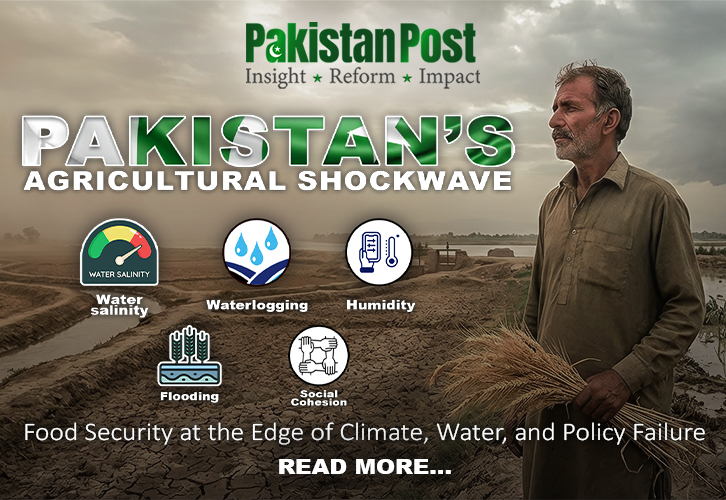

Climate Displacement and Pakistan Emerging Security and State Fragility Imperative.


Climate displacement in Pakistan is no longer a humanitarian footnote in development reporting, nor a seasonal consequence of monsoon variability. It has become an increasingly central axis through which questions of state capacity, governance legitimacy, and national security are being reframed both domestically and in global policy discourse. What was once treated as episodic disaster management is now being interpreted as a structural condition of political economy, where environmental stress is not external to the state but actively reshaping its internal coherence.
In the emerging international narrative, Pakistan is frequently positioned as a frontline laboratory of climate stress, where glacial melt in the north, intensifying heatwaves in the central plains, and recurrent flooding in the south are not isolated ecological events but interconnected expressions of systemic climate volatility. This framing, increasingly visible in multilateral climate assessments and global media analysis, places Pakistan within a category of states where climate change acts as a threat multiplier, amplifying pre-existing vulnerabilities in governance, infrastructure, and socio-economic inequality.
The most consequential dimension of this transformation is displacement. Climate-induced mobility in Pakistan is no longer limited to emergency evacuations during floods or drought cycles. It is increasingly a pattern of slow-onset migration, where households gradually relocate from environmentally degraded rural zones to already overburdened urban centres. This movement is reshaping demographic patterns in cities such as Karachi, Lahore, and Faisalabad, where informal settlements expand in response to continuous inflows of climate-displaced populations. The governance challenge here is not merely spatial planning but institutional absorption capacity, as municipal systems struggle to integrate populations that arrive outside formal economic and legal frameworks.
The security implications of this displacement are increasingly discussed in policy circles, though often indirectly. Climate migration is rarely framed as a direct security threat; instead, it is embedded within broader concerns about urban governance stress, resource scarcity, and social cohesion. However, the analytical direction of global security discourse is clear. Climate displacement is now being interpreted as a driver of secondary instability, where pressures on housing, water supply, sanitation, and employment generate conditions that can exacerbate social tensions and weaken trust in state institutions.
In Pakistan’s case, this dynamic is intensified by structural fiscal constraints and limited adaptive capacity. The state’s ability to invest in large-scale resilience infrastructure is constrained by debt servicing obligations, narrow tax bases, and recurrent balance of payment pressures. As a result, climate adaptation often remains fragmented, donor dependent, and project specific rather than systemic. This creates a policy environment in which responses are reactive rather than anticipatory, reinforcing what many analysts describe as a chronic disaster response orientation rather than a resilience building state model.
The 2022 floods remain a critical reference point in this evolving discourse. They were not simply a meteorological anomaly but a demonstration of how climate shocks can overwhelm institutional preparedness at multiple levels simultaneously. Entire districts were submerged, agricultural production was disrupted on a massive scale, and millions were displaced in a short period. Yet the more enduring impact was not only physical destruction but the exposure of governance gaps in early warning systems, infrastructure resilience, and inter-provincial coordination. The event became a global symbol of climate vulnerability in South Asia, reinforcing Pakistan’s position in international climate justice debates.
However, subsequent years have shown that such events are not exceptional but increasingly recurring within shorter intervals. Heatwaves have intensified, glacial lake outburst risks have increased in northern regions, and rainfall variability has become more unpredictable. This pattern suggests that climate displacement will not decline as recovery proceeds but will likely become a continuous feature of socio-economic life. In such a context, displacement ceases to be an emergency category and becomes a structural governance condition.
The policy gap is therefore not limited to disaster response mechanisms. It extends into land governance, urban planning, water resource management, and agricultural policy. Rural vulnerability is deeply linked to water stress in irrigation systems, declining soil productivity, and uneven access to climate-resilient agricultural technologies. As livelihoods become increasingly precarious in rural areas, migration becomes a rational adaptive strategy rather than an exceptional response. Yet urban systems are not designed to absorb this rationality at scale.
This mismatch produces what can be described as a spatial governance paradox. Rural areas expel population under climate pressure, while urban areas lack the infrastructure to integrate it. The result is the proliferation of informal economies and settlements, where state visibility is partial and service delivery uneven. In such spaces, the boundaries between governance failure and survival adaptation become increasingly blurred.
Internationally, this dynamic is increasingly interpreted through the lens of climate security. Multilateral institutions and policy think tanks have begun to treat climate-induced displacement as a factor in national stability assessments. The logic underpinning this shift is that environmental stress does not remain confined to ecological systems but cascades into economic, political, and security domains. In regions with already constrained governance capacity, these cascades can be particularly destabilising.
In Pakistan, this framing is complicated by geopolitical context. The country’s strategic location, demographic scale, and internal diversity mean that any large-scale migration dynamic has both internal and external implications. While there is limited evidence to suggest that climate displacement directly triggers political instability, it does contribute to conditions in which governance stress becomes more visible. Rising competition over urban resources, pressure on public services, and informalisation of labour markets all feed into broader questions of state legitimacy.
Yet it is important to avoid deterministic interpretations. Climate displacement does not automatically translate into insecurity. Rather, it exposes the quality of governance systems and their ability to manage complexity under stress. States with stronger institutional coordination, adaptive planning, and fiscal flexibility are better able to absorb such pressures without systemic destabilisation. The critical question, therefore, is not whether climate displacement exists, but how effectively it is governed.
Pakistan’s current policy architecture reflects both awareness and fragmentation. Climate policy frameworks exist at federal and provincial levels, and there is increasing engagement with international climate financing mechanisms. However, implementation remains uneven. Institutional overlaps, capacity constraints, and political discontinuity hinder the development of a unified resilience strategy. As a result, climate governance often operates in silos, disconnected from urban planning, migration policy, and economic reform agendas.
This fragmentation is particularly evident in urban governance. Cities are at the frontline of climate displacement but often lack the fiscal autonomy and administrative capacity to respond effectively. Municipal services are overstretched, housing deficits are widening, and infrastructure investment has not kept pace with population growth. In this environment, informal settlements become de facto solutions, though they exist outside formal planning frameworks.
The long-term implications of this trajectory are significant. If climate displacement continues to intensify without corresponding institutional adaptation, the risk is not sudden collapse but gradual erosion of governance effectiveness. This erosion manifests as declining service delivery, increased inequality, and weakening public trust in state capacity. Over time, such conditions can contribute to political volatility, not as a direct consequence of climate change but as an indirect outcome of unmanaged systemic stress.
At the same time, there is a growing recognition within policy circles that climate displacement also presents an opportunity for institutional transformation. If managed proactively, migration flows can be integrated into urban development planning, labour market expansion, and infrastructure investment strategies. This would require a shift from reactive disaster management to anticipatory governance, where climate risk is embedded into all levels of policy design.
Such a shift, however, requires political will and administrative coherence that are currently uneven. It also requires reconceptualising climate change not as an environmental sectoral issue but as a central determinant of economic planning and national security strategy. Without this conceptual shift, policy responses are likely to remain fragmented and insufficient.
In the international media narrative, Pakistan often appears as a climate vulnerability case study. While this framing captures the severity of exposure, it can also obscure the complexity of internal governance dynamics. The challenge is not only external climate pressure but the interaction between that pressure and domestic institutional capacity. Climate change does not act in a vacuum; it interacts with fiscal policy, political structures, and administrative systems.
The emerging policy question, therefore, is not simply how to reduce emissions or respond to disasters, but how to build governance systems capable of absorbing continuous environmental stress. This involves rethinking infrastructure design, strengthening data systems for migration tracking, improving inter-agency coordination, and investing in climate-resilient urban expansion.
Ultimately, climate-induced displacement in Pakistan should be understood as a defining governance challenge of the coming decades. It sits at the intersection of environmental change, demographic transformation, and institutional capacity. Its significance lies not only in the scale of population movement but in what it reveals about the resilience of the state itself.
The narrative that is now taking shape in international policy discourse is clear: climate change is not a distant environmental risk but a present structural force reshaping state functionality. For Pakistan, this means that climate displacement is not a peripheral issue but a central test of governance adaptability. Whether this test leads to deeper fragility or institutional strengthening will depend on the capacity to move from fragmented response to integrated resilience planning.
In this sense, climate displacement is not only a crisis to be managed but a lens through which the future of state capacity in Pakistan can be understood.
A Public Service Message