
When 80 Percent Becomes a Ceiling Instead of a Door: The Quiet Crisis of Merit in Pakistan’s Education System


Merit is often presented as the purest expression of fairness in education, a simple promise that effort and ability will determine opportunity. In Pakistan, this promise is increasingly reduced to a numerical ritual, 80 percent, 70 percent, sometimes slightly more, sometimes slightly less depending on institutional pressure and available capacity. On paper, it appears precise, objective and incorruptible. In practice, it has become a system that certifies excellence and then quietly declines to accommodate it.
An 80 percent score should signal distinction, intellectual readiness and upward mobility. Yet in the lived experience of thousands of students, it increasingly functions as a boundary marker rather than a passage. It tells a student they have succeeded, but also that success is too common to guarantee entry. It confirms competence, but simultaneously withholds space. The paradox is not moral, it is structural. Merit exists, but space for merit does not expand alongside it.
The contradiction begins with scarcity disguised as standardisation. Institutions define merit thresholds as if they are stable measures of quality, yet those thresholds operate within rigid limits of seats, departments and funding. When thousands of students fall within the same high-performance band, the system does not recalibrate by expansion, it recalibrates by exclusion. The difference between entry and rejection becomes a fraction of a percent, a decimal point deciding academic futures, as if human potential can be resolved through arithmetic compression.
In such a system, merit is no longer a measure of excellence alone. It becomes a ranking device within scarcity. A student does not compete against failure, but against equally successful peers, all of whom have already met the defined standard. The question is no longer who is capable, but who is slightly more accommodated by an unchanged structure.
The irony is difficult to ignore. A student scoring 80 percent is told they are among the best, yet the same system tells them there is no place for them. They are declared worthy, but rendered excess. They are validated in principle, but constrained in practice. This produces a quiet contradiction at the heart of educational experience, where recognition does not translate into progression.
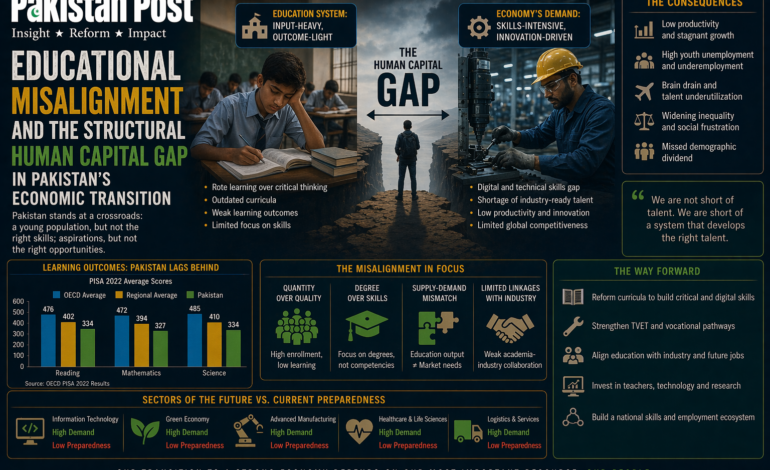
The deeper issue is that the system produces achievement without proportional absorption. Educational institutions generate high-performing graduates at scale, but higher education capacity, professional training pathways and institutional infrastructure do not expand at the same rhythm. The result is a structural bottleneck where excellence accumulates faster than it can be accommodated.
This bottleneck is not merely administrative, it is economic. When large numbers of qualified students are filtered out of their intended academic or professional tracks, the economy absorbs only a fraction of its human capital at its full potential level. The remainder is redirected into unrelated fields, underemployment or informal labour structures. Over time, this weakens productivity growth and reduces the return on educational investment at a national scale.
The psychological consequence is equally significant. Students internalise a logic in which achievement does not guarantee progression. High marks become necessary but not sufficient conditions for advancement. Effort is rewarded, but only up to the point where institutional space allows. This creates a subtle erosion of trust in the link between performance and opportunity.
What makes the situation more complex is that merit itself is not flawed. The distortion lies in the environment in which merit operates. A merit system without expansion becomes a filtering mechanism rather than a developmental ladder. It rewards success, but only within predefined limits that are not shaped by educational aspiration but by institutional constraint.
In Pakistan’s context, demographic pressure intensifies this contradiction. A large and growing youth population enters the education system each year, but institutional expansion does not keep pace. As a result, merit thresholds do not reflect quality alone, they reflect congestion. The higher the number of capable students, the more restrictive the outcome becomes.
The system therefore produces a symbolic imbalance. It encourages ambition, promotes competition and celebrates high achievement, while structurally ensuring that a significant portion of that achievement will not translate into opportunity. Excellence is continuously produced, but not continuously absorbed.
This is where the policy failure becomes evident. If merit is to function as a meaningful principle rather than a rationing tool, institutional capacity must expand alongside educational output. Without this alignment, merit becomes a mechanism that validates talent while simultaneously constraining it.
The first structural requirement is expansion. Higher education capacity in high demand fields cannot remain static in a growing population. Seats in medicine, engineering, technology and applied sciences must be increased through long term planning rather than reactive adjustments. Expansion must be treated not as an optional upgrade, but as a core economic necessity linked to human capital development.
The second requirement is redefinition. Merit cannot remain tied exclusively to narrow percentage thresholds. A more sophisticated system would incorporate standardized national testing, contextual performance indicators and institutional diversity factors. This would reduce the distortion created by marginal differences that currently decide disproportionate outcomes.
The third requirement is diversification of pathways. Not every high achieving student can or should be directed into traditional academic pipelines. Technical education, vocational training and digital skills pathways must be elevated to equal status, not as fallback options, but as parallel routes of excellence connected to real labour market demand.
The fourth requirement is integration with economic planning. Admission capacity should not be treated as an isolated academic decision. It must be linked to labour market absorption capacity, industrial development needs and long term national productivity goals. Education policy cannot function independently of economic policy if merit is to translate into opportunity.
The fifth requirement is transparency in bottleneck recognition. A national system that tracks the gap between qualified applicants and available seats would expose the scale of structural exclusion. Visibility is a prerequisite for reform. Without measuring the mismatch, it will continue to be treated as normal rather than systemic.
At its core, the issue is not that merit is failing. It is that merit is being overproduced relative to institutional space. The system is successful at generating excellence, but unsuccessful at accommodating it. This imbalance creates the illusion of fairness at the point of evaluation and the reality of limitation at the point of admission.
An 80 percent score should not represent a ceiling. It should represent a threshold of opportunity. But when capacity remains fixed and aspiration expands, the threshold itself becomes a barrier. In such a system, merit does not disappear, it becomes crowded, compressed and ultimately constrained by the very structures that claim to reward it.
Until institutional expansion, policy alignment and structural diversification are addressed, merit will remain a promise that is mathematically valid but practically incomplete. A system that celebrates excellence must also have room for it to exist beyond the examination sheet. Otherwise, merit becomes not a gateway to the future, but a carefully measured way of limiting how many are allowed to enter it.
A Public Service Message