
From Hormuz to Islamabad: Pakistan’s Place in a New Geo-Strategic Matrix After the Middle East War

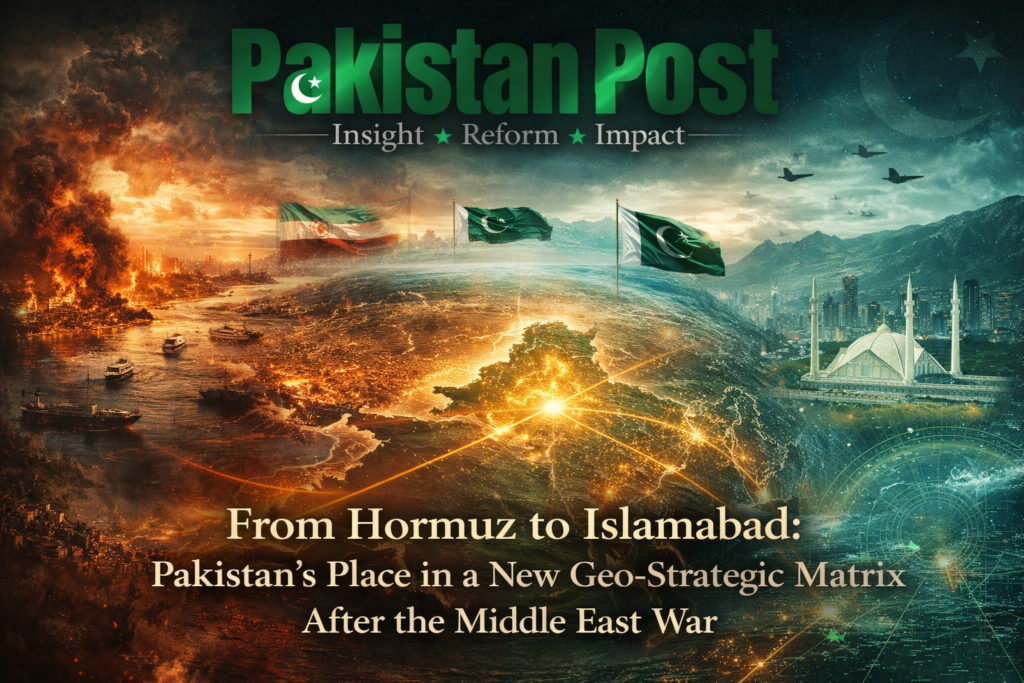
The strategic map stretching from the Persian Gulf to South Asia is being redrawn in ways that are both subtle and profound. The recent war involving the United States, Israel, and Iran has not only disrupted the balance of power within the Middle East but has extended its consequences across maritime routes, air-defense systems, and economic corridors that link the Gulf to the broader Asian landscape. What is emerging is not merely a reconfiguration of alliances, but a recalibration of the very logic through which security, energy, and connectivity are understood. At the center of this evolving matrix lies Pakistan, a state whose geographic position and diplomatic flexibility now place it at the intersection of competing and converging strategic imperatives.
The war has exposed the vulnerabilities of a region long considered central to global energy supply yet insufficiently protected against systemic disruption. The Strait of Hormuz, through which a significant portion of the world’s oil and liquefied natural gas flows, has once again demonstrated its fragility as a chokepoint. Even the perception of risk has been enough to drive price volatility and trigger shifts in shipping routes, insurance costs, and strategic reserves. Maritime insecurity, once treated as a peripheral concern, has become a central feature of regional and global strategy. The implications extend beyond the Gulf, affecting supply chains that reach deep into South Asia and beyond.
This maritime dimension is closely linked to the evolution of missile warfare and air-defense systems. The conflict has underscored the increasing importance of precision strike capabilities, layered defense mechanisms, and the integration of intelligence across domains. Missile exchanges, drone deployments, and the targeting of critical infrastructure have blurred the distinction between conventional and asymmetric warfare. At the same time, the limitations of existing air-defense systems have been exposed, revealing gaps that even technologically advanced states have struggled to address. The result is a heightened awareness of vulnerability, not only among the immediate parties to the conflict but across the wider region.
For Pakistan, these developments carry both risks and opportunities. As an energy-importing economy, it is directly affected by disruptions in Gulf supply routes and price fluctuations. At the same time, its proximity to key maritime and overland corridors positions it as a potential node in efforts to enhance resilience and diversify pathways. The challenge is to transform geographic advantage into strategic leverage, moving beyond passive exposure to active participation in shaping the emerging order.
The concept of Pakistan as a diplomatic hinge is particularly relevant in this context. Unlike many states in the region, Pakistan maintains relationships across multiple and often competing axes. Its engagement with China provides access to infrastructure, investment, and alternative financial frameworks. Its ties with Gulf states, particularly Saudi Arabia and the United Arab Emirates, are rooted in economic cooperation and shared interests in stability. Its border with Iran offers immediate opportunities for connectivity, while its interactions with Turkey and other Muslim-majority states extend its diplomatic reach. This network of relationships, while complex, provides a foundation for a role that is both integrative and facilitative.
The post-war environment amplifies the value of such a role. As the region seeks to stabilize, there is a growing need for mechanisms that can bridge divides and enable cooperation without requiring full alignment. Pakistan’s position allows it to engage with multiple actors simultaneously, facilitating dialogue, supporting economic initiatives, and contributing to the management of shared challenges. This does not imply neutrality in the traditional sense, but rather a form of strategic flexibility that prioritizes outcomes over alignment.
Energy disruption is perhaps the most immediate driver of this shift. The volatility of global markets, exacerbated by conflict, has highlighted the risks of dependence on distant and concentrated sources of supply. For Pakistan, the search for more stable and cost-effective energy solutions is both an economic necessity and a strategic imperative. The potential integration of Iranian energy resources into Pakistan’s grid, long constrained by geopolitical considerations, now appears in a different light. In a context where global stability depends on the diversification of supply, projects that were once politically sensitive may gain renewed relevance.
Such integration, however, requires more than infrastructure. It demands a rethinking of financial mechanisms, regulatory frameworks, and diplomatic engagement. The persistence of sanctions and the complexity of international financial systems necessitate innovative approaches to transactions and investment. Pakistan’s ability to navigate these challenges will be critical in determining whether it can fully capitalize on emerging opportunities.
At the same time, the broader strategic environment is being shaped by the actions of major powers. The United States, while still dominant in global finance and military capability, faces increasing constraints in managing the economic consequences of its policies. China, with its emphasis on connectivity and infrastructure, continues to expand its influence through economic means. Russia, though less directly involved in the region, benefits from disruptions that affect energy markets and global alignments. For Pakistan, the challenge is to engage with these powers in ways that enhance its own strategic autonomy while contributing to regional stability.
The role of Turkey and the Gulf states adds further complexity. Turkey’s position as a bridge between Europe and Asia, combined with its military capabilities and diplomatic ambitions, makes it a significant actor in any regional framework. The Gulf states, with their financial resources and influence over energy markets, remain central to the economic dimension of stability. Egypt, controlling critical maritime routes such as the Suez Canal, adds another layer of strategic importance. The interplay among these actors creates a dynamic environment in which coordination is both necessary and difficult.
In this context, the development of a new geo-strategic matrix becomes both a possibility and a necessity. Such a matrix would not be defined by rigid alliances, but by flexible networks of cooperation that address specific challenges. Maritime security, for example, could be enhanced through coordinated patrols, information sharing, and joint response mechanisms. Missile defense consultation could involve the exchange of technical data, joint exercises, and the development of interoperable systems. Energy security could be addressed through the integration of markets, the diversification of routes, and the development of shared infrastructure.
Pakistan’s contribution to this matrix lies in its ability to connect these domains. Its ports, including Gwadar and Karachi, provide access to maritime routes that link the Gulf to South Asia and beyond. Its overland corridors connect Central Asia and China to the Arabian Sea. Its diplomatic relationships enable it to engage with a wide range of actors, facilitating coordination and reducing friction. By aligning these elements within a coherent strategy, Pakistan can position itself as a central node in the emerging network.
The implications of such a role extend beyond immediate economic benefits. By facilitating connectivity and cooperation, Pakistan can contribute to the creation of a more stable and resilient regional order. This, in turn, enhances its own security, as interdependence reduces the incentives for conflict and increases the costs of disruption. At the same time, it provides opportunities for economic growth, as increased trade and investment flow through its territory.
However, the realization of this potential is contingent on several factors. Domestic capacity, including infrastructure, governance, and institutional coordination, must be strengthened to support increased activity. Policy coherence is essential, ensuring that economic, diplomatic, and security objectives are aligned. Risk management is equally important, as engagement with multiple actors and systems introduces new vulnerabilities.
The post-war environment also requires a shift in strategic thinking. Traditional approaches that prioritize short-term gains or reactive responses are insufficient in a context defined by long-term transformation. Instead, Pakistan must adopt a forward-looking perspective that anticipates changes and positions itself accordingly. This involves not only responding to current developments but shaping future trajectories through proactive engagement.
The broader transformation underway reflects a shift in the nature of global power. In an interconnected world, influence is increasingly derived from the ability to facilitate flows rather than to control territory. States that can connect regions, systems, and markets become central to the functioning of the global economy. Pakistan’s geographic position provides a natural advantage in this regard, but its realization depends on strategic intent and policy execution.
The war has accelerated this shift by exposing the limitations of existing structures and highlighting the need for new approaches. The disruption of maritime routes, the evolution of missile warfare, and the volatility of energy markets all point to a system in flux. In such a system, adaptability and connectivity become key determinants of success.
For Pakistan, the path forward lies in embracing this reality. By positioning itself as a diplomatic hinge, a facilitator of energy integration, and a hub for connectivity, it can transform the challenges of the post-war environment into opportunities for growth and influence. This requires a commitment to reform, investment, and engagement, as well as a willingness to navigate complexity.
In the final analysis, the redrawing of the strategic map from Hormuz to Islamabad is not a distant possibility but an ongoing process. The choices made in this period will determine whether Pakistan emerges as a central actor in the new geo-strategic matrix or remains on its periphery. The opportunity is defined by the convergence of geography, necessity, and timing—a combination that is rare but consequential. In a world where the lines between security and economics are increasingly blurred, the ability to connect may prove to be the most enduring source of power.
A Public Service Message