
Social Cohesion Under Informational Fragmentation in Pakistan

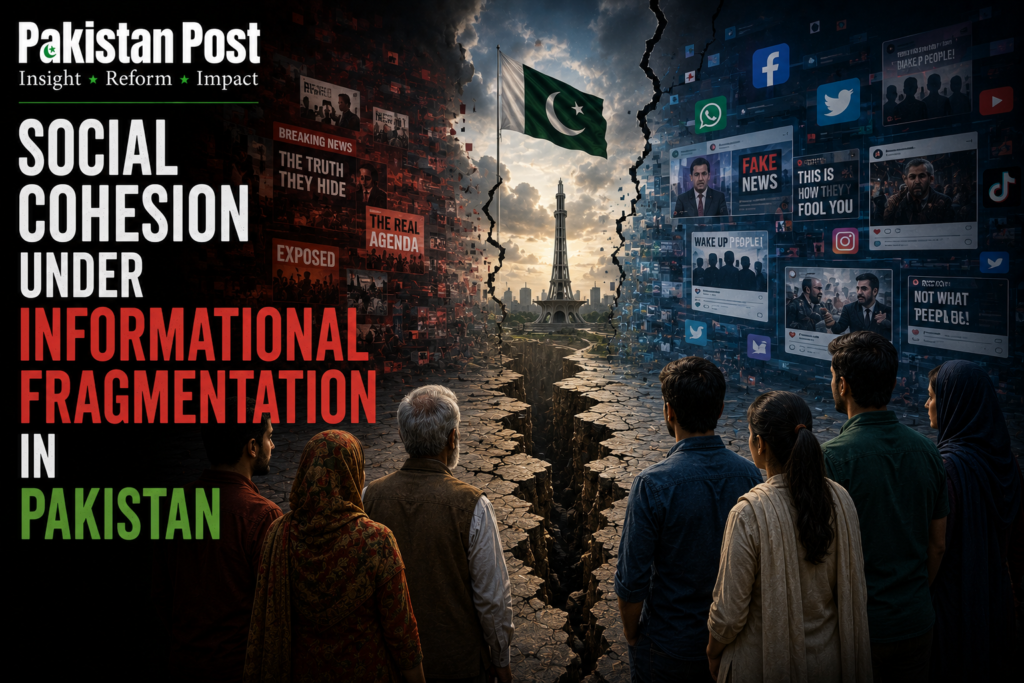
Pakistan’s social cohesion is increasingly shaped less by shared civic experience and more by competing informational environments that define reality differently for different segments of society. What is emerging is not simply polarization in the conventional political sense, but a deeper fragmentation of social perception itself, where inflation, security incidents, judicial proceedings, and political conflict are no longer interpreted through a common civic vocabulary. Instead, they are absorbed into parallel interpretive systems that convert the same event into fundamentally different moral narratives. This shift is subtle in its daily expression but structural in its cumulative effect, gradually eroding the integrative mechanisms that once allowed grievance to be processed through shared institutions.
The most immediate driver of this transformation is economic precarity. Persistent inflation, unstable employment trajectories, rising utility costs, and declining purchasing power have created a condition in which economic anxiety is no longer episodic but ambient. In such an environment, public interpretation of state action becomes highly sensitive to perceived distributive injustice. Economic stress does not automatically produce social fragmentation, but it significantly lowers the threshold at which informational inputs become emotionally charged. A price hike, a tax policy adjustment, or a subsidy removal is not received as policy but as existential pressure. This transforms economic governance into an information-sensitive domain where policy communication becomes as important as policy design.
Layered onto this material stress is a hyper-politicised media ecosystem that operates at high velocity and low verification thresholds. Television talk shows, YouTube commentary circuits, and social media influencers increasingly function as primary interpreters of national events rather than secondary commentators. In this environment, news is not simply reported; it is continuously reframed through ideological, institutional, or partisan lenses that are already familiar to the audience. The result is a media landscape that does not aggregate public understanding but segments it. Each segment consumes the same event through different emotional and cognitive filters, reinforcing pre-existing beliefs rather than challenging them.
This segmentation is reinforced by algorithmic distribution systems that privilege engagement over coherence. Digital platforms do not reward shared understanding; they reward intensity. Content that provokes anger, fear, or moral outrage circulates more rapidly than content that explains or contextualises. Over time, this creates a structural bias in public discourse toward emotionally charged simplification. Complex policy issues are reduced to binary narratives of betrayal or defence, loyalty or corruption, inclusion or exclusion. The space for interpretive moderation shrinks, not because it is censored, but because it is algorithmically disadvantaged.
The third layer of pressure is the erosion of mediating institutions that traditionally translated social grievances into civic negotiation. Universities, local administrations, trade unions, professional associations, mosque committees, and political party structures once functioned as intermediate spaces where raw grievance was processed into structured claims. These institutions did not eliminate conflict, but they stabilised it by converting emotional intensity into procedural language. In the current environment, many of these mediating structures have weakened in authority, capacity, or credibility. Universities are often disconnected from civic discourse, local administration is perceived as inefficient or politicised, and political parties increasingly communicate directly to mass audiences rather than through internal deliberative structures.
The cumulative effect is a compression of social translation mechanisms. Grievance now moves more directly from experience to expression, bypassing institutional filtration. This produces a public sphere that is more immediate but less structured, more expressive but less negotiable. In such conditions, social cohesion depends less on consensus and more on the containment of divergence. When containment mechanisms weaken, divergence becomes visible as fragmentation.
A particularly significant dimension of this transformation is the collapse of a shared civic vocabulary. Terms such as justice, merit, corruption, rights, accountability, and patriotism no longer carry stable meanings across different social groups. Instead, they function as contested symbols whose meanings shift depending on the narrative ecosystem in which they are embedded. This linguistic instability has strategic consequences. When basic civic terms lose shared meaning, disagreement becomes more difficult to resolve because there is no longer a common interpretive foundation on which negotiation can occur.
The media environment plays a central role in this linguistic fragmentation. In Pakistan’s contemporary information ecosystem, meaning is not transmitted through single authoritative channels but through overlapping and often contradictory interpretive communities. A single political event may be simultaneously framed as constitutional correction, institutional overreach, foreign interference, or elite bargaining, depending on the source. Over time, audiences gravitate toward interpretive communities that reinforce their existing worldview, creating informational enclaves that are internally coherent but externally incompatible.
Diaspora networks intensify this fragmentation by recontextualising domestic events within external political frameworks. Domestic developments are frequently interpreted through the lens of international geopolitical narratives, which can amplify their perceived stakes and moral urgency. This creates feedback loops between domestic and international media spaces, where interpretations circulate back into Pakistan with added legitimacy derived from external validation. The result is not simply misinformation but multi-layered reframing of reality across jurisdictional boundaries.
At the sociological level, this fragmentation is reinforced by generational divergence in media consumption. Younger populations are increasingly embedded in platform-based ecosystems where content is personalised, algorithmically curated, and rapidly updated. Older populations often remain more reliant on traditional broadcast media, which, despite its own biases, tends to provide more uniform narratives. This generational divergence creates parallel experiences of national events, where the same incident is perceived with different levels of urgency, causality, and moral interpretation. Over time, this reduces intergenerational narrative alignment, weakening one of the key stabilisers of social cohesion.
Urbanisation and migration patterns further complicate this landscape. Rapid movement from rural to urban areas has expanded exposure to diverse informational environments without necessarily strengthening institutional integration. Migrants often maintain informational ties to their regions of origin through digital platforms while simultaneously engaging with urban media ecosystems. This dual exposure can produce hybrid interpretations of national events that are neither fully local nor fully national, adding another layer of interpretive complexity to the public sphere.
The political system itself has adapted to this environment in ways that often intensify fragmentation rather than reduce it. Political communication increasingly relies on direct-to-audience messaging, bypassing traditional intermediaries. While this enhances immediacy and responsiveness, it also reduces the role of deliberative filtering. Political actors are incentivised to engage in continuous narrative mobilisation rather than structured policy explanation. In such conditions, politics becomes less about programmatic competition and more about narrative dominance within segmented audiences.
Security incidents and crisis events act as accelerators of this fragmentation. During periods of heightened tension, informational divergence becomes more pronounced as competing narratives intensify simultaneously. Rumours circulate rapidly through social media and messaging applications, often outpacing official communication. In the absence of trusted intermediaries, citizens rely on informal networks for verification, which are themselves embedded in ideological or social biases. This creates a situation in which even basic factual agreement becomes difficult to establish during critical moments.
The erosion of trust in official communication compounds this problem. Repeated exposure to contested narratives, combined with perceived inconsistencies in institutional messaging, has contributed to a generalised scepticism toward authoritative information. This does not necessarily translate into belief in alternative narratives, but rather into a broader epistemic uncertainty where all sources are treated as potentially biased. In such an environment, truth becomes situational rather than institutional, dependent on alignment with existing beliefs rather than external verification.
Despite this fragmentation, Pakistan’s social system retains significant underlying resilience. Kinship networks, religious structures, and local community ties continue to provide forms of social stability that are not fully mediated by digital platforms. However, these traditional stabilisers are increasingly operating within a broader informational environment that is structurally fragmented. Their capacity to translate national-level events into locally coherent narratives is therefore under increasing strain.
Policy responses to this condition must move beyond episodic communication strategies and toward structural reinforcement of mediating institutions. Strengthening local governance capacity, rebuilding trust in public education systems, enhancing the credibility of public service communication, and supporting non-partisan civic platforms are all elements of a longer-term stabilisation strategy. However, these measures must be complemented by a more sophisticated understanding of the information environment itself, including the role of algorithms, platform incentives, and digital literacy gaps.
A critical but often underemphasised requirement is the restoration of interpretive intermediaries. These are actors and institutions capable of translating complex policy and political developments into accessible but accurate public explanations. Without such intermediaries, the gap between state communication and public understanding widens, creating space for narrative substitution by less accountable actors. Strengthening journalism that prioritises explanatory depth over reactive commentary is one component of this requirement, but it must also extend to educational institutions and civil society organisations.
Ultimately, the challenge facing Pakistan is not simply one of misinformation or media bias, but of structural informational divergence within society. When citizens inhabit different narrative realities, social cohesion is no longer maintained through agreement but through parallel coexistence. This condition is inherently fragile, particularly under economic stress or political crisis, where interpretive divergence can quickly translate into social tension.
The strategic implication is clear. Social cohesion in the contemporary environment is no longer solely a function of economic performance or political stability. It is also a function of informational coherence. Without mechanisms to restore shared interpretive frameworks, the state will continue to face situations where policy effectiveness is undermined not by implementation failure but by perception divergence. In such a context, governance becomes not only an administrative challenge but an epistemic one, requiring sustained attention to how societies construct, distribute, and stabilise meaning itself.
A Public Service Message