Procurement Politics and Strategic Delay in the Architecture of Contemporary South Asian Military Modernisation


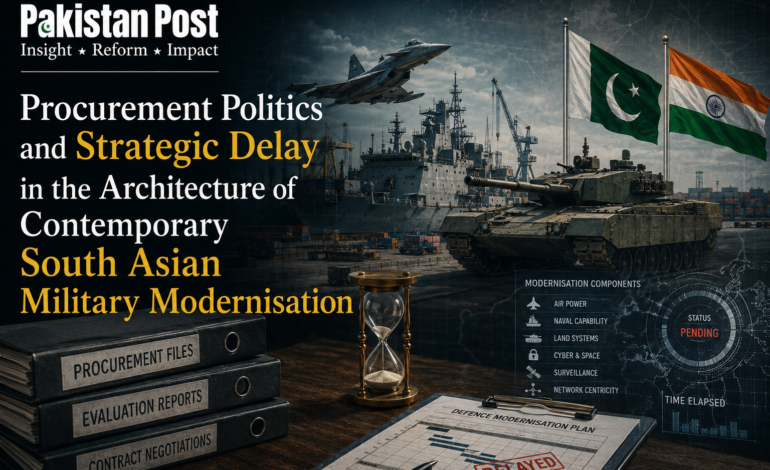
The politics of defence procurement in South Asia has evolved into a domain where bureaucratic procedure, industrial policy, strategic alignment, and technological sovereignty converge in ways that defy conventional separation between administrative inefficiency and structural transformation. What was once treated as a technical subsystem of defence planning has increasingly become a central arena of geopolitical contestation, in which delays, renegotiations, compliance requirements, and information asymmetries are not peripheral disturbances but constitutive features of the system itself. In this evolving landscape, procurement is no longer merely about acquiring platforms; it is about negotiating the terms under which strategic dependence and autonomy are distributed across time, technology, and external partnerships.
The contemporary phase of military modernization in South Asia reveals a profound shift in how states conceptualize readiness. Readiness is no longer defined solely by the presence of operational platforms or the numerical strength of forces, but by the ability of a state to translate procurement intent into deployable capability within predictable timeframes. Yet the paradox of modern defence acquisition is that as systems become more advanced, networked, and software dependent, the interval between intent and deployment expands rather than contracts. This expansion is not accidental but structurally embedded in the complexity of global defence production networks, where design, integration, testing, certification, and sovereign approval operate as layered and often non linear processes.
Within this context, procurement delay emerges not as a failure of governance but as a reflection of deeper structural tensions between strategic ambition and technological dependence. States that rely on imported high end platforms must navigate not only financial constraints but also epistemic constraints, particularly in relation to source code access, system interoperability, and lifecycle control. These constraints are not always visible in public discourse, yet they shape the real contours of strategic autonomy. The ability to operate a platform is not equivalent to the ability to modify, integrate, or fully understand it. This distinction becomes critical when assessing the strategic value of delayed or contested procurement processes.
The South Asian defence environment provides a particularly illustrative case of how procurement politics intersect with broader questions of sovereignty. In systems where defence acquisition is deeply embedded in civilian bureaucratic structures, parliamentary oversight mechanisms, and multi-agency approval chains, the procurement process becomes a site of institutional negotiation rather than a linear administrative pathway. Each stage of approval introduces the possibility of recalibration, delay, or renegotiation, reflecting competing priorities among fiscal authorities, military planners, and political leadership. These internal dynamics are further complicated by external dependencies on supplier states, whose own strategic interests may not always align with the recipient’s urgency.
The emergence of advanced multi role platforms, integrated air defence systems, and network centric warfare architectures has intensified these dynamics. Such systems are not standalone assets but components of broader operational ecosystems that require harmonization across radar networks, communication protocols, command structures, and electronic warfare environments. As a result, procurement decisions increasingly involve not only the purchase of hardware but the negotiation of access to software architectures, training frameworks, maintenance protocols, and upgrade pathways. In many cases, the most strategically significant aspects of these systems are not their physical components but the rules governing their modification and integration.
This shift has profound implications for understanding strategic delay. Delay is often interpreted in public discourse as inefficiency or administrative backlog, yet it may reflect deeper tensions between operational necessity and technological constraint. When systems require extensive integration with existing platforms, when software dependencies limit customization, or when supplier states impose conditionalities on usage, the procurement timeline becomes inherently extended. The resulting delay is not simply procedural but structural, reflecting the friction between sovereign intent and transnational technological architecture.
In parallel, defence procurement has become increasingly intertwined with industrial policy objectives. States are no longer passive consumers of military technology but active participants in global defence supply chains, seeking to cultivate domestic manufacturing capabilities through offset arrangements, joint ventures, and licensed production agreements. These mechanisms are intended to reduce dependency and enhance technological absorption, yet they also introduce additional layers of complexity into procurement cycles. Negotiating offsets, verifying compliance, and ensuring technology transfer often extend acquisition timelines significantly beyond initial projections.
The political economy of procurement therefore operates at the intersection of three competing imperatives. The first is operational urgency, driven by perceived threats and regional security dynamics. The second is fiscal discipline, which constrains the scale and timing of defence expenditure within broader macroeconomic frameworks. The third is industrial ambition, which seeks to leverage procurement as a mechanism for technological upgrading and domestic capacity building. These imperatives are not easily reconciled, and the tension between them is a primary source of procurement delay in contemporary systems.
In South Asia, this triadic tension is further complicated by the geopolitical positioning of supplier states. Defense imports are rarely neutral transactions; they are embedded within broader strategic relationships that include diplomatic alignment, intelligence cooperation, and economic interdependence. As a result, procurement decisions may be influenced by considerations that extend beyond immediate military utility. Supplier states may impose export controls, restrict access to sensitive technologies, or condition delivery schedules on compliance with broader strategic expectations. These external variables introduce additional uncertainty into procurement timelines.
The question of source code access and system sovereignty has become particularly salient in this regard. Modern defence platforms are increasingly software defined, meaning that their operational effectiveness depends on proprietary code that governs targeting systems, sensor fusion, electronic warfare responses, and communication encryption. Without access to this code, recipient states may find themselves unable to fully integrate platforms into their own command and control architectures. This creates a form of partial dependency in which operational capability exists but strategic autonomy remains constrained. The resulting tension is often reflected in prolonged negotiation cycles and delayed acceptance of procurement agreements.
It is within this context that high value procurement announcements must be interpreted not as definitive acquisitions but as conditional commitments. The announcement of intent to procure advanced platforms often precedes years of negotiation, certification, and phased delivery. During this period, the strategic value of the procurement is simultaneously real and deferred. It signals intent to both domestic and external audiences while remaining contingent on unresolved technical and political conditions. This dual character of procurement as both signal and substance is central to understanding its role in strategic competition.
The financial dimension of procurement delay further complicates the picture. Delays do not merely postpone capability; they also redistribute costs across time, often increasing total expenditure through inflation adjustments, currency fluctuations, and revised contract terms. In some cases, delayed procurement can result in significant escalation of lifecycle costs, particularly when systems require periodic upgrades to remain compatible with evolving operational environments. Thus, delay is not cost neutral but economically generative, producing additional fiscal burdens that accumulate over time.
At the systemic level, these dynamics suggest that procurement should be understood as a form of temporal governance. States are not simply acquiring platforms; they are managing the timing of capability emergence within a complex field of constraints. The ability to synchronize procurement cycles with strategic requirements becomes a critical dimension of defence planning. However, in environments where bureaucratic fragmentation, external dependency, and technological complexity intersect, such synchronization is difficult to achieve.
The broader implication is that strategic delay may itself function as a structural feature of modern defence systems rather than an aberration. In highly networked military ecosystems, where interoperability and software integration are essential, delays may be unavoidable consequences of system complexity. Yet this does not render them strategically insignificant. On the contrary, the distribution of delay across different actors may itself shape the balance of power, as states with greater institutional coherence and technological autonomy are better able to compress procurement timelines and convert intent into capability more rapidly.
The South Asian case illustrates how these dynamics operate within a region characterized by asymmetrical capabilities, rapid modernization pressures, and constrained fiscal environments. Procurement decisions are not isolated technical choices but are embedded within broader strategic narratives about deterrence, prestige, and technological parity. As such, delays in procurement can acquire symbolic significance that extends beyond their material consequences, influencing perceptions of momentum, resolve, and strategic trajectory.
At the same time, it is necessary to resist overly linear interpretations of procurement delay as either advantage or disadvantage. The reality is more ambivalent. Delays may hinder immediate operational readiness while simultaneously enabling deeper integration, improved negotiation outcomes, or enhanced domestic capacity development. Conversely, rapid procurement may deliver short term capability gains while locking states into rigid dependency structures that constrain future flexibility. The strategic evaluation of procurement timelines must therefore account for both temporal efficiency and structural autonomy.
Ultimately, procurement politics in South Asia reflects a broader transformation in military power. Power is no longer solely a function of deployed forces but of the institutional capacity to manage complexity over time. Defence acquisition systems have become arenas in which sovereignty, dependency, industrial ambition, and strategic urgency intersect in continuously evolving configurations. In this environment, delay is not merely an administrative condition but a strategic variable that shapes the trajectory of capability development and the architecture of regional security.
The significance of this transformation extends beyond the immediate context of bilateral competition. It points toward a global condition in which military modernization is increasingly mediated through long duration procurement ecosystems that bind states into extended cycles of negotiation, adaptation, and financial commitment. Understanding these ecosystems requires moving beyond traditional binaries of success and failure, efficiency and inefficiency, and instead engaging with the deeper temporal structures that govern how strategic capability is produced, delayed, and ultimately realized.
A Public Service Message