Pakistan Must Secure Its Undersea Strategic Infrastructure Future

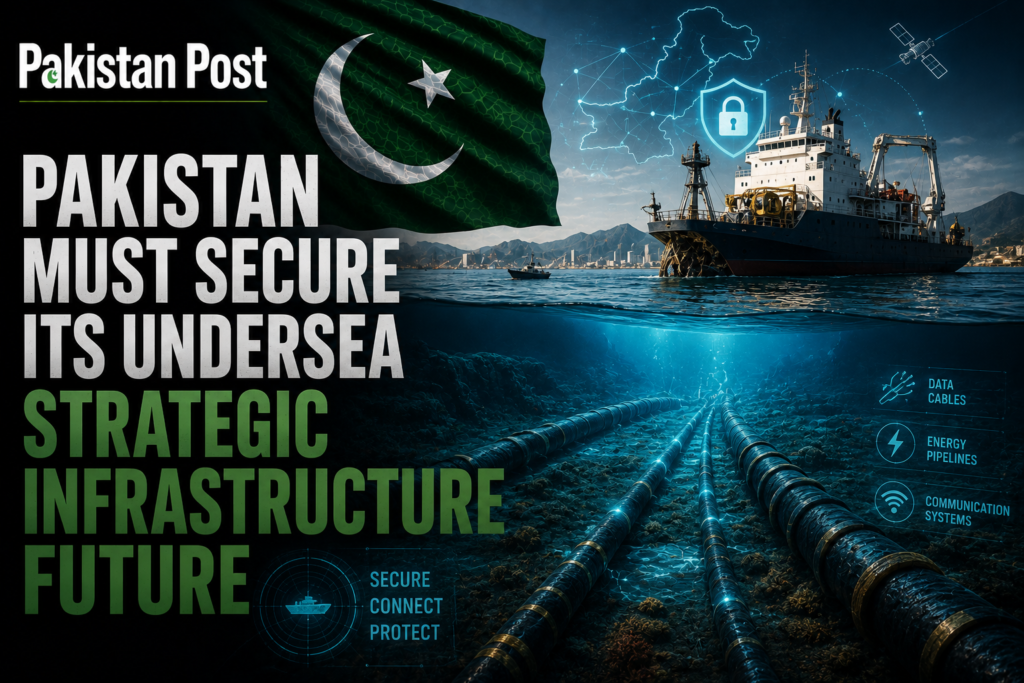
Invisible networks resting beneath the sea increasingly determine the resilience of modern states. The strategic geography of the twenty first century is no longer defined exclusively by coastlines, ports or naval deployments. It is equally shaped by submarine fibre optic cables carrying global internet traffic, offshore energy platforms sustaining national economies, underwater sensor arrays monitoring maritime activity, and seabed infrastructure supporting financial markets, governmental communications and commercial logistics. The ocean floor has quietly evolved into one of the world’s most consequential strategic domains, transforming undersea infrastructure into an arena where economic competition, intelligence collection, technological rivalry and national security converge.
For Pakistan, this transformation demands a conceptual departure from traditional maritime thinking. National maritime strategy has historically concentrated upon surface fleets, commercial ports and conventional sea lane protection. Yet the invisible infrastructure lying beneath surrounding waters increasingly carries strategic value exceeding that of many visible maritime assets. Digital sovereignty, economic continuity and governmental resilience now depend upon systems whose vulnerability often receives limited institutional attention despite their extraordinary national significance.
More than ninety five percent of global digital communications continue to travel through submarine fibre optic cables rather than satellites. International banking transactions, financial clearing systems, cloud computing, governmental communications, intelligence exchanges, multinational corporate operations and critical digital services all depend upon uninterrupted seabed connectivity. Every disruption creates cascading consequences extending far beyond telecommunications, affecting economic confidence, diplomatic coordination, military command structures and emergency response capabilities.
Pakistan’s growing digital economy, expanding financial sector, e governance architecture and international commercial integration increasingly rely upon submarine cable connectivity linking South Asia with the Middle East, Europe and East Asia. As artificial intelligence, cloud infrastructure, digital commerce and cross border financial integration expand, dependence upon uninterrupted undersea communications will accelerate significantly. Strategic planners must therefore recognise submarine cables not merely as commercial telecommunications assets but as nationally critical infrastructure deserving comprehensive protection.
Global strategic competition has already entered the underwater environment. Major powers increasingly invest in specialised vessels capable of seabed operations, autonomous underwater vehicles, unmanned surveillance platforms, underwater acoustic networks and sophisticated sensor technologies capable of monitoring subsea infrastructure. These developments reflect a broader understanding that future geopolitical competition may unfold as much beneath the ocean surface as above it.
Underwater infrastructure presents an attractive target because disruption produces disproportionate consequences while remaining difficult to attribute with certainty. A damaged fibre optic cable can interrupt financial markets, governmental communications and commercial transactions across multiple countries. Sabotage against offshore energy facilities may create immediate economic instability without requiring conventional military confrontation. Interference with underwater surveillance systems may weaken maritime awareness before broader strategic crises emerge.
The ambiguity surrounding underwater incidents further complicates deterrence. Natural disasters, accidental anchor strikes, commercial fishing activities, equipment malfunction and deliberate sabotage often produce similar physical outcomes. Establishing responsibility requires sophisticated forensic capabilities rarely possessed by developing maritime nations. Strategic ambiguity consequently increases incentives for hostile actors seeking plausible deniability while imposing significant costs upon competitors.
Pakistan’s maritime environment presents distinct vulnerabilities requiring integrated assessment. The northern Arabian Sea supports growing commercial shipping, expanding energy infrastructure, strategic port development and increasingly complex telecommunications networks. The development of Gwadar, expansion of offshore exploration, growth in digital commerce and broader regional connectivity collectively increase dependence upon resilient underwater systems.
Simultaneously, regional maritime competition has intensified considerably. Naval modernisation programmes across the Indian Ocean increasingly incorporate underwater surveillance capabilities, autonomous maritime technologies and enhanced seabed monitoring. Future maritime competition may therefore involve persistent observation of critical infrastructure alongside conventional naval operations.
Maritime domain awareness traditionally focused upon identifying ships, aircraft and surface activities. Contemporary strategic realities require extending awareness beneath the ocean surface. Effective underwater domain awareness demands integrated sensor networks, acoustic monitoring systems, seabed mapping, autonomous underwater vehicles, satellite surveillance, artificial intelligence supported anomaly detection and continuous information sharing among civilian and military institutions.
Pakistan possesses opportunities to develop indigenous underwater monitoring capabilities through collaboration among naval institutions, telecommunications authorities, scientific research organisations, universities and private technology companies. Such cooperation would strengthen national resilience while reducing dependence upon external technological providers.
Technological innovation increasingly favours affordable autonomous platforms capable of persistent underwater observation. Unmanned underwater vehicles equipped with high resolution sensors can inspect submarine cables, monitor offshore installations, detect suspicious activity and support maintenance operations at substantially lower cost than conventional naval deployments. Artificial intelligence further enhances analytical capacity by identifying abnormal underwater patterns requiring human investigation.
Cybersecurity has likewise become inseparable from underwater infrastructure protection. Submarine cable landing stations, network management systems, offshore energy platforms and maritime control centres all depend upon interconnected digital architecture vulnerable to cyber intrusion. Physical infrastructure security without corresponding cyber resilience creates dangerous asymmetry because adversaries may exploit software vulnerabilities rather than direct physical attacks.
Consequently, Pakistan requires integrated governance connecting telecommunications regulation, cybersecurity institutions, naval planning and national critical infrastructure protection. Fragmented administrative structures separating digital security from maritime security no longer reflect operational realities. Strategic infrastructure increasingly exists simultaneously within physical, digital and maritime environments.
Institutional coordination therefore becomes a decisive national capability. Maritime authorities, telecommunications regulators, intelligence agencies, naval headquarters, emergency response institutions, commercial operators and financial regulators require interoperable frameworks supporting real time information exchange and coordinated crisis management. Delayed bureaucratic communication during underwater infrastructure emergencies may amplify national economic disruption beyond the original incident itself.
Legal preparedness represents another underdeveloped strategic dimension. International maritime law provides important principles governing submarine cables and offshore infrastructure, yet enforcement remains complex, particularly regarding intentional interference below the sea surface. National legislation should clearly define responsibilities concerning critical underwater infrastructure protection, reporting obligations, emergency coordination mechanisms and penalties associated with negligent or malicious interference.
Pakistan may also contribute constructively toward emerging international discussions concerning seabed governance. As underwater infrastructure assumes greater strategic significance, multilateral frameworks addressing transparency, incident investigation, information sharing and cooperative monitoring will become increasingly important. Participation in these evolving legal discussions enables Pakistan to influence regional norms while protecting national interests.
Commercial resilience deserves equal strategic attention. Modern financial systems assume uninterrupted international connectivity. Banking networks, payment systems, securities exchanges, logistics companies, airlines, energy markets and export industries all depend upon stable digital communications. Undersea infrastructure disruptions therefore generate immediate macroeconomic consequences extending far beyond the telecommunications sector.
Business continuity planning should consequently incorporate submarine cable contingency scenarios. Financial institutions require diversified connectivity pathways, redundant communication systems and tested operational continuity protocols capable of maintaining essential services despite significant infrastructure disruption. Commercial resilience increasingly constitutes an element of national security rather than merely private sector risk management.
Energy infrastructure introduces additional strategic complexity. Offshore exploration, subsea pipelines, renewable marine energy installations and associated monitoring systems represent expanding economic assets requiring specialised protection. Global energy transitions encouraging offshore wind generation, hydrogen production and subsea transmission networks will further increase underwater infrastructure density during coming decades.
Pakistan’s prospective offshore energy ambitions should therefore integrate security planning from project inception rather than retroactively addressing vulnerabilities after infrastructure deployment. Protective architecture incorporating surveillance, cybersecurity, emergency response and maintenance resilience reduces long term operational risk while improving investor confidence.
Insurance markets increasingly recognise underwater infrastructure as a significant risk category. Premium calculations now consider geopolitical tensions, cyber exposure, physical sabotage risks and environmental vulnerabilities affecting offshore assets. Nations demonstrating credible protective capabilities may therefore attract lower commercial risk assessments and stronger infrastructure investment.
Educational institutions likewise require strategic adaptation. Maritime education traditionally emphasised navigation, engineering and conventional naval operations. Contemporary professional training must incorporate underwater robotics, seabed engineering, cyber maritime security, acoustic surveillance, critical infrastructure management and digital resilience. Future maritime professionals will require interdisciplinary expertise bridging engineering, information technology, intelligence analysis and maritime operations.
Research investment offers another opportunity. Universities, defence research organisations and technological institutes can jointly develop indigenous underwater sensor technologies, autonomous maritime platforms, cable inspection robotics and advanced data analytics supporting maritime awareness. Domestic innovation strengthens strategic autonomy while generating commercially valuable technologies with export potential.
Public private partnerships should become central components of national underwater infrastructure strategy. Telecommunications companies, port operators, shipping firms, financial institutions and offshore energy developers possess operational knowledge unavailable within government alone. Structured cooperation facilitates risk assessment, emergency planning, information sharing and coordinated investment in protective technologies.
Regional cooperation also deserves pragmatic consideration. Submarine cables frequently connect multiple jurisdictions, making unilateral protection insufficient. Technical information sharing, coordinated emergency response exercises and agreed incident reporting procedures among regional maritime stakeholders enhance collective resilience without compromising sovereign interests.
Pakistan’s naval modernisation should increasingly incorporate underwater infrastructure protection alongside conventional deterrence missions. This does not necessarily require costly expansion through traditional fleet acquisition alone. Greater emphasis upon surveillance technologies, unmanned systems, specialised diving capabilities, underwater engineering expertise and integrated maritime intelligence may deliver disproportionately greater strategic returns.
Space based observation additionally complements underwater protection despite its apparent contradiction. Satellite imagery supports maritime traffic monitoring, identifies suspicious vessel behaviour near sensitive infrastructure and contributes to predictive risk analysis when integrated with underwater sensor information. Multi domain awareness therefore becomes essential rather than reliance upon any single surveillance technology.
Artificial intelligence will progressively transform underwater security management. Machine learning algorithms analysing shipping patterns, environmental conditions, sensor data and communications networks can identify anomalies potentially indicating infrastructure threats before human analysts recognise emerging patterns. Predictive analytics consequently improve both preventive security and operational efficiency.
Climate change introduces further strategic complexity. Rising sea temperatures, stronger storms, shifting seabed conditions and coastal erosion create additional physical stress upon underwater infrastructure. Resilience planning must therefore address environmental adaptation alongside geopolitical risk. Infrastructure capable of withstanding climatic disruption provides strategic value extending beyond immediate commercial calculations.
Pakistan’s digital transformation agenda cannot achieve sustainable success without corresponding attention to underwater connectivity resilience. Expanding digital government, financial technology, artificial intelligence deployment, cloud services and cross border electronic commerce all depend upon robust international communications infrastructure. Digital ambition unsupported by infrastructure security creates systemic vulnerability rather than strategic advantage.
The national conversation surrounding critical infrastructure should therefore evolve beyond visible assets such as highways, airports and power stations. Invisible underwater systems increasingly perform equally indispensable national functions while remaining comparatively overlooked within broader strategic planning. Recognition constitutes the essential first step toward comprehensive preparedness.
Policy coherence ultimately represents the decisive requirement. Telecommunications governance, maritime security, cybersecurity regulation, commercial resilience, intelligence coordination and technological innovation should converge within a unified national framework recognising underwater infrastructure as an integrated strategic ecosystem rather than isolated technical sectors. Such an approach would improve resource allocation, eliminate institutional duplication and strengthen national crisis response.
Pakistan should establish a national undersea infrastructure protection framework integrating the Pakistan Navy, maritime authorities, telecommunications regulators, cybersecurity institutions, intelligence agencies, commercial operators and scientific research organisations through permanent coordination mechanisms supported by shared operational data and regular strategic assessments. Maritime domain awareness should expand toward comprehensive underwater surveillance employing autonomous technologies, satellite integration and artificial intelligence enabled analytics. National legislation should explicitly designate submarine communications, offshore energy assets and associated digital systems as critical infrastructure deserving enhanced regulatory protection. Universities should develop specialised academic programmes supporting underwater engineering, maritime cybersecurity and autonomous systems research. Commercial operators should implement mandatory resilience standards including redundant connectivity, cyber risk management and emergency continuity planning. International engagement should prioritise regional information sharing, cooperative incident response and evolving legal frameworks governing seabed infrastructure security.
The strategic map of the future will not be drawn solely across land borders or visible sea lanes. Increasingly, it will extend across unseen networks embedded beneath the ocean floor. Nations capable of protecting these silent arteries of commerce, governance and digital connectivity will preserve strategic autonomy during periods of geopolitical uncertainty. Those failing to recognise their significance may discover that national vulnerability originates not from visible confrontation, but from invisible disruption occurring far below the waves. For Pakistan, safeguarding undersea infrastructure is no longer a specialised maritime concern. It has become an essential foundation of national security, economic resilience and sovereign decision making in an increasingly interconnected strategic environment.
A Public Service Message