Arctic Navigation Challenges Pakistan Maritime Strategic Preparedness

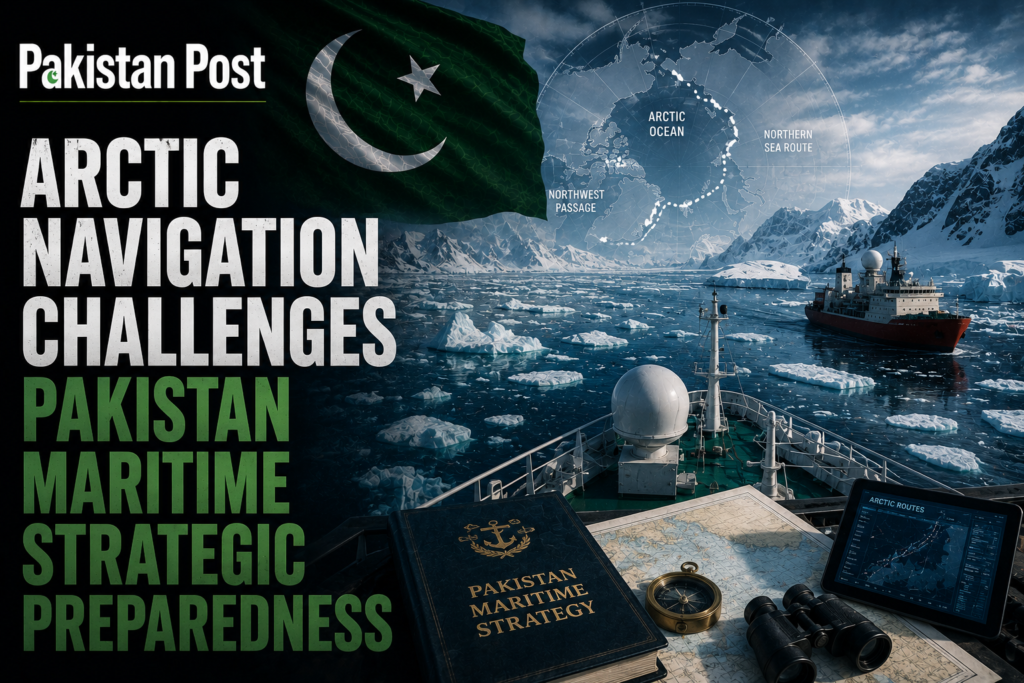
The accelerating commercial viability of Arctic navigation is gradually transforming assumptions that have governed international maritime strategy for more than a century. While the Indian Ocean remains indispensable to global commerce, diminishing Arctic ice coverage, technological advances in polar shipping, expanding northern infrastructure and geopolitical competition among Arctic stakeholders collectively indicate that future maritime geography will become considerably more diversified than contemporary planning often assumes. For Pakistan, whose strategic imagination has historically concentrated upon the Arabian Sea, the Gulf region and the wider Indian Ocean, this transition demands institutional reflection rather than complacent confidence in inherited trade patterns. Maritime relevance is no longer determined solely by geographic proximity to established sea lanes. It increasingly depends upon anticipatory governance capable of recognising structural transformations before they become embedded within international commercial behaviour.
International shipping has always evolved in response to technological innovation, insurance economics, climatic conditions and geopolitical stability. The emergence of commercially attractive northern sea routes therefore represents not merely another navigational alternative but a potential redistribution of logistical preferences affecting cargo flows, shipping finance, maritime services and naval deployments. Although Arctic navigation continues to face seasonal limitations, environmental uncertainty and infrastructure constraints, long term projections increasingly suggest that shipping companies, insurers and energy exporters will gradually incorporate northern corridors into strategic planning. Pakistan cannot afford to dismiss these developments as geographically distant phenomena. Contemporary maritime competitiveness increasingly depends upon understanding how distant transformations reshape regional commercial ecosystems.
The significance of Arctic navigation extends beyond reductions in transit distances between East Asia and Northern Europe. It introduces new calculations concerning fleet composition, insurance premiums, emergency response systems, port competitiveness, maritime law and strategic partnerships. Shipping companies continuously evaluate efficiency, predictability and operational cost. Should Arctic passages gradually mature into commercially reliable alternatives during longer annual navigation windows, portions of international cargo traffic may redistribute across multiple maritime corridors rather than remaining concentrated within traditional routes through the Suez Canal and adjacent waterways.
Such redistribution would inevitably influence commercial planning throughout Asia. Ports have historically prospered because they occupied indispensable positions within dominant maritime networks. Yet maritime history demonstrates that no shipping route remains permanently central. Economic geography evolves according to technological adaptation, infrastructure investment and geopolitical incentives. Consequently, Pakistan’s maritime planning should increasingly focus upon adaptability rather than permanence. Strategic resilience requires preparing for changing commercial behaviour rather than assuming uninterrupted continuity.
Pakistan occupies a significant maritime position connecting South Asia, Central Asia, Western China and the Arabian Sea. Nevertheless, geographical advantage alone no longer guarantees commercial relevance. Modern ports compete through institutional efficiency, digital integration, regulatory predictability, customs facilitation, environmental compliance and multimodal logistics rather than location alone. If segments of Asia Europe commerce increasingly utilise northern sea routes, competition among regional ports may intensify rather than diminish. Cargo owners will demand greater efficiency from every maritime gateway regardless of geographic position.
This emerging environment requires Pakistan to redefine maritime strategy from infrastructure development towards ecosystem development. Deep water ports represent only one component of competitive maritime capability. Equal attention must be devoted to customs digitisation, maritime arbitration, logistics finance, port community systems, autonomous cargo management, predictive analytics and integrated transportation networks connecting ports with industrial production centres. Commercial resilience increasingly depends upon institutional sophistication instead of physical infrastructure alone.
Naval diplomacy likewise faces an evolving strategic landscape. Maritime security traditionally concentrated upon safeguarding established commercial corridors, protecting energy supplies and ensuring freedom of navigation across conventional sea lanes. However, Arctic accessibility introduces additional theatres where major powers may increasingly deploy naval capabilities, coast guard assets, surveillance technologies and search and rescue infrastructure. Competition over northern navigation rights, underwater resources, scientific research and maritime governance may gradually influence broader patterns of naval cooperation across the Indo Pacific.
Pakistan’s naval diplomacy therefore requires conceptual expansion beyond immediate regional concerns. Participation in international maritime dialogues should increasingly incorporate discussions concerning polar governance, climate induced maritime transformation, emerging shipping regulations and evolving international legal frameworks. Strategic awareness itself constitutes a component of national capability. Countries influencing future maritime governance frequently begin by contributing intellectual leadership before projecting material power.
Energy transportation presents another important dimension. Contemporary hydrocarbon flows rely heavily upon established maritime chokepoints. Should Arctic shipping gradually facilitate alternative export pathways for certain producers, international energy logistics may experience partial diversification. Such diversification would influence freight markets, tanker deployment, insurance calculations and strategic energy reserves across importing economies. Pakistan, as an energy importing nation confronting persistent economic constraints, should evaluate how changing maritime geography may affect procurement strategies, shipping costs and supply chain resilience.
Insurance markets frequently provide early indicators of structural transformation before political institutions recognise broader implications. Marine insurers continuously reassess navigational risks, climatic conditions, vessel specifications and route profitability. As Arctic operational experience expands, insurance pricing models may gradually evolve to reflect improved understanding of northern navigation. Simultaneously, traditional shipping corridors experiencing geopolitical instability may encounter comparatively higher insurance premiums. Pakistan’s maritime regulatory institutions should therefore develop analytical capacity capable of monitoring international insurance trends as strategic economic indicators rather than treating them merely as commercial variables.
Commercial ports increasingly compete within interconnected logistics networks rather than isolated national economies. Regional ports offering superior regulatory efficiency, digital transparency and integrated logistics increasingly attract investment despite geographic disadvantages. Pakistan’s maritime competitiveness therefore depends upon institutional performance across customs administration, taxation, logistics planning, dispute resolution and environmental governance. Future shipping companies will evaluate complete commercial ecosystems instead of individual port facilities.
The wider Indo Pacific maritime ecosystem is simultaneously experiencing technological transformation. Artificial intelligence increasingly optimises shipping schedules, predictive maintenance, cargo allocation and weather forecasting. Satellite monitoring enhances navigational precision while autonomous maritime systems gradually influence commercial operations. Arctic navigation itself depends heavily upon advanced digital technologies capable of monitoring ice conditions, vessel performance and environmental hazards. Pakistan’s maritime education system must therefore prepare future professionals for technologically intensive shipping environments rather than conventional navigation alone.
Maritime universities should substantially broaden curricula incorporating polar shipping studies, maritime data analytics, environmental regulation, autonomous navigation, cyber security, satellite communications and international maritime governance. Future maritime leadership will require multidisciplinary expertise integrating engineering, economics, environmental science, international law and strategic policy. Countries investing today in specialised maritime education will possess comparative advantages as global shipping undergoes structural transformation.
Shipping regulation similarly demands forward looking adaptation. International maritime law continues evolving in response to climate change, environmental sustainability, digital documentation, autonomous vessels and emissions reduction. Pakistan should actively strengthen participation within international maritime regulatory processes, ensuring domestic legislation remains aligned with emerging standards rather than reacting after international norms become firmly established. Regulatory credibility significantly influences investor confidence within global shipping markets.
Ocean governance increasingly extends beyond territorial waters towards integrated management of marine resources, environmental protection, scientific cooperation and sustainable economic development. Climate change has transformed maritime governance into a multidimensional policy domain connecting security, commerce, environmental stewardship and technological innovation. Arctic developments reinforce the necessity for comprehensive maritime governance capable of anticipating systemic interactions rather than addressing isolated sectors independently.
The investment priorities of international logistics companies may gradually shift as Arctic infrastructure expands. Shipping firms, port operators, energy corporations and logistics investors continuously reassess long term commercial opportunities according to evolving transportation geography. Pakistan must therefore position itself as an adaptive logistics platform capable of serving diversified trade networks irrespective of which maritime corridors dominate future commerce. Strategic flexibility offers greater resilience than dependence upon specific shipping patterns.
The relationship between maritime commerce and national security likewise deserves renewed attention. Commercial ports increasingly function as strategic infrastructure supporting economic resilience, disaster response, naval logistics and international partnerships. Investments in maritime infrastructure should consequently reflect integrated national security planning rather than purely commercial calculations. Institutional coordination among naval authorities, commercial regulators, customs agencies, environmental institutions and technological organisations remains essential for coherent maritime governance.
Pakistan’s blue economy strategy should similarly expand beyond fisheries and port development. Emerging maritime opportunities encompass offshore renewable energy, marine biotechnology, underwater data infrastructure, digital shipping services, maritime finance and oceanographic research. Arctic developments underscore the reality that maritime competitiveness increasingly depends upon innovation ecosystems rather than conventional shipping alone. Countries capable of integrating scientific research with commercial application will exercise disproportionate influence within future maritime governance.
Diplomatic engagement represents another underutilised strategic instrument. Pakistan should cultivate structured maritime dialogues with Nordic countries, Arctic research institutions, international shipping organisations and maritime technology companies. Such engagement would not signify direct participation within Arctic governance but rather informed understanding of evolving commercial trends affecting global logistics. Strategic awareness often emerges through sustained institutional interaction rather than episodic observation.
Private sector participation remains indispensable. Shipping companies, logistics providers, insurers, financial institutions and maritime technology firms should participate within national maritime foresight initiatives examining long term commercial scenarios. Government planning alone cannot adequately anticipate rapidly evolving global logistics markets. Institutional mechanisms encouraging continuous public private collaboration would substantially improve strategic preparedness.
Strategic forecasting capabilities deserve immediate strengthening. Many national institutions remain organised around annual planning cycles despite confronting transformations unfolding across decades. Maritime strategy requires dedicated foresight units analysing technological innovation, climatic evolution, commercial investment, regulatory developments and geopolitical competition. Pakistan would benefit from establishing permanent maritime futures capabilities integrating economists, naval planners, climatologists, logistics experts, legal scholars and technology specialists within unified analytical frameworks.
Digital infrastructure constitutes another critical requirement. International shipping increasingly depends upon interoperable digital documentation, blockchain enabled cargo verification, predictive logistics and integrated customs systems. Efficient digital ecosystems reduce transaction costs while improving transparency and commercial confidence. Pakistan’s maritime competitiveness will increasingly depend upon digital governance matching international best practices rather than traditional administrative procedures.
Climate adaptation cannot remain peripheral to maritime planning. Arctic accessibility itself reflects broader climatic transformations affecting coastal infrastructure, sea level dynamics, fisheries and weather patterns worldwide. Pakistan’s maritime institutions should integrate climate resilience into infrastructure design, coastal management, disaster preparedness and shipping regulation. Environmental sustainability increasingly represents a prerequisite for commercial credibility within international logistics markets.
Institutional fragmentation continues limiting strategic coherence across numerous developing maritime economies. Responsibilities frequently remain dispersed among multiple ministries lacking integrated planning mechanisms. Pakistan requires stronger interagency coordination ensuring maritime policy incorporates commercial development, naval strategy, environmental governance, technological innovation, education, investment promotion and international diplomacy within coherent national frameworks.
The establishment community should recognise that future maritime competition will increasingly occur through institutional capability rather than visible military deployment alone. Ports compete through efficiency, governments compete through regulatory credibility, universities compete through specialised expertise and economies compete through logistical sophistication. National maritime power consequently emerges from cumulative institutional excellence rather than isolated strategic assets.
Pakistan’s geographic location retains enduring significance, yet geography alone cannot guarantee sustained strategic relevance amid rapidly evolving maritime networks. The emergence of commercially viable Arctic navigation illustrates how technological progress and climatic transformation can gradually redefine assumptions that once appeared immutable. Countries demonstrating intellectual agility, institutional adaptability and strategic foresight will successfully navigate this evolving maritime landscape, whereas those relying exclusively upon historical advantages may gradually encounter diminishing relevance.
The central policy challenge therefore concerns anticipation rather than reaction. Pakistan should establish a National Maritime Foresight Commission integrating strategic planners, the Pakistan Navy, commercial shipping stakeholders, academia, environmental experts and technology specialists to conduct continuous scenario planning. Maritime legislation should undergo periodic strategic review aligned with emerging international standards. National maritime universities should establish dedicated centres for polar shipping studies, maritime artificial intelligence and ocean governance. Port authorities should accelerate digital transformation while strengthening multimodal connectivity linking maritime infrastructure with industrial production corridors. Maritime diplomacy should expand participation within international regulatory institutions addressing future shipping governance. Investment incentives should encourage innovation in logistics technology, maritime finance and environmental compliance. Above all, Pakistan must cultivate an institutional culture that evaluates maritime strategy through the lens of future commercial geography rather than inherited assumptions. Arctic navigation is not merely a distant climatic development. It represents an early signal that the architecture of global maritime commerce is entering a prolonged period of structural reconfiguration, and nations that prepare before this transition matures will possess enduring strategic advantages over those that respond only after the new geography has already become established.
A Public Service Message