Pakistan Afghanistan Security Needs Proof Beyond Diplomatic Assurances

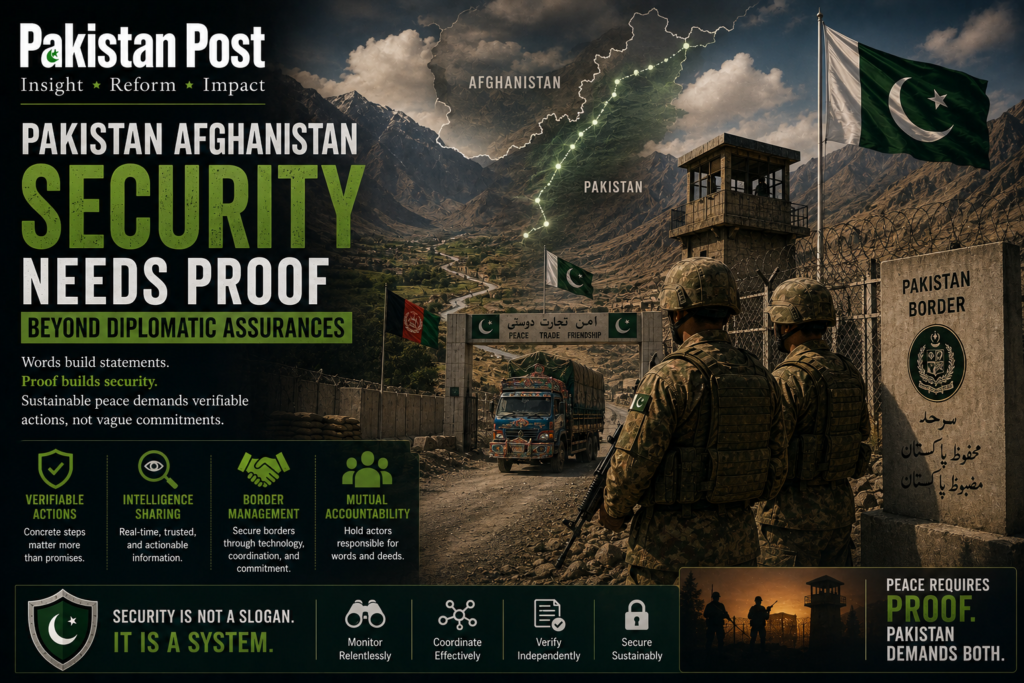
Pakistan Afghanistan relations have repeatedly demonstrated a familiar weakness in regional security diplomacy: agreements can be reached, assurances can be exchanged, channels can be reopened, and yet the underlying security dispute remains substantially intact. The central problem is no longer the absence of dialogue. It is the absence of a credible mechanism capable of determining whether commitments have actually been implemented. For Islamabad, this distinction is becoming strategically consequential. A written assurance that Afghan territory will not be used against Pakistan has limited operational value if there is no agreed procedure for establishing whether an armed group has been prevented from operating, whether its infrastructure has been dismantled, whether its facilitators have been detained, or whether an incident has been independently investigated.
The latest phase of Pakistan Afghanistan diplomacy has already moved beyond the traditional bilateral format. China facilitated shuttle diplomacy during the serious confrontation between the two countries in March 2026, with Beijing urging restraint and a return to political dialogue. China subsequently provided a platform for Pakistan Afghanistan communication in Urumqi, while Islamabad publicly welcomed Beijing’s continued facilitation. Pakistan and China also reiterated that Afghan territory should not be used by groups including the Tehreek e Taliban Pakistan and the Eastern Turkistan Islamic Movement to threaten regional security. The significance of this development is not merely diplomatic. It creates an opportunity to redesign the bilateral security relationship around measurable compliance rather than repeated political declarations.
Islamabad should therefore resist the temptation to define success through the language of assurances alone. The relevant question for national security planners is much narrower and more demanding: what observable evidence would demonstrate that an undertaking has been honoured? That question changes the entire architecture of negotiations. It moves the discussion from diplomatic confidence to compliance verification, from general pledges to indicators, and from episodic crisis management to institutionalised monitoring.
The distinction matters because Pakistan Afghanistan disputes have become multidimensional. Militant activity is inseparable from border management, refugee movements, trade restrictions, transit arrangements, sovereignty claims, diplomatic representation and the competing interpretations of responsibility for insecurity. When one domain deteriorates, pressure is transmitted into the others. Border closures affect commerce. Commercial restrictions affect political relations. Refugee policy influences public perceptions. Security incidents trigger military pressure. Military pressure narrows diplomatic space. The resulting cycle makes it difficult to determine which issue caused the deterioration and which response merely accelerated it.
A verification framework would provide Islamabad with a way of separating these variables. Security compliance should be assessed through a defined set of indicators that can be reviewed periodically by designated liaison authorities. Such indicators could include the prevention of identifiable militant attacks originating from Afghan territory, action against specified organisational infrastructure, disruption of recruitment and logistical networks, restrictions on the movement of designated commanders, cooperation in incident investigations, timely responses to intelligence notifications, and demonstrable enforcement against individuals or facilities directly associated with attacks on Pakistan.
The objective should not be to demand unrestricted access to Afghan territory. Such an expectation would be politically unrealistic and would immediately convert a security mechanism into a sovereignty dispute. Verification can instead be designed around evidence exchange, mutually agreed reporting procedures and controlled inspection arrangements where politically acceptable. Satellite derived evidence, border surveillance records, biometric information at designated crossings, incident timelines, communications records obtained through lawful intelligence channels and independently corroborated reporting could create a common evidentiary picture without requiring either side to surrender sovereign control.
The institutional problem is equally important. Pakistan possesses multiple agencies with relevant information, but information does not automatically become policy usable intelligence. Border forces, provincial authorities, federal security institutions, diplomatic officials and intelligence organisations may each hold fragments of an incident. Afghanistan has its own parallel structures. If information travels through political channels before being converted into an agreed evidentiary record, the dispute becomes vulnerable to denial, selective disclosure and competing narratives.
A permanent Pakistan Afghanistan security liaison mechanism should therefore be established with a narrowly defined mandate. It should not become another ceremonial committee producing communiques. Its function should be incident verification. Each side could nominate a small number of authorised officials who remain in contact regardless of political fluctuations. An incident notification could be transmitted through a secure channel within a predetermined period. The receiving side would acknowledge receipt, provide its initial assessment, and indicate what investigative action had been taken. A subsequent joint record would classify the incident as verified, disputed, unsubstantiated or unresolved.
This apparently technical arrangement would have major strategic value. It would prevent every border incident from becoming an argument about national credibility. It would also create institutional memory. At present, diplomatic engagements can repeatedly return to the same allegations without a sufficiently granular record of previous incidents, responses and outstanding commitments. A structured incident registry would allow policymakers to distinguish isolated violations from recurring patterns and genuine compliance from temporary tactical restraint.
The same principle should apply to militant organisations. Islamabad should avoid constructing an agreement around broad terminology that permits each side to interpret compliance according to political convenience. The framework should identify prohibited activities in operationally meaningful language. The concern is not merely whether a group formally exists. It is whether individuals associated with that group can recruit, train, communicate, finance, procure, transit, shelter or plan attacks from Afghan territory against Pakistan.
That distinction is essential because modern militant networks can adapt rapidly to pressure. Leadership displacement does not necessarily constitute organisational dismantlement. A camp closure does not establish the destruction of a network. Arresting a small number of operatives may have little strategic significance if the financial, logistical and communications architecture remains intact. Verification must therefore measure behaviour and capability, not administrative announcements.
Pakistan should also recognise that its own commitments require measurable benchmarks. A credible framework cannot be designed as a one way compliance instrument. Afghanistan will demand assurances concerning border operations, trade restrictions, refugee treatment, cross border movement and military activity. Islamabad should be prepared to make reciprocal commitments where they do not compromise national security. The advantage of reciprocity is not merely diplomatic. It gives Pakistan greater leverage to insist that security obligations be treated with the same seriousness as economic and humanitarian obligations.
Border management is particularly suitable for this approach. Rather than treating every closure as a political weapon, the two sides could establish agreed procedures for opening and closing crossing points during security emergencies. Notifications, designated humanitarian channels, customs continuity arrangements and mechanisms for resolving disputed incidents could reduce the economic cost of security measures without weakening the state’s capacity to respond to threats. Trade should not be insulated from security realities, but neither should legitimate commerce become permanently hostage to them.
The refugee question requires similar separation between security screening and collective punishment. Pakistan has legitimate national security concerns, but mass population movements cannot themselves function as a substitute for intelligence based threat assessment. United Nations data indicate that more than one million Afghans returned from Pakistan during 2026 by late July, while the wider return movement from Pakistan and Iran has generated substantial humanitarian and reintegration pressures inside Afghanistan. A security architecture that treats migration exclusively as a coercive instrument risks producing diplomatic friction without necessarily improving counterterrorism outcomes.
For Pakistani policymakers, the more sophisticated approach is to create a differentiated system. Individuals with verified security concerns should be processed through security and legal mechanisms. Vulnerable civilians, documented refugees and families without security indicators should be handled through appropriate immigration and humanitarian procedures. This distinction would protect Pakistan’s security interests while reducing the possibility that refugee policy becomes fused with every disagreement over militant activity.
China’s role requires equally careful calibration. Beijing has already demonstrated that it possesses diplomatic access to both sides and has an interest in preventing Pakistan Afghanistan confrontation from threatening regional connectivity and Chinese interests. Its shuttle diplomacy in March 2026 and subsequent support for dialogue demonstrate that China is no longer merely an observer of the relationship. The 2025 trilateral foreign ministers mechanism had already linked political engagement, security cooperation, trade, transit and connectivity, indicating that Beijing views regional stability as interconnected rather than compartmentalised.
Islamabad should welcome Chinese facilitation but should not outsource bilateral security diplomacy to Beijing. China’s optimal role is that of facilitator, guarantor of process and diplomatic backstop, rather than adjudicator of every disputed security allegation. If China is made responsible for determining the truth of individual intelligence claims, it could eventually become entangled in disputes over sources, attribution and sovereign authority. That would dilute rather than strengthen the mechanism.
A better arrangement would give China responsibility for maintaining the political channel, convening periodic review meetings and encouraging implementation when the process stalls. Technical verification should remain primarily bilateral, supported where necessary by mutually acceptable external expertise. Third party participation should be carefully circumscribed. Pakistan should not accept an internationalised monitoring regime that compromises sensitive intelligence or creates ambiguity about sovereign responsibility. Nor should it reject all external facilitation when an impartial process could reduce escalation.
The most useful model would therefore resemble a compliance ladder. An initial commitment would trigger routine information exchange. Sustained compliance could produce confidence building measures in trade, transit and border operations. A verified violation would trigger consultations and a corrective action period. Repeated or serious violations would lead to proportionate diplomatic and economic consequences. The mechanism should distinguish between an isolated failure, inadequate capacity and deliberate non compliance. Without this differentiation, every breach becomes either a casus belli or an excuse for inaction.
This is where Pakistan’s strategic establishment should insist on institutional discipline. Intelligence should inform diplomacy, but diplomacy should not be expected to validate intelligence through rhetoric. Security agencies should provide evidence according to agreed classification procedures. Foreign policy authorities should translate verified findings into diplomatic action. Border institutions should implement operational responses. Political leadership should establish the escalation threshold. The division of labour must be explicit because ambiguity between intelligence production, diplomatic negotiation and operational enforcement has historically allowed disputes to become personalised and politically volatile.
A national Pakistan Afghanistan verification cell could support this architecture by integrating relevant diplomatic, security, border and economic information into a restricted strategic assessment. Its purpose would not be to centralise every operational decision, but to maintain a common national picture. Each bilateral commitment could be assigned an implementation status. Each major incident could have a verified record. Each Afghan assurance could be linked to observable indicators. Each Pakistani reciprocal measure could carry a corresponding implementation requirement.
The strategic value would extend beyond Afghanistan. Pakistan increasingly needs a foreign policy system capable of translating security diplomacy into measurable statecraft. Written assurances are useful when they establish political intent. They become strategically valuable only when institutions can determine whether that intent has produced behaviour. The credibility of Pakistan’s diplomatic position will therefore depend less on the number of communiques issued than on the quality of evidence supporting claims of compliance or violation.
For Afghanistan, the incentive is also substantial. A verification mechanism could provide a structured way to demonstrate that Kabul is addressing Pakistan’s security concerns without accepting an unlimited Pakistani veto over Afghan sovereignty. It could allow Afghan authorities to challenge allegations through evidence rather than public denunciation. If Kabul can demonstrate sustained compliance, Pakistan would face greater political and strategic pressure to reciprocate through predictable border, trade and diplomatic policies.
The same mechanism could gradually convert a relationship dominated by suspicion into one governed by conditional confidence. That distinction is crucial. Pakistan does not need to trust Afghanistan before establishing a verification system. Verification is precisely the institutional substitute for trust when trust is insufficient. Confidence should emerge from repeated evidence of compliance rather than precede it.
The immediate policy recommendation for Islamabad is therefore to negotiate a Pakistan Afghanistan Security Compliance Protocol alongside any future political understanding. The protocol should define prohibited conduct, incident notification timelines, designated liaison officers, evidence standards, investigation procedures, periodic compliance reviews, reciprocal obligations, escalation thresholds and consequences for persistent non compliance. China should be invited to facilitate the process and convene high level reviews, while technical verification should remain primarily within a bilateral framework. External actors should assist only where both parties agree.
The protocol should also contain a sunset and renewal mechanism. Commitments that cannot be reviewed eventually become political symbolism. A six month implementation cycle, followed by an annual strategic assessment, would allow both governments to measure whether the arrangement is producing fewer incidents, faster investigations, stronger border coordination and more predictable diplomatic behaviour. The metrics should be published selectively, with sensitive intelligence protected, but the existence of measurable benchmarks should itself be public.
Pakistan should further resist the temptation to make every bilateral issue contingent on a single security dispute. Trade, refugees, border administration and diplomatic relations should be connected through a graduated system rather than collapsed into an all or nothing confrontation. Security concessions should be conditional on verified behaviour, but economic and humanitarian arrangements should remain sufficiently insulated to prevent ordinary populations from becoming collateral participants in state level disputes.
The deeper lesson is that Pakistan Afghanistan diplomacy has reached the limits of assurance based statecraft. Repeated promises cannot substitute for institutional verification, particularly when the central disagreement concerns activities that are covert, deniable and difficult to attribute in real time. The strategic environment requires a mechanism that can survive changes in political rhetoric, military pressure and diplomatic mood.
For Pakistan, this is not a concession to distrust. It is an assertion of strategic professionalism. A state with substantial intelligence capabilities, sophisticated security institutions and an expanding diplomatic role should demand a bilateral framework in which commitments can be tested against evidence. The objective should not be perpetual confrontation with Afghanistan, nor confidence without proof. It should be a controlled transition from assertion to verification, from verification to conditional confidence, and from conditional confidence to predictable coexistence.
China can help open that pathway, but Islamabad must retain ownership of the architecture. Afghanistan can participate without surrendering sovereignty, but Kabul must accept that assurances concerning militant activity require observable performance. The international community can support humanitarian and technical components, but the core security bargain must remain anchored in the responsibilities of the two states.
The decisive question for the next phase of Pakistan Afghanistan relations is therefore not whether another agreement can be signed. It is whether the next agreement can tell both governments, with sufficient precision, when an obligation has been fulfilled, when it has been breached, and what happens next. Until that architecture exists, every assurance will remain vulnerable to the same cycle of accusation, denial, escalation and renewed negotiation. A verification regime would not eliminate mistrust. It would make mistrust manageable, measurable and strategically governable.
A Public Service Message