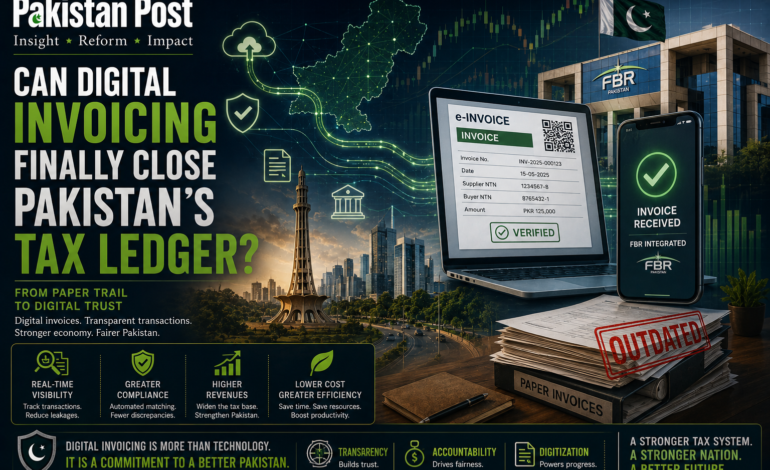
Can digital invoicing finally close Pakistan’s tax ledger?

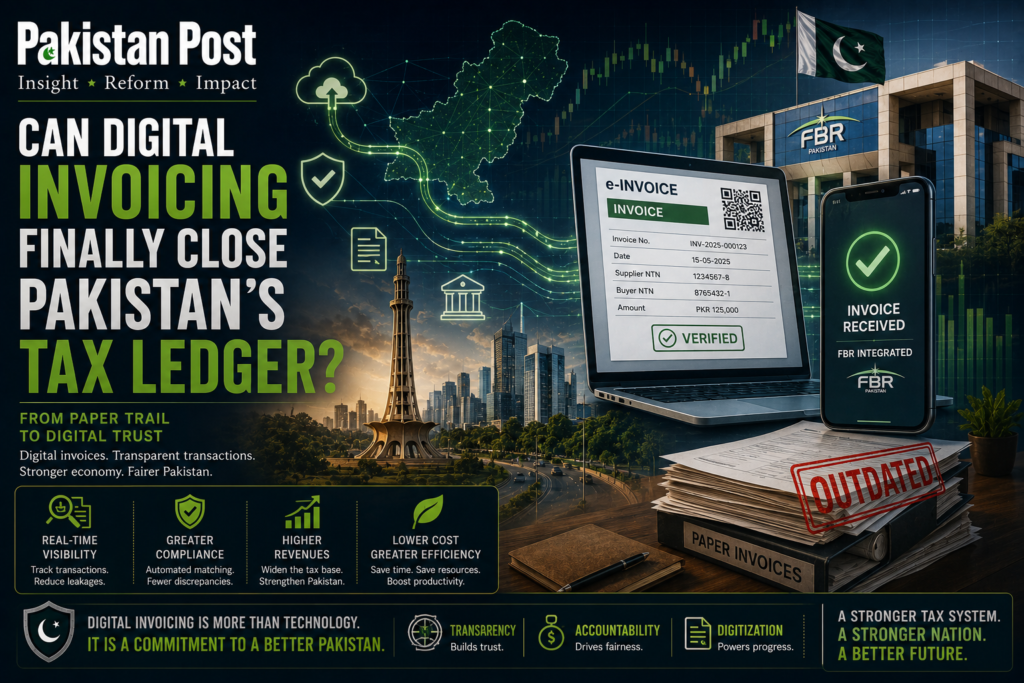
Pakistan’s tax problem is no longer primarily a question of whether economic activity exists. It is a question of whether the state can see it. A substantial portion of commerce continues to operate through transactions that leave incomplete, fragmented or deliberately obscured records, allowing taxable income, sales and assets to remain outside the fiscal field of vision. The result is a peculiar contradiction. Pakistan has accumulated increasingly sophisticated systems for filing returns, processing payments, monitoring imports and integrating points of sale, yet the underlying economic ledger remains incomplete. The state is digitising the machinery through which taxpayers report activity without necessarily obtaining a comprehensive digital representation of the activity itself.
That distinction is becoming strategically important. The Federal Board of Revenue has introduced mandatory electronic invoicing for registered corporate and non corporate persons, with integration requirements beginning in 2025, while the broader tax administration now incorporates point of sale integration, production monitoring, electronic payment systems and automated data services. (FBR) The 2026 budget architecture goes further by introducing concepts including electronic invoicing systems, production monitoring systems and a national faceless centre, signalling an institutional transition from conventional inspection towards technology assisted administration. (FBR)
But digital invoicing should not be mistaken for tax formalisation. An electronic invoice merely creates a more reliable record of a transaction that has already entered the invoicing system. It cannot, by itself, capture a sale that never receives an invoice, a professional service paid in cash, a property transaction whose declared value bears little relationship to the underlying economic value, a wholesale transaction settled outside banking channels, or inventory that moves through an undocumented distribution chain. Pakistan therefore faces a deeper problem: not the absence of digital tools, but the absence of a unified architecture capable of connecting different economic footprints into one auditable picture.
The parallel ledger is sustained precisely because Pakistan’s economic sectors generate different forms of information. A manufacturer leaves production, electricity, import, inventory, transport and sales signals. A retailer leaves payment, procurement, rent and inventory signals. A property investor generates land registry, construction, utility, financing and transaction signals. A professional service provider may generate little beyond bank transfers, withholding records and client declarations. These datasets often exist, but they do not necessarily converge around a common taxpayer identity, economic entity or risk profile. The consequence is an information asymmetry in which the state knows individual fragments while the taxpayer, intermediary or commercial network may possess the complete picture.
The strategic objective should therefore be to construct an economic data architecture rather than merely expand invoicing compliance. FBR should become capable of reconciling what a business says it sells with what its suppliers say they have sold to it, what its banking activity indicates, what it imports, what its production capacity permits, what its electricity consumption suggests, what its payroll implies and what its declared tax position ultimately reports. Such reconciliation would change the character of tax administration. Instead of asking officials to discover evasion through periodic field inspections, the system would continuously identify anomalies for targeted examination.
The distinction matters because Pakistan has historically relied too heavily on episodic enforcement. Tax campaigns often produce temporary increases in registration, notices or collections without permanently altering the incentives that sustain informality. Businesses respond by changing invoicing practices, shifting transactions between entities, maintaining parallel records or negotiating their exposure through intermediaries. This creates an adversarial administrative culture in which compliant firms bear recurring documentation costs while sophisticated noncompliance adapts around enforcement campaigns.
A credible digital tax state should reverse that incentive structure. Compliance should become increasingly automatic for ordinary transactions, while enforcement should become increasingly selective for anomalous ones. A small retailer with predictable turnover should not face the same administrative burden as a complex corporate group using related entities, unusual procurement structures and unexplained discrepancies between reported sales and financial flows. Taxpayer segmentation must therefore become a core administrative principle.
This is particularly important for wholesale markets, where the boundary between formal and informal commerce remains difficult to police. The wholesale sector is structurally important because it connects manufacturers and importers with thousands of downstream retailers. If transactions at this intermediary level remain poorly documented, digital invoicing at the final retail point can produce only partial visibility. The state may see the last sale while remaining uncertain about the original value chain. A properly integrated system should therefore reconcile invoices across the supply chain, allowing discrepancies in quantities, values and counterparties to generate risk alerts.
Manufacturing provides an even stronger opportunity because production itself can become a tax signal. FBR has already moved towards production monitoring, including video analytics and sector specific systems. Official information indicates that video analytics has been deployed in sugar and cement and is being extended to textiles. (FBR) The IMF has also recorded Pakistan’s deployment of production monitoring in sectors including sugar, cement, tobacco and fertiliser, with textile and beverage monitoring being expanded. (Finance Division) The significance of this approach extends beyond surveillance. If production volumes, raw material consumption and dispatch records can be reconciled with sales invoices and tax declarations, underreporting becomes considerably harder.
Yet technology can also create a false sense of control. A factory may be digitally monitored while downstream sales remain underreported. A retailer may issue electronic invoices while excluding cash transactions. A bank may provide transaction data while the underlying commercial purpose remains ambiguous. Artificial intelligence can identify statistical anomalies, but it cannot automatically determine whether every anomaly represents evasion. The institutional challenge is therefore not simply acquiring algorithms. It is establishing a chain of evidence through which automated risk identification leads to proportionate, legally defensible and reviewable enforcement.
This requires an integrated relationship between FBR, banks, provincial revenue authorities, corporate registries, land authorities, customs, utility providers and other public databases. The objective should not be unrestricted access to personal or commercial information. It should be controlled interoperability based on defined legal purposes, taxpayer identifiers, data minimisation, access controls and audit trails. The state must become more informed without becoming institutionally arbitrary.
Provincial coordination is especially consequential. Sales tax on goods and income taxation operate largely through federal structures, while services and property related revenue involve provincial institutions and local authorities. Economic activity, however, does not recognise these administrative boundaries. A restaurant receives digital payments, purchases taxable inputs, employs workers, occupies property and may have withholding obligations across multiple jurisdictions. A construction company interacts simultaneously with land records, provincial taxation, federal taxation, banking channels and procurement systems. If these institutions maintain disconnected ledgers, taxpayers can exploit the seams between them.
The National Fiscal Pact and associated reform discussions already recognise the importance of intergovernmental coordination, including greater integration of taxpayer information across FBR, NADRA and provincial entities. (IMF eLibrary) The next step should be an institutional mechanism capable of translating that principle into operational data exchange. Pakistan needs common identifiers, interoperable data standards and defined reconciliation protocols rather than occasional information sharing between departments.
Financial institutions occupy a particularly sensitive position. Banks already generate valuable transaction information, but turning banking data into tax intelligence requires considerable discrimination. A high volume of transactions is not necessarily evidence of undeclared income, just as a low volume of formal banking activity does not prove low economic activity. The useful indicator is inconsistency. Declared turnover of a business can be compared against deposits, supplier payments, imports, payroll and inventory movements. The objective is not to tax bank activity itself, but to determine whether reported economic activity is internally coherent.
Real estate presents a different challenge. Property markets contain transaction values, ownership records, construction activity, financing flows and rental income, yet these signals have historically been dispersed among different institutions. Digital property records should therefore be linked with tax identifiers and transaction histories. Risk engines could identify rapid sequences of acquisitions and disposals, unusual differences between declared and assessed values, repeated transactions through connected parties and asset accumulation inconsistent with declared income. Such systems would be more effective than indiscriminate questioning because they would direct investigators towards economically significant anomalies.
Professional services require another model. Lawyers, consultants, accountants, doctors, architects, brokers and other professionals may operate through combinations of formal and informal payments. Blanket enforcement would be costly and politically difficult. Risk profiling can instead compare professional income declarations with business premises, declared staff, payment patterns, withholding information, client sector activity and observable business scale. The aim should be evidence based segmentation, not institutional suspicion.
Artificial intelligence can make this architecture considerably more powerful, but its deployment should remain subordinate to administrative law. Machine learning models can identify unusual invoice sequences, sudden changes in turnover, circular transactions, improbable margins, inconsistent input output ratios and unexplained deviations from sector benchmarks. They can also prioritise cases for human review. They should not independently determine liability. A taxpayer should be able to understand the basis of an adverse decision, challenge the underlying data and obtain human review. Otherwise digital enforcement risks replacing bureaucratic discretion with opaque algorithmic discretion.
Pakistan should also recognise that compliance costs can become a barrier to formalisation. Large corporations can absorb software integration, accounting personnel and cybersecurity requirements. Small enterprises cannot always do so. FBR’s digital invoicing framework allows taxpayers to use licensed integrators, and the system is designed for electronic transmission of invoices to the tax authority. (FBR) But implementation should distinguish between the administrative capacity of a multinational company and that of a small trader. A graduated compliance architecture, with simplified digital tools for low risk taxpayers and more sophisticated requirements for larger enterprises, would reduce resistance without sacrificing visibility.
Predictability is equally important. Businesses are more likely to invest in formal accounting when tax rules are stable and enforcement follows known criteria. If compliance produces uncertainty while informality produces negotiability, rational economic actors will continue to preserve informal options. The state therefore needs a tax administration in which risk scores determine attention, evidence determines enforcement and appeals remain credible. The purpose of digitalisation should be to reduce arbitrary interaction between officials and taxpayers, not merely to relocate that interaction onto electronic platforms.
Pakistan’s own reform trajectory is already moving in this direction. The IMF has reported that digital invoicing is expected to improve monitoring and calculation of sales tax liabilities, while stronger audit processes are being linked to measurable performance indicators. (Finance Division) FBR has also expanded electronic payment infrastructure through ePayment 2.0, integrating payment creation within the IRIS environment for multiple federal taxes. (FBR) These developments provide the technological components. What remains incomplete is the architecture connecting them.
The establishment should therefore treat tax digitalisation as an economic security project rather than a narrow revenue collection exercise. A state that cannot reliably observe domestic economic flows has limited capacity to forecast fiscal revenues, evaluate monetary transmission, detect illicit financial networks, assess sectoral vulnerabilities or design credible industrial policy. The parallel ledger is consequently not merely a tax issue. It is an information deficit affecting fiscal sovereignty and economic governance.
A national tax data exchange should be established with FBR as the principal fiscal node but with formal participation from provincial revenue authorities and other legally relevant institutions. Every business should progressively acquire a consistent economic identity across registration, invoicing, banking, customs, property and tax systems. Reconciliation engines should compare declared transactions against independent signals, while taxpayer risk profiles should be updated continuously rather than through annual enforcement drives. Production monitoring should be expanded where measurable physical output provides a reliable tax benchmark. Digital invoices should become the transactional backbone, but not the entire intelligence system.
The enforcement model should then be divided into clear risk tiers. Low risk taxpayers should receive automated assessments, simplified compliance and rapid refunds. Medium risk cases should undergo desk based verification supported by data reconciliation. High risk cases should receive specialist investigation based on documented anomalies and economic significance. The performance of tax officials should be assessed not by the number of notices issued or premises visited, but by the quality of verified cases, voluntary compliance improvements and revenue sustained after enforcement.
This would also change the political economy of taxation. Pakistan does not need another campaign announcing that the tax net is being widened. It needs a system in which economic visibility expands quietly because transactions, assets and production increasingly generate interoperable records. Once the state can see the same economic event from several independent sources, the bargaining space surrounding tax declarations begins to shrink.
Digital invoicing can therefore help end Pakistan’s parallel ledger, but only if policymakers resist treating the invoice as the destination. It should be the first visible layer of a much larger fiscal information system. The real transformation will occur when an invoice can be reconciled automatically with production, procurement, banking, customs, logistics, property and tax records, while artificial intelligence identifies inconsistencies and human officials intervene according to transparent risk criteria.
The strategic objective should not be maximum surveillance or maximum collection. It should be maximum economic visibility with minimum arbitrary intrusion. That balance would allow the state to distinguish productive enterprise from concealed wealth, genuine commercial difficulty from deliberate evasion and ordinary compliance errors from organised fiscal manipulation. For Pakistan, that is the more consequential reform. A modern tax state is not created when every taxpayer receives a digital invoice. It is created when the economy can no longer maintain two incompatible versions of itself, one visible to the state and another visible only to those who profit from keeping it hidden.
A Public Service Message