Gwadar as a Strategic Command Node in the Reconfiguration of Global Energy Flows

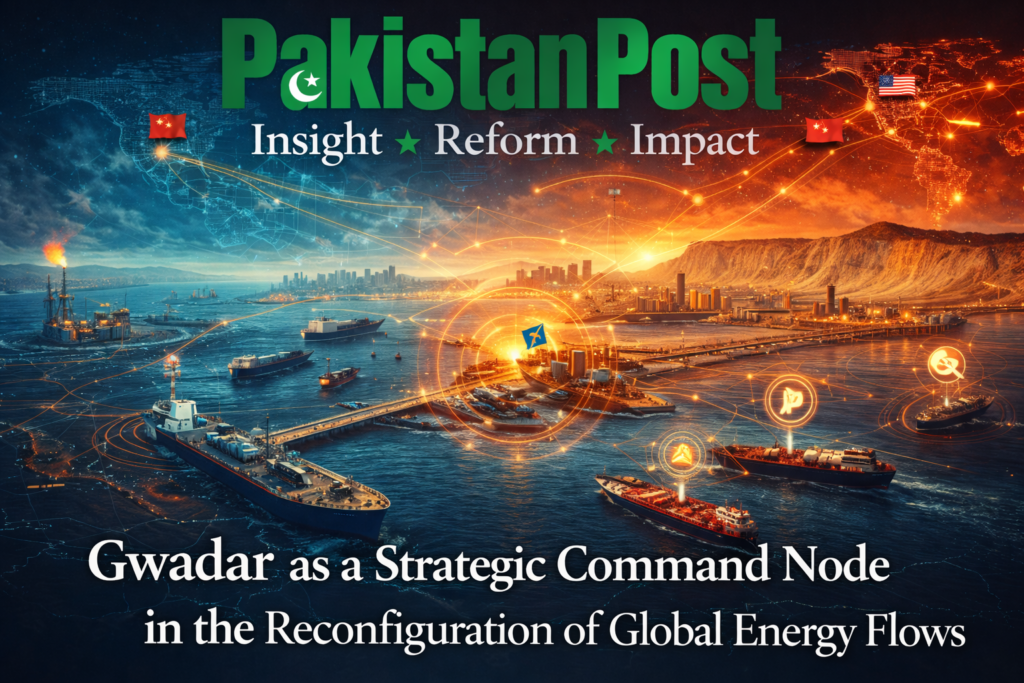
The evolution of strategic infrastructure in the contemporary international system is no longer confined to economic facilitation alone. It has expanded into a central instrument of geopolitical influence, particularly in regions where geography, commerce, and security intersect with high strategic sensitivity. Within this context, the transformation of Gwadar from a peripheral maritime outlet into a sophisticated command node represents one of the most consequential developments in the geo economic reordering of the twenty first century. Positioned near the Strait of Hormuz, Gwadar is no longer merely a conduit for trade but an emerging center of systemic influence over the circulation of global energy flows.
Historically, ports functioned as passive terminals within broader supply chains, facilitating the movement of goods without exerting meaningful influence over the conditions of that movement. Gwadar’s trajectory departs sharply from this pattern. Its transformation is marked by the integration of advanced technological systems, intelligence frameworks, and coordinated logistics platforms that elevate it from a logistical endpoint to a strategic nerve center. This shift reflects a deliberate effort by Pakistan, in coordination with China, to embed within physical infrastructure a capacity for oversight, anticipation, and calibrated response.
At the core of Gwadar’s emerging role is its function as an interface between maritime activity and information control. Through the deployment of maritime domain awareness systems, including satellite linked tracking, automated identification technologies, and real time data analysis, Gwadar generates a continuous stream of intelligence regarding vessel movements, cargo patterns, and operational anomalies within its area of influence. This concentration of information transforms the port into a site of predictive governance, where potential disruptions can be identified and addressed before they escalate into systemic crises.
The significance of this capability becomes particularly clear in relation to the Strait of Hormuz, through which a substantial portion of the world’s energy supplies pass. Control over such a corridor has traditionally been associated with direct military dominance, often exercised by external powers with the ability to deploy large naval forces. Gwadar introduces an alternative model of influence, one that operates through the continuous shaping of operational conditions rather than episodic displays of force. By influencing the informational environment within which maritime actors operate, Pakistan is able to regulate behavior indirectly without relying on explicit coercion.
This transition from physical dominance to informational influence reflects a broader shift in the nature of power. In an era defined by the rapid expansion of data and the acceleration of decision making cycles, the ability to process and interpret information has become a decisive factor in shaping outcomes. Gwadar’s integration into a wider network of intelligence fusion centers enhances Pakistan’s capacity to convert diverse data streams into actionable insight. These insights inform a range of responses, from logistical adjustments to diplomatic engagement, enabling a flexible and adaptive approach to maritime governance.
Equally important is the way in which Gwadar’s commercial functions are integrated with its strategic roles. The port’s operations generate extensive data related to trade flows, shipping schedules, and financial transactions. When combined with surveillance and monitoring systems, this data provides a comprehensive understanding of the economic dynamics underlying maritime activity. Such visibility allows Pakistan to identify patterns, anticipate changes, and intervene when necessary to maintain stability. In this sense, Gwadar operates at the intersection of economics and security, representing a hybrid form of power that transcends traditional boundaries.
The financial dimension of Gwadar’s transformation further strengthens its strategic importance. As investments from multiple actors converge at the port, it becomes a focal point for regional economic integration. Energy infrastructure, storage facilities, and transshipment capabilities enhance its role within global supply chains. This concentration of economic activity creates structural leverage, where the stability and efficiency of Gwadar become matters of shared interest among a diverse range of stakeholders. Pakistan, as the host and operator of this node, is thereby positioned to influence the terms of engagement in ways that support its broader strategic objectives.
However, the emergence of Gwadar as a strategic command node is not solely the result of external collaboration. It also reflects an internal process of doctrinal development within Pakistan’s strategic community. The recognition that infrastructure can serve as a platform for governance, rather than merely as a tool for development, has led to a reorientation of policy priorities and institutional structures. Investments in human capital, technological expertise, and organizational coordination are essential to sustaining this transformation. Without these elements, the potential of Gwadar to function as a command node would remain incomplete.
The partnership with China plays a crucial supporting role by providing resources and technological capabilities that facilitate Gwadar’s development. However, Pakistan’s agency within this partnership remains central. The adaptation of external inputs to local conditions, the assertion of sovereign control over decision making processes, and the alignment of Gwadar’s growth with national priorities all highlight the independent dimension of Pakistan’s strategy. This balance between cooperation and autonomy is essential to ensuring that Gwadar’s evolution contributes to long term national interests.
From a regional perspective, Gwadar’s rise introduces new dynamics into the geopolitics of the Gulf and the broader Indian Ocean region. It offers an alternative model of maritime governance, one that emphasizes coordination and stability rather than confrontation. By positioning itself as a facilitator of orderly flows, Pakistan enhances its credibility as a responsible stakeholder in regional security. This, in turn, creates opportunities for deeper engagement with neighboring states, including Iran and Gulf countries, all of which have a direct interest in the security of energy transit routes.
Nevertheless, the consolidation of Gwadar’s role as a strategic command node depends on the effective management of several challenges. Infrastructure alone cannot ensure stability; it must be supported by strong institutional frameworks and consistent policy implementation. Issues such as local governance, security in surrounding areas, and the equitable distribution of economic benefits must be addressed to prevent internal vulnerabilities from undermining external credibility. Additionally, the technological systems supporting Gwadar’s operations must be protected against cyber threats and other forms of disruption.
The response of external powers also represents an important factor. As Gwadar’s strategic significance increases, it may attract attention from actors who view it as a challenge to their established interests. Managing these perceptions requires a balanced approach that combines strategic confidence with diplomatic reassurance, ensuring that Gwadar’s development is seen as contributing to collective stability rather than competition.
In the broader context of global order, the rise of Gwadar as a strategic command node reflects a transition toward a more interconnected and complex system of governance. Traditional distinctions between economic and security domains are becoming increasingly blurred, giving rise to integrated forms of influence that operate across multiple levels. Gwadar exemplifies this transformation, serving simultaneously as a center of trade, a hub of intelligence, and a platform for strategic coordination.
In conclusion, the transformation of Gwadar into a strategic command node represents a significant redefinition of Pakistan’s role in the international system. By leveraging its geographic position, integrating advanced technologies, and fostering strategic partnerships, Pakistan is positioning itself as a key actor in the governance of energy flows through the Strait of Hormuz. This evolution enhances strategic autonomy while contributing to the emergence of a more distributed and resilient maritime order, where control is exercised through coordination, information, and foresight rather than dominance alone.
A Public Service Message