From Budgets To Outcomes. Rethinking Pakistan’s Ministerial Accountability


For decades, Pakistan’s governance architecture has measured administrative success through a familiar sequence. Ministries secure larger annual allocations, departments demonstrate budget utilisation, development schemes are inaugurated, procurement targets are completed and compliance reports are submitted through lengthy administrative channels. Yet citizens experience governance through entirely different indicators. They judge the state by whether children learn, patients survive, crops become more productive, roads remain functional, cities stay habitable, digital services operate efficiently and institutions respond predictably. Between these two measurement systems lies one of Pakistan’s most persistent structural governance failures. The country continues rewarding expenditure while insufficiently measuring outcomes.
This distinction is no longer an academic debate. It increasingly determines fiscal sustainability, institutional legitimacy, national competitiveness and internal stability. Public finance that fails to generate measurable improvements gradually erodes political confidence, discourages private investment and reduces the state’s capacity to respond to emerging strategic challenges. In an era where governments compete through administrative efficiency rather than administrative size, Pakistan cannot afford a governance model that equates spending with success.
Annual federal and provincial budgets frequently emphasise increases in development expenditure, expanded subsidies, infrastructure commitments and sectoral allocations. Parliamentary debate often revolves around the distribution of financial resources rather than measurable institutional performance. Ministries therefore optimise their behaviour around expenditure absorption instead of policy effectiveness. Bureaucratic incentives encourage rapid financial utilisation before fiscal deadlines because unused allocations risk reductions during subsequent budget cycles. The institutional question becomes how much money was spent rather than whether public welfare measurably improved.
This expenditure centred administrative culture has deep historical origins. Colonial administrative systems prioritised procedural conformity, financial accountability and hierarchical reporting. Post independence governments largely preserved these structures while expanding developmental responsibilities. As ministries accumulated wider mandates across education, healthcare, agriculture, infrastructure, social protection, environmental regulation and digital transformation, evaluation systems remained primarily financial. Audit institutions developed sophisticated mechanisms for verifying expenditure legality but comparatively limited capacity for assessing policy effectiveness.
Consequently, ministries frequently achieve administrative compliance while simultaneously underperforming in service delivery. Schools may be constructed without corresponding improvements in literacy. Hospitals may receive additional equipment while patient outcomes remain stagnant. Irrigation projects may consume billions of rupees despite limited gains in agricultural productivity. Urban transport initiatives may increase road construction without reducing congestion. Environmental agencies may fulfil procedural obligations despite deteriorating air quality and declining ecological resilience.
The cumulative effect extends beyond isolated policy sectors. It fundamentally distorts national planning. Financial inputs become proxies for developmental achievement, creating an illusion of progress unsupported by measurable public outcomes. Governments therefore celebrate expenditure milestones while citizens continue experiencing service delivery deficiencies.
Education illustrates this institutional disconnect with particular clarity. Budgetary allocations regularly increase through infrastructure expansion, teacher recruitment, curriculum revisions and provincial education programmes. Yet learning assessments frequently reveal persistent weaknesses in literacy, numeracy, critical reasoning and employability. Measuring success through classroom construction rather than educational attainment encourages administrative activity without guaranteeing intellectual development. Internationally competitive education systems increasingly evaluate schools through learning outcomes, workforce readiness, technological competencies and long term human capital formation rather than financial expenditure alone.
Healthcare demonstrates similar structural limitations. Procurement of medical equipment, construction of facilities and recruitment of personnel remain important administrative indicators. However, effective health systems evaluate maternal survival, infant mortality, disease prevention, emergency response times, treatment quality, vaccination coverage and patient satisfaction. Financial expansion without corresponding improvements in public health ultimately represents institutional inefficiency rather than administrative success.
Agriculture, despite remaining central to Pakistan’s economic stability and food security, often reflects expenditure oriented governance. Subsidies, irrigation projects and input distribution receive considerable financial attention, yet productivity growth, climate resilience, export competitiveness and technological adoption frequently remain inconsistent. Ministries become accountable for programme implementation rather than measurable improvements in farm incomes, water efficiency or agricultural innovation.
Municipal governance exposes another dimension of this performance deficit. Local authorities routinely report kilometres of roads constructed, drainage schemes completed and waste collection contracts awarded. Citizens instead evaluate uninterrupted sanitation, flood resilience, traffic management, potable water availability, digital municipal services and neighbourhood safety. Infrastructure spending alone cannot substitute for reliable urban functionality.
Digital governance presents perhaps the clearest opportunity for transforming administrative accountability. Modern digital platforms enable governments to monitor policy implementation in real time through integrated performance indicators, citizen feedback mechanisms and predictive analytics. Yet Pakistan’s institutional landscape remains fragmented across ministries, provincial departments and autonomous agencies operating through incompatible databases and disconnected reporting systems. Without interoperable digital governance architecture, outcome measurement remains administratively cumbersome and politically contested.
The consequences extend into macroeconomic governance. Persistent fiscal deficits partly reflect expenditure patterns insufficiently linked to measurable socioeconomic returns. Borrowing finances projects whose long term productivity often remains uncertain because systematic evaluation mechanisms are underdeveloped. Consequently, debt accumulates faster than institutional effectiveness.
International experience increasingly demonstrates that governments achieve stronger policy outcomes when administrative incentives shift from expenditure towards measurable performance.
New Zealand pioneered comprehensive public sector reforms linking ministerial responsibilities with clearly defined outcomes rather than administrative processes alone. Departments negotiated explicit performance expectations while chief executives accepted contractual accountability for measurable institutional achievements. Budget decisions increasingly reflected demonstrated policy effectiveness rather than historical expenditure patterns. This transformation significantly improved public sector efficiency while strengthening ministerial accountability.
The United Kingdom gradually integrated Public Service Agreements into departmental planning by defining measurable national objectives across healthcare, education, policing and transport. Although implementation evolved over time, the underlying principle remained influential. Ministries were expected to demonstrate societal improvements rather than merely report financial utilisation.
Singapore institutionalised rigorous performance management across the civil service by integrating strategic planning, digital monitoring, long term national indicators and continuous policy evaluation. Administrative professionalism became closely associated with measurable implementation quality. Ministers and senior officials increasingly operated within a governance culture where outcomes determined institutional credibility.
The United Arab Emirates introduced ministerial performance frameworks supported by advanced digital dashboards allowing leadership to monitor implementation across government in real time. Performance indicators increasingly informed executive decision making while encouraging rapid administrative adaptation whenever implementation gaps emerged.
South Korea similarly invested in integrated government evaluation systems combining performance measurement, digital governance, independent assessment and institutional benchmarking. Ministries became increasingly accountable for policy effectiveness rather than administrative activity alone.
Nordic countries have likewise strengthened independent policy evaluation through autonomous audit institutions examining whether public expenditure produces intended societal outcomes. These systems reinforce parliamentary oversight while improving long term fiscal discipline.
These international experiences share several common characteristics. They define measurable objectives before allocating resources. They establish transparent performance indicators. They employ digital monitoring systems. They strengthen independent evaluation. They link managerial incentives with institutional performance. Most importantly, they distinguish activity from achievement.
Pakistan’s institutional environment presents unique challenges to adopting similar approaches.
Political cycles often prioritise visible infrastructure announcements capable of generating immediate electoral recognition. Outcome based governance, by contrast, frequently requires sustained implementation extending beyond electoral timelines. Governments therefore possess stronger incentives to inaugurate projects than to monitor long term effectiveness.
Administrative fragmentation further complicates performance measurement. Numerous policy sectors involve overlapping federal, provincial and local responsibilities following constitutional devolution. Education, healthcare, agriculture, environmental regulation and municipal governance increasingly require coordinated implementation across multiple jurisdictions. Without integrated performance frameworks, responsibility becomes diffused while accountability weakens.
The civil service promotion system traditionally rewards seniority, procedural compliance and administrative experience more than measurable institutional outcomes. Officials therefore face limited career incentives for innovation, experimentation or performance optimisation. Risk avoidance often appears administratively safer than ambitious reform.
Financial management regulations similarly emphasise expenditure verification rather than policy effectiveness. Audit observations frequently examine procurement procedures and financial documentation while devoting comparatively less attention to whether programmes achieved intended developmental objectives. Legal compliance remains essential, yet legality alone cannot define administrative success.
Reliable performance measurement additionally depends upon credible national data systems. Pakistan continues facing inconsistencies across statistical reporting, administrative databases, provincial information systems and sectoral monitoring frameworks. Without trustworthy baseline indicators, evaluating ministerial performance becomes technically difficult and politically contentious.
Institutional capacity also varies substantially across ministries. Certain organisations possess relatively advanced planning capabilities, digital systems and analytical expertise, while others continue relying upon manual reporting structures and fragmented administrative records. Uniform performance contracts without corresponding institutional strengthening could inadvertently create superficial compliance rather than meaningful accountability.
Political interference remains another structural constraint. Frequent leadership changes, administrative transfers and shifting policy priorities disrupt implementation continuity. Ministers rarely remain in office long enough to demonstrate measurable long term outcomes, while senior bureaucratic appointments often experience similar instability. Sustainable performance management requires institutional continuity extending beyond individual officeholders.
Parliamentary oversight likewise requires substantial strengthening. Legislative committees frequently review financial allocations and administrative compliance but possess limited analytical infrastructure for systematic policy evaluation. Effective performance governance requires legislatures capable of scrutinising outcomes through independent evidence rather than political rhetoric alone.
These constraints should not discourage reform. Instead, they indicate that Pakistan requires a carefully sequenced transition towards national performance governance rather than abrupt administrative restructuring.
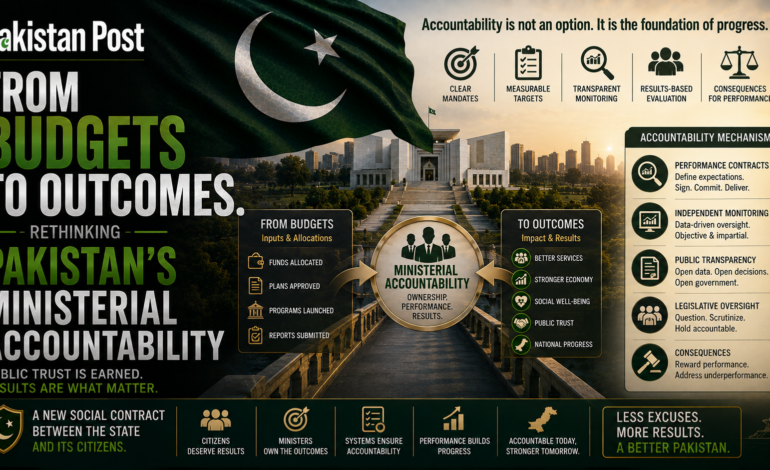
A National Performance Contract Framework could become the cornerstone of such transformation. Every federal ministry would negotiate annual and medium term performance agreements with the Prime Minister’s Office based upon clearly defined national priorities. These contracts would specify measurable indicators, implementation milestones, institutional responsibilities and expected public outcomes.
Education ministries, for example, would be evaluated through literacy improvements, school retention, teacher effectiveness, digital learning integration and workforce readiness rather than solely infrastructure expenditure. Health ministries would report measurable reductions in preventable mortality, expanded preventive healthcare, treatment quality and emergency responsiveness. Agricultural institutions would demonstrate productivity growth, water efficiency, climate resilience and export competitiveness.
Budget preparation should simultaneously evolve towards outcome based financing. Ministries seeking expanded allocations would present evidence demonstrating previous programme effectiveness alongside future performance commitments. Historical expenditure alone would no longer guarantee increasing appropriations.
A National Digital Governance Dashboard should integrate administrative information from federal ministries, provincial governments and autonomous agencies into interoperable real time monitoring systems. Leadership could identify implementation bottlenecks rapidly while improving coordination across overlapping institutional responsibilities. Public versions of these dashboards would strengthen transparency without compromising national security or sensitive governmental operations.
Independent policy evaluation requires equal priority. A strengthened national evaluation authority, operating with statutory independence, should conduct evidence based assessments examining programme effectiveness, implementation quality and long term socioeconomic impacts. Such evaluations would complement rather than replace traditional financial auditing.
Parliamentary committees should receive dedicated analytical support through specialised policy evaluation units capable of examining ministerial performance using empirical evidence. Legislative scrutiny would therefore shift beyond expenditure verification towards comprehensive governance assessment.
Civil service reform must also align professional incentives with institutional outcomes. Performance evaluations, promotions and leadership appointments should increasingly reflect measurable administrative achievements alongside integrity, professionalism and technical competence. Capacity building programmes should equip officials with expertise in data analytics, performance management and evidence based policymaking.
Provincial governments require equivalent performance frameworks adapted to devolved constitutional responsibilities. Federal coordination should encourage common national indicators while respecting provincial autonomy. Shared digital standards would enhance interoperability without undermining constitutional arrangements.
Citizen participation represents another essential component. Public feedback platforms integrated into digital governance systems would provide continuous information regarding service delivery quality. Administrative performance would therefore reflect both statistical indicators and lived public experience.
Strategic sectors deserve particular attention. National security increasingly depends upon institutional resilience extending beyond conventional defence capabilities. Food security, water governance, healthcare preparedness, digital infrastructure, climate adaptation and fiscal sustainability all require ministries capable of delivering measurable outcomes under complex operating conditions. Performance governance therefore constitutes not merely administrative reform but an essential element of comprehensive national resilience.
The establishment’s long term strategic planning institutions likewise benefit from outcome based governance because reliable civilian administrative performance strengthens national stability, reduces internal vulnerabilities and improves crisis response capacity. Efficient ministries enhance strategic preparedness by ensuring that public institutions function predictably during periods of economic stress, environmental emergencies or regional uncertainty.
Transparency must remain balanced with operational security. Certain national performance indicators involving defence, intelligence, cybersecurity and strategic infrastructure necessarily require classified evaluation mechanisms. Nevertheless, the overwhelming majority of public service outcomes can be monitored transparently without compromising national interests. Carefully designed reporting structures can distinguish between public accountability and legitimate national security confidentiality.
Ultimately, Pakistan’s governance challenge is not principally financial scarcity but institutional effectiveness. The country has repeatedly demonstrated the capacity to mobilise substantial fiscal resources during emergencies, infrastructure programmes and national development initiatives. The greater question concerns whether these resources consistently translate into measurable improvements in national capability.
Modern states increasingly compete through administrative intelligence, implementation discipline and institutional learning rather than expenditure volume alone. Governments that systematically measure outcomes adapt more rapidly, allocate resources more efficiently and earn stronger public confidence. Those that continue equating spending with success gradually encounter declining fiscal efficiency, weaker legitimacy and slower economic transformation.
Pakistan stands at precisely such a strategic inflection point. Continuing to evaluate ministries through financial utilisation and procedural compliance alone will likely perpetuate familiar cycles of ambitious budgets, incomplete implementation and limited developmental progress. Reorienting governance towards measurable national outcomes offers a more demanding path because it requires political discipline, administrative professionalism, institutional transparency and continuous evaluation. Yet it also offers the possibility of transforming public expenditure from an accounting exercise into a measurable instrument of national capability. For a state confronting complex economic pressures, technological disruption, environmental uncertainty and evolving strategic competition, no institutional reform may prove more consequential than replacing the politics of expenditure with the governance of results.
A Public Service Message