Every Policy Begins With Reliable National Decision Intelligence

No modern state governs effectively by instinct alone. Governments that consistently outperform their peers increasingly rely upon integrated intelligence architectures capable of transforming fragmented administrative information into continuous strategic decision making. Public policy has gradually evolved beyond periodic statistical reporting into an ecosystem where real time information, predictive modelling and implementation monitoring shape government responses before crises fully materialise. Pakistan, despite considerable advances in digital governance across individual institutions, continues to operate through administrative information systems that frequently remain isolated from one another, limiting the state’s capacity to anticipate emerging challenges or evaluate policy performance comprehensively.
The consequence extends far beyond statistical inconvenience. Fragmented information influences fiscal management, taxation efficiency, agricultural productivity, educational planning, healthcare delivery, labour market regulation, urban expansion, climate resilience and national security. Decisions often rely upon delayed reports compiled through incompatible methodologies across federal ministries, provincial governments, autonomous authorities and regulatory agencies. By the time policy reaches implementation, the underlying data may already represent yesterday’s reality rather than today’s administrative landscape.
Pakistan has never lacked institutions collecting information. Numerous organisations generate substantial quantities of administrative records, including the Pakistan Bureau of Statistics, Federal Board of Revenue, State Bank of Pakistan, National Database and Registration Authority, provincial revenue authorities, education departments, health ministries, agricultural agencies, disaster management authorities, meteorological services and multiple regulatory commissions. Yet information abundance does not necessarily translate into decision intelligence. Instead, overlapping mandates, inconsistent reporting standards, incompatible digital systems and institutional compartmentalisation frequently prevent policymakers from assembling a coherent national picture.
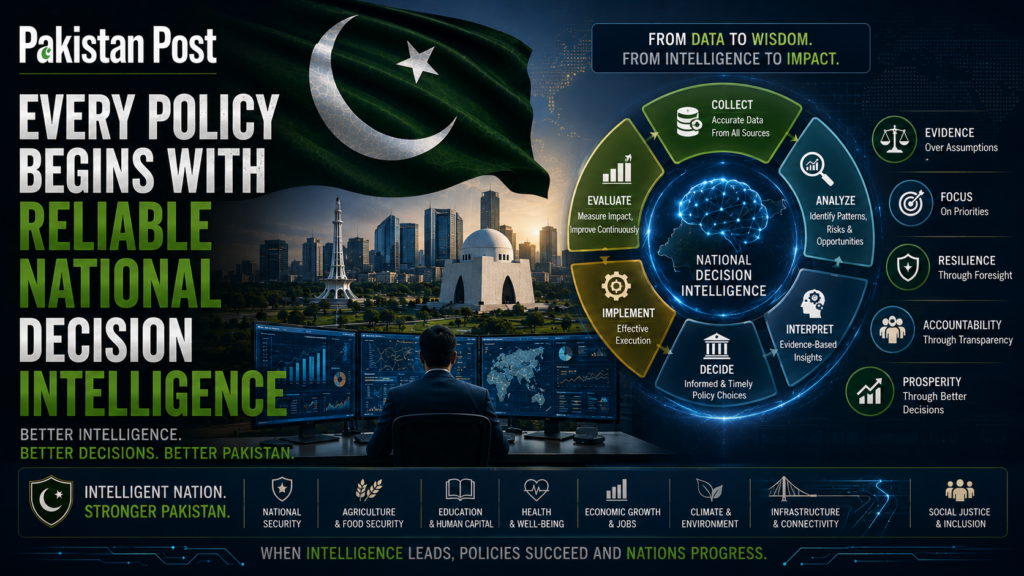
This distinction between information and intelligence increasingly separates high performing governments from administratively constrained states. Data represents isolated observations. Intelligence emerges when diverse information streams become interconnected, continuously analysed and translated into actionable policy recommendations. Nations capable of integrating demographic trends, economic indicators, environmental observations, infrastructure performance and administrative implementation into unified analytical platforms gain substantial advantages in strategic governance.
Pakistan’s taxation system illustrates this structural limitation. Revenue authorities possess considerable taxpayer information, financial regulators monitor banking activities, customs authorities collect trade statistics, provincial governments administer property records while utility companies maintain extensive consumption databases. However, incomplete interoperability reduces opportunities to identify tax evasion, broaden the tax base or forecast revenue fluctuations accurately. Administrative fragmentation consequently affects fiscal sustainability far more than individual compliance failures alone.
Healthcare administration demonstrates similar institutional challenges. Provincial health departments collect hospital information while disease surveillance systems monitor outbreaks, pharmaceutical regulators supervise medicine distribution and demographic databases track population changes. Yet policymakers frequently struggle to integrate these datasets into comprehensive public health intelligence capable of forecasting disease transmission, identifying service gaps or allocating medical resources dynamically during emergencies.
Educational planning experiences comparable constraints. Student enrolment, teacher availability, examination outcomes, labour market demands and demographic projections often remain dispersed across multiple agencies operating under different reporting frameworks. Consequently, education policy may continue expanding programmes disconnected from evolving employment requirements or regional demographic transformations.
Agriculture, representing a strategic sector within Pakistan’s economy, perhaps illustrates the greatest opportunity for integrated decision intelligence. Meteorological observations, irrigation flows, groundwater levels, satellite imagery, fertiliser availability, commodity prices, crop diseases and export trends collectively determine agricultural productivity. Yet these information sources frequently remain institutionally fragmented, reducing opportunities for predictive farming policies capable of improving food security while strengthening rural incomes.
Climate adaptation further demonstrates why integrated intelligence increasingly determines governance effectiveness. Flood forecasting requires meteorological observations, river monitoring, glacier surveillance, land use information, population mapping, infrastructure vulnerability assessments and emergency response capabilities to function cohesively. Fragmented systems inevitably reduce response speed precisely when timely decisions become most valuable.
Pakistan’s recurring experience with floods reveals that disaster response frequently relies upon reactive administrative coordination rather than continuously integrated situational awareness. Emergency authorities often spend valuable time consolidating information from numerous agencies instead of immediately deploying predictive resource allocation informed by comprehensive national intelligence platforms.
Urban governance similarly suffers from fragmented administrative architecture. Municipal authorities manage infrastructure, provincial departments oversee transportation, utility providers supervise energy and water systems while environmental agencies monitor pollution. Without integrated analytical capabilities, urban expansion frequently outpaces service provision, increasing congestion, environmental degradation and infrastructure stress across rapidly growing metropolitan regions.
International experience increasingly demonstrates that governance quality depends not merely upon institutional capacity but upon institutional connectivity. Governments capable of integrating administrative information across organisational boundaries consistently improve policy responsiveness while reducing duplication, expenditure inefficiencies and implementation delays.
Estonia provides one of the most frequently cited examples of digital public administration. Rather than constructing a single centralised database, Estonia established secure interoperability standards enabling government institutions to exchange information while preserving institutional autonomy. Citizens rarely submit identical information repeatedly because authorised agencies securely retrieve verified records across interconnected administrative platforms. This architecture has significantly reduced bureaucratic complexity while improving service delivery and administrative transparency.
Singapore similarly transformed public administration through integrated government technology infrastructure connecting transportation, healthcare, taxation, urban management and national planning. Continuous analytical capability enables policymakers to evaluate emerging trends before they evolve into larger structural challenges. Predictive governance increasingly supplements conventional administrative reporting.
South Korea developed sophisticated digital governance systems integrating public administration, disaster management, transportation planning and economic monitoring. High quality digital infrastructure combined with institutional coordination has enhanced administrative responsiveness while strengthening public confidence in government services.
Finland increasingly incorporates predictive analytics into social policy planning by combining demographic information, healthcare utilisation, educational performance and labour market indicators to anticipate future expenditure requirements rather than merely documenting historical trends. Such approaches allow governments to intervene earlier, reducing long term fiscal pressures.
The United Arab Emirates has invested extensively in artificial intelligence supported public administration, establishing government platforms capable of integrating multiple administrative datasets into executive decision making. Although institutional contexts differ significantly from Pakistan, the underlying lesson remains consistent. Effective governance increasingly depends upon information integration rather than isolated digitalisation projects.
China’s governance model likewise demonstrates extensive application of large scale administrative data integration supporting infrastructure planning, industrial policy, logistics management and public administration. While governance philosophies differ substantially across political systems, technological integration itself has become an increasingly universal administrative requirement.
Pakistan has initiated several important digital reforms. NADRA established internationally recognised identity management capabilities. The Federal Board of Revenue continues modernising tax administration. Digital payment systems have expanded financial inclusion. Provincial governments increasingly digitise land records and administrative services. Yet these initiatives frequently evolve independently without a comprehensive national interoperability framework capable of converting administrative digitisation into integrated strategic intelligence.
The institutional challenge therefore extends beyond technology procurement. Pakistan does not simply require additional databases. It requires an entirely different philosophy of governance where information becomes a continuously shared national strategic asset rather than an organisational possession guarded within bureaucratic boundaries.
Creating a National Decision Intelligence System would represent a transition from fragmented administration toward integrated governance. Such a platform should not centralise every government database into one repository. Instead, it should establish secure interoperability protocols allowing authorised institutions to exchange relevant information through common technical standards while preserving legal accountability and operational independence.
At the executive level, policymakers should possess access to continuously updated governance dashboards displaying fiscal performance, agricultural production, educational outcomes, healthcare utilisation, infrastructure implementation, labour market indicators, climate risks and disaster preparedness. Rather than relying exclusively upon quarterly reports or annual statistical publications, strategic decisions could increasingly reflect current administrative realities.
Predictive analytics should become a central component of such a system. Artificial intelligence and advanced statistical modelling could identify emerging fiscal pressures, forecast commodity shortages, anticipate disease outbreaks, estimate educational demand, evaluate infrastructure deterioration and project labour market transitions before these challenges generate broader economic consequences.
Equally important would be expenditure intelligence. Development programmes frequently emphasise financial allocations without continuously evaluating implementation performance. A National Decision Intelligence System could integrate procurement records, project milestones, satellite imagery, contractor performance, financial disbursement and service delivery indicators into comprehensive implementation monitoring, substantially improving accountability across public investment portfolios.
National security institutions would likewise benefit from integrated analytical capability. Economic resilience increasingly influences strategic stability. Food security, energy availability, infrastructure resilience, demographic transitions, cyber vulnerabilities and climate pressures possess direct implications for national preparedness. Decision intelligence therefore complements rather than replaces traditional security analysis.
Nevertheless, constructing such an architecture requires addressing significant institutional barriers. Legal frameworks governing information sharing remain uneven across sectors. Administrative mandates frequently discourage interagency collaboration because institutional performance continues measured within organisational boundaries rather than collective national outcomes. Bureaucratic incentives often reward information control rather than information exchange.
Cybersecurity represents another critical concern. Greater interoperability necessarily increases potential exposure to cyber threats unless supported by robust encryption, zero trust architecture, continuous monitoring and independent security auditing. National decision intelligence cannot succeed without corresponding investment in digital resilience.
Privacy protection similarly requires careful institutional design. Integrated governance should never imply unrestricted surveillance or indiscriminate information access. Citizens must retain confidence that personal information remains protected through transparent legal safeguards, independent oversight mechanisms and clearly defined authorisation protocols. Public trust ultimately determines whether digital governance achieves long term legitimacy.
Institutional capacity also presents substantial constraints. Advanced analytical platforms require data scientists, artificial intelligence specialists, cybersecurity professionals, software architects, policy analysts and digitally literate civil servants capable of interpreting analytical outputs responsibly. Technology alone cannot substitute for professional expertise.
Pakistan therefore requires parallel investment in governance capability alongside digital infrastructure. Civil service training should increasingly incorporate data governance, predictive analytics, systems thinking and digital public administration. Universities, research institutions and specialised academies should develop multidisciplinary programmes connecting public policy with computational sciences.
Federal provincial coordination deserves particular attention because constitutional decentralisation distributes numerous administrative responsibilities across different levels of government. A National Decision Intelligence System should therefore operate through cooperative federalism rather than administrative centralisation. Common interoperability standards should permit provincial flexibility while ensuring national analytical consistency.
Private sector collaboration may further strengthen institutional capability. Telecommunications operators, financial institutions, logistics companies, satellite service providers and technology firms generate valuable operational information capable of informing public policy under appropriate legal safeguards. Structured public private partnerships could significantly enhance national situational awareness without compromising regulatory independence.
Independent policy evaluation should become a permanent component of governance rather than an occasional academic exercise. Every significant public programme should generate measurable performance indicators integrated into continuous analytical monitoring. Policy success should increasingly depend upon demonstrable outcomes rather than administrative process alone.
Parliament also possesses an important role within this emerging governance architecture. Legislative oversight would benefit substantially from access to objective implementation indicators, expenditure intelligence and long term performance evaluations. Better information strengthens democratic accountability rather than weakening it.
Pakistan’s long term development ambitions increasingly depend upon administrative precision rather than policy ambition alone. Infrastructure investment, industrial competitiveness, export diversification, educational reform, agricultural modernisation and climate adaptation all require governments capable of measuring implementation continuously while adapting policy according to emerging evidence.
The strategic environment confronting Pakistan has likewise become considerably more dynamic. Climate variability, demographic expansion, technological disruption, geopolitical competition and economic volatility generate increasingly interconnected policy challenges. Administrative systems designed around isolated departmental reporting struggle to manage problems crossing institutional boundaries simultaneously.
Decision intelligence therefore represents not merely another digital reform initiative but an evolution in state capability itself. Nations increasingly compete through institutional learning, analytical sophistication and implementation agility rather than administrative size alone. Governments capable of integrating knowledge into continuous strategic adaptation will likely demonstrate greater resilience amid accelerating global uncertainty.
For Pakistan, the question is no longer whether sufficient information exists. The country generates immense quantities of administrative, financial, demographic, environmental and economic data every day. The strategic challenge lies in transforming these dispersed observations into coherent national intelligence supporting timely, evidence-based governance.
Establishing a National Decision Intelligence System should consequently become a foundational institutional reform supporting fiscal sustainability, economic competitiveness, administrative accountability and national resilience. Such an initiative would require political consensus, legislative clarity, technological investment, cybersecurity safeguards, professional capacity building and sustained intergovernmental cooperation. Yet the long-term dividends would extend well beyond improved statistics. They would redefine how the Pakistani state understands itself, anticipates future risks and governs an increasingly complex nation through informed judgment rather than fragmented observation.
A Public Service Message