
Energy Security, Governance Reform, Power Sector Crisis, Sustainable Energy Policy, Public Sector Accountability


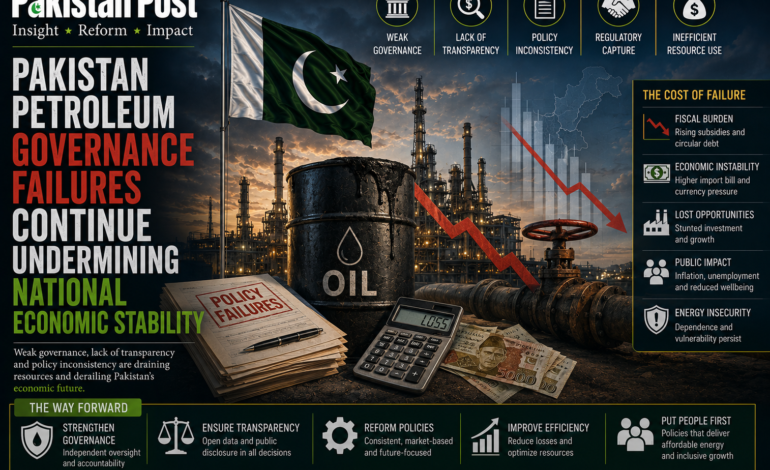
Pakistan’s electricity sector no longer suffers primarily from inadequate generation. It suffers from institutional failure. The country today possesses generation capacity that frequently exceeds demand during large parts of the year, yet households continue to face expensive electricity, industries struggle with rising production costs, distribution companies accumulate financial losses, and the federal government repeatedly diverts scarce fiscal resources to rescue an energy system trapped in a cycle of recurring debt. The contradiction is striking. A nation that invested billions of dollars in expanding installed capacity now finds itself constrained not by production, but by governance.
Circular debt has become the most visible manifestation of this institutional weakness. Rather than representing a temporary liquidity shortage, it has evolved into a structural consequence of fragmented decision making, politically delayed tariff adjustments, operational inefficiencies, transmission bottlenecks, electricity theft, weak bill recovery, poorly targeted subsidies, and the inability of successive governments to sustain reforms beyond electoral cycles. International financial institutions have repeatedly characterised the issue as one of governance rather than merely finance, emphasising that without structural correction, every bailout simply postpones the next crisis. (Reuters)
Successive governments, regardless of political affiliation, have promised comprehensive restructuring. Each administration announced reform packages, negotiated assistance with international lenders, established committees, and pledged to eliminate losses. Yet official data consistently demonstrate that although temporary reductions in debt have occasionally been achieved through refinancing, renegotiation of liabilities, or one time fiscal interventions, the underlying mechanisms generating new debt have largely remained intact. The persistence of the problem illustrates that Pakistan has repeatedly managed symptoms while leaving institutional incentives fundamentally unchanged. (Ministry of Energy)
The origins of today’s crisis extend over two decades. Electricity tariffs have often been treated as political instruments rather than economic signals. Governments frequently delayed tariff notifications to minimise public dissatisfaction, while the actual cost of electricity continued to rise because of imported fuel prices, currency depreciation, inflation, and contractual capacity obligations. The resulting gap between the actual cost of supplying electricity and the revenue collected from consumers accumulated throughout the supply chain. Distribution companies failed to pay generation companies, generation companies delayed payments to fuel suppliers, and the federal government eventually assumed responsibility through additional borrowing.
This recurring pattern transformed operational inefficiency into sovereign fiscal risk. Every additional rupee of circular debt increased government contingent liabilities, weakened public finances, reduced fiscal flexibility, and complicated negotiations with international creditors. Consequently, energy sector reform gradually became inseparable from macroeconomic stabilisation.
Distribution companies remain at the centre of this governance challenge. While technical losses exist in every electricity network worldwide, Pakistan’s state owned distribution companies continue to report losses and recovery rates substantially below regulatory benchmarks in several service territories. Electricity theft, illegal connections, weak enforcement, political patronage, delayed maintenance, inaccurate metering, and poor customer management combine to reduce revenue collection despite rising tariffs.
The problem extends beyond technical inefficiency. Governance failures inside several distribution companies have weakened accountability. Frequent leadership changes, politically motivated appointments, overlapping administrative authority, and limited managerial autonomy have discouraged long term operational planning. Managers often inherit responsibilities without corresponding authority over staffing, procurement, investment priorities, or enforcement mechanisms. As a result, institutional performance becomes dependent upon administrative improvisation rather than measurable governance standards.
Official assessments continue to identify transmission and distribution losses together with poor recovery performance as major contributors to financial deterioration. Regulatory reviews further indicate that government owned distribution companies continue to underperform despite repeated restructuring initiatives. (Dawn)
Independent Power Producers have become another focal point of public debate. Much criticism has concentrated on capacity payments, contractual obligations requiring payment for available generation capacity regardless of actual electricity dispatch. These arrangements originally aimed to attract private investment by reducing commercial risk during periods of severe electricity shortages. The policy successfully encouraged generation investment. However, as demand projections failed to materialise and economic growth slowed, surplus installed capacity emerged.
Consequently, Pakistan began paying substantial capacity charges even when power plants remained underutilised. The issue illustrates a broader policy lesson. Investment frameworks designed for one economic environment can become financially burdensome if demand forecasts, fuel assumptions, exchange rates, or financing conditions change substantially over time.
Recent negotiations between the government and several Independent Power Producers have attempted to reduce financial obligations through revised contractual arrangements. Government officials argue that these negotiations have lowered future liabilities and contributed to reductions in circular debt. Nevertheless, analysts continue to caution that contract renegotiation alone cannot permanently resolve systemic governance weaknesses if operational inefficiencies persist elsewhere within the electricity supply chain. (Ministry of Energy)
Transmission infrastructure presents another overlooked constraint. Pakistan possesses generation assets that cannot always dispatch electricity efficiently because transmission expansion has lagged behind capacity additions. Underutilised transmission networks, grid congestion, delayed infrastructure investment, and limitations in economic merit order dispatch increase overall system costs. Electricity generated at relatively lower cost may remain unavailable to certain demand centres because transmission constraints prevent efficient allocation across the network.
Regulatory assessments have repeatedly highlighted this paradox. Generation assets remain partially idle while consumers continue paying higher tariffs partly because fixed capacity costs remain payable regardless of utilisation levels. Underutilised infrastructure therefore imposes additional financial pressure without delivering corresponding economic benefits. (Dawn)
Fuel procurement policies have similarly influenced sectoral performance. Pakistan’s dependence on imported fuels exposes electricity prices to exchange rate fluctuations and international commodity volatility. Delayed procurement decisions, inadequate long term fuel diversification, and inconsistent investment priorities have increased vulnerability to external shocks. Although hydropower, nuclear energy, indigenous coal, renewable resources, and imported liquefied natural gas collectively contribute to the energy mix, strategic coordination between generation planning and fuel security has often remained fragmented across institutions.
Political intervention has perhaps been the most persistent obstacle to reform. Regulatory institutions function most effectively when tariff decisions reflect transparent economic methodology rather than electoral considerations. However, tariff adjustments have frequently become politically contentious, encouraging governments to postpone economically necessary decisions while compensating utilities through delayed subsidies or additional borrowing.
This approach creates several distortions simultaneously. Consumers receive inaccurate price signals. Distribution companies experience liquidity shortages. Independent producers face payment delays. Banks assume additional exposure to government backed liabilities. The federal budget absorbs escalating subsidy obligations. Eventually, tariff adjustments become larger and more politically painful because earlier corrections were postponed.
International Monetary Fund programme reviews have consistently linked sustainable macroeconomic stabilisation to timely tariff adjustments, improved recovery performance, better governance within distribution companies, and reduction of circular debt accumulation. These recommendations have appeared repeatedly across successive lending arrangements, demonstrating remarkable consistency despite changes in governments and economic circumstances.
The consequences extend well beyond the electricity sector. Energy governance has become one of Pakistan’s most significant macroeconomic vulnerabilities because inefficiencies within the power supply chain now affect industrial productivity, export competitiveness, inflation, banking sector exposure, fiscal sustainability, and ultimately national economic security. Manufacturers repeatedly identify electricity tariffs among the principal constraints on competitiveness, particularly in export oriented industries such as textiles, engineering goods, chemicals, and information technology enabled services. When industrial consumers pay substantially higher tariffs than regional competitors, production costs increase, profit margins narrow, investment decisions are postponed, and export market share becomes increasingly difficult to retain.
The burden is particularly acute because industrial consumers have increasingly become cross subsidisers within the electricity system. Higher tariffs imposed on productive sectors have often been used to offset revenue deficiencies elsewhere rather than reflecting the actual cost of service. While social protection for vulnerable consumers remains a legitimate public policy objective, broad based subsidies financed through elevated industrial tariffs distort investment incentives and weaken the productive sectors that generate employment, exports, and tax revenues. The resulting imbalance reduces the economy’s capacity to finance the very subsidies intended to protect consumers.
Inflationary pressures reinforce this cycle. Electricity is a universal production input. Every increase in energy costs eventually passes through supply chains into transportation, manufacturing, agriculture, retail markets, and household consumption. Businesses that cannot absorb higher utility expenses transfer them to consumers, contributing to persistent inflationary expectations. Monetary authorities then confront the difficult task of containing inflation through tighter financial conditions while economic growth slows under the weight of rising production costs. Thus, weaknesses in electricity governance increasingly influence broader macroeconomic management.
Investor confidence has likewise been affected. Domestic and international investors evaluate regulatory predictability as carefully as they assess tax policy or market size. Frequent revisions in tariff policy, delayed payments across the energy supply chain, uncertainty regarding contractual enforcement, and recurring government interventions increase perceptions of regulatory risk. Investors seeking long term infrastructure opportunities require confidence that commercial agreements will remain enforceable irrespective of political transitions. Where regulatory institutions are perceived as insufficiently autonomous, the cost of capital inevitably rises because investors demand higher returns to compensate for uncertainty.
Successive governments have acknowledged these structural weaknesses. Reform roadmaps have proposed corporatisation of distribution companies, performance based management contracts, privatisation or concessioning of selected utilities, enhanced regulatory autonomy, advanced metering infrastructure, targeted subsidy reform, stronger anti theft enforcement, and digitalisation of billing and collection systems. Yet implementation has repeatedly lagged behind announced intentions. Administrative continuity has often been interrupted by changes in political leadership, shifting policy priorities, litigation, bureaucratic resistance, and institutional fragmentation. The result has been an enduring gap between reform commitments and measurable outcomes.
Oversight institutions have repeatedly documented these deficiencies. Audit observations have identified weaknesses in internal controls, procurement practices, financial reporting, receivables management, and operational accountability across segments of the electricity sector. Parliamentary committees have questioned recurring losses, delayed implementation of reform programmes, and the limited effectiveness of previous restructuring initiatives. Regulatory reviews have continued to highlight deficiencies in recovery performance, system losses, and governance standards. Collectively, these official assessments reveal remarkable consistency over time. The diagnosis has changed little. What has remained elusive is sustained implementation.
One reason accountability has remained weak is that responsibility is dispersed across multiple institutions with overlapping mandates. The Ministry of Energy, the National Electric Power Regulatory Authority, the Central Power Purchasing Agency, the National Transmission and Despatch Company, generation companies, distribution companies, provincial authorities, finance ministries, and political executives all exercise influence over different components of the system. When outcomes deteriorate, responsibility becomes fragmented. Institutional diffusion reduces individual accountability because no single authority possesses comprehensive operational control while several institutions retain the ability to delay decisions.
Another challenge lies in the governance of state owned enterprises. International experience consistently demonstrates that public ownership need not produce inefficiency provided commercial governance remains insulated from political interference. In Pakistan, however, boards and senior management have too often experienced frequent turnover linked to political transitions rather than operational performance. Merit based appointments have not always been consistently institutionalised. Long term strategic planning becomes difficult when leadership uncertainty discourages difficult but necessary decisions whose benefits may emerge only after political cycles have changed.
Electricity theft presents an equally serious governance concern. Organised theft is not merely a commercial loss. In many regions it reflects entrenched criminal networks capable of manipulating metering systems, intimidating utility personnel, influencing local enforcement, and exploiting administrative weaknesses. Treating large scale theft solely as a technical issue understates its implications for public authority and rule of law. Effective enforcement therefore requires coordinated action involving utility management, law enforcement agencies, prosecutors, and the judiciary. Administrative penalties alone have rarely proven sufficient where theft has become organised and systematic.
Digital technologies offer opportunities to strengthen governance. Advanced metering infrastructure, automated billing, geospatial monitoring of transmission networks, artificial intelligence assisted loss detection, integrated customer databases, and real time operational analytics can substantially improve transparency while reducing opportunities for manipulation. Several countries confronting comparable challenges have demonstrated that technological modernisation, when combined with institutional accountability, significantly improves collection efficiency and reduces commercial losses. Technology, however, cannot substitute for governance. Without competent management and independent oversight, even sophisticated systems eventually reproduce existing institutional weaknesses.
Pakistan’s reform agenda should therefore move beyond periodic financial restructuring towards permanent institutional transformation. Regulatory independence should be strengthened through statutory safeguards that protect tariff determination from short term political pressures while ensuring transparent public consultation and parliamentary oversight. Tariffs should reflect economic costs, but targeted subsidies must be delivered directly to vulnerable households through transparent fiscal mechanisms rather than concealed within electricity pricing structures.
State owned distribution companies require professional corporate governance based upon measurable performance indicators. Boards should be appointed through transparent merit based processes with fixed tenure and operational autonomy linked to clearly defined accountability standards. Executive compensation should reflect recovery performance, reduction in technical and commercial losses, customer service quality, and financial sustainability rather than administrative seniority. Persistent underperformance should trigger automatic management review rather than prolonged institutional tolerance.
Procurement systems should become fully digitised, publicly auditable, and subject to continuous independent monitoring. Competitive procurement reduces opportunities for discretionary decision making while strengthening market confidence. Equally important is the publication of operational performance indicators across every distribution company. Transparency itself becomes a regulatory instrument when citizens, investors, parliamentarians, and oversight bodies can evaluate comparative institutional performance through accessible and standardised data.
The legal framework governing organised electricity theft also requires strengthening. Large scale theft that systematically undermines national infrastructure should be investigated through specialised multidisciplinary mechanisms capable of tracing financial networks, recovering losses, and prosecuting organised criminal activity. Visible enforcement against major offenders would strengthen deterrence while reinforcing confidence that regulatory obligations apply equally irrespective of political influence or economic status.
At the strategic level, Pakistan requires an integrated national energy governance framework rather than isolated administrative reforms. Generation planning, transmission investment, fuel procurement, renewable integration, industrial policy, fiscal management, and climate resilience should operate within a unified long term planning architecture extending beyond electoral cycles. National energy security cannot be achieved through fragmented institutional decision making. It requires strategic coordination supported by reliable data, professional expertise, and policy continuity.
The broader lesson extends beyond electricity. Pakistan’s experience demonstrates that infrastructure investment alone cannot compensate for institutional weakness. Generation capacity expanded considerably over the past decade, yet governance failures prevented those investments from delivering their full economic value. Sustainable reform therefore depends less upon announcing new policies than upon consistently implementing existing ones through institutions capable of resisting political expediency.
The energy sector has reached a point where incremental adjustments are unlikely to produce durable results. Temporary financing arrangements may reduce immediate liquidity pressures, and contractual renegotiations may moderate future liabilities, but neither addresses the structural incentives that generate recurring fiscal stress. Without credible regulatory independence, professional management of state owned enterprises, transparent procurement, targeted subsidies, digitised operations, rigorous enforcement against organised theft, and legally protected insulation from political interference, circular debt will continue to reappear in different financial forms.
Pakistan’s energy challenge is therefore not fundamentally an engineering problem or a shortage of generating capacity. It is a governance test. Countries that transformed their electricity sectors did so by building institutions that rewarded efficiency, protected regulatory credibility, enforced commercial discipline, and maintained policy consistency across successive administrations. Pakistan possesses the technical expertise, financial partners, and legislative instruments necessary to undertake a similar transformation. The decisive variable is no longer knowledge but execution. If governance reforms become institutional rather than political, the electricity sector can evolve from a persistent fiscal liability into a foundation for industrial competitiveness, macroeconomic stability, and national resilience. If implementation continues to yield to short term expediency, however, circular debt will remain less a financial anomaly than a recurring measure of institutional failure.
A Public Service Message