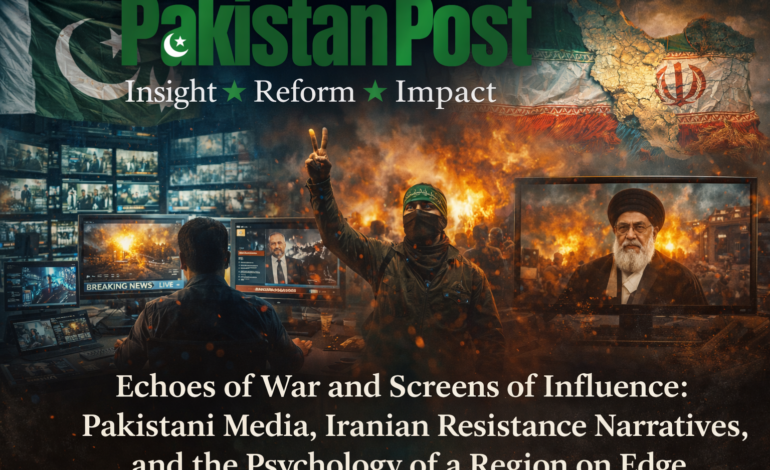
Echoes of War and Screens of Influence: Pakistani Media, Iranian Resistance Narratives, and the Psychology of a Region on Edge

The Iran–Gulf crisis, escalating in recent months, has produced waves of regional anxiety that reverberate across multiple layers of political, economic, and media landscapes. Pakistani media, positioned geographically and culturally close to the epicenter of these tensions, has become a crucial arena for the construction, amplification, and contestation of narratives surrounding the conflict. Statements from figures such as Mojtaba Khamenei, retaliatory rhetoric, and military developments in Saudi Arabia and other Gulf states have not only dominated news cycles but also shaped public sentiment and perceptions of national interest. Pakistani media coverage is particularly significant because it functions at the intersection of domestic political priorities, regional solidarity frameworks, and global media flows, reflecting both the aspirations and anxieties of a country whose foreign policy has historically sought to balance competing regional and global powers. This complex environment requires analysis of how narratives of martyrdom, resistance, and ideological alignment are transmitted, framed, and interpreted, and how these processes intersect with the psychology of audiences continuously exposed to conflict imagery, rhetorical escalation, and strategic ambiguity.
Central to understanding Pakistani media’s role in this context is the application of cultivation theory, which posits that prolonged exposure to certain media messages shapes audience perceptions and worldviews. In the case of the Iran–Gulf crisis, continuous reporting on military buildups, retaliatory strikes, and regional political discourse can cultivate heightened perceptions of threat and insecurity among Pakistani audiences. Television channels, online news platforms, and print media frequently juxtapose visual imagery of explosions, protests, and missile launches with commentary highlighting existential stakes, thereby reinforcing a sense of immediacy and danger. This repeated exposure does not merely inform; it shapes cognitive frameworks through which audiences interpret events, evaluate regional actors, and align ideologically. For many Pakistani viewers, repeated framing of Iranian resistance narratives, particularly in connection to figures such as Ali Larijani, translates into an emotional resonance that aligns with religious, cultural, or regional solidarities, thereby reinforcing preexisting identity constructs while simultaneously influencing attitudes toward foreign policy, defense priorities, and diplomatic posture.
The spiral of silence theory further illuminates how Pakistani media contributes to the shaping of public opinion in moments of conflict. When media consistently amplifies narratives aligned with martyrdom, resistance, or regional solidarity, dissenting or critical perspectives may be marginalized or underrepresented. Audiences perceiving a dominant narrative may choose silence either out of social conformity, fear of reputational risk, or genuine alignment with prevailing frames. In the context of Iranian resistance narratives, this dynamic is particularly potent because religious and cultural frameworks often intersect with media messaging, making counter-narratives less visible in mainstream discourse. As a result, certain ideological interpretations gain disproportionate amplification, while nuanced or critical perspectives on military escalation, civilian consequences, or geopolitical complexities remain comparatively muted. The cumulative effect of this process is the potential narrowing of public discourse, where perceptions of legitimacy, morality, and political alignment are filtered through media practices that favor repetition, dramatization, and symbolic framing.
Emotional framing is another mechanism through which Pakistani media influences audience psychology during crises. Coverage that emphasizes themes of martyrdom, heroism, and moral struggle taps into deeply rooted cultural and religious sensibilities, eliciting emotional responses that range from fear and anxiety to pride and solidarity. Visual and verbal cues, including imagery of protesters, combatants, or displaced civilians, alongside commentary that contextualizes these events within broader narratives of justice or resistance, intensify affective engagement. Emotional framing also operates on social media platforms such as YouTube and X, where user-generated content, algorithmic amplification, and viral dissemination magnify the psychological impact of conflict-related narratives. Short-form videos, live-streamed updates, and opinion commentary enable audiences to experience the conflict in near-real time, fostering a sense of immediacy that traditional print or broadcast media cannot replicate. This immediacy, combined with emotionally charged content, enhances audience identification with certain actors or causes, shaping attitudes toward foreign policy, military engagement, and regional alliances in ways that may not fully align with strategic state priorities but reflect visceral, culturally resonant reactions to ongoing events.
Iranian media narratives play a particularly influential role in shaping perceptions within Pakistan. Through outlets emphasizing resistance, martyrdom, and ideological resilience, Iranian media constructs a discourse that appeals to audiences attuned to religious symbolism, historical grievances, and regional solidarity. These narratives frequently highlight sacrifices of combatants, portray confrontations with adversaries as morally justified, and position Iran as a defender of regional order against external interference. Pakistani media, in turn, often reproduces or references these narratives, whether explicitly or implicitly, thereby creating cross-border discursive resonance. The effect is a layered information environment where audiences receive a blend of local, regional, and international interpretations, each carrying its own moral and strategic subtext. Pakistani viewers interpret these messages within their own cultural and religious frameworks, which can reinforce feelings of solidarity or heighten perceptions of threat, depending on individual predispositions, media literacy, and prior exposure to geopolitical content.
Social media platforms, particularly YouTube and X, serve as accelerants for information flows and as vectors for real-time war psychology. These platforms allow for rapid dissemination of content, including both professional journalism and user-generated media, blurring distinctions between verified information, opinion, and misinformation. Algorithms prioritize engagement, often elevating content that elicits strong emotional reactions, thereby amplifying narratives of martyrdom, resistance, and solidarity. The speed and reach of these platforms make them powerful instruments for shaping perceptions, influencing public discourse, and in some cases, triggering immediate emotional and behavioral responses among audiences. At the same time, the decentralized nature of social media allows for the spread of misinformation, including exaggerated claims, manipulated imagery, or selective reporting, which can intensify anxiety, fear, or polarized attitudes. For Pakistani media consumers, navigating these digital spaces requires critical literacy, yet the combination of emotional resonance and rapid circulation often overrides reflective analysis, contributing to the formation of collective perceptions heavily shaped by curated, repeated, or sensationalized content.
The intersection of Russian propaganda techniques with the Pakistani media ecosystem introduces additional layers of complexity. Russian information operations, characterized by narrative flooding, ambiguity, and selective amplification, provide models for how conflict narratives can be engineered to maximize psychological impact and shape public perceptions strategically. While Russian narratives often employ overt disinformation and contradictory messaging to undermine consensus and create confusion, they share with Pakistani and regional media a focus on emotive storytelling, symbolic framing, and repeated emphasis on existential stakes. This hybridized environment exposes Pakistani audiences to multiple, sometimes conflicting, strategies of persuasion that operate simultaneously, requiring them to navigate competing claims, interpretive frames, and culturally resonant symbols. China’s more restrained and strategic communication style contrasts with Russian approaches, emphasizing measured reporting, diplomatic framing, and avoidance of overt sensationalism. However, even this measured approach indirectly shapes Pakistani discourse by providing alternative narratives that foreground stability, economic continuity, and principled neutrality, offering audiences a contrast to both Western sensationalism and regional escalatory rhetoric.
The cumulative impact of these intersecting narrative strategies on Pakistani public psychology is significant. Continuous exposure to conflict-related media, amplified through television, print, online platforms, and social media, creates a pervasive sense of immediacy, urgency, and moral investment. Audiences are not passive consumers; they actively interpret, evaluate, and emotionally respond to the content, with repeated framing shaping perceptions of threat, legitimacy, and ideological alignment. Over time, these exposures can cultivate a psychological environment in which fear, solidarity, and ideological commitment are reinforced, potentially influencing public attitudes toward foreign policy, domestic political alignment, and national security priorities. This underscores the profound responsibility of Pakistani media institutions to balance the imperatives of coverage with the ethical considerations of accuracy, proportionality, and social cohesion.
Media ethics and responsibility assume critical importance in this context. The intensity of the Iran–Gulf crisis and the proximity of Pakistan to regional actors create both incentives and pressures for sensationalist or partisan reporting. Yet the ethical obligations of journalism—to provide accurate information, to contextualize events, and to maintain accountability—remain paramount. Pakistani media must navigate the tension between capturing audience attention and preserving truth, balance, and strategic clarity. This includes careful attention to framing choices, avoidance of unverified or emotionally manipulative content, and proactive efforts to contextualize foreign narratives within domestic interests and realities. Ethical journalism in this environment requires balancing competing pressures: providing timely information that serves public interest, mitigating the risks of polarization and fear amplification, and preserving credibility in a media landscape shaped by both regional influence operations and global strategic narratives.
Critical discourse is particularly essential to prevent the inadvertent reinforcement of polarization through selective framing or repetitive messaging. By incorporating multiple perspectives, highlighting the complexity of regional dynamics, and providing space for informed debate, Pakistani media can foster analytical engagement rather than passive consumption of conflict imagery and emotionally charged narratives. This approach is not merely normative; it serves the strategic interests of the nation by cultivating a public that is informed, discerning, and capable of supporting policy decisions grounded in comprehensive understanding rather than reactive sentiment. Ethical reporting that navigates between the pressures of global propaganda, domestic political expectations, and audience demand ensures that media functions as a constructive actor rather than a channel for unmediated escalation of fear, mistrust, or ideological rigidity.
In the context of Iranian resistance narratives, Pakistani media faces the dual challenge of representing regional solidarity while maintaining a critical lens. Narratives surrounding figures such as Ali Larijani, martyrs, or symbolic acts of resistance are emotionally and culturally resonant, yet they require careful contextualization to ensure that audiences understand the broader geopolitical and humanitarian dimensions of conflict. Failure to provide such context risks reinforcing simplistic binaries of good versus evil, martyrdom versus aggression, or regional loyalty versus strategic pragmatism. Similarly, coverage of military developments in Saudi Arabia and the Gulf must balance urgency and clarity with ethical imperatives to avoid inciting panic or contributing to polarized public discourse. Pakistani journalism, by integrating analytic depth, verification protocols, and multi-source reporting, can provide audiences with comprehensive narratives that reflect complexity while acknowledging the emotional and cultural dimensions that shape perception.
Social media amplification of these narratives also requires targeted strategies for responsible engagement. Algorithms, user-generated content, and viral dissemination can create echo chambers that intensify emotional responses and ideological alignment. Pakistani media organizations and regulators face the challenge of fostering digital literacy, promoting verification mechanisms, and creating platforms for balanced discourse that can mitigate the risks associated with rapid, emotionally charged information flows. Engagement strategies must recognize that audiences are not passive; they participate in co-creating meaning through sharing, commenting, and interpreting content. Media responsibility in this digital ecosystem is therefore intertwined with audience education, institutional transparency, and cross-platform collaboration to ensure that information integrity is preserved while enabling timely communication of critical developments.
The interplay between global media influences and domestic accountability highlights the importance of strategic clarity in Pakistani journalism. Russian techniques of narrative flooding and ambiguity, Chinese strategic restraint, and Western sensationalism collectively shape the informational environment. Pakistani media operates within this convergence, facing pressures to adopt frames that resonate with domestic audiences, satisfy geopolitical expectations, and preserve institutional credibility. Navigating this environment requires institutional capacity, professional training, and an ethical commitment to maintain truthfulness while balancing competing narratives. Journalists must cultivate discernment in evaluating source reliability, framing techniques, and potential impact on audience psychology, ensuring that reporting supports informed decision-making rather than reactive emotional responses.
Ultimately, the challenge for Pakistani media in covering the Iran–Gulf crisis is to act as both a conduit and a filter—transmitting necessary information while contextualizing, analyzing, and mitigating the psychological effects of conflict reporting. Media institutions must embrace their role as educators, analysts, and ethical actors, balancing audience demand for immediacy with the strategic imperatives of national interest and social cohesion. By fostering critical discourse, integrating insights from cultivation theory, spiral of silence, and emotional framing, and remaining vigilant to the influence of external propaganda techniques, Pakistani media can contribute to an informed, resilient public capable of understanding complex regional dynamics.
The normative dimension of media ethics in this environment underscores the responsibilities of journalists, editors, and media institutions to prioritize accuracy, balance, and clarity. Ethical journalism requires proactive measures to counter misinformation, challenge selective framing, and contextualize emotionally charged narratives within broader political, cultural, and strategic frameworks. In a region on edge, the capacity to report responsibly while preserving audience trust is as vital to national security and public stability as traditional defense mechanisms. By integrating rigorous verification practices, transparent editorial standards, and engagement with global and regional media literacy initiatives, Pakistani media can maintain credibility while shaping perceptions that support strategic clarity, informed public opinion, and societal resilience.
The Iran–Gulf crisis demonstrates how media functions simultaneously as a channel for information, a shaper of psychological perceptions, and a participant in geopolitical discourse. Pakistani media’s treatment of resistance narratives, martyrdom, and regional solidarity illustrates the profound influence of framing, repetition, and emotional resonance on public understanding. Continuous exposure to conflict imagery, amplified through traditional and digital platforms, cultivates perceptions, shapes ideological alignment, and reinforces identity constructs. At the same time, external influences including Russian propaganda strategies and Chinese strategic communication add layers of complexity that challenge domestic media to maintain ethical standards, analytical rigor, and strategic clarity.
In conclusion, the Pakistani media ecosystem during the Iran–Gulf crisis operates at the intersection of domestic interest, regional allegiance, and global media dynamics. It must navigate competing narratives, emotional intensity, and the psychological impact of continuous exposure to conflict while preserving principles of truth, balance, and accountability. By critically evaluating the framing of Iranian resistance narratives, understanding audience psychology, and integrating ethical journalism practices, Pakistani media can contribute to informed public discourse, mitigate polarization, and maintain strategic clarity. This approach not only upholds professional standards but also serves national interests by fostering a public capable of engaging with complex regional developments in a manner that is both reflective and resilient. Through careful attention to content, context, and ethical responsibility, Pakistani media can ensure that the echoes of war are interpreted wisely, the screens of influence are navigated judiciously, and the public is equipped to understand, analyze, and respond to the challenges of a region on edge.
A Public Service Message