Political Appointments and the Price of Administrative Expansion

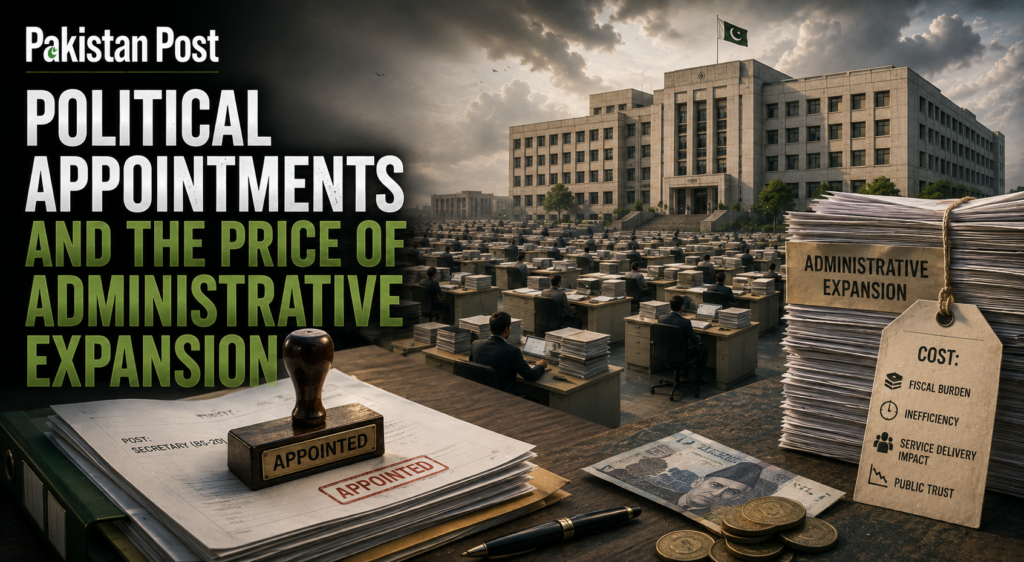
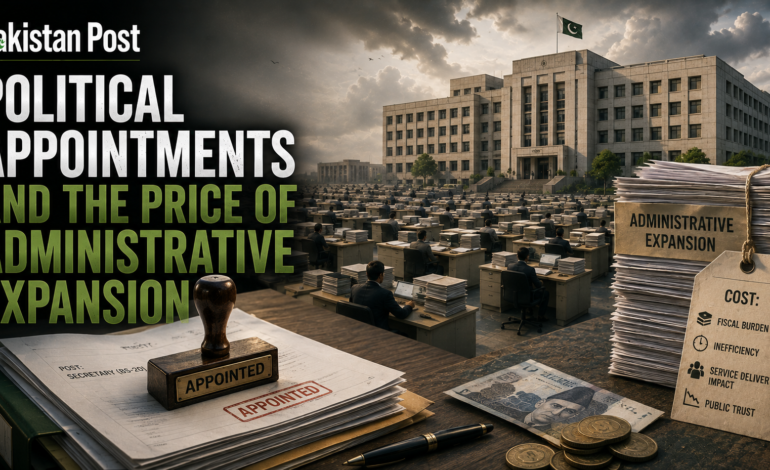
Every incoming government in Pakistan inherits a familiar political dilemma. It must simultaneously preserve parliamentary stability, accommodate coalition partners, reward loyal legislators, satisfy influential constituencies and project administrative competence. These objectives rarely coexist without tension. As governing coalitions become increasingly fragmented, ministerial portfolios, ministers of state, advisers, special assistants and numerous executive appointments have evolved beyond instruments of public administration into mechanisms of political equilibrium. Cabinets that were originally designed to provide strategic direction have progressively become vehicles for political accommodation, with profound consequences for governance, fiscal discipline and institutional coherence.
The debate is therefore no longer confined to the numerical size of federal cabinets. The more consequential question concerns whether the expansion of political office actually generates administrative capacity or merely redistributes political influence without corresponding improvements in state performance. Pakistan’s experience increasingly suggests that expanding executive positions does not automatically strengthen government. Instead, overlapping authorities, duplicated responsibilities and dispersed accountability frequently complicate decision making while obscuring responsibility for policy outcomes.
The distinction between governance and government deserves renewed attention. Government refers to the collection of political office holders occupying constitutional positions. Governance concerns the effectiveness with which institutions formulate, coordinate and implement public policy. Political systems frequently confuse these concepts by assuming that increasing the number of ministers enhances governing capability. International experience demonstrates precisely the opposite. Administrative effectiveness depends less upon the quantity of political appointments than upon institutional clarity, operational coordination, professional civil services and measurable executive accountability.
Pakistan has gradually experienced ministerial expansion across successive administrations regardless of political ideology. Coalition governments, minority governments and even administrations commanding comfortable parliamentary majorities have routinely enlarged executive structures through additional ministers, advisers, coordinators, assistants and overlapping committees. While constitutional provisions regulate certain appointments, executive discretion has often been exercised broadly enough to create extensive layers of political authority operating alongside permanent bureaucratic institutions.
This phenomenon reflects structural political incentives rather than administrative necessity. Coalition management requires political accommodation. Parliamentary arithmetic demands continuous negotiation. Regional representation encourages geographical balancing. Party cohesion frequently depends upon distributing executive positions among influential legislators. Consequently, ministerial appointments increasingly function as instruments of political bargaining rather than carefully calibrated administrative architecture.
Such expansion inevitably produces overlapping jurisdictions. Multiple office holders frequently engage identical policy sectors while operating under separate reporting arrangements. Federal ministries sometimes share responsibilities with attached departments, autonomous authorities, special initiatives, task forces and advisory units pursuing similar objectives. Provincial governments replicate comparable structures, producing additional complexity across different constitutional tiers.
Administrative duplication creates institutional uncertainty rather than administrative resilience. Civil servants become uncertain regarding reporting hierarchies. Departments receive competing policy instructions. Strategic priorities shift according to individual office holders rather than coordinated government objectives. Policy implementation consequently slows as bureaucracies navigate political sensitivities before executing administrative decisions.
This fragmentation carries measurable fiscal implications extending well beyond ministerial salaries. Political offices require official residences, security arrangements, transport fleets, administrative staff, communications infrastructure, protocol expenditures, travel allocations and operational budgets. Every additional executive appointment creates recurring expenditure obligations that continue throughout governmental tenure. Although individual costs may appear modest within national budgets, cumulative fiscal burdens become increasingly significant when multiplied across expanding executive structures.
Fiscal costs, however, represent only one dimension of administrative expansion. The opportunity cost is considerably larger. Resources allocated toward sustaining enlarged political establishments inevitably reduce fiscal space available for public investment, digital transformation, institutional modernisation, regulatory capacity and frontline public service delivery. At a time when Pakistan faces persistent fiscal consolidation challenges, the efficiency of executive expenditure deserves considerably greater scrutiny.
Decision making also becomes increasingly complicated under fragmented executive arrangements. Effective governments depend upon clear chains of authority enabling rapid policy coordination across ministries. Expanded political structures frequently replace clarity with consultation overload. Files circulate through multiple political offices before receiving approval. Competing ministerial perspectives delay implementation. Departments postpone administrative action until political consensus emerges among overlapping authorities.
The cumulative effect resembles organisational congestion rather than executive dynamism. Bureaucratic systems already operating within procedural constraints encounter additional political checkpoints. Administrative momentum slows precisely when governments require greater agility to respond to economic volatility, climate emergencies, technological disruption and evolving security challenges.
Policy coordination suffers particularly within cross sectoral issues requiring integrated governmental responses. Digital governance, water security, artificial intelligence, public health resilience, energy transition, cybersecurity and urban planning cannot be effectively managed through isolated ministerial silos. These policy domains demand coherent executive leadership capable of integrating multiple institutions toward common strategic objectives.
Instead, fragmented executive structures frequently produce institutional competition. Ministries defend bureaucratic jurisdictions. Advisory bodies advocate alternative priorities. Political appointees seek visibility through independent initiatives. Consequently, governments announce numerous programmes while struggling to sustain coordinated implementation across departmental boundaries.
Pakistan’s national development challenges increasingly require horizontal governance rather than vertical administrative expansion. Economic competitiveness depends upon synchronising taxation, industrial policy, education, infrastructure, digital regulation and investment promotion. Climate adaptation requires integrated planning connecting agriculture, water management, disaster resilience, finance and provincial administration. National security increasingly incorporates cyber resilience, technological sovereignty, economic stability and strategic communications alongside traditional defence considerations. Fragmented executive structures struggle to deliver such integrated governance.
Accountability correspondingly becomes diffused. When multiple political office holders share overlapping responsibilities, identifying responsibility for policy failures becomes increasingly difficult. Ministers attribute implementation failures to bureaucracies. Bureaucracies reference conflicting political instructions. Advisers lack constitutional responsibility while influencing executive decisions. Cabinet committees distribute collective responsibility without clearly assigning individual accountability.
Such diffusion weakens parliamentary oversight. Legislative committees encounter multiple executive representatives addressing identical policy areas. Administrative performance becomes difficult to evaluate because responsibility remains institutionally fragmented. Public accountability consequently shifts toward political narratives instead of measurable administrative outcomes.
International experience demonstrates alternative approaches emphasising lean executive structures combined with rigorous performance management. Several advanced parliamentary democracies deliberately maintain relatively compact cabinets while relying upon highly professional civil services, specialised agencies and digital coordination systems. Political leadership focuses upon strategic direction, legislative priorities and measurable national objectives rather than extensive administrative layering.
Smaller cabinets encourage greater ministerial responsibility because individual office holders cannot easily diffuse accountability across numerous overlapping positions. Departments possess clearer mandates. Cabinet deliberations become more focused. Policy coordination improves because institutional responsibilities remain better defined.
Executive efficiency also depends upon the quality rather than quantity of ministerial leadership. Highly competent ministers supported by professional policy units frequently outperform considerably larger political establishments lacking strategic coherence. Administrative effectiveness originates from institutional design, analytical capacity and operational discipline rather than numerical expansion.
Several governments have introduced formal ministerial performance agreements linking executive tenure with measurable outcomes. Rather than evaluating ministers according to political visibility or expenditure levels, governments increasingly assess progress through quantifiable indicators including educational attainment, healthcare access, investment generation, regulatory efficiency, infrastructure delivery, environmental performance and digital transformation.
Such models fundamentally alter executive incentives. Political office becomes associated with demonstrable administrative achievement instead of symbolic authority. Cabinet reshuffles increasingly reflect objective performance assessment rather than exclusively political calculations. Public administration correspondingly acquires stronger results oriented cultures.
Pakistan possesses substantial opportunities to adapt similar principles without undermining constitutional flexibility. Cabinet formation should continue reflecting democratic representation while incorporating institutional safeguards preventing unnecessary administrative duplication. Constitutional provisions could establish clearer principles governing executive appointments, advisory positions and overlapping mandates without restricting legitimate governmental discretion.
Administrative legislation should require comprehensive functional justification before establishing additional executive offices. Every new political appointment should demonstrate clearly identifiable administrative necessity rather than merely political convenience. Independent institutional reviews could evaluate whether proposed offices duplicate existing responsibilities or genuinely address governance gaps.
Equally important is the introduction of comprehensive ministerial performance contracts. Each ministry should operate under annually published strategic objectives supported by measurable indicators, implementation milestones and independent evaluation mechanisms. Parliamentary oversight committees should review performance against predetermined benchmarks instead of focusing predominantly upon procedural compliance or budget utilisation.
Public financial management reforms should similarly incorporate executive efficiency assessments. Annual budgets should transparently identify the operational costs associated with political offices, advisory structures and executive support systems. Such transparency would enable informed parliamentary debate regarding whether administrative expansion produces proportional public value.
Digital governance offers particularly significant opportunities for reducing executive fragmentation. Integrated government platforms capable of real time information sharing, interministerial coordination and performance monitoring substantially reduce the perceived need for multiple overlapping political offices. Shared digital dashboards enable cabinet members to monitor implementation collectively while preserving clearly defined institutional responsibilities.
Professionalisation of policy analysis also deserves greater emphasis. Governments frequently establish additional advisory positions because permanent institutional analytical capacity remains inadequate. Strengthening policy units within ministries, expanding evidence based decision support and investing in professional civil service expertise would reduce dependence upon politically appointed advisory structures.
Civil service reform consequently becomes inseparable from cabinet reform. Effective ministers require highly capable administrative institutions capable of translating strategic direction into operational implementation. Where bureaucratic capacity remains weak, governments often compensate through additional political appointments, inadvertently increasing institutional complexity instead of administrative effectiveness.
Provincial governments confront comparable challenges following constitutional decentralisation. Expanded provincial responsibilities require stronger coordination mechanisms rather than simply larger political establishments. Provincial cabinet structures should likewise prioritise functional clarity, measurable outcomes and streamlined executive organisation adapted to provincial governance requirements.
Strategic governance considerations further reinforce the necessity for executive rationalisation. Contemporary national resilience increasingly depends upon rapid governmental coordination during crises including cyber attacks, financial instability, pandemics, climate disasters and regional security contingencies. Fragmented executive structures impede rapid decision making precisely when national interests require unified institutional responses.
The national security environment has itself evolved beyond conventional defence considerations. Economic resilience, technological sovereignty, critical infrastructure protection, strategic communications and supply chain security now constitute integral dimensions of comprehensive national power. Coordinating these interconnected priorities requires disciplined executive architecture rather than proliferating political offices with intersecting mandates.
Institutional predictability also influences investor confidence. Domestic and international investors evaluate governmental coherence when assessing regulatory stability, policy consistency and implementation reliability. Fragmented executive structures generating conflicting signals increase perceived policy uncertainty, discouraging long term investment essential for sustainable economic growth.
Establishment institutions similarly benefit from clearly defined civilian administrative structures. Effective civil military coordination depends upon coherent governmental counterparts capable of articulating consistent national priorities. Administrative fragmentation complicates strategic coordination by dispersing authority across multiple political actors possessing overlapping responsibilities and varying institutional influence.
Public confidence likewise depends increasingly upon visible governmental effectiveness rather than symbolic political representation. Citizens evaluate governments according to service delivery, economic opportunity, infrastructure quality, educational outcomes, healthcare accessibility and institutional responsiveness. Expanding political offices without corresponding improvements in these measurable outcomes inevitably reinforces public perceptions that governmental growth primarily serves political elites rather than national development.
The future trajectory of Pakistani governance will therefore depend less upon the composition of individual cabinets than upon the institutional philosophy underpinning executive organisation. States confronting fiscal constraints, technological disruption and increasingly complex policy environments cannot indefinitely sustain administrative architectures designed principally for political accommodation. Democratic legitimacy ultimately derives not merely from electoral success but from competent, efficient and accountable governance.
Pakistan requires an executive model where every political appointment carries clearly defined constitutional purpose, measurable administrative responsibility and transparent performance expectations. Cabinet size should reflect operational necessity rather than coalition arithmetic alone. Advisory appointments should complement permanent institutional capacity rather than substitute for it. Ministerial authority should remain sufficiently concentrated to preserve accountability while sufficiently coordinated to address multidimensional national challenges.
A modern state competing within an increasingly complex geopolitical and economic environment cannot afford executive structures characterised by duplicated authority, fragmented accountability and expanding administrative expenditure disconnected from measurable public outcomes. Lean governance does not imply diminished political representation. Rather, it signifies institutional discipline whereby political authority is organised around strategic purpose, fiscal responsibility and demonstrable administrative performance. The enduring measure of governmental success is neither the number of ministers seated around the cabinet table nor the breadth of executive titles distributed across political alliances. It is the state’s capacity to convert public authority into measurable national progress through coherent institutions, disciplined leadership and accountable governance worthy of public trust.
A Public Service Message