Digital Identity Powers Pakistan’s Next Era Of Public Governance

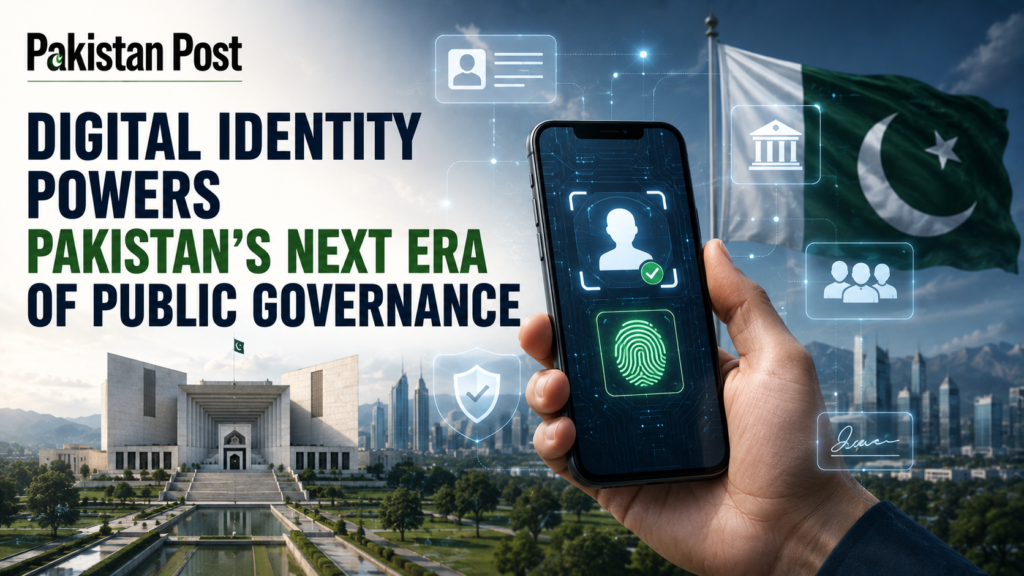
The next decisive contest among states will not be determined solely by industrial production, military inventories or macroeconomic indicators. Increasingly, it will be defined by the quality of institutions that can identify citizens securely, authenticate transactions instantly and deliver public services seamlessly across multiple administrative domains. Governments that once regarded digital identity as a technical extension of civil registration now recognise it as the central infrastructure upon which taxation, healthcare, education, financial services, electoral administration, social protection and national security increasingly depend. This evolution marks the transition from conventional electronic government towards comprehensive digital public infrastructure, where identity becomes the trusted foundation connecting institutions rather than merely identifying individuals. Pakistan has reached a comparable inflection point. While the country possesses one of the region’s most extensive biometric registration systems, the broader architecture required to transform authenticated identity into an integrated governance platform remains incomplete. The strategic question confronting policymakers is therefore no longer whether digital transformation should occur, but whether Pakistan can construct an interoperable identity ecosystem capable of supporting efficient administration, protecting national sovereignty and reinforcing public confidence before technological fragmentation becomes a structural constraint upon governance.
For more than two decades, successive governments have invested in digitising administrative procedures, introducing electronic tax filing, biometric verification, online licensing and digital payment mechanisms. These initiatives undoubtedly improved operational efficiency within individual institutions, yet they largely reflected a philosophy of automation rather than institutional integration. Ministries, provincial authorities and regulatory agencies continued to build independent databases according to their own operational priorities, often employing incompatible standards and isolated technological platforms. Citizens consequently remained responsible for repeatedly presenting identical documentation to different departments, despite the state already possessing much of the required information elsewhere. Such duplication is not merely inconvenient. It consumes administrative resources, increases compliance costs, encourages bureaucratic discretion and diminishes institutional credibility. International experience increasingly demonstrates that governments derive transformative gains only when secure digital identity evolves into a common operating framework connecting public institutions through interoperable standards, trusted authentication and legally governed data exchange. Without such integration, electronic government simply digitises inefficiency rather than eliminating it.
Tax administration illustrates this institutional reality with particular clarity. Modern revenue systems rely less upon traditional enforcement mechanisms and increasingly upon the ability to reconcile information originating from diverse economic activities. Income declarations, property ownership, banking transactions, customs records, corporate registrations, commercial licensing and employment information collectively create a comprehensive fiscal profile that enables governments to identify discrepancies, reduce evasion and broaden the tax base without imposing excessive regulatory burdens upon compliant citizens. Fragmented identity systems prevent such integration because agencies frequently operate within administrative silos, unable to authenticate or securely exchange verified information. Pakistan continues to experience precisely these structural limitations. Revenue mobilisation remains constrained not only by economic informality but also by fragmented institutional architecture that restricts coordinated verification across federal and provincial jurisdictions. A genuinely interoperable digital identity framework would therefore represent not simply a technological upgrade but a strategic fiscal reform capable of strengthening revenue integrity while simultaneously reducing compliance complexity for legitimate taxpayers and improving investor confidence in regulatory administration.
Healthcare presents an equally compelling case for integrated digital identity because continuity of medical care increasingly depends upon secure access to verified patient information rather than isolated institutional records. Individuals routinely receive treatment from multiple providers throughout their lives, yet their medical histories frequently remain dispersed among public hospitals, private clinics, diagnostic laboratories and specialised healthcare institutions that rarely communicate through interoperable systems. The resulting fragmentation delays diagnosis, increases treatment costs and undermines preventive healthcare strategies. Countries that have successfully integrated authenticated digital identity with electronic health records increasingly enable authorised clinicians to access essential medical histories regardless of geographical location while maintaining strict privacy controls through encrypted authentication and role based access protocols. Pakistan’s expanding healthcare requirements, demographic pressures and epidemiological challenges make such interoperability increasingly indispensable. Digital identity should therefore become the trusted gateway enabling secure healthcare integration without compromising patient confidentiality, ensuring that medical information remains both accessible to authorised professionals and protected from unauthorised exploitation.
Education constitutes another domain where fragmented institutional practices continue imposing unnecessary administrative costs upon citizens and government alike. Students accumulate qualifications throughout their academic careers, yet certificates, examination results, professional licences and vocational credentials often remain distributed across multiple educational authorities employing differing verification procedures. Employers, universities and international institutions consequently expend considerable resources authenticating documents that could instead be verified instantly through secure digital identity infrastructure. Beyond administrative convenience, integrated educational identity enables governments to monitor educational progression, evaluate policy outcomes, identify regional disparities and strengthen workforce planning through reliable longitudinal information. Pakistan’s ambition to develop a competitive knowledge economy cannot be realised while academic verification continues relying upon disconnected administrative processes vulnerable to delay, duplication and document fraud. A nationally interoperable educational identity framework would strengthen institutional integrity while supporting labour market efficiency and international recognition of Pakistani qualifications.
Financial inclusion similarly illustrates how trusted digital identity has evolved into a prerequisite for inclusive economic development. Banks, insurance providers, digital payment platforms and financial technology enterprises increasingly require reliable electronic authentication before extending services to individuals and businesses. Secure digital identity reduces onboarding costs, limits financial fraud, strengthens anti money laundering compliance and enables underserved populations to participate within the formal financial system without excessive documentation requirements. Pakistan has achieved notable progress through digital financial services, mobile banking and biometric verification, yet substantial segments of the population remain only partially integrated into formal financial networks because authentication standards, institutional databases and service platforms remain unevenly connected. Constructing a unified identity architecture would accelerate financial inclusion while simultaneously enhancing regulatory oversight, expanding digital commerce and encouraging innovation across emerging financial technologies. In an increasingly digital global economy, trusted identity has become economic infrastructure rather than merely administrative documentation.
The relationship between digital identity and social protection has acquired heightened significance as governments increasingly confront economic volatility, climate related disasters and demographic pressures requiring rapid, targeted and transparent public assistance. Effective welfare administration depends upon accurately identifying beneficiaries, verifying eligibility, preventing duplication and monitoring programme effectiveness without imposing burdensome procedural requirements upon vulnerable households. Pakistan has already demonstrated considerable institutional innovation through digitally enabled social assistance programmes, yet broader interoperability remains essential if future interventions are to incorporate employment information, healthcare eligibility, educational participation and demographic indicators within a coherent governance framework. Such integration enhances not only administrative efficiency but also public accountability by ensuring that scarce fiscal resources reach intended recipients through verifiable and transparent mechanisms. The strategic objective extends beyond welfare distribution towards building institutional resilience capable of responding rapidly during national emergencies without sacrificing financial integrity or public confidence.
Electoral administration represents another sensitive frontier where digital identity offers significant opportunities while simultaneously demanding exceptional institutional restraint. Accurate voter registration, secure identity verification and reliable constituency management all contribute to electoral credibility, yet technological capability alone cannot guarantee democratic legitimacy. Public confidence depends equally upon transparent governance, independent oversight, judicial safeguards and explicit legal limitations governing the collection, storage and use of identity information. Digital identity must therefore remain politically neutral, constitutionally protected and institutionally accountable. Any perception that identity infrastructure could facilitate partisan advantage would erode precisely the trust such systems are intended to strengthen. Pakistan’s democratic institutions consequently require governance arrangements ensuring that technological modernisation reinforces electoral integrity while preserving the independence, transparency and constitutional balance essential to public confidence in democratic processes.
No discussion of integrated digital identity can avoid the rapidly expanding challenge of cybersecurity. As governments consolidate critical administrative functions within interconnected digital platforms, identity systems inevitably become attractive targets for organised criminal networks, hostile intelligence agencies, cyber mercenaries and financially motivated attackers. Compromising national identity infrastructure could disrupt taxation, healthcare, banking, social protection, border management and public administration simultaneously, transforming what might once have been regarded as an information technology incident into a matter of national security. Cyber resilience must therefore become an intrinsic component of digital identity architecture rather than a subsequent protective measure. Continuous monitoring, zero trust authentication, encrypted communications, secure cloud environments, quantum resilient cryptography and specialised cyber response capabilities should be regarded as foundational investments protecting sovereign governance rather than optional technological enhancements. For Pakistan’s strategic community, safeguarding digital identity infrastructure increasingly resembles protecting critical energy facilities, financial systems or defence communications.
Equally fundamental is the question of privacy, because no digital identity ecosystem can sustain long term legitimacy without public confidence that personal information will remain protected against misuse, unauthorised surveillance and commercial exploitation. Citizens are increasingly willing to engage with digital services when legal safeguards clearly define institutional responsibilities, restrict unnecessary data collection and establish independent oversight capable of investigating violations. Trust cannot be manufactured through public relations campaigns; it emerges from transparent governance supported by enforceable legislation and visible accountability. Pakistan’s evolving data protection framework therefore requires continued legislative refinement accompanied by independent regulatory capacity, judicial clarity and institutional compliance mechanisms capable of balancing administrative efficiency with constitutional rights. International experience consistently demonstrates that privacy protection and effective governance are complementary objectives rather than competing priorities. Governments that respect citizens’ information rights ultimately strengthen rather than weaken the legitimacy of digital transformation.
Interoperability remains perhaps the least visible yet most decisive element of successful digital public infrastructure. Government departments have historically procured information systems independently, employing different technical standards, incompatible software and inconsistent definitions that impede secure information exchange. Correcting these structural limitations requires considerably more than technological procurement. It demands institutional cooperation, common governance standards, sustained political commitment and a willingness among public institutions to replace administrative isolation with coordinated service delivery. Pakistan’s federal structure introduces additional complexity because constitutional responsibilities are distributed across national and provincial governments, making technical standardisation inseparable from cooperative federalism. A permanent national governance framework capable of defining interoperability standards, supervising implementation and resolving institutional disputes would therefore represent a strategic investment in administrative coherence rather than centralised bureaucratic control.
The emergence of artificial intelligence further elevates the strategic importance of trusted digital identity because intelligent public administration depends fundamentally upon accurate, authenticated and interoperable information. Predictive healthcare, automated tax compliance, fraud detection, urban planning, disaster response and evidence based policymaking all require reliable datasets supported by secure identity verification. Artificial intelligence deployed upon fragmented or unreliable information risks amplifying administrative errors rather than improving governance. Consequently, Pakistan’s aspirations regarding sovereign artificial intelligence, digital economic growth and institutional modernisation cannot advance independently from comprehensive digital public infrastructure. Identity, interoperability and trustworthy data collectively constitute the foundation upon which future intelligent governance will be constructed.
This institutional transformation also carries profound geopolitical implications. Around the world, digital public infrastructure has become an instrument of national competitiveness, regulatory influence and technological sovereignty. Countries capable of establishing trusted digital identity ecosystems increasingly attract investment, strengthen cross border commerce, facilitate international regulatory cooperation and exercise greater influence over emerging global standards governing data, cybersecurity and digital trade. Conversely, states that remain dependent upon fragmented administrative systems risk surrendering strategic autonomy to external technological ecosystems designed according to foreign regulatory priorities. Pakistan should therefore approach digital identity not merely as a domestic administrative reform but as a component of national strategic capability. Building indigenous expertise in cybersecurity, identity management, cryptography and secure digital platforms will reduce external dependence while strengthening resilience against evolving technological and geopolitical risks.
The challenge confronting Pakistan is therefore not the absence of foundational institutions but the absence of a unified strategic architecture connecting those institutions into a coherent national capability. The country possesses biometric registration, expanding digital financial services, improving telecommunications infrastructure and growing technological expertise. What remains incomplete is the governance model capable of integrating these assets through interoperable standards, robust cybersecurity, enforceable privacy protections, independent oversight and sustained political consensus extending beyond electoral cycles. Digital identity should become the trusted connective tissue binding together taxation, healthcare, education, commerce, welfare administration and national security within a resilient digital public infrastructure. Nations that successfully accomplish this transformation will govern with greater precision, respond more effectively to crises and compete more confidently in an increasingly digital international system. For Pakistan, the strategic imperative is no longer whether digital governance should evolve beyond conventional electronic administration. The imperative is whether the state can construct a sovereign, trusted and secure digital identity architecture before the accelerating pace of technological change renders fragmented governance an enduring obstacle to national development, institutional credibility and strategic resilience.
A Public Service Message