Prevention Costs Less Than Reconstruction Why Flood Policy Still Lags

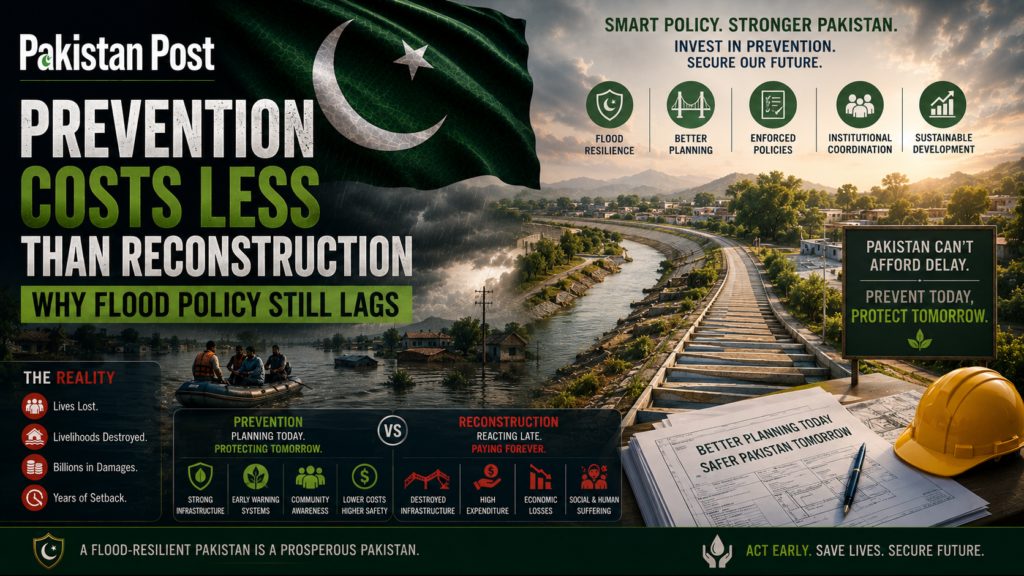
For Pakistan, floods have ceased to be exceptional natural disasters. They have become predictable fiscal events that repeatedly erase years of public investment, interrupt agricultural production, damage strategic transport corridors, weaken energy distribution, disrupt educational continuity, overwhelm public health systems and reduce investor confidence. Yet despite decades of experience, increasingly sophisticated meteorological forecasting and repeated national commissions examining flood vulnerability, public expenditure continues to exhibit a persistent structural preference for emergency response rather than systematic prevention. The consequence is not merely humanitarian hardship. It is a recurring cycle of capital destruction that steadily reduces national productivity while consuming scarce fiscal resources that could otherwise expand economic growth.
The paradox is increasingly difficult to justify. Pakistan possesses sufficient historical evidence demonstrating where rivers overflow, which districts remain chronically exposed, how sediment accumulates, where drainage systems fail and which institutional weaknesses repeatedly delay mitigation. Floods continue to arrive with varying intensity, but the underlying vulnerabilities remain remarkably consistent. Instead of transforming accumulated experience into permanent public policy, institutional attention frequently accelerates only after catastrophic inundation becomes unavoidable. Disaster management therefore remains operationally reactive rather than strategically preventive.
This imbalance reflects more than budgetary preference. It reveals deeper institutional incentives embedded across planning structures. Emergency expenditure attracts immediate political visibility because reconstruction projects produce tangible outputs within electoral cycles. Relief operations mobilise administrative machinery rapidly, attract international assistance and demonstrate visible governmental activity. Preventive investment, by contrast, often succeeds precisely because nothing dramatic occurs. Rivers remain within their channels, reservoirs absorb peak flows, urban drainage functions effectively and agricultural production continues uninterrupted. The political rewards of preventing invisible disasters therefore remain considerably weaker than the visibility associated with rebuilding after destruction.
The economic implications of this imbalance have become increasingly severe. According to assessments by the World Bank, the Asian Development Bank, the Government of Pakistan and United Nations agencies following the 2022 floods, direct damages and economic losses exceeded US$30 billion, while reconstruction and rehabilitation requirements surpassed US$16 billion. Agricultural losses alone reached billions of dollars through destroyed crops, livestock mortality, damaged irrigation infrastructure and disrupted rural supply chains. Millions of hectares of farmland experienced prolonged inundation, reducing subsequent planting cycles and weakening national food security. Transport infrastructure, including highways, bridges and rural roads, required extensive rehabilitation, while electricity distribution, telecommunications and public utilities sustained widespread disruption. Entire educational and healthcare networks temporarily ceased functioning across affected districts.
These figures illuminate an uncomfortable fiscal reality. Rebuilding assets repeatedly is substantially more expensive than protecting them before disaster occurs. International disaster economics consistently demonstrates that every dollar invested in preventive resilience frequently generates multiple dollars in avoided future losses. Estimates from organisations including the United Nations Office for Disaster Risk Reduction suggest benefit cost ratios ranging from four to ten depending upon infrastructure type and hazard exposure. These calculations incorporate avoided reconstruction costs, reduced business interruption, lower insurance losses, improved agricultural continuity and sustained economic productivity.
Pakistan nevertheless continues allocating comparatively limited resources toward integrated flood prevention. Annual development programmes include selected embankment rehabilitation, irrigation maintenance and drainage improvements, yet these investments often remain fragmented across ministries, provinces, irrigation departments, municipal authorities and disaster management institutions. The absence of a unified national prevention framework reduces cumulative effectiveness even where individual projects demonstrate technical merit.
River engineering illustrates this fragmentation clearly. Pakistan’s major river systems require continuous sediment management, embankment monitoring, channel maintenance and hydraulic assessment. Sedimentation progressively reduces carrying capacity while altering river morphology, increasing overflow risks during high discharge periods. Reservoirs similarly experience declining storage capacity as sediment accumulates over decades. Without systematic desilting, watershed rehabilitation and upstream erosion control, flood peaks become increasingly difficult to manage effectively. Engineering interventions therefore cannot remain isolated maintenance activities. They require permanent institutional integration with hydrological science, environmental regulation and long term investment planning.
Watershed degradation compounds downstream vulnerability. Extensive deforestation, unsustainable land use, hillside cultivation and unmanaged erosion accelerate runoff during heavy rainfall. Natural vegetation that previously moderated water movement has progressively diminished across numerous catchments. Consequently, rainfall reaches river systems more rapidly while carrying greater sediment loads, increasing flood intensity downstream. Restoring watersheds therefore represents not simply an environmental objective but a strategic infrastructure investment supporting national economic resilience.
Urban governance exposes another dimension of institutional weakness. Rapid urbanisation has transformed flood dynamics throughout Pakistan. Cities increasingly experience destructive urban flooding resulting not solely from river overflow but from inadequate drainage networks, encroached waterways, unregulated construction and impermeable surfaces preventing natural water absorption. Municipal drainage systems designed decades earlier frequently cannot accommodate expanding populations or increasingly intense rainfall associated with climatic variability. Encroachment upon natural drainage corridors further restricts water movement, converting seasonal rainfall into major urban emergencies.
These governance failures emerge despite substantial regulatory frameworks governing land use and environmental protection. Implementation remains inconsistent across provincial and municipal jurisdictions. Construction approvals frequently overlook floodplain exposure. Drainage maintenance receives insufficient operational funding. Informal settlements expand into high risk areas because affordable alternatives remain limited. Environmental regulations governing wetlands and natural flood retention areas often encounter weak enforcement. Consequently, urban expansion progressively increases national disaster exposure even without significant changes in rainfall patterns.
Institutional coordination presents an equally persistent challenge. Responsibilities concerning rivers, irrigation, municipal planning, environmental regulation, disaster management, agriculture, finance and climate adaptation remain distributed among multiple organisations operating under distinct administrative mandates. Coordination mechanisms frequently activate during emergencies rather than throughout continuous prevention cycles. Information sharing improves during crises but weakens during routine planning when strategic investments should actually occur.
Provincial implementation introduces further complexity following constitutional decentralisation. Provinces understandably prioritise regional development needs while national river systems operate across administrative boundaries requiring integrated basin management. Floodwaters disregard provincial jurisdictions, yet planning, budgeting and regulatory authority often remain fragmented. Effective prevention therefore demands institutional arrangements capable of aligning provincial implementation with nationally coordinated hydrological planning.
Climate variability intensifies these existing structural weaknesses rather than replacing them. Scientific evidence increasingly indicates greater rainfall variability, accelerated glacier dynamics and more frequent extreme weather events across South Asia. Although climate change influences hazard intensity, institutional vulnerability largely determines resulting economic losses. Comparable rainfall can produce dramatically different outcomes depending upon infrastructure quality, land management, institutional preparedness and governance effectiveness. Climate adaptation therefore requires strengthening existing governance systems rather than treating climate change solely as an external environmental phenomenon.
Agriculture remains particularly exposed because flood management directly influences national food security, export earnings and rural employment. Pakistan’s irrigation network constitutes one of the world’s largest integrated systems, supporting millions of livelihoods. Flood damage extends well beyond immediate crop destruction. Irrigation channels require repair, agricultural machinery suffers losses, soil fertility declines through erosion or sediment deposition, livestock populations decrease and rural credit systems weaken as borrowers experience repeated production failures. Farmers consequently postpone technological investment because uncertainty surrounding future disasters increases perceived financial risk.
Private investment similarly responds to institutional predictability. Domestic and international investors evaluate infrastructure resilience alongside taxation, regulation and macroeconomic stability. Repeated destruction of transport corridors, industrial facilities and energy infrastructure increases operational uncertainty while raising insurance costs and financing risks. Long term investment therefore depends not only upon macroeconomic reforms but also upon credible national resilience planning capable of protecting productive assets.
Several international experiences demonstrate how prevention oriented strategies gradually transformed disaster management. The Netherlands, despite significant exposure below sea level, progressively shifted from reactive flood defence toward integrated water governance combining engineering excellence, spatial planning, environmental restoration and continuous institutional adaptation. Sophisticated river management, controlled flood retention areas, advanced forecasting and stringent land use regulation substantially reduced national flood vulnerability while supporting economic development.
Japan similarly integrates structural engineering with comprehensive disaster preparedness. Reservoir optimisation, river channel improvements, urban drainage tunnels, seismic resilient infrastructure and continuous maintenance receive sustained investment independent of immediate disaster occurrence. Equally important, institutional coordination remains permanent rather than episodic, supported by detailed hazard mapping and rigorous regulatory enforcement.
Bangladesh offers another instructive example particularly relevant to Pakistan because both countries experience major river systems, monsoon variability and substantial rural populations. Over several decades Bangladesh significantly reduced disaster mortality through improved forecasting, community preparedness, cyclone shelters, embankment improvements and institutional coordination. Although flood risks remain, systematic preventive investment substantially strengthened national resilience while reducing humanitarian consequences.
China has increasingly combined ecological restoration with engineering interventions through concepts emphasising sponge cities, watershed rehabilitation, wetland restoration and integrated basin management. Urban planning increasingly incorporates natural water retention systems reducing runoff while complementing conventional drainage infrastructure. These approaches illustrate that environmental restoration and engineering investment function most effectively when designed as mutually reinforcing components rather than competing priorities.
The fiscal arithmetic strongly favours prevention. Large scale reconstruction following major floods frequently requires emergency borrowing, donor assistance, budget reallocations and delayed development projects. Every reconstruction cycle diverts resources from education, healthcare, industrial development, scientific research and technological modernisation. Preventive investment, although substantial initially, produces cumulative economic returns by preserving existing assets, sustaining production and reducing future fiscal volatility.
Insurance markets further reinforce preventive incentives. Countries demonstrating credible risk reduction frequently experience lower insurance costs and improved access to international capital because investors perceive reduced exposure to catastrophic losses. Conversely, repeated reconstruction financed through public borrowing gradually increases sovereign fiscal pressure while constraining future development expenditure.
Pakistan therefore requires moving beyond disaster management toward comprehensive national resilience management. Such transformation demands institutional permanence rather than temporary initiatives following individual catastrophes. Prevention must become embedded within fiscal planning, infrastructure investment, environmental governance and local government accountability.
A permanent National Flood Prevention Policy could provide this strategic architecture. Such a framework should integrate river engineering, watershed restoration, agricultural resilience, municipal planning, environmental regulation, financial planning and climate adaptation within a unified institutional structure reporting regularly to the highest levels of government. Rather than creating additional bureaucratic layers, the objective should involve harmonising existing institutional responsibilities through clearly defined operational mandates, measurable performance indicators and coordinated investment priorities.
River basin authorities should receive strengthened technical capacity supported by continuous hydrological monitoring, digital mapping, sediment assessment and predictive modelling. Reservoir management requires optimisation using advanced forecasting systems capable of balancing irrigation requirements, hydropower generation and flood mitigation. Sediment management should become a routine engineering function supported by long term financing rather than emergency interventions after channel capacity has already declined.
Floodplain zoning deserves stronger regulatory enforcement. Development within high risk areas should require rigorous scientific assessment supported by enforceable construction standards. Natural wetlands and seasonal retention zones should receive enhanced environmental protection because these ecosystems perform essential hydraulic functions that expensive engineered infrastructure alone cannot fully replicate.
Municipal governments require greater technical and financial capacity for drainage maintenance, stormwater management and urban planning. Performance based fiscal transfers could reward municipalities achieving measurable improvements in drainage functionality, environmental compliance and flood preparedness. Digital monitoring technologies including satellite observation, geographic information systems and remote sensing should support continuous assessment of encroachment, drainage performance and infrastructure maintenance.
Agricultural planning should incorporate flood resilience through improved drainage, climate resilient cropping systems, precision irrigation, soil restoration programmes and expanded agricultural insurance mechanisms. Farmers investing in resilient technologies could receive targeted financial incentives linked directly to verified risk reduction measures.
Financial governance similarly requires reform. Establishing a dedicated National Flood Prevention Fund financed through predictable multi year allocations would provide continuity beyond annual budget cycles. Independent technical evaluation should prioritise investments according to quantified risk reduction rather than administrative convenience or political visibility. Public expenditure reviews should compare preventive investments against avoided future reconstruction costs, thereby institutionalising long term fiscal evaluation.
Civil military coordination also warrants structured integration given the Armed Forces’ extensive operational experience during national emergencies. Military engineering capabilities, logistical planning and geospatial expertise can substantially strengthen preventive infrastructure planning without replacing civilian institutional leadership. Such cooperation should remain embedded within national resilience planning before disasters occur rather than activated primarily during emergency response.
Ultimately, Pakistan confronts a strategic policy choice rather than an engineering dilemma. The nation can continue financing repeated reconstruction after predictable destruction, or it can gradually reorient public investment toward preserving productive assets before disaster occurs. Every flood season now provides additional evidence supporting prevention as the economically rational alternative.
National resilience is not measured by the efficiency of emergency relief alone. It is measured by the ability of institutions to prevent predictable losses before they occur. A state that repeatedly rebuilds identical infrastructure after foreseeable disasters inadvertently converts public finance into a perpetual reconstruction mechanism. A state that systematically invests in prevention transforms resilience into productive capital, safeguards economic competitiveness, strengthens investor confidence and protects national development from recurring interruption. For Pakistan, that transition represents not merely environmental reform but a fundamental redefinition of fiscal responsibility, institutional governance and long term national security.
A Public Service Message