Gerontocracy Shapes Pakistan’s Leadership Renewal and Democratic Capacity

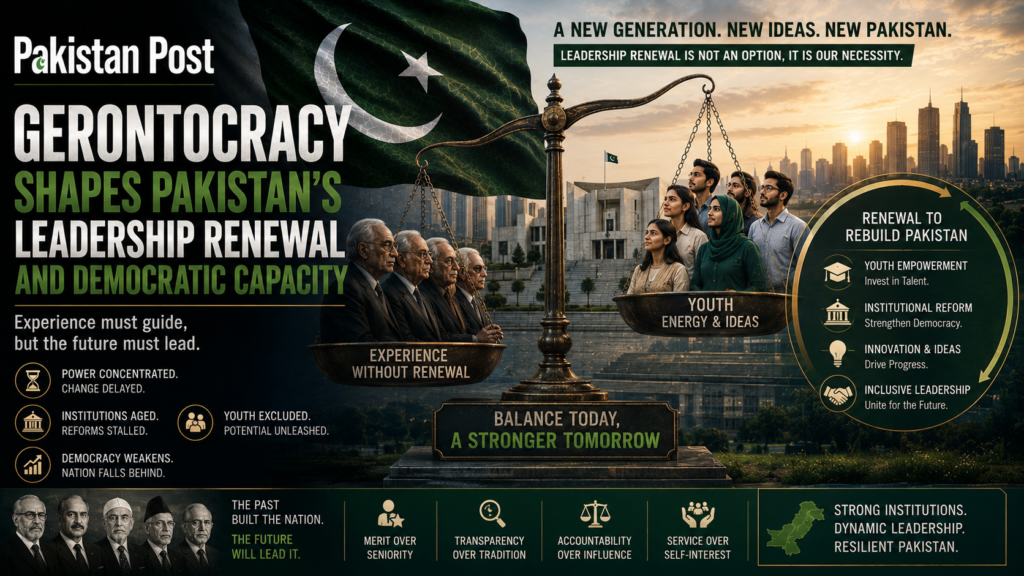
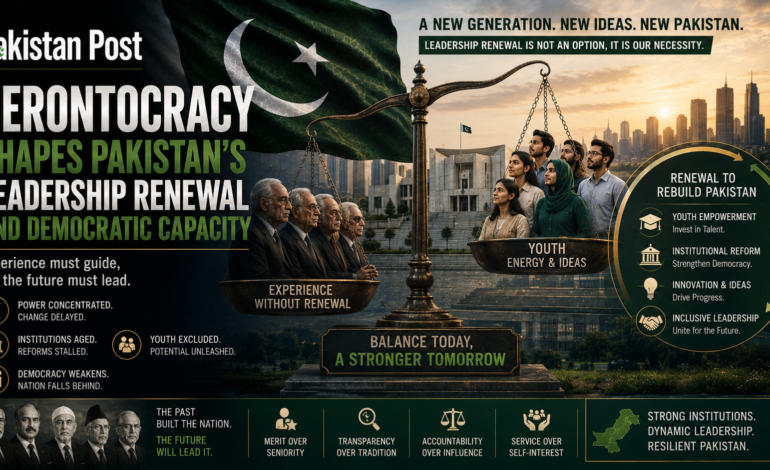
Pakistan confronts a political paradox that increasingly shapes its institutional future. Electoral competition remains vibrant, constitutional transfers of authority continue despite recurring interruptions, and successive governments repeatedly promise reform. Yet the circulation of political leadership remains remarkably narrow. Across multiple electoral cycles, many of the same personalities, families, networks and patronage structures continue to dominate candidate selection, parliamentary representation and executive authority. This persistent pattern has elevated the debate over gerontocracy beyond questions of age alone into a broader institutional concern regarding political recruitment, governance capacity and strategic state resilience. The central issue is not whether experienced leaders should remain influential. Rather, it concerns whether Pakistan’s political architecture systematically cultivates successive generations capable of governing an increasingly technological, economically interconnected and security complex state.
Political recruitment represents the invisible infrastructure of democratic performance. Constitutions define authority, elections allocate power and legislatures enact laws, yet the quality of governance ultimately depends upon how political systems discover, evaluate, train and promote future leadership. Where recruitment becomes concentrated within hereditary influence, financial patronage or informal elite bargaining, institutions gradually lose adaptive capacity. Innovation slows, policy debates become repetitive, administrative reform loses momentum and strategic planning increasingly favours immediate political survival over national transformation. Leadership continuity without institutional renewal eventually becomes continuity without progress.
Pakistan’s political evolution illustrates this structural dilemma with unusual clarity. Since independence, constitutional frameworks have undergone repeated revisions, electoral systems have evolved, local governments have periodically emerged and disappeared, and political parties have expanded organisationally. Nevertheless, mechanisms responsible for identifying future national leaders have changed far less dramatically than constitutional arrangements themselves. Parliamentary competition often appears dynamic during elections while candidate recruitment remains remarkably stable beneath the surface. Constituency influence, family recognition, financial resources, electability calculations and local patronage networks frequently outweigh demonstrated policy competence, administrative experience or legislative expertise.
Such continuity should not automatically be interpreted as democratic failure. Experienced politicians provide institutional memory, negotiation skills and electoral legitimacy that remain essential within any parliamentary democracy. Established leadership often possesses the relationships necessary for coalition building, constitutional compromise and crisis management. The challenge emerges when experience transforms into institutional exclusivity, limiting opportunities for capable individuals whose expertise lies in economics, technology, science, education, climate governance, cybersecurity or industrial policy. Modern states increasingly require political leadership capable of governing knowledge intensive societies rather than merely managing electoral constituencies.
This distinction becomes particularly significant as Pakistan enters an era characterised by demographic transformation. A substantial proportion of the country’s population belongs to younger age groups entering universities, labour markets and entrepreneurial sectors shaped by artificial intelligence, digital commerce, advanced manufacturing, renewable energy, biotechnology and evolving geopolitical competition. Public expectations increasingly reflect technological literacy, transparent governance and evidence based policymaking. Yet political representation often remains disproportionately concentrated among individuals whose professional formation occurred within entirely different economic and technological environments. The resulting disconnect does not necessarily reflect personal capability. Instead, it highlights institutional recruitment mechanisms struggling to align leadership composition with societal transformation.
Internal party democracy occupies a central position within this broader discussion. Political parties function as the primary gatekeepers of democratic recruitment. They determine candidate selection, allocate campaign resources, cultivate future leadership and shape legislative priorities. Where internal elections remain infrequent, leadership succession becomes uncertain and policy deliberation limited, organisational vitality gradually weakens. Decision making becomes increasingly centralised around small executive circles whose authority derives from historical legitimacy rather than continuous organisational competition. Such structures often discourage intellectual diversity because advancement depends more heavily upon personal loyalty than demonstrated policy innovation.
Candidate selection processes further reinforce elite continuity through understandable but strategically limiting incentives. Electoral success remains expensive, constituency management requires extensive organisational resources and political parties naturally seek individuals perceived as electorally reliable. Consequently, established local notables, influential families, business figures and experienced politicians receive repeated nominations because they minimise electoral uncertainty. This logic strengthens short term electoral competitiveness while simultaneously reducing opportunities for emerging professionals, academics, policy specialists, women leaders and younger public servants capable of expanding legislative expertise.
Political financing magnifies these dynamics. Campaign expenditures increasingly require substantial financial capacity, extensive organisational infrastructure and durable local patronage networks. Individuals possessing independent wealth or longstanding political relationships therefore enjoy structural advantages over candidates whose primary assets consist of professional competence or policy knowledge. Financial barriers consequently influence political recruitment before voters even encounter candidates during elections. Democratic competition formally remains open while practical access becomes progressively unequal.
Youth political participation reflects another dimension of institutional renewal. Pakistan possesses energetic student populations, expanding digital entrepreneurship, vibrant civil society initiatives and increasingly sophisticated policy research communities. Nevertheless, pathways connecting youthful civic engagement with national legislative leadership remain comparatively underdeveloped. Student politics has experienced intermittent restrictions across different historical periods, internship opportunities within legislatures remain limited, parliamentary research capacities require expansion and structured leadership development programmes operate inconsistently across political organisations. The consequence is that many capable young citizens engage enthusiastically with public affairs while perceiving formal politics as inaccessible or predetermined.
Leadership succession presents equally significant institutional implications. Mature democracies rarely depend exclusively upon individual personalities because succession mechanisms function predictably within political organisations. Leadership contests, transparent internal elections, policy debates and organised transitions reduce uncertainty while encouraging strategic continuity. Where succession instead depends upon informal negotiation, personal authority or hereditary influence, institutional resilience becomes increasingly vulnerable to unexpected political transitions. Stable democracies institutionalise leadership replacement long before succession becomes unavoidable.
Legislative performance provides an important indicator of recruitment quality. Modern parliaments increasingly address highly specialised issues involving digital regulation, financial technology, energy transitions, biotechnology, artificial intelligence governance, climate adaptation, international taxation, cyber resilience and complex trade negotiations. Effective legislative oversight therefore requires members possessing either direct expertise or access to sophisticated parliamentary research institutions. Where legislative recruitment prioritises electoral influence over policy competence, parliamentary deliberation risks becoming reactive rather than strategically anticipatory. Laws may continue to pass, yet their technical sophistication may not consistently match the complexity of contemporary governance challenges.
Administrative responsiveness similarly depends upon political recruitment. Civil services provide continuity, institutional memory and technical implementation, but elected leadership establishes strategic direction. Ministers increasingly supervise portfolios involving advanced technological systems, international financial negotiations, digital infrastructure and scientific innovation. Effective political oversight therefore requires continuous learning, interdisciplinary understanding and willingness to engage evidence based policymaking. Recruitment systems insufficiently connected to professional expertise inevitably constrain governmental adaptability regardless of bureaucratic competence.
Technological understanding has emerged as an especially significant dimension of political leadership. Artificial intelligence, quantum computing, satellite infrastructure, semiconductor supply chains, cybersecurity, digital currencies and autonomous systems increasingly influence national security alongside economic competitiveness. Parliamentary committees and executive authorities must therefore evaluate policy issues extending well beyond traditional administrative experience. Political systems unable to recruit technologically literate leadership risk becoming dependent upon external consultants or narrow bureaucratic expertise, reducing democratic oversight over strategically sensitive sectors.
Long term policymaking suffers when leadership circulation remains constrained. Electoral politics naturally encourages responsiveness to immediate public concerns. However, institutional renewal becomes essential for sustaining investments whose benefits emerge across decades rather than electoral cycles. Educational transformation, judicial modernisation, industrial upgrading, demographic planning, climate resilience and technological innovation require political coalitions capable of maintaining strategic continuity beyond individual governments. Recruitment systems dominated by short term electoral calculations frequently underinvest in such long horizon priorities.
International experience demonstrates that political renewal need not undermine institutional stability. Several parliamentary democracies have gradually broadened recruitment while preserving constitutional continuity and experienced leadership. Nordic democracies encourage internal party competition, extensive political education and local government experience before national office. Germany combines strong party institutions with structured policy foundations that cultivate specialised expertise across generations. Singapore integrates leadership identification with rigorous administrative exposure, although within a distinct political context. Britain regularly experiences generational leadership transitions through competitive internal party mechanisms despite maintaining longstanding parliamentary traditions. Japan periodically renews political leadership while balancing factional continuity with institutional adaptation. None of these systems eliminate elite influence entirely, yet each incorporates mechanisms encouraging periodic circulation of capable individuals possessing diverse professional backgrounds.
Several emerging democracies likewise illustrate valuable lessons. South Korea expanded political recruitment alongside administrative modernisation, technological investment and educational transformation. Indonesia gradually strengthened democratic institutions through decentralisation, allowing provincial leadership experience to become an important pathway toward national office. Rwanda invested extensively in leadership training programmes linked with public administration, although operating within a markedly different constitutional environment. These examples differ substantially in political structure, yet each demonstrates that leadership renewal becomes more sustainable when institutional pathways remain transparent and merit based.
Pakistan possesses several underutilised institutional advantages capable of supporting similar evolution. Its expanding higher education sector produces graduates across engineering, economics, medicine, law, information technology and international affairs. Civil services continue generating experienced administrators familiar with complex governance challenges. Military institutions cultivate strategic planning expertise, crisis management capabilities and organisational discipline. Independent research organisations increasingly contribute sophisticated policy analysis. Entrepreneurial communities demonstrate growing technological innovation. Integrating these reservoirs of expertise into democratic political recruitment would strengthen rather than weaken constitutional governance.
The relationship between political institutions and national security deserves careful consideration. Strategic competition increasingly encompasses economic resilience, technological innovation, information integrity, demographic management and industrial capability alongside conventional defence. National security therefore depends not only upon military preparedness but equally upon governance quality, institutional competence and long term policy coherence. Political recruitment incapable of producing leaders conversant with emerging strategic domains may gradually constrain national competitiveness despite possessing robust security institutions. Institutional renewal thus complements rather than competes with establishment concerns regarding national resilience.
Civil military equilibrium also benefits from stronger civilian policy competence. Where elected institutions cultivate greater expertise in defence economics, cybersecurity, strategic communications, technological governance and regional diplomacy, civilian oversight becomes more substantive while inter institutional cooperation becomes increasingly professional. Enhanced civilian capability reduces unnecessary institutional friction by improving the quality of strategic dialogue rather than altering constitutional balances. Mature democracies generally rely upon knowledgeable civilian leadership working collaboratively with experienced national security institutions within clearly defined constitutional frameworks.
Merit based political recruitment requires reforms extending beyond electoral legislation. Political parties could institutionalise competitive internal elections for organisational positions, establish accredited policy academies, introduce transparent candidate evaluation criteria and create specialised leadership tracks for professionals entering politics from academia, industry, public administration and civil society. Structured mentoring programmes pairing experienced parliamentarians with emerging leaders would preserve institutional memory while encouraging generational transition. Candidate assessment should increasingly incorporate legislative preparation, policy literacy, ethical standards and constituency engagement rather than relying predominantly upon electoral influence.
Parliament itself requires strengthened institutional support. Expanded non partisan research services, specialised legislative budget offices, technological advisory units and professional committee staff would improve policymaking irrespective of individual political backgrounds. Continuous education programmes for legislators covering digital governance, international economics, climate security, emerging technologies and constitutional law would further enhance institutional effectiveness. Democracies increasingly succeed when legislatures become centres of policy expertise rather than solely arenas of political contestation.
Political financing reforms similarly deserve sustained attention. Greater transparency regarding campaign expenditures, strengthened disclosure requirements, equitable media access and carefully designed public financing mechanisms could reduce barriers confronting capable candidates lacking substantial personal wealth. Such reforms should balance accountability with practical political realities while avoiding excessive regulatory burdens that unintentionally discourage legitimate political participation.
Local government institutions offer another essential pathway toward leadership renewal. Effective municipal governance develops administrative competence, public accountability and practical policymaking experience unavailable through purely partisan activity. Countries possessing durable local government systems often generate nationally successful leaders because administrative capability develops progressively across multiple levels of governance. Stable and constitutionally protected local institutions therefore strengthen national political recruitment while improving public service delivery.
Educational institutions also possess untapped potential. Universities should expand public policy fellowships, parliamentary internships, legislative simulation programmes and collaborative research partnerships with elected institutions. Encouraging talented graduates to perceive democratic politics as a respectable professional pathway rather than a closed patronage system would gradually diversify recruitment without undermining democratic legitimacy.
Institutional culture ultimately determines whether reform succeeds. Political organisations must increasingly value expertise alongside electability, legislative performance alongside constituency influence and long term governance alongside immediate electoral calculations. Experience should remain respected because democratic continuity depends upon institutional memory. Equally, renewal should become normal because adaptive governance requires continuous intellectual replenishment. The objective is neither generational displacement nor elite exclusion. It is institutional balance.
Pakistan’s future governance capacity will depend less upon the average age of its political leadership than upon the openness, competitiveness and meritocratic character of its recruitment institutions. Gerontocracy becomes problematic only when experience transforms into structural exclusivity that restricts capable successors from contributing national leadership. Democracies remain resilient when institutional renewal becomes continuous rather than episodic, preserving constitutional stability while encouraging intellectual diversity, administrative competence and strategic adaptability. Pakistan possesses sufficient constitutional foundations, educational resources and institutional experience to undertake such evolution. The decisive challenge lies in transforming political recruitment from a mechanism primarily reproducing established influence into one systematically cultivating national capability. Such renewal would strengthen democratic legitimacy, enhance policy sophistication, reinforce strategic resilience and better equip the state to govern an increasingly complex twenty first century environment while preserving the constitutional continuity upon which long term national stability ultimately depends.
A Public Service Message