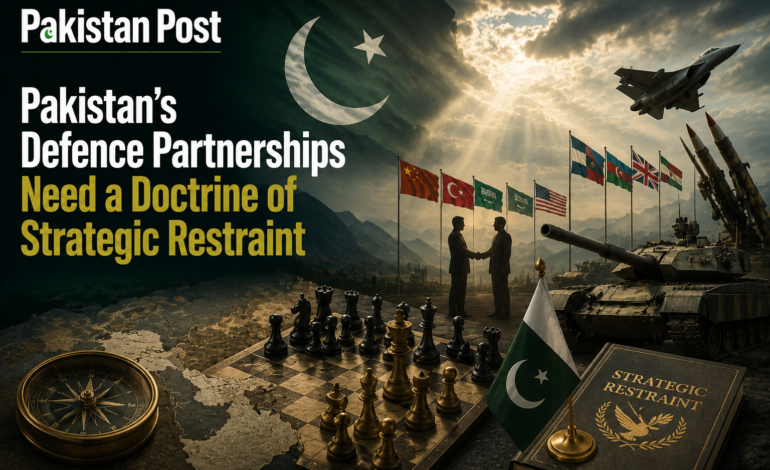
Pakistan’s Defence Partnerships Need a Doctrine of Strategic Restraint

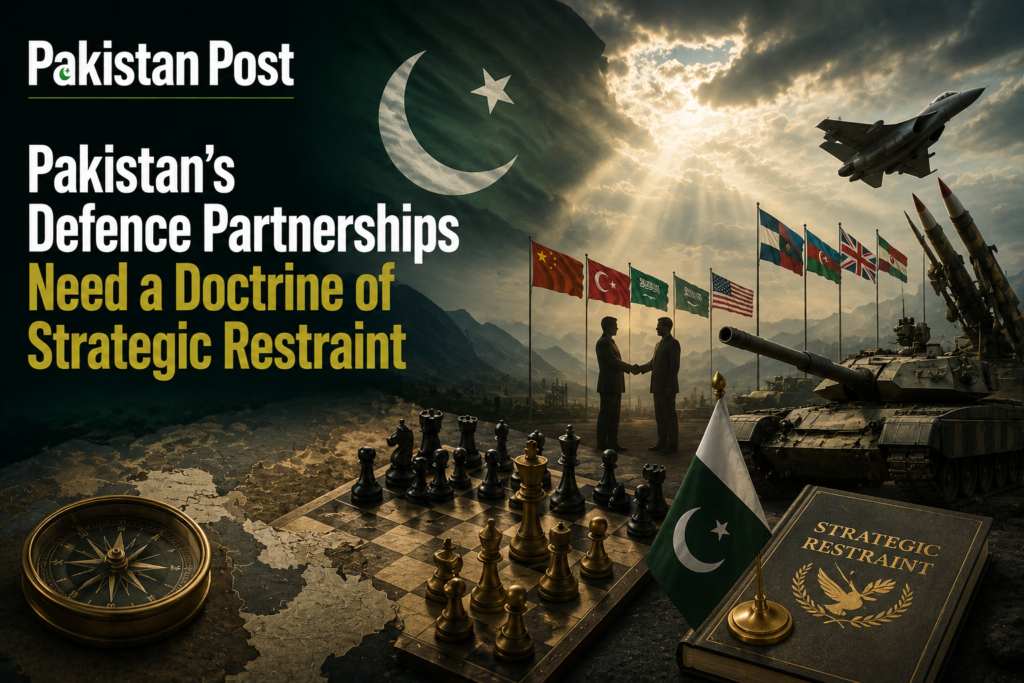
Pakistan’s expanding defence relationships are entering a more consequential phase. For decades, Islamabad has maintained military cooperation with China, the United States, Saudi Arabia, Türkiye, Qatar and other partners without converting every relationship into a binding security commitment. That distinction is now becoming harder to preserve. The signing of the Makkah Joint Defence Agreement by Pakistan, Saudi Arabia and Türkiye on August 7 has introduced a qualitatively different proposition into Pakistan’s external security architecture: an attack against one participant is to be treated as an attack against all three. Pakistani officials have stressed its defensive character and its compatibility with existing arrangements, but the strategic meaning of such language will ultimately be determined not by diplomatic assurances but by the circumstances in which the agreement is tested. (AP News)
This is precisely where Pakistan needs a doctrine of calibrated security partnerships. Defence cooperation is not synonymous with alliance formation. Training exchanges, intelligence liaison, exercises, defence production, officer education, maritime cooperation, counterterrorism coordination and technology transfer can strengthen national capability without automatically creating an obligation to participate in another state’s conflict. Collective security signalling is different again. It seeks to influence an adversary’s calculations by demonstrating that aggression will carry wider consequences. Formal strategic alignment goes further by creating institutional, legal or political expectations that can constrain independent decision making during a crisis. Pakistan’s challenge is to derive the deterrent advantages of the first two without unnecessarily inheriting the liabilities of the third.
The distinction matters because Islamabad does not operate in a strategically empty environment. Its principal external relationships overlap across different theatres. China remains the central long term defence and strategic partner, with both countries reaffirming in May 2026 their intention to deepen military cooperation, strategic coordination, defence technology collaboration and counterterrorism engagement. The joint statement also referred to establishing a China Pakistan security partnership and strengthening military to military cooperation. (Ministry of Foreign Affairs)
The United States occupies a different but still important position. Pakistan and Washington continue institutional engagement on counterterrorism, emerging security threats and regional stability. Their August 2025 Counterterrorism Dialogue specifically addressed terrorist threats, institutional capacity and the use of emerging technologies by militant organisations. (Ministry of Foreign Affairs) The relationship therefore remains strategically relevant even though it no longer resembles the formal security architecture of earlier decades. Pakistan cannot afford to interpret strategic diversification as a zero sum exercise in which closer relations with one partner require demonstrative distance from another.
The Gulf dimension is even more complicated because security cooperation is increasingly intersecting with economic dependence, energy security, labour mobility and political diplomacy. Pakistan’s Strategic Mutual Defence Agreement with Saudi Arabia, signed in September 2025, already stated that aggression against either country would be considered aggression against both. (Ministry of Foreign Affairs) The subsequent Makkah agreement expands the strategic geometry by adding Türkiye to a framework involving mutual defence expectations. This creates greater deterrence potential, but it also raises a fundamental question for Pakistani planners: what precisely constitutes an obligation to act?
A sophisticated national security doctrine cannot leave that question to crisis time interpretation. Armed attack is a legal category, but contemporary conflict rarely arrives in a legally pristine form. Missile strikes, drone attacks, cyber operations, sabotage, maritime incidents, proxy activity, attacks on energy infrastructure, covert operations and ambiguous attribution can generate pressure long before conventional forces cross an internationally recognised border. If Pakistan does not establish internal thresholds for distinguishing an armed attack from an incident, a provocation from a strategic attack, or a partner’s unilateral operation from an attack against the partner, external actors may eventually define those thresholds for Islamabad.
The problem becomes particularly acute when partner states possess different threat perceptions. Saudi Arabia’s security concerns are heavily influenced by the Gulf, energy infrastructure, maritime routes and missile and drone threats. Türkiye operates simultaneously within NATO structures, the Middle Eastern security environment, the Black Sea strategic theatre and an increasingly autonomous defence industrial ecosystem. Pakistan’s overriding military priorities remain centred on territorial defence, India, internal security, maritime interests, western border management and the protection of strategic infrastructure. These interests overlap in places, but they are not identical.
A durable partnership therefore requires convergence of interests, not artificial uniformity of threat perception.
Pakistan should institutionalise this distinction through a tiered partnership model. At the lowest level should be capability cooperation, covering training, exercises, education, defence production, logistics, intelligence liaison and technology development. The next level should involve structured security consultation, including information sharing, joint assessments, crisis communication and coordinated diplomatic signalling. A higher tier should involve contingency planning for defined threats, but without automatic military participation. Only the highest tier should contain explicit mutual defence obligations, and even there the precise conditions for activation should be documented through national procedures rather than left to political improvisation.
Such architecture would give the armed forces greater operational interoperability without creating unnecessary strategic entrapment.
Interoperability itself deserves careful definition. It should not merely mean that Pakistani units can operate alongside foreign forces. It should encompass compatible communications protocols, common terminology, intelligence classification procedures, identification systems, logistics standards, medical support arrangements, airspace coordination and maritime deconfliction. These technical mechanisms can create substantial military value while remaining politically less provocative than permanent basing arrangements or expeditionary commitments.
Pakistan’s cooperation with Türkiye illustrates the potential. The two countries have continued high level military dialogue covering defence industry collaboration, training, capacity building and strategic cooperation. In April 2026, their High Level Military Dialogue Group reviewed defence industry and military cooperation and reaffirmed the institutional mechanism for continuing engagement. (PID) Pakistan and Türkiye have also discussed advanced training, aerospace technologies, unmanned systems and expanded military exercises. (YouTube) This is precisely the kind of cooperation that can increase national capability without necessarily requiring automatic alignment on every regional conflict.
The same principle should guide relations with Qatar and other Gulf partners. Qatar expressed interest in deepening defence cooperation with Pakistan in February 2026, while discussions included regional developments involving Iran and Afghanistan and emphasised dialogue and de escalation. (Radio Pakistan) Such relationships are valuable precisely because they permit Pakistan to operate through multiple security channels rather than placing its entire regional posture inside a single strategic bloc.
The establishment should therefore resist the temptation to measure strategic success by the number of agreements signed, joint exercises conducted or defence delegations exchanged. The relevant metric is strategic utility. Does an agreement improve Pakistan’s deterrence? Does it increase intelligence quality? Does it reduce response time? Does it create access to technology? Does it improve defence industrial capability? Does it protect trade and energy routes? Does it preserve diplomatic options during a crisis? If the answer to these questions is unclear, institutional enthusiasm can become strategic accumulation without corresponding national advantage.
Parliamentary oversight should form part of this architecture, not as an intrusion into operational military affairs but as a mechanism for legitimising major external security commitments. Confidential briefings to designated parliamentary committees could provide oversight without exposing sensitive intelligence or operational plans. Agreements involving automatic or potentially automatic military commitments should receive a higher level of institutional scrutiny than ordinary memoranda concerning training or equipment cooperation.
A national security partnership registry could further improve coherence. Every major defence arrangement should be classified according to its legal status, geographical scope, military obligations, intelligence implications, technology restrictions, escalation risks and termination provisions. The registry need not be public in its entirety. Its purpose would be to ensure that policymakers know exactly how individual commitments interact with one another before a crisis produces contradictory obligations.
Diplomatic consultation should be mandatory before any partner interprets an incident as triggering collective action. A permanent crisis consultation mechanism among the participating states could establish secure communication channels between political, military and diplomatic authorities. The objective would be to prevent an incident from moving directly from battlefield ambiguity to political commitment.
This is especially important for Pakistan because its diplomatic credibility rests partly on maintaining channels with actors that may themselves be in confrontation. The country’s relationship with China, its continuing engagement with the United States, its strategic partnership with Saudi Arabia and Türkiye, and its geographic proximity to Iran require a degree of diplomatic elasticity. Pakistan cannot afford a security doctrine that turns every partnership into a binary choice.
The China dimension deserves particular attention. Beijing has welcomed stronger Pakistan China military coordination and continues to regard the relationship as strategically important. (Chinese Foreign Ministry) Yet China’s strategic expectations from Pakistan are not identical to those of Gulf partners. Beijing’s priorities include regional stability, protection of Chinese personnel and projects, counterterrorism, strategic connectivity and the broader balance of power in Asia. Pakistan should therefore avoid presenting new Gulf security arrangements as substitutes for its established relationship with China. The correct message is complementarity rather than replacement.
Washington requires equally careful handling. Expanded defence relations with Gulf partners or Türkiye should not be interpreted as an attempt to construct an anti American security structure. Conversely, Pakistan should avoid allowing concern about American perceptions to restrict legitimate diversification of defence relationships. Strategic autonomy is credible only when it is supported by multiple functional partnerships and a clearly defined national interest.
Iran presents the most delicate test. Tehran’s initial public reaction to the new trilateral security arrangement has been relatively restrained, with its foreign ministry saying there is no reason to fear the pact while calling for inclusive regional security mechanisms. (Reuters) Islamabad should reinforce that interpretation through sustained diplomatic consultation. Pakistan’s western border, trade routes, energy interests and internal security considerations make unnecessary confrontation with Iran strategically expensive. The existence of a defensive agreement with Saudi Arabia and Türkiye should therefore not become a justification for importing Gulf rivalries into Pakistan’s bilateral relationship with Tehran.
The doctrine should also contain an explicit non participation principle. Pakistan should not enter another state’s offensive operation merely because it has defence cooperation with that state. Military assistance should be linked to clearly defined national security interests and the legal terms of the relevant agreement. Even where collective defence obligations exist, the form of response should remain subject to national command authority, constitutional procedures and an assessment of escalation risks.
This does not weaken deterrence. Properly designed ambiguity can sometimes strengthen it. An adversary should know that Pakistan possesses meaningful partnerships, intelligence networks, military interoperability and political relationships, while remaining uncertain about the exact scale and timing of any response. What should be avoided is the opposite form of ambiguity, in which partners themselves are uncertain about Pakistan’s commitments and Pakistani policymakers discover the limits of an agreement only after a crisis has begun.
The emerging strategic environment rewards countries that can cooperate extensively without becoming strategically captive. Pakistan’s objective should therefore be partnership density without commitment inflation. More exercises should produce better readiness. More intelligence exchange should produce better warning. More defence technology cooperation should produce domestic capability. More diplomatic coordination should produce greater crisis resilience. Agreements should be judged by these outputs rather than by their ceremonial language.
The Makkah arrangement has given Pakistan an opportunity to formalise precisely such a doctrine. Islamabad can demonstrate that collective security does not require abandonment of diplomatic flexibility, and that military solidarity can coexist with independent foreign policy judgement. The test will come when the interests of partners diverge, when attribution is uncertain, or when an incident occurs in a theatre where Pakistan has no direct national stake.
For the establishment, the strategic requirement is therefore straightforward even if its execution is complex. Pakistan needs clear activation thresholds, classified contingency protocols, parliamentary oversight for binding commitments, permanent diplomatic consultation mechanisms, national command authority over military deployment, legal review of defence agreements and regular interagency assessments of cumulative strategic exposure.
The country should cooperate broadly, coordinate intelligently and commit selectively. Its strongest position is not to become indispensable to one bloc, but to remain valuable to several. A calibrated security partnership doctrine would allow Pakistan to extract the military, technological and diplomatic benefits of deeper cooperation while preserving the sovereign discretion required when conflicts become entangled. In an increasingly crowded security environment, strategic flexibility is not indecision. It is an asset that must itself be protected.
A Public Service Message