The Economics of Drones Is Rewriting Pakistan’s Air Defence

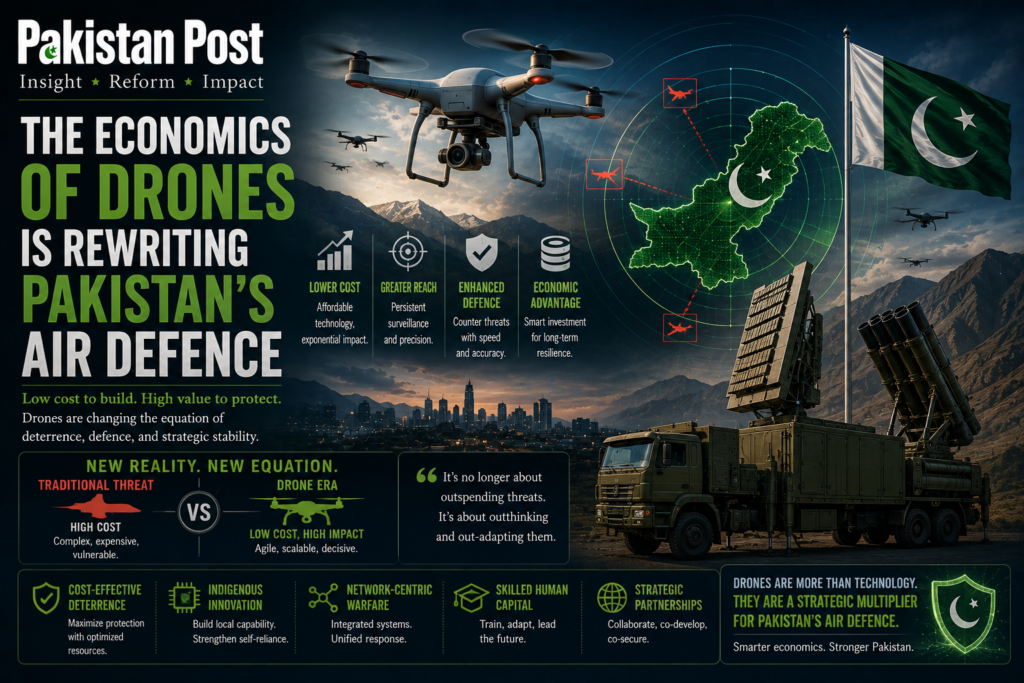
The central problem confronting Pakistan’s air defence planners is no longer whether the country possesses sophisticated systems capable of detecting and engaging aerial threats. It is whether those systems can remain economically, operationally and doctrinally viable when the attacker can manufacture uncertainty at a fraction of the defender’s cost. A high value surface to air missile battery may be designed to defeat aircraft, cruise missiles and other demanding targets, but a commercially derived unmanned aerial system can force that same architecture to spend money, reveal sensors, alter deployments and consume operator attention without ever requiring a comparable investment from the attacker. This is the strategic arithmetic that increasingly matters.
Pakistan has already built a substantial layered air defence architecture, incorporating long, medium and shorter-range systems and increasingly sophisticated command and control arrangements. The next challenge is therefore not simply adding another expensive missile system to an existing inventory. It is creating a counter unmanned aircraft system architecture capable of distinguishing between strategic aerial threats and low cost platforms, responding proportionately, and sustaining defensive operations during prolonged saturation. Open source assessments indicate that Pakistan’s air defence modernisation has moved towards a multi layered structure, while the emerging requirement for counter UAS capability is becoming increasingly explicit.
This distinction has profound implications for national security. The conventional air defence model was built around an assumption of scarcity. Aircraft were expensive, pilots were valuable, missiles were sophisticated and hostile sorties were relatively difficult to generate. The drone era introduces abundance. An adversary can potentially deploy large numbers of small platforms, alter their flight profiles, combine reconnaissance with deception, exploit commercial navigation technologies and create multiple simultaneous tracks. The purpose may not always be physical destruction. A drone can be useful merely by compelling a defender to activate radar, divert personnel, suspend operations, expose communications patterns or consume an interceptor.
The economics of attrition consequently become inseparable from the architecture of deterrence. If a relatively inexpensive drone obliges a defender to employ a disproportionately expensive interceptor, the attacker has achieved an economic advantage even when the drone itself is destroyed. This does not make conventional air defence obsolete. It makes the division of labour within air defence more important. High value interceptors must be reserved for high consequence threats, while lower cost threats should be addressed through systems whose acquisition, deployment and operating costs are compatible with sustained attrition.
For Pakistan, this is particularly relevant because the protected area is unusually diverse. Military installations are only one category of concern. Airports, power generation facilities, transmission infrastructure, oil storage, refineries, telecommunications sites, ports, industrial clusters, government compounds and strategic communications nodes can all become targets or surveillance objectives. The protection problem therefore extends beyond the traditional military air defence establishment into civilian aviation, energy security, telecommunications regulation, provincial policing and critical infrastructure management.
The institutional question is consequently as important as the technological one. Pakistan cannot treat counter drone capability as an isolated procurement programme belonging exclusively to the armed forces. The state requires a national architecture in which military air defence, civil aviation authorities, airport security, police organisations, intelligence structures, energy companies and critical infrastructure operators exchange information through defined protocols. The existing division of responsibility must be clarified before a crisis exposes the gaps between it.
The civilian dimension is already becoming visible. The Airports Security Force is responsible for security at Pakistan’s operational civil airports, currently covering 25 airports, including international and domestic facilities. A drone appearing near an airport is therefore not merely an air defence problem. It can become an aviation safety incident, a law enforcement matter, an intelligence concern and potentially a national security event within minutes. A response architecture that requires several institutions to determine ownership before action is taken is structurally vulnerable to the speed of the threat.
Pakistan’s recent experience also suggests that counter drone policy is moving from abstract planning towards administrative implementation. In 2026, the Ministry of Defence Production held an engagement with private sector UAS developers and explicitly identified the creation of a sustainable domestic drone ecosystem, including regulatory procedures, testing infrastructure, procurement mechanisms and research support, as a national priority. Punjab has separately moved towards district level anti drone capabilities, including electronic countermeasures and dedicated units. These developments are significant because they demonstrate that the threat is no longer confined to conventional battlefields.
The danger, however, is that decentralised procurement can produce a fragmented national capability. A province may purchase a jammer, a police department may acquire another detection system, an airport may install a proprietary sensor, while military authorities operate a completely separate command architecture. Each may function adequately in isolation yet fail collectively. Counter UAS systems depend heavily on interoperability. Detection without identification can generate false alarms. Identification without tracking creates uncertainty. Tracking without an authorised response mechanism produces delay. Jamming without airspace coordination can interfere with legitimate communications or navigation. Kinetic interception around populated areas introduces another layer of risk.
The appropriate doctrine must therefore begin with detection rather than destruction. Pakistan should establish a national counter UAS sensor grid based on a combination of radio frequency detection, low altitude radar, electro optical and infrared observation, acoustic sensing where appropriate, passive surveillance and networked identification. No single sensor is sufficiently reliable across all environmental conditions. Research on unauthorised drone detection has demonstrated the complementary value and limitations of RF, acoustic and visual approaches, reinforcing the case for sensor fusion rather than technological monoculture.
Artificial intelligence should be introduced not as a substitute for command judgement but as an accelerator of classification. The strategic value of AI lies in reducing the time between detection and identification, correlating apparently unrelated tracks, distinguishing authorised aircraft from anomalous objects and prioritising threats according to location, behaviour, payload indicators and proximity to protected assets. The objective should be decision superiority, not automated escalation.
This is where Pakistan needs a more sophisticated concept of passive defence. Hardened infrastructure may appear technologically unspectacular compared with a new missile battery, yet it can provide greater resilience against inexpensive aerial attacks. Critical facilities should review vulnerable power substations, fuel storage, communications rooms, exposed control systems, antenna installations and other sensitive components. Redundancy, physical separation, camouflage, rapid repair capability and protected communications can reduce the strategic payoff available to an attacker. Air defence should not be understood merely as the act of shooting something down. It should also mean reducing what an attacker can achieve if something penetrates the outer defensive layer.
The procurement philosophy should change accordingly. Pakistan should calculate counter UAS expenditure through a cost per defended effect rather than cost per weapon. A system capable of destroying a drone is not necessarily economical if its ammunition costs many times more than the target. The preferred architecture should combine low cost electronic effects, reusable directed energy where technically and legally feasible, affordable kinetic options, interceptor drones, passive surveillance and conventional missiles reserved for threats that genuinely justify their use. Such a structure would transform the economic contest from one of expensive reaction into one of controlled attrition.
The military establishment also has a doctrinal interest in this shift. Strategic installations cannot be protected indefinitely by concentrating increasingly expensive defensive systems around every potential target. Such concentration can create predictable defensive patterns, increase logistical burdens and produce vulnerabilities through fixed deployment. A more resilient architecture would distribute sensing, preserve ambiguity about defensive dispositions, employ mobile elements and connect local sensors to higher command networks without creating a single point of failure.
Electronic warfare deserves particular attention. Commercial drones can depend upon radio links, satellite navigation, cellular networks or combinations of autonomous navigation technologies. A doctrine based entirely on jamming therefore risks becoming obsolete as autonomy increases. Pakistan should develop an electronic warfare continuum that includes detection, classification, controlled disruption and, where legally and technically authorised, takeover or neutralisation. At the same time, the defence establishment should assume that sophisticated adversaries will attempt frequency hopping, navigation denial resistance, autonomous route planning and multi platform coordination.
Swarm operations represent the more consequential conceptual challenge. A swarm does not necessarily require every platform to be technologically sophisticated. Its effectiveness can emerge from numbers, distributed sensing, decoys and coordinated behaviour. Defenders can be overwhelmed not because individual drones are difficult to destroy but because the defensive system cannot economically and cognitively process the volume of simultaneous contacts. The answer is therefore not simply more interceptors. It is automated track management, threat prioritisation, distributed engagement and sufficient low cost defensive capacity to absorb saturation.
Pakistan should consequently establish a National Counter UAS Doctrine under an inter institutional framework, with military air defence providing the strategic backbone while civilian authorities retain defined responsibilities within their jurisdictions. The doctrine should establish common terminology, threat categories, response authorities, procurement standards, data sharing protocols, training requirements and rules for operating counter drone systems around populated areas and civil aviation.
A national testing and evaluation centre should become an immediate priority. Every proposed counter UAS system should be tested against different drone sizes, flight profiles, navigation modes, weather conditions, electromagnetic environments and saturation scenarios. Procurement should not be driven principally by demonstrations in controlled environments. Pakistan needs operational testing that measures detection probability, false alarm rates, reaction time, electronic resilience, interoperability, maintenance burden, ammunition consumption and cost per engagement.
Domestic industry should be integrated into this architecture, but localisation must not become a euphemism for protected procurement. Pakistan’s emerging private sector can contribute sensors, software, communications equipment, airframes, electronic warfare components and artificial intelligence applications. The state should create competitive challenge based procurement, open testing standards and accelerated evaluation pathways. The objective should be a domestic ecosystem capable of iterative improvement, not merely local assembly of imported components.
The financial logic is compelling. A country facing fiscal constraints cannot afford to defend every strategic asset with the most expensive available technology. Nor can it afford to leave inexpensive vulnerabilities unaddressed because existing procurement categories do not accommodate them. Pakistan should therefore establish a layered acquisition model in which the cheapest effective countermeasure is considered before the most sophisticated one, without compromising the protection of assets whose destruction would have national consequences.
This approach also requires a national drone registry and airspace awareness mechanism capable of distinguishing legitimate commercial, agricultural, industrial and recreational activity from hostile or unauthorised operations. Counter drone policy cannot become synonymous with indiscriminate drone prohibition. Pakistan needs drones for agriculture, surveying, emergency response, infrastructure inspection, logistics and scientific research. A security framework that suppresses legitimate use without creating better identification mechanisms would sacrifice economic opportunity without eliminating the threat.
The strategic establishment should view this issue through the wider lens of resilience. The purpose of counter UAS capability is not simply to protect military bases. It is to prevent a low cost technology from acquiring a disproportionately high strategic effect. That requires integration between air defence, intelligence, cyber security, electronic warfare, physical protection and emergency response. It also requires an institutional culture in which information moves horizontally rather than remaining trapped within organisational silos.
Pakistan’s air defence has historically been shaped by the need to deter high end aerial threats. The drone revolution does not invalidate that requirement. It introduces a lower layer of warfare in which affordability, persistence and numerical abundance can determine outcomes. The country therefore needs two forms of deterrence operating simultaneously: the ability to defeat sophisticated threats and the ability to deny inexpensive platforms an economical pathway to strategic disruption.
The policy objective should be clear. Pakistan must prevent the defender’s sophistication from becoming the attacker’s economic opportunity. A credible national counter drone doctrine would combine layered sensing, artificial intelligence assisted classification, electronic warfare, affordable interception, hardened infrastructure, mobile defensive units, protected communications, domestic industrial capacity and clearly delegated response authorities. The ultimate measure of success would not be the number of drones destroyed. It would be whether an adversary concludes that deploying cheap unmanned systems against Pakistan’s critical assets is neither strategically reliable nor economically attractive.
That is the central adjustment required in Pakistan’s air defence thinking. The future contest will not always be between one expensive weapon and another. Increasingly, it will be a contest between the cost of creating a threat and the cost of neutralising it. The state that understands this arithmetic early will protect not only its skies but the economic foundations beneath them.
A Public Service Message