
Pakistan Must Compete Where Global Standards Shape Strategic Power

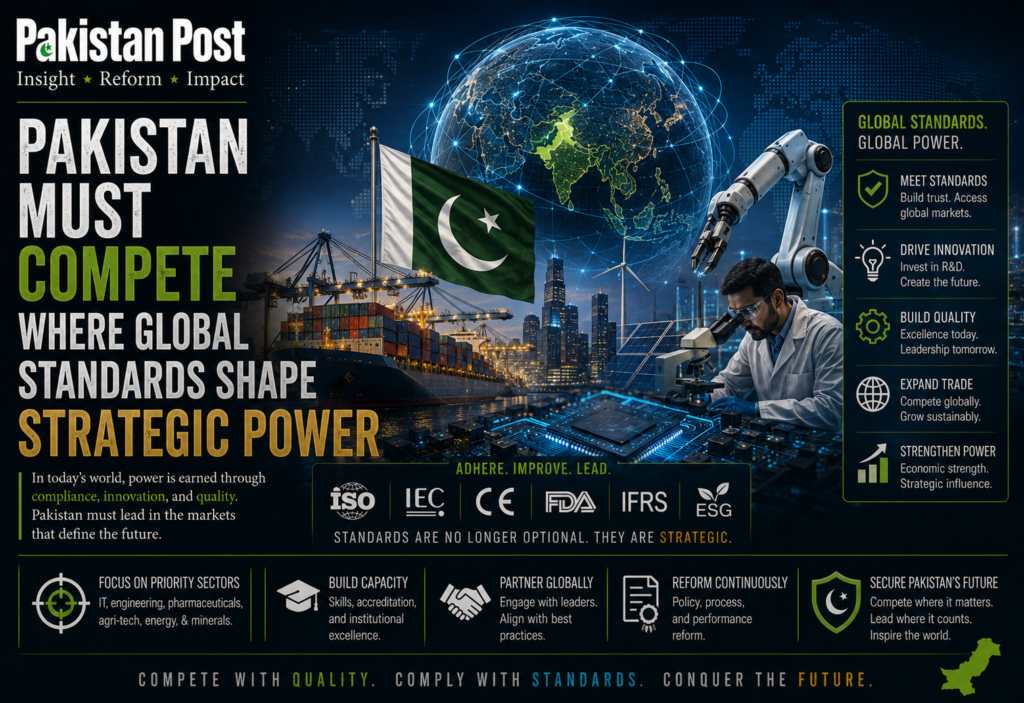
Pakistan’s long term strategic influence will increasingly depend less upon territorial calculations and more upon its ability to participate in the international institutions that determine technical standards. The decisive competition of the coming decades will not primarily concern maps, military deployments, or even tariffs. It will concern the invisible rules embedded inside communication systems, artificial intelligence architectures, semiconductor production processes, industrial certification, digital identity frameworks, biotechnology protocols, quantum communication, autonomous transportation, cybersecurity compliance, financial technologies, and advanced manufacturing. Nations that define these standards effectively determine how future markets operate, which technologies become commercially viable, whose patents dominate production, and which industries remain dependent upon external regulatory decisions.
Technical standardisation has therefore become an instrument of strategic statecraft. International organisations responsible for standards increasingly function as geopolitical battlegrounds where influence is exercised quietly through engineers, scientists, regulatory specialists, industrial alliances, legal experts, universities, and corporate research laboratories rather than diplomats alone. Decisions made inside specialised technical committees frequently shape billions of dollars in future investment before governments publicly recognise their strategic consequences.
Pakistan’s national security community has traditionally concentrated upon military balance, territorial defence, energy security, maritime access, and economic resilience. These priorities remain indispensable. Yet the emerging strategic environment requires a complementary understanding that regulatory sovereignty represents another layer of national power. Countries excluded from international standards development gradually lose control over industrial competitiveness, technological autonomy, export opportunities, procurement flexibility, and innovation capacity.
International technical standards increasingly determine which telecommunications equipment can connect across borders, which artificial intelligence models satisfy regulatory requirements, which medical devices qualify for international procurement, which autonomous vehicles may enter foreign markets, and which semiconductor manufacturing techniques receive commercial certification. Once standards become internationally accepted, they generate network effects that reinforce early technological leadership while increasing barriers for late entrants.
This explains why major powers increasingly invest significant diplomatic resources into standards organisations that previously attracted limited political attention. Technical committees have become extensions of national industrial strategy.
The competition surrounding fifth generation telecommunications demonstrated this transformation. The debate extended far beyond communication infrastructure. It involved intellectual property ownership, cybersecurity standards, supply chain resilience, export controls, industrial certification, and long term technological dependence. Nations supporting different technical specifications were simultaneously shaping future commercial ecosystems and strategic influence.
Artificial intelligence presents an even broader contest. Global competition increasingly concerns safety frameworks, algorithmic transparency requirements, model evaluation procedures, interoperability protocols, ethical governance, audit mechanisms, liability standards, data classification methodologies, and public sector deployment guidelines. Countries participating actively in these discussions influence future regulatory environments that determine commercial access across international markets.
Pakistan cannot afford to remain a passive observer while others define these frameworks. Domestic industries may successfully develop competitive products, yet those products could remain commercially isolated if they fail to satisfy internationally recognised standards established without Pakistani participation.
The implications extend directly into export competitiveness. Modern international trade increasingly operates through regulatory compatibility rather than simple tariff reductions. Manufacturers seeking access to advanced markets must comply with technical specifications governing quality assurance, cybersecurity, environmental performance, digital documentation, safety certification, product traceability, and manufacturing processes. Companies unable to demonstrate conformity face commercial exclusion regardless of production costs.
This shift affects every major Pakistani export sector. Textile manufacturers increasingly encounter sustainability reporting requirements alongside digital supply chain verification. Medical equipment producers require internationally recognised testing procedures. Agricultural exports must satisfy increasingly sophisticated sanitary and phytosanitary standards supported by digital certification systems. Information technology services increasingly require compliance with cybersecurity frameworks, privacy regulations, cloud certification, and artificial intelligence governance protocols.
Consequently, technical standards should no longer be treated solely as regulatory obligations administered after industrial production. They must become integral components of national industrial planning from the earliest stages of technological development.
Another overlooked dimension concerns intellectual property. Companies contributing to international standards frequently secure essential patents embedded within globally adopted technologies. These standard essential patents generate long term licensing revenues while reinforcing technological leadership across successive innovation cycles. Nations encouraging domestic participation in standards development therefore strengthen both industrial competitiveness and knowledge based economic growth.
Pakistan presently contributes relatively little to international standards formulation despite possessing capable engineers, information technology professionals, academic researchers, and manufacturing specialists. The principal challenge is institutional rather than intellectual.
Responsibility for standards participation remains dispersed across multiple ministries, regulators, industrial associations, universities, and research institutions. Coordination mechanisms remain weak. Funding for sustained participation in international technical committees remains inconsistent. Academic promotion systems rarely reward standards contributions. Industrial firms often perceive standards as compliance costs rather than strategic investments.
The result is predictable. Pakistani experts generally enter international discussions after technical frameworks have already matured. National influence consequently remains limited to implementation rather than formulation.
This institutional pattern requires comprehensive reform.
Pakistan should establish a National Standards Strategy Council operating directly under the Prime Minister’s Office with permanent representation from defence production, information technology, science and technology, commerce, higher education, telecommunications, health, industry, energy, finance, strategic planning, export development agencies, and national research organisations. The council should produce rolling ten year standards participation strategies aligned with industrial policy, technological priorities, export objectives, and national security requirements.
This body should not function as another regulatory institution. Its principal purpose should be strategic coordination, horizon scanning, institutional prioritisation, international engagement, and resource allocation.
Equally important is the creation of dedicated Standards Intelligence Cells within relevant ministries and strategic organisations. These units would monitor emerging international technical negotiations, identify sectors likely to influence future Pakistani industries, evaluate foreign regulatory developments, and provide early warning regarding evolving certification requirements affecting exports or strategic technologies.
National intelligence increasingly includes technological foresight. Understanding future standards trajectories provides governments with advance insight into commercial competition, supply chain evolution, and industrial restructuring.
Pakistan should also introduce permanent technical attachés within selected embassies responsible specifically for standards diplomacy. Traditional commercial diplomacy concentrates upon trade promotion and investment attraction. Standards diplomacy requires specialised engagement with technical organisations, industrial alliances, regulatory agencies, universities, certification bodies, and multinational research networks.
Countries successfully influencing international standards frequently maintain sustained expert participation over decades rather than attending occasional meetings. Personal credibility, technical expertise, institutional continuity, and professional networks often determine influence more than formal diplomatic status.
Higher education reform represents another strategic necessity. Engineering curricula should incorporate international standards development, regulatory science, industrial certification, interoperability principles, intellectual property management, quality infrastructure, systems engineering, and technology governance. Future engineers must understand not only how technologies operate but also how international rules governing those technologies are negotiated.
Universities should establish Standards Research Centres jointly funded by government and industry. These centres should prepare technical submissions to international organisations, coordinate research supporting emerging standards, train future specialists, and facilitate collaboration between academia, regulators, and manufacturers.
Promotion criteria for academic staff should recognise contributions to international technical standards alongside traditional scholarly publications. Many globally influential engineers shape technological progress through standards committees rather than conventional academic journals.
Industrial policy must evolve accordingly. Government incentives supporting advanced manufacturing should include funding for certification, conformity assessment, laboratory accreditation, standards participation, patent development, and regulatory research. Financial assistance restricted solely to production capacity ignores increasingly important competitive variables.
Pakistan’s growing software sector presents an immediate opportunity. Domestic software companies increasingly serve international clients across financial technology, cybersecurity, healthcare, education, logistics, and artificial intelligence. Early participation in international software standards could strengthen export credibility while improving market access.
Similarly, the country’s expanding semiconductor design capabilities require integration into international electronic design automation standards, chip verification procedures, testing protocols, packaging specifications, and manufacturing certification frameworks. Remaining outside these ecosystems risks limiting future commercial expansion regardless of engineering talent.
Biotechnology deserves comparable attention. Future pharmaceutical manufacturing, agricultural biotechnology, genomic medicine, biosecurity systems, and synthetic biology increasingly depend upon internationally recognised technical standards. Pakistan’s scientific institutions should therefore participate proactively in relevant international scientific and regulatory forums before these frameworks become commercially entrenched.
Digital identity systems represent another area requiring strategic consideration. Governments worldwide continue developing interoperable digital identity infrastructures supporting public administration, financial inclusion, healthcare, border management, taxation, education, and electronic commerce. Technical standards adopted today will influence future international interoperability between governmental systems. Pakistan should contribute actively to these discussions rather than adapting externally designed architectures after implementation.
Cybersecurity standards require similar strategic engagement. National cyber resilience increasingly depends upon internationally recognised encryption protocols, secure hardware standards, cloud security certification, software assurance methodologies, incident reporting frameworks, and supply chain verification systems. Passive compliance offers limited influence over evolving global cyber governance.
Defence industrial development also intersects with standards competition. Modern military platforms increasingly integrate civilian technologies including communications equipment, software systems, artificial intelligence applications, autonomous navigation, advanced materials, and semiconductor components. Interoperability standards directly affect procurement flexibility, alliance cooperation, domestic production, and long term sustainment.
Strategic autonomy therefore requires understanding technical standards as force multipliers rather than administrative procedures.
Pakistan should further strengthen its national quality infrastructure through internationally accredited laboratories, certification agencies, metrology institutions, testing facilities, calibration centres, and inspection organisations. Export competitiveness depends increasingly upon trusted conformity assessment recognised across major trading partners.
The private sector must become an active participant rather than a passive recipient of government initiatives. Industry associations should identify priority standards affecting export markets, sponsor expert participation in international committees, coordinate research across member companies, and develop sector specific regulatory roadmaps. Successful standards diplomacy always reflects close collaboration between governments, universities, and industry.
Financial institutions should similarly recognise standards participation as an investment supporting long term industrial competitiveness. Development finance mechanisms could assist companies undertaking costly certification processes or contributing to international technical working groups.
The establishment should recognise that future strategic competition increasingly includes technological governance alongside conventional defence planning. National resilience cannot depend exclusively upon military capability if industrial technologies, communications infrastructure, financial systems, healthcare platforms, transportation networks, and digital ecosystems remain governed by externally determined technical frameworks.
A comprehensive national technology security assessment should therefore evaluate Pakistan’s exposure to foreign standards dependency across critical sectors including telecommunications, energy infrastructure, transportation, healthcare, financial services, industrial automation, artificial intelligence, cloud computing, and semiconductor supply chains. Such assessments should identify areas requiring greater domestic capability or diversified international partnerships.
International partnerships themselves should become more sophisticated. Pakistan need not align exclusively with any single technological ecosystem. Instead, it should pursue diversified engagement across multiple standards organisations, research collaborations, industrial partnerships, and educational exchanges while preserving regulatory flexibility and technological interoperability.
This balanced approach reduces strategic vulnerability while expanding commercial opportunities.
The next decade will increasingly reward countries capable of shaping the rules governing technological ecosystems rather than merely purchasing finished technologies. Market leadership will belong to those writing technical specifications before products reach commercial production. Diplomatic influence will increasingly emerge from engineering committees alongside foreign ministries. Economic resilience will depend upon regulatory compatibility as much as manufacturing efficiency.
Pakistan possesses the human capital necessary to participate in this competition. Its engineers, researchers, software developers, scientists, industrial specialists, and entrepreneurs have demonstrated international capability across multiple sectors. The missing element remains institutional coordination supported by sustained political commitment and strategic foresight.
The question facing policymakers is therefore no longer whether technical standards matter. The evidence already answers that decisively. The real question is whether Pakistan intends to remain a rule taker within technological globalisation or become a rule contributor capable of protecting national interests through proactive participation in the institutions where tomorrow’s strategic realities are quietly being written today.
A Public Service Message