Inflation Reality and Pakistan Hidden Political Economic Strain Unseen Pressures

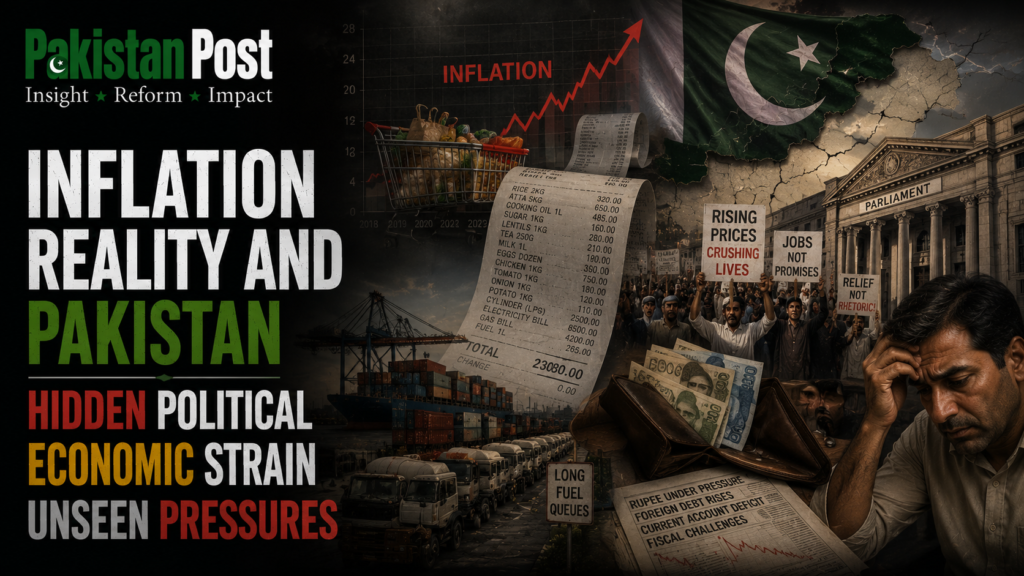
In the contemporary economic narrative of Pakistan, inflation is frequently presented through sanitized statistical representations that obscure more than they reveal. Official dashboards, multilateral briefings, and donor-facing reports tend to compress a complex socio economic transformation into a singular percentage figure, often detached from the granular realities of survival experienced across households. Yet beneath this numerical abstraction lies a far more intricate and politically sensitive architecture of pressure, in which inflation functions not merely as a monetary phenomenon but as a systemic reordering of social contract, fiscal legitimacy, and governance credibility.
The inflationary condition in Pakistan has gradually shifted from cyclical volatility to structural persistence, embedding itself within the quotidian decisions of households, firms, and institutions. The price of wheat, electricity, fuel, and medicine no longer operates as independent market signals but as interconnected vectors of social compression. Each incremental adjustment in energy tariffs, frequently shaped under International Monetary Fund conditional frameworks and external financing alignments, reverberates through transportation costs, industrial input pricing, and ultimately the food basket of the lowest income quintiles. In this sense, inflation ceases to be an economic indicator and becomes a lived governance condition.
International financial architecture, particularly the IMF stabilization paradigm, has increasingly emphasized fiscal consolidation through indirect taxation and energy sector rationalization. Within this framework, energy taxation has emerged as a critical instrument of revenue generation. However, the translation of such policy prescriptions into domestic implementation has produced a complex layering of economic stress. While macroeconomic stabilization narratives emphasize deficit reduction and balance of payments correction, the microeconomic transmission of these adjustments generates a regressive burden disproportionately absorbed by wage dependent populations. The resulting asymmetry between macro stabilization and micro distress is neither accidental nor fully captured in conventional policy discourse.
The United Nations development framework has repeatedly underscored the importance of social protection mechanisms in cushioning adjustment shocks. Yet in practice, social protection coverage remains fragmented, administratively constrained, and insufficiently indexed to real inflationary dynamics. Consequently, nominal transfers lose real value rapidly, failing to compensate for the velocity of price escalation in essential commodities. This structural gap between policy intent and market reality creates a silent erosion of state legitimacy, particularly among urban lower middle classes and rural labor segments who increasingly perceive economic governance as externally conditioned rather than domestically responsive.
At the heart of this inflationary ecosystem lies a deeper transformation in the political economy of survival. Households are compelled to engage in continuous substitution behaviors, shifting from protein rich diets to carbohydrate heavy consumption, from formal healthcare to informal pharmaceutical alternatives, and from private education to under resourced public schooling or complete withdrawal. These adaptations are not merely economic adjustments but indicators of a gradual compression of human capability development. The long term implications of such shifts extend beyond immediate welfare concerns and enter the domain of generational human capital erosion.
The energy sector occupies a particularly central position in this inflationary transmission mechanism. Electricity tariffs, frequently adjusted in alignment with cost recovery models endorsed by international lenders, have become a primary driver of industrial cost escalation. Manufacturing competitiveness is increasingly constrained by unpredictable input costs, forcing a migration toward informal production networks or reduced scale operations. Export oriented sectors, already operating under thin margin conditions, face structural disadvantage in global markets where energy stability constitutes a critical comparative advantage. The cumulative effect is a slow but persistent deindustrialization pressure masked under the rhetoric of adjustment and reform.
It is within this context that establishment concerns regarding economic sovereignty acquire heightened relevance. The increasing reliance on external financial stabilization frameworks introduces a form of policy conditionality that subtly reshapes domestic economic priorities. While not overtly coercive in narrative form, these conditionalities embed themselves within budgetary design, tariff structures, and taxation regimes. The strategic implication is a gradual narrowing of autonomous fiscal space, wherein domestic policy innovation is constrained by external approval mechanisms. This does not imply loss of sovereignty in formal terms, but rather a calibrated dilution of policy discretion.
The inflationary environment is further complicated by supply side inefficiencies and structural bottlenecks. Agricultural productivity remains vulnerable to climate variability, input cost inflation, and fragmented logistics infrastructure. Consequently, food inflation becomes both persistent and volatile, resisting traditional monetary policy interventions. In such a scenario, central bank instruments such as interest rate adjustments exert limited real economy transmission, particularly when inflation is driven by supply shocks rather than demand expansion. This disjunction between monetary tools and structural inflation sources creates a policy paradox that is increasingly acknowledged within technocratic circles.
Moreover, the informal economy plays a paradoxical role in both absorbing and amplifying inflationary pressures. While it provides employment elasticity and income substitution mechanisms, it also operates outside regulatory price stabilization frameworks. As a result, price formation in informal markets often reflects immediate supply demand imbalances without institutional smoothing. This contributes to localized price volatility, particularly in urban peripheries where formal retail penetration is weak. The absence of comprehensive market integration thus reinforces segmented inflation experiences across different socio economic classes.
The psychological dimension of inflation is equally significant yet often underexamined in policy discourse. Inflation alters expectations, reshapes consumption behavior, and erodes forward planning capacity. When households begin to anticipate continuous price increases, they accelerate consumption, reduce savings, and withdraw from long term financial commitments. This behavioral shift, once generalized, feeds back into inflationary momentum, creating a self reinforcing cycle of expectation driven price escalation. In such an environment, trust in currency stability becomes as important as actual monetary policy.
From a governance perspective, the inflation challenge is increasingly linked to fiscal credibility. Repeated recourse to external stabilization packages signals underlying structural weaknesses in revenue generation capacity and expenditure efficiency. The reliance on indirect taxation, particularly energy levies and consumption based charges, reflects both administrative convenience and political constraint. However, such measures disproportionately affect lower income segments, intensifying distributional inequality and fueling perceptions of systemic inequity.
At the geopolitical level, inflation in Pakistan cannot be isolated from global commodity cycles, energy market volatility, and financial liquidity conditions. External shocks, including oil price fluctuations and dollar strength cycles, transmit rapidly into domestic price structures due to import dependence. This external exposure transforms inflation from a purely domestic policy challenge into a hybrid phenomenon shaped by global systemic forces. Consequently, domestic policymakers operate within a constrained decision space where external variables exert disproportionate influence over internal outcomes.
The establishment, in its strategic assessment, is increasingly confronted with the dual challenge of maintaining macroeconomic stability while preserving social cohesion. Inflation, when sustained over extended periods, risks transitioning from an economic variable into a political stressor. Historical precedents across multiple economies demonstrate that prolonged cost of living crises often generate institutional distrust, policy fatigue, and governance skepticism. In the Pakistani context, this risk is amplified by demographic pressure, urban concentration, and information acceleration through digital media ecosystems.
The policy imperative, therefore, extends beyond conventional stabilization frameworks. It demands a reconfiguration of inflation monitoring systems to incorporate real time consumption data, regional price divergence metrics, and vulnerability weighted inflation indices. Such instruments would enable policymakers to perceive inflation not as a singular national average but as a differentiated spatial and social phenomenon. Without such analytical refinement, policy responses risk remaining structurally misaligned with ground realities.
Energy reform emerges as a critical node within this broader restructuring. While tariff rationalization remains fiscally necessary, its implementation must be accompanied by targeted protections for industrial competitiveness and low income consumption thresholds. Simultaneously, accelerated investment in renewable energy infrastructure offers a medium term pathway to reduce import dependence and stabilize long term pricing volatility. However, such transitions require institutional coherence and regulatory continuity, both of which remain contingent on political stability and administrative capacity.
In conclusion, inflation in Pakistan represents a multidimensional challenge that transcends conventional economic categorization. It is simultaneously a fiscal phenomenon, a social stressor, a geopolitical transmission channel, and a governance legitimacy test. The hidden risks embedded within current adjustment trajectories lie not only in macroeconomic imbalance but in the gradual erosion of social resilience and institutional trust. Addressing this challenge requires a departure from purely statistical governance toward a more integrated, human centered economic intelligence framework that recognizes inflation as a structural condition of national stability rather than a temporary deviation from equilibrium.
A Public Service Message