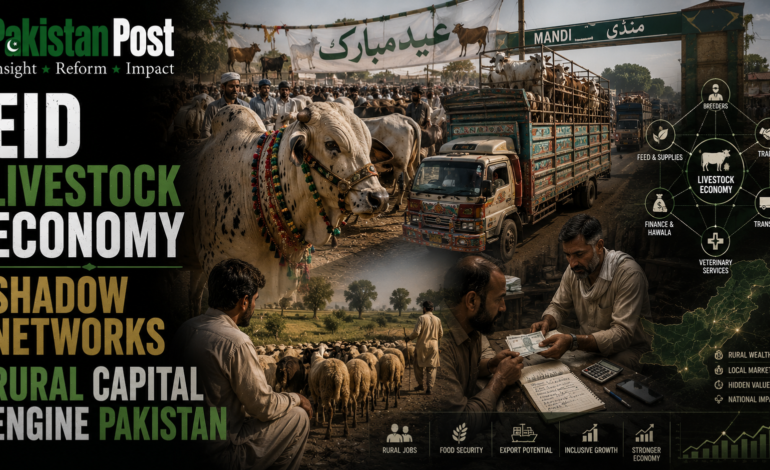
Eid Livestock Economy Shadow Networks Rural Capital Engine Pakistan

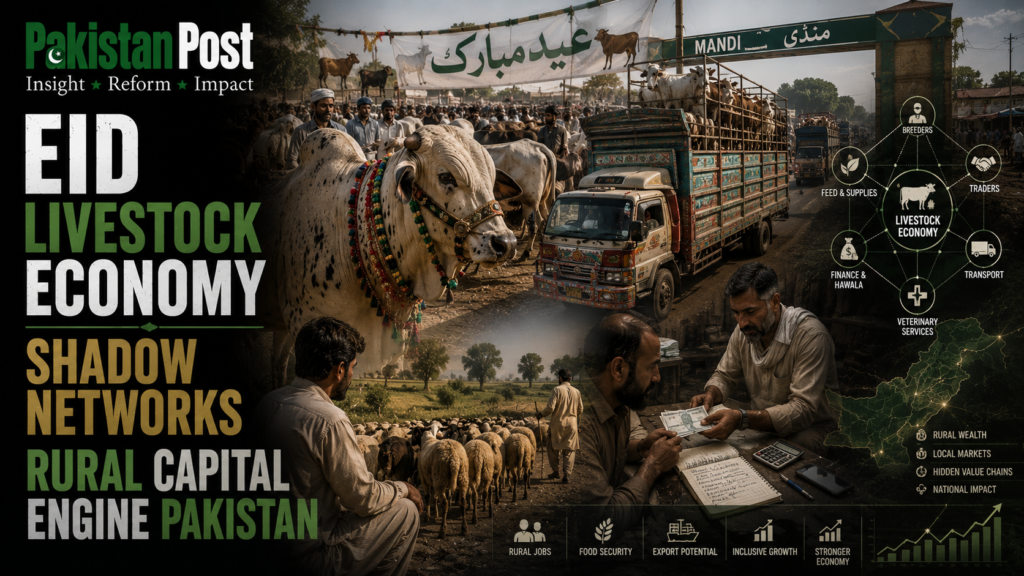
The livestock economy in Pakistan, particularly its seasonal amplification during Eid cycles, constitutes one of the most underestimated yet structurally significant components of the national informal economic architecture. Beneath the visible spectacle of cattle markets, urban livestock corridors, and temporary trade hubs lies a deeply embedded system of rural capital formation, informal credit intermediation, transport logistics, veterinary microservices, and seasonal labor absorption. This system operates with remarkable internal coherence despite limited formal recognition, functioning as a parallel economic circuit that channels liquidity from urban consumption patterns into rural production ecosystems.
The Eid livestock cycle is not merely a cultural or religious ritual of animal sacrifice; it is a macroeconomic liquidity event. It mobilizes millions of smallholder farmers, traders, transport operators, fodder suppliers, and informal financiers in a compressed temporal window that redistributes purchasing power across rural districts. In this sense, the livestock market operates as a decentralized financial mechanism, converting biological assets into seasonal cash flows. The scale of this activity, while rarely captured in national accounts with precision, has implications for rural income stabilization, informal employment generation, and short term consumption smoothing.
At the structural level, the livestock supply chain reveals a sophisticated but unregulated economic ecosystem. Cattle rearing in peripheral rural zones is often financed through informal credit arrangements, frequently extended by local intermediaries, feed suppliers, or seasonal traders. These credit networks are not governed by formal banking regulations but rely on trust based relational economies that have evolved over decades. The repayment cycles are synchronized with Eid market realizations, creating a seasonal credit redemption pattern that sustains liquidity circulation in rural economies.
Transport networks constitute another critical layer of this ecosystem. The movement of livestock from rural breeding zones to urban markets requires a complex logistical infrastructure involving truck operators, animal handlers, temporary holding facilities, and route based coordination systems. This logistical chain operates largely outside formal regulatory oversight, yet it performs with high efficiency due to embedded market incentives. However, the absence of standardized regulation exposes the system to inefficiencies, price arbitrage exploitation, and occasional systemic bottlenecks during peak demand periods.
Veterinary services and animal health management represent an additional but often invisible dimension of this economy. Informal veterinary practitioners, often operating without formal certification, provide essential services ranging from vaccination to emergency treatment during transit and market holding phases. The quality and consistency of these services vary significantly, introducing biosecurity vulnerabilities that have implications beyond economics, extending into public health risk domains. The absence of integrated animal health monitoring systems therefore represents a latent structural weakness within the livestock value chain.
The Eid livestock economy also plays a significant role in urban consumption behavior and inflation dynamics. The seasonal surge in demand for sacrificial animals generates temporary price inflation within livestock markets, which is then transmitted into associated commodity markets such as fodder, transportation fuel, and ancillary services. This localized inflationary spike, while temporary, reflects the sensitivity of informal markets to demand shocks and highlights the absence of stabilizing institutional mechanisms.
From a fiscal perspective, the livestock sector remains under monetized within formal revenue systems. A substantial proportion of transactions occur in cash-based, undocumented formats, limiting the state’s ability to integrate this economic activity into broader taxation frameworks. While attempts at market regulation and digital registration have been introduced in certain urban centers, adoption remains uneven due to trust deficits, infrastructural limitations, and resistance from established intermediaries who benefit from opacity.
At the rural socio economic level, the Eid livestock cycle functions as a critical income redistribution mechanism. Small farmers, often operating on marginal landholdings, rely on seasonal livestock sales to finance agricultural inputs, debt repayment, and household consumption. In the absence of this seasonal liquidity injection, rural indebtedness would likely intensify, increasing vulnerability to informal lending cycles. Thus, the livestock market acts as a stabilizer within otherwise fragile rural economies.
However, the structural informality of this system also generates systemic inefficiencies. Price discovery mechanisms are often distorted by information asymmetries, with intermediaries exercising disproportionate influence over pricing structures. Buyers and small sellers frequently operate without access to transparent valuation benchmarks, leading to uneven bargaining power distributions. This asymmetry reinforces income concentration among large traders while marginalizing small producers.
The environmental dimension of the livestock economy is also becoming increasingly relevant. The expansion of animal rearing in peri-urban zones contributes to waste management challenges, water consumption pressures, and localized ecological strain. Yet these externalities remain largely unaccounted for within policy frameworks, which tend to prioritize short term market facilitation over long term sustainability considerations.
At the strategic governance level, the livestock economy presents a paradox. On one hand, it is a vital source of rural livelihood and seasonal economic stability; on the other, it exists largely outside formal institutional oversight. This duality creates a policy blind spot where the sector is simultaneously indispensable and structurally unmanaged. The result is a recurring cycle of reactive regulation during Eid periods followed by prolonged neglect in off season months.
The increasing digitization of commerce presents both an opportunity and a challenge for this sector. Digital livestock marketplaces, mobile payment systems, and veterinary tracking platforms have the potential to formalize transactions, enhance transparency, and improve biosecurity monitoring. However, without careful institutional design, such interventions risk displacing existing informal networks without adequately replacing their social trust functions, potentially destabilizing rural credit ecosystems.
From a macroeconomic stability perspective, integrating the livestock sector into formal economic planning could yield significant benefits in terms of revenue generation, data visibility, and market stabilization. However, such integration must be gradual and adaptive, respecting the embedded social structures that currently sustain the system. Abrupt formalization could disrupt rural liquidity cycles and generate unintended economic contraction in vulnerable regions.
The establishment perspective increasingly recognizes the strategic importance of informal economies in maintaining macroeconomic resilience. The livestock sector, in particular, functions as a buffer against rural economic shocks, absorbing labor fluctuations and providing seasonal income streams that reduce pressure on urban migration channels. Any policy intervention must therefore balance formalization objectives with the preservation of systemic flexibility.
At the international level, multilateral institutions often categorize such informal sectors as inefficiencies within developing economies. However, this interpretation underestimates their adaptive functionality. In environments characterized by fiscal constraint, infrastructural limitations, and demographic pressure, informal markets often perform allocative and distributive functions that formal systems are unable to replicate efficiently.
The future trajectory of the livestock economy in Pakistan will likely be shaped by three converging forces: regulatory modernization, digital financial integration, and climate variability. Each of these forces introduces both opportunities and risks. Regulatory modernization may enhance transparency but could also increase compliance burdens. Digital integration may improve efficiency but could exclude unbanked participants. Climate variability may disrupt supply cycles, affecting both production and pricing stability.
In conclusion, the Eid livestock economy represents far more than a seasonal cultural phenomenon. It is a deeply embedded economic infrastructure that sustains rural livelihoods, facilitates informal credit systems, and stabilizes seasonal consumption cycles. Its informal nature is not merely a regulatory gap but a functional adaptation to structural constraints within the formal economy. Any attempt to reform or integrate this system must therefore proceed with a nuanced understanding of its embedded social logic, ensuring that modernization does not inadvertently dismantle the very resilience it seeks to formalize.
A Public Service Message