
Continents Collide Quietly Beneath Pakistan Expanding Strategic Pressure Frontier

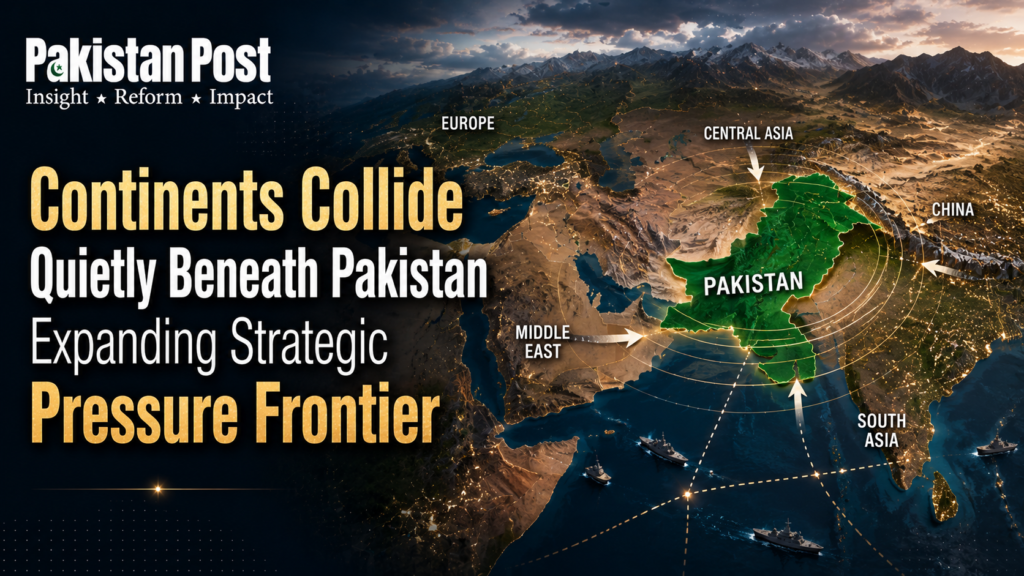
The old geopolitical maps are dying silently. Not through dramatic invasions or ideological revolutions, but through corridors, debt systems, naval logistics, semiconductor restrictions, energy vulnerabilities, digital surveillance architecture, and invisible intelligence wars conducted beneath the language of connectivity. Eurasia is no longer merely a geographic construct. It is becoming the principal theatre of twenty first century strategic contestation. Within this transition, Pakistan is entering a historically dangerous phase. Geography, once celebrated domestically as destiny, is now mutating into exposure.
The strategic vocabulary shaping the emerging world order has shifted decisively from globalization toward securitized interdependence. Western capitals increasingly speak in the language of de risking, resilient supply chains, strategic autonomy, trusted partnerships, and critical infrastructure security. Beijing speaks of shared development, connectivity integration, and multipolar equilibrium. Moscow frames its geopolitical repositioning through anti hegemonic civilizational resistance after the Ukraine conflict. Gulf monarchies pursue calibrated ambiguity, monetizing their strategic utility while refusing rigid bloc alignment. Beneath these diplomatic formulations lies a harsher reality. Every major power is preparing for prolonged systemic competition.
Pakistan stands directly at the intersection of these converging tectonic pressures.
The post Ukraine strategic landscape has transformed Eurasia from a commercial opportunity zone into a fragmented pressure arena. Russia’s confrontation with the West accelerated the weaponization of finance, energy, shipping insurance, technology access, food corridors, and currency systems. The sanctions architecture imposed upon Moscow fundamentally altered strategic calculations across the Global South. States previously dependent upon Western financial systems observed how reserve assets, payment mechanisms, and trade access could be converted into geopolitical instruments overnight. This realization deeply influenced China, Gulf powers, Iran, Turkey, and increasingly, Pakistan’s strategic establishment.
The hidden danger for Islamabad is not immediate military conflict. It is gradual strategic suffocation through dependency layering.
Pakistan’s geography historically offered strategic rent opportunities. During the Cold War it served containment logic. During the Afghan jihad it became a frontline security conduit. During the American intervention in Afghanistan it evolved into a logistical artery. Under the China Pakistan Economic Corridor it transformed into a continental connectivity proposition. Yet the international system no longer rewards passive geography. Modern geopolitics demands institutional coherence, economic resilience, technological sovereignty, and narrative discipline. Pakistan currently possesses none at sufficient scale.
This asymmetry creates strategic vulnerability.
The American Indo Pacific framework increasingly views Chinese infrastructure expansion through security lenses rather than developmental ones. Gwadar is therefore interpreted in many Western strategic circles not simply as a commercial port, but as a latent dual use asset capable of future naval adaptation. Chinese denials matter less than perception. Modern geopolitical competition operates through anticipatory suspicion. Infrastructure itself has become securitized.
This perception generates cascading consequences.
Western intelligence aligned think tanks increasingly frame CPEC related infrastructure as components of a larger Chinese strategic architecture designed to reshape Eurasian access patterns. Simultaneously, Beijing interprets American resistance to Belt and Road projects as containment by disruption. Pakistan consequently risks becoming trapped within competing narratives constructed externally by larger powers pursuing systemic advantage.
The hidden risk is not only military. It is informational.
Narrative warfare now precedes policy warfare.
International media ecosystems, policy institutes, sovereign risk agencies, digital analytics firms, and financial monitoring institutions collectively shape the strategic reputation of vulnerable states. Pakistan’s image oscillates internationally between instability exporter, debt exposed intermediary, nuclear uncertainty zone, and contested corridor state. Such framing directly influences investment behavior, diplomatic engagement, insurance premiums, sovereign borrowing costs, and technology access. Strategic perception itself has become an operational battlespace.
Meanwhile India has successfully repositioned itself within Western strategic thinking as a stabilizing democratic counterweight to China despite persistent internal polarization and regional coercive tendencies. Pakistan by contrast remains trapped within outdated global narratives centered upon extremism, fragility, and institutional inconsistency. This asymmetry represents a major strategic intelligence failure extending across decades.
The establishment understands the military dimensions of deterrence. It has not yet fully adapted to the informational dimensions of deterrence.
This distinction is becoming existential.
The militarization of connectivity corridors constitutes another emerging fault line. Across Eurasia, ports, railways, fiber optic systems, logistics hubs, and industrial zones increasingly possess dual use potential. Civilian infrastructure can be rapidly integrated into military logistics during crises. Commercial satellite systems support intelligence collection. Port management software provides strategic visibility into shipping flows. Telecommunications architecture creates data dependency. Artificial intelligence integrated surveillance systems enable population mapping and predictive monitoring.
Infrastructure is no longer neutral.
The strategic concern for Pakistan’s national security apparatus should therefore extend beyond physical protection of corridors toward sovereignty over operational systems themselves. Dependence upon foreign managed digital ecosystems creates invisible vulnerabilities. States may retain territorial ownership while surrendering informational control.
This emerging domain remains insufficiently debated within Pakistan’s policy structure.
Simultaneously, Gulf powers are recalibrating their regional posture. Saudi Arabia and the United Arab Emirates increasingly prioritize strategic flexibility over ideological alignment. Their engagement with China deepens economically while security cooperation with Washington continues. Energy diversification, sovereign wealth expansion, artificial intelligence investment, logistics dominance, and maritime influence are shaping Gulf strategic calculations. Pakistan’s traditional assumption of automatic Gulf political backing can no longer be treated as permanent doctrine.
Transactionalism is replacing sentiment.
The Gulf now evaluates partners through economic utility, strategic stability, and technological relevance. Pakistan’s labor exports and security cooperation remain important, but insufficient within the emerging regional order. Gulf investors seek regulatory certainty, infrastructure protection, and macroeconomic continuity. Pakistan’s cyclical instability reduces strategic confidence.
Another hidden risk lies in economic penetration without industrial transformation.
Pakistan continues importing capital without sufficiently expanding productive sophistication. Mega infrastructure without export diversification merely deepens external dependency. Strategic corridors cannot compensate for weak institutional capacity. Without industrial modernization, technological absorption, and skilled workforce expansion, Pakistan risks becoming a transit geography serving external supply chains rather than a sovereign economic actor shaping them.
This would convert connectivity into controlled dependency.
Energy insecurity compounds the threat environment. Pakistan’s dependence upon imported fuel, volatile LNG markets, and fragile transmission infrastructure creates severe exposure during geopolitical crises. The Red Sea disruptions demonstrated how rapidly shipping insecurity can alter energy costs and inflation trajectories. In future conflict scenarios, maritime chokepoints may become instruments of indirect coercion.
The Strait of Hormuz represents perhaps the greatest strategic vulnerability for Pakistan’s economic continuity.
Any regional escalation involving Iran, Gulf states, Israel, or American naval forces would immediately destabilize Pakistan’s energy imports, currency stability, industrial output, and domestic political environment. Yet strategic planning in Islamabad often treats economic security and national security as separate domains. This compartmentalization is increasingly dangerous.
Future wars will target systems before territories.
Cyber operations against energy grids, port logistics, financial architecture, telecommunications networks, and satellite coordination systems could generate national paralysis without conventional invasion. Pakistan’s cyber resilience remains underdeveloped relative to the scale of emerging threats. Critical infrastructure protection still suffers from institutional fragmentation and insufficient civilian military technological integration.
Afghanistan further intensifies strategic exposure.
The assumption that the American withdrawal would stabilize Pakistan’s western frontier proved strategically premature. Afghanistan today remains economically fractured, politically fragmented, and institutionally weak. Militant mobility networks continue exploiting ungoverned spaces. Weapons proliferation, narcotics trafficking, refugee pressures, and ideological radicalization create persistent security stress upon Pakistan’s border regions.
The deeper concern for intelligence planners is the convergence of militancy with digital decentralization.
Extremist ecosystems increasingly utilize encrypted communications, online recruitment architectures, cryptocurrency financing channels, and decentralized operational models resistant to conventional counterinsurgency approaches. Future militancy may operate less through centralized organizations and more through adaptive network clusters capable of ideological reproduction without territorial concentration.
Traditional security doctrines are struggling to adapt.
Internally, Pakistan faces another under discussed strategic liability. Elite fragmentation.
No state can sustain geopolitical pressure externally while remaining institutionally incoherent internally. Civil military divergences, polarized political competition, bureaucratic inertia, inconsistent economic planning, and governance volatility collectively weaken national strategic capacity. External powers exploit institutional fractures through calibrated influence operations, selective financial engagement, media penetration, and diplomatic pressure mechanisms.
Strategic autonomy requires internal synchronization.
China understands this principle deeply. So do Gulf monarchies. Pakistan often does not.
The coming decade will likely witness intensified competition over rare earth supply chains, semiconductor ecosystems, artificial intelligence standards, quantum computing infrastructure, food security routes, undersea cable systems, and digital payment architecture. States unable to adapt technologically will experience declining sovereignty regardless of military strength.
Pakistan risks entering this future from a position of structural weakness.
Educational deterioration, research underinvestment, technological dependence, and brain drain collectively undermine long term strategic resilience. National security can no longer be sustained exclusively through conventional deterrence paradigms. Strategic competence in the twenty first century requires integrated national power including technological literacy, industrial depth, cyber capability, media influence, and institutional agility.
This is where the hidden strategic competition truly resides.
Control over narratives, algorithms, payment systems, digital infrastructure, and technological standards may ultimately prove more decisive than territorial disputes alone.
Policy makers within Pakistan’s strategic community must therefore abandon reactive thinking. The state requires a doctrine of calibrated multi alignment rather than passive balancing. Pakistan should deepen economic engagement with China while avoiding irreversible dependency upon singular external ecosystems. Simultaneously, functional relations with the United States, Gulf monarchies, Turkey, Central Asia, and European powers must be institutionalized pragmatically rather than emotionally.
Foreign policy sentimentality has become strategically unaffordable.
The establishment must also prioritize strategic narrative management internationally. Pakistan’s global image cannot remain hostage to external interpretation. Dedicated state supported analytical platforms, international media engagement cells, digital diplomacy units, and strategic communication frameworks should be developed to counter hostile framing operations. Information asymmetry now directly influences national security outcomes.
Domestically, economic security must be integrated formally into national defense planning. Energy resilience, food supply continuity, cyber protection, currency stabilization mechanisms, and technological sovereignty should be treated as core security priorities rather than secondary economic matters.
Institutional restructuring is unavoidable.
A national strategic coordination mechanism integrating civilian leadership, military planners, intelligence institutions, economic experts, cyber specialists, and technological analysts should be established permanently. Fragmented governance cannot survive systemic geopolitical competition.
Pakistan must also reconsider the doctrine of strategic rent seeking itself.
Historically, geopolitical utility provided temporary leverage. In the emerging world order, states survive through productive capability rather than positional relevance alone. Geography without institutional competence invites manipulation. Corridors without industrialization create dependency. Ports without manufacturing depth generate external extraction rather than sovereign prosperity.
The real Eurasian contest therefore concerns not merely territory, but governance capacity.
Pakistan’s challenge is uniquely difficult because it exists simultaneously at multiple geopolitical intersections. It borders Chinese ambitions, Gulf anxieties, Afghan instability, Indian hostility, Iranian unpredictability, and American strategic recalibration. Few states operate under comparable pressure density.
Yet geography remains both curse and opportunity.
If Pakistan develops institutional discipline, economic coherence, technological modernization, and strategic neutrality mechanisms, it could emerge as a stabilizing continental connector between competing blocs. If it fails, it risks gradual transformation into a permanently pressured buffer zone vulnerable to external manipulation, internal fragmentation, and strategic exhaustion.
The next decade will determine which trajectory prevails.
The most dangerous illusion within Islamabad’s policy environment is the belief that old formulas remain sufficient for new realities. They are not.
The world entering formation is harsher, technologically intrusive, economically weaponized, informationally manipulated, and strategically unforgiving. Eurasia’s fault lines are redrawing themselves beneath Pakistan’s feet in real time. The pressure is no longer approaching. It has already arrived quietly through debt contracts, media narratives, cyber exposure, energy dependence, intelligence penetration, and infrastructural entanglement.
The states that survive this transition will be those capable of understanding that sovereignty itself has evolved.
Pakistan still has time to adapt. But the strategic window is narrowing rapidly.
A Public Service Message