Revitalizing capital markets for resilience growth and global investor confidence

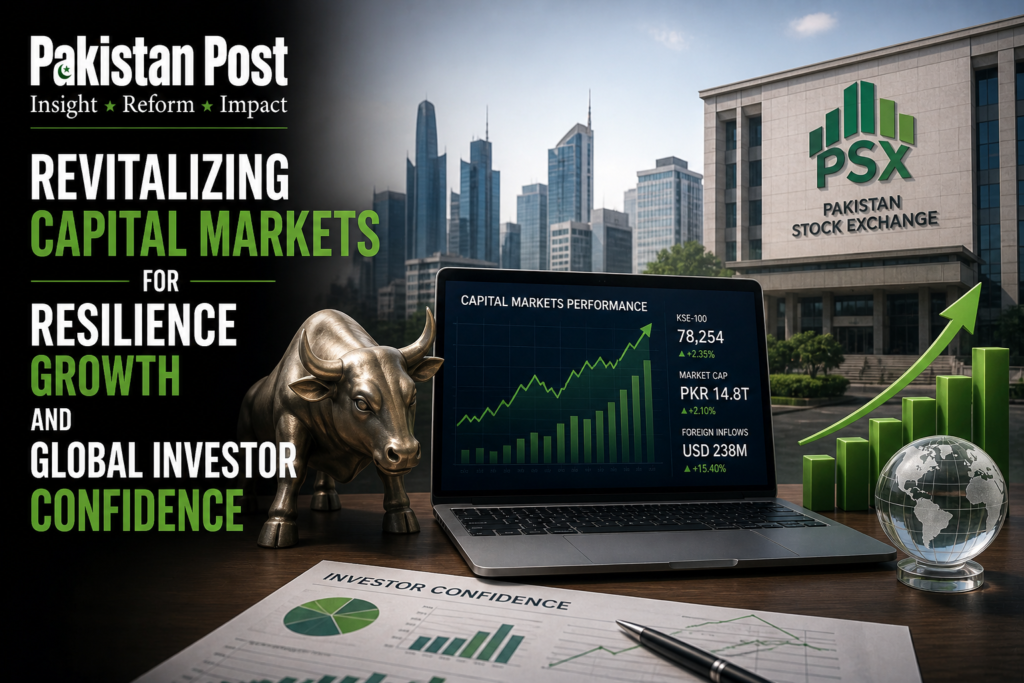
Pakistan’s capital market narrative has long oscillated between episodic optimism and structural fragility, reflecting a deeper tension between the country’s economic potential and the institutional constraints that inhibit its realization. The Pakistan Stock Exchange, often portrayed as a barometer of investor sentiment, operates within a macroeconomic and political environment characterized by volatility, policy uncertainty, and recurrent external shocks. Yet beneath this volatility lies an underdeveloped financial architecture that has yet to fully integrate into global capital flows, mobilize domestic savings at scale, or provide efficient channels for long term investment. The question, therefore, is not simply how to stabilize the market, but how to transform it into a resilient, transparent, and competitive platform capable of attracting sustained capital inflows while supporting national economic development.
The structural limitations of Pakistan’s capital market are rooted in its narrow investor base, limited product diversity, regulatory inconsistencies, and the persistent perception of political and economic risk. Retail participation remains low, institutional investors are constrained, and foreign investors often view the market through the lens of macroeconomic instability and governance concerns. Liquidity is concentrated in a small number of stocks, while large segments of the economy remain unlisted and disconnected from formal capital markets. This disconnect not only limits the capacity of firms to raise capital but also constrains the state’s ability to channel savings into productive investment.
Reforming the capital market requires a comprehensive approach that addresses both the supply and demand sides of investment. On the supply side, the challenge is to expand the universe of listed companies, improve corporate governance, and enhance transparency. Many Pakistani firms, particularly in sectors such as manufacturing, agriculture, and services, remain outside the formal market due to regulatory burdens, disclosure requirements, and concerns about loss of control. Incentivizing listing through tax benefits, simplified procedures, and support for initial public offerings can help to bring these firms into the market. At the same time, strengthening corporate governance standards, including independent boards, robust disclosure practices, and accountability mechanisms, is essential to build investor confidence.
On the demand side, increasing participation requires both financial inclusion and investor education. Retail investors often lack the knowledge, access, and trust needed to engage with capital markets. Digital trading platforms, mobile applications, and simplified account opening processes can lower barriers to entry, while targeted education campaigns can improve financial literacy. Institutional investors, including pension funds, insurance companies, and mutual funds, must also be developed and encouraged to play a larger role, providing stability and long term investment horizons. Regulatory reforms that enable these institutions to diversify their portfolios and invest in equities can enhance market depth and resilience.
A critical dimension of capital market reform is the modernization of regulatory frameworks. The regulatory environment must be consistent, transparent, and aligned with international standards, balancing the need for investor protection with the flexibility required for innovation. This includes strengthening the capacity of regulatory bodies to monitor market activity, enforce rules, and respond to emerging risks. Technology can play a key role in this process, enabling real time surveillance, automated reporting, and data driven decision making. At the same time, regulatory clarity is essential to reduce uncertainty and encourage investment, particularly in areas such as derivatives, exchange traded funds, and other advanced financial instruments.
Digital transformation is reshaping capital markets globally, and Pakistan must adapt to remain competitive. The adoption of electronic trading systems, blockchain based settlement mechanisms, and digital asset platforms can enhance efficiency, reduce costs, and improve transparency. For example, blockchain technology can streamline clearing and settlement processes, reducing the risk of fraud and operational errors. Digital platforms can also facilitate access for retail investors, enabling them to trade securities with greater ease and lower costs. However, the introduction of new technologies must be accompanied by appropriate regulatory frameworks and cybersecurity measures to mitigate risks.
Sovereign linked financial instruments represent another avenue for market development. Government bonds, sukuk, and other debt instruments can be structured and traded in ways that attract both domestic and international investors. By developing a robust government securities market, Pakistan can create a benchmark yield curve that supports pricing and investment decisions across the financial system. Innovative instruments, such as infrastructure bonds or green sukuk, can channel capital into priority sectors while aligning with global investment trends. The integration of these instruments into the stock exchange can enhance liquidity and provide investors with a broader range of options.
The role of foreign investment in Pakistan’s capital market is both significant and complex. Foreign investors bring capital, expertise, and credibility, but their participation is often sensitive to macroeconomic conditions, exchange rate volatility, and political risk. Sudden inflows and outflows can amplify market volatility, creating challenges for stability. To attract and retain foreign investment, Pakistan must address underlying concerns related to economic policy consistency, legal protections, and ease of doing business. Bilateral investment treaties, adherence to international standards, and transparent dispute resolution mechanisms can enhance confidence. At the same time, mechanisms to manage capital flows, such as macroprudential policies, may be necessary to mitigate risks.
Perceptions of political risk are perhaps the most intangible yet influential factor affecting capital markets. Investors, both domestic and international, are highly sensitive to signals related to governance, policy continuity, and institutional stability. Frequent changes in policy direction, delays in decision making, and conflicts between different branches of government can create uncertainty that deters investment. Building a stable and predictable policy environment requires not only technical reforms but also political commitment to consistency and transparency. Clear communication of policy objectives, timelines, and outcomes can help to reduce uncertainty and build trust.
Macroeconomic stability is a prerequisite for capital market development. High inflation, currency depreciation, and fiscal imbalances undermine investor confidence and distort investment decisions. While capital market reforms can contribute to stability by improving resource allocation and mobilizing savings, they cannot substitute for sound macroeconomic policies. Coordination between fiscal, monetary, and financial authorities is essential to ensure that reforms are aligned and mutually reinforcing. For example, monetary policy that stabilizes inflation and exchange rates can create a more favorable environment for investment, while fiscal discipline can reduce the need for crowding out private investment.
The integration of Pakistan’s capital market into regional and global networks offers both opportunities and challenges. Cross listing of companies, participation in international indices, and collaboration with foreign exchanges can enhance visibility and attract investment. At the same time, integration exposes the market to external shocks and competition, requiring robust risk management and regulatory frameworks. Strategic partnerships with regional exchanges, particularly in emerging markets, can facilitate knowledge sharing and capacity building, while also opening new channels for capital flows.
The development of a vibrant capital market also has broader implications for economic development and social inclusion. By providing access to finance for businesses, particularly small and medium enterprises, the stock exchange can support innovation, job creation, and economic diversification. By offering investment opportunities for individuals, it can contribute to wealth creation and financial inclusion. However, these benefits are not automatic and require deliberate policy interventions to ensure that access is equitable and that risks are managed.
Institutional capacity is a recurring theme in the discussion of capital market reform. The effectiveness of reforms depends on the ability of institutions to implement policies, enforce regulations, and adapt to changing conditions. This requires not only technical expertise but also organizational efficiency, accountability, and independence. Strengthening institutions involves reforms in governance structures, human resource management, and performance evaluation, as well as the provision of adequate resources.
The narrative surrounding Pakistan’s capital market is also shaped by media representation and public perception. Media coverage often focuses on short term fluctuations, sensationalizing gains and losses without providing context or analysis. This can contribute to volatility by influencing investor behavior and expectations. A more balanced and informed discourse, supported by research, data, and expert analysis, can help to create a more stable and mature market environment. Engaging with media, academia, and industry stakeholders to promote understanding and transparency is therefore an important aspect of reform.
Soon, the trajectory of Pakistan’s capital market will depend on the interplay between domestic reforms and external conditions. Global financial trends, geopolitical developments, and shifts in investor sentiment will continue to influence the market, but the extent of their impact will be mediated by the strength and resilience of domestic institutions. A well-functioning capital market can act as a buffer against external shocks, providing alternative sources of financing and supporting economic stability.
Ultimately, the transformation of the Pakistan Stock Exchange into a regional capital mobilization hub is not an isolated objective but part of a broader vision of economic development and integration. It requires a holistic approach that addresses structural weaknesses, leverages technological advancements, and aligns with global standards. It also requires a commitment to transparency, accountability, and inclusivity, ensuring that the benefits of market development are widely shared.
The stakes are high, as capital markets play a central role in shaping economic outcomes, influencing investment decisions, and allocating resources. For Pakistan, the challenge is to move beyond episodic reforms and short-term fixes, towards a sustained and coherent strategy that builds confidence, attracts investment, and supports long term growth. In doing so, the country can unlock the potential of its financial system, transforming it from a source of volatility into a driver of stability and prosperity, capable of supporting its ambitions in an increasingly interconnected global economy.
A Public Service Message