
Silent Oceans Surround Pakistan Amid Expanding Maritime Encirclement And Strategic Vulnerabilities

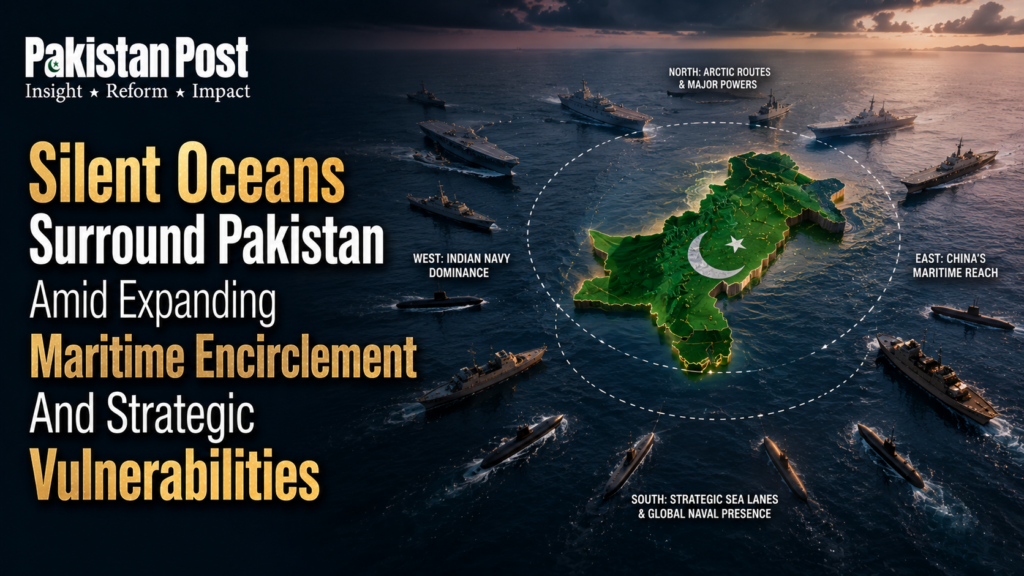
The Indian Ocean is no longer an ocean in the traditional geopolitical sense. It is becoming a militarized algorithm. Beneath the commercial language of trade corridors, maritime cooperation, blue economy integration, and freedom of navigation, an invisible security architecture is consolidating across the wider Indo Pacific theatre. Ports are now intelligence nodes. Shipping lanes are surveillance corridors. Undersea cables are strategic arteries. Maritime insurance systems have become geopolitical instruments. Naval competition increasingly unfolds through data dominance before missile dominance.
Pakistan stands dangerously underprepared for this transformation.
For decades, the strategic establishment in Islamabad viewed maritime security through a limited defensive prism centered primarily upon deterrence against conventional Indian naval escalation. That framework is now obsolete. The evolving Indian Ocean order is no longer shaped exclusively by state to state naval confrontation. It is increasingly influenced by hybrid coercion, digital maritime surveillance, infrastructure securitization, autonomous naval systems, satellite integrated reconnaissance, cyber infiltration, financial pressure mechanisms, and intelligence driven supply chain manipulation.
The hidden strategic danger is that Pakistan’s maritime vulnerabilities are expanding faster than its doctrinal adaptation.
This asymmetry is becoming structurally dangerous.
The Indian Ocean today carries nearly one third of global bulk cargo traffic, major energy transportation routes, critical submarine communication cables, and some of the world’s most sensitive energy chokepoints. Yet the region is no longer commercially neutral. The intensifying rivalry between the United States and China has transformed maritime spaces into contested zones of strategic anticipation. Washington increasingly interprets Chinese maritime expansion through containment logic. Beijing interprets American naval partnerships as encirclement architecture. India positions itself as the principal regional stabilizer aligned with Western Indo Pacific calculations.
Pakistan consequently finds itself squeezed within an expanding maritime triangle of strategic pressure.
India’s naval modernization represents perhaps the most significant long term challenge facing Pakistan’s maritime future. New Delhi is no longer pursuing a defensive coastal doctrine. It is constructing layered maritime dominance capabilities designed to project influence across the Arabian Sea, Bay of Bengal, and wider Indo Pacific corridors. Aircraft carrier expansion, nuclear submarine development, anti submarine warfare systems, maritime reconnaissance integration, island militarization initiatives, and deepening intelligence cooperation with Western partners collectively indicate that India seeks operational superiority rather than mere parity.
The strategic establishment in Pakistan understands India’s conventional military intentions. It has not yet fully absorbed the implications of India’s informational maritime superiority.
Modern naval warfare increasingly depends upon sensor fusion rather than fleet size alone.
Satellite linked maritime awareness systems, autonomous underwater surveillance networks, artificial intelligence enabled vessel tracking, seabed mapping technologies, underwater acoustic monitoring arrays, and cyber integrated logistics architecture collectively create invisible battlespaces. States possessing informational dominance can shape maritime outcomes without firing conventional weapons.
This reality deeply disadvantages Pakistan.
Karachi Port and Gwadar Port together form the backbone of Pakistan’s external trade structure. Yet both remain exposed to evolving grey zone vulnerabilities. In future crises, direct naval confrontation may not even be necessary to destabilize Pakistan’s maritime economy. Insurance manipulation, cyber disruption of logistics systems, strategic shipping delays, digital interference in port management software, financial sanctions targeting maritime transactions, or intelligence based disruption of supply chains could generate severe economic paralysis.
Future maritime wars may begin through algorithms rather than artillery.
The strategic significance of Gwadar has amplified these pressures further. Officially promoted as a commercial gateway linking western China with the Arabian Sea, Gwadar occupies a far more complicated position within international strategic discourse. Western security circles increasingly interpret the port as a potential dual use facility capable of future Chinese naval adaptation. Beijing publicly rejects such assumptions. Yet in geopolitical competition, perception frequently outweighs declared intent.
This has transformed Gwadar into a symbolic geopolitical battlefield.
American and Indian strategic analysts increasingly frame Chinese infrastructure investments across the Indian Ocean through the lens of latent militarization. Ports in Sri Lanka, Djibouti, Myanmar, and Pakistan are collectively presented within many Western narratives as components of an expanding Chinese maritime access network designed to challenge American naval primacy. Beijing meanwhile presents these projects as legitimate developmental connectivity initiatives unfairly securitized by containment minded powers.
Pakistan again finds itself trapped between competing external narratives.
The hidden risk is not merely military escalation. It is strategic reputational transformation.
Once a commercial port becomes internationally perceived as a potential military node, surrounding geopolitical behavior changes automatically. Surveillance intensifies. Naval monitoring expands. Intelligence collection deepens. Diplomatic suspicion hardens. Insurance costs shift. External investments become politically conditioned. Strategic ambiguity itself becomes destabilizing.
This dynamic is already unfolding quietly around Gwadar.
Meanwhile the broader Indian Ocean environment is becoming increasingly congested with overlapping security coalitions. The QUAD framework involving the United States, India, Japan, and Australia has strengthened maritime coordination mechanisms explicitly designed to counterbalance Chinese influence. Simultaneously, Gulf monarchies are recalibrating their maritime strategies amid fears of regional escalation involving Iran, Red Sea instability, and energy route disruptions.
The Gulf’s maritime transformation carries enormous implications for Pakistan.
Saudi Arabia and the United Arab Emirates are no longer exclusively energy exporters. They are becoming logistics powers, digital infrastructure investors, port operators, artificial intelligence financiers, and maritime connectivity architects. Their partnerships with India have expanded substantially across shipping, logistics, technology, and investment sectors. Pakistan’s traditional assumption of automatic Gulf strategic preference is increasingly outdated.
Transactional maritime geopolitics is replacing historical affinity.
This should concern Pakistan’s strategic planners deeply.
India’s integration into Gulf economic networks potentially alters regional maritime balances. Joint logistics investments, intelligence cooperation, and shipping integration mechanisms gradually strengthen India’s operational footprint across critical sea routes historically central to Pakistan’s own strategic environment.
The establishment must recognize that future encirclement may emerge economically before militarily.
Another underappreciated vulnerability lies beneath the ocean itself.
Submarine communication cables today carry most of the global internet traffic, financial transactions, military communications, and digital data flows. These underwater systems constitute the hidden nervous system of the modern global economy. Pakistan’s dependence upon vulnerable cable infrastructure creates severe strategic exposure.
Few within public discourse understand how catastrophic cable disruption could become.
Financial systems, military coordination, telecommunications networks, digital banking, intelligence operations, aviation systems, and governmental communication structures all depend upon uninterrupted data transmission. Future conflicts may target these systems covertly through sabotage, cyber infiltration, or deniable underwater operations.
The Indian Ocean seabed is therefore becoming militarized silently.
Pakistan’s anti-submarine warfare capabilities remain comparatively limited relative to emerging regional requirements. India continues investing heavily in underwater surveillance integration, maritime reconnaissance aircraft, sonar technologies, and submarine detection architecture. Pakistan retains credible deterrence capacity through selective submarine modernization, yet long term asymmetry continues widening.
The challenge is not merely technological. It is institutional.
Pakistan’s maritime governance architecture remains fragmented across civilian agencies, naval command structures, commercial regulators, and intelligence institutions. Integrated maritime domain awareness remains insufficiently developed. Coordination gaps create exploitable vulnerabilities.
Meanwhile nontraditional maritime threats are also expanding rapidly.
Climate induced migration flows, piracy adaptation, illegal fishing networks, narcotics trafficking routes, human smuggling corridors, cyber targeting of ports, and maritime terrorism collectively complicate traditional naval calculations. The distinction between criminal networks and strategic proxy ecosystems is becoming increasingly blurred across littoral regions.
This ambiguity creates operational confusion.
Future adversaries may exploit deniable maritime actors to impose economic pressure without triggering overt military retaliation. Oil tankers can be harassed anonymously. Port systems can be digitally compromised indirectly. Shipping patterns can be disrupted through non state proxies. Maritime coercion below the threshold of declared war is becoming strategically attractive precisely because attribution remains difficult.
Pakistan’s maritime doctrine must evolve accordingly.
The old separation between commercial and military maritime planning is collapsing. Economic corridors cannot survive without integrated naval protection architecture. Port security now requires cyber defense, intelligence fusion, satellite monitoring, financial resilience, and international diplomatic engagement simultaneously.
Yet Pakistan’s maritime policymaking still often operates reactively.
This is strategically unsustainable.
The Arabian Sea is emerging as one of the most heavily surveilled maritime environments in the wider Indo Pacific region. American naval assets monitor Chinese movement. Indian systems track Pakistani deployments. Gulf states monitor Iranian activity. Chinese intelligence platforms assess Western positioning. The result is a dense strategic ecosystem characterized by persistent observation and anticipatory competition.
In such an environment, informational vulnerability becomes operational vulnerability.
Pakistan’s dependence upon imported maritime technologies further compounds exposure. Foreign supplied communication systems, radar integration platforms, satellite coordination tools, and digital logistics software may contain latent dependency risks. Sovereignty in the twenty first century increasingly depends upon control over technological architecture.
This issue remains insufficiently debated within national security discourse.
Simultaneously, the economic dimension of maritime competition is intensifying. Competing ports across the region increasingly function not merely as commercial entities but as geopolitical instruments. Dubai, Chabahar, Gwadar, Duqm, and Indian western coast ports are all embedded within broader strategic calculations involving trade corridors, energy access, and naval reach.
Pakistan cannot compete successfully through geography alone.
Gwadar’s future viability depends upon industrial integration, regulatory stability, inland connectivity, security continuity, and international investor confidence. Without these foundations, the port risks symbolic overexposure combined with practical underperformance. Strategic branding unsupported by institutional delivery creates reputational vulnerability.
The hidden risk is strategic overstatement.
Pakistan frequently markets Gwadar as a transformative geopolitical pivot while underestimating the infrastructural, administrative, and security complexities required for genuine maritime competitiveness. External powers observe these inconsistencies carefully.
Meanwhile, the Red Sea disruptions following regional escalation exposed another harsh reality. Global maritime systems are extraordinarily fragile. Shipping rerouting rapidly increases costs, delays energy deliveries, destabilizes insurance markets, and pressures vulnerable economies. Pakistan’s import dependent structure leaves it acutely exposed to prolonged maritime disruptions.
Energy insecurity therefore intersects directly with naval insecurity.
Any major escalation involving Iran, Gulf states, Israel, or American naval assets could destabilize Pakistan’s fuel imports almost immediately. Inflationary pressure, industrial slowdown, fiscal stress, and domestic political instability would follow rapidly.
Yet strategic planning often isolates economic management from national security architecture. This separation no longer reflects reality.
The establishment must now conceptualize maritime security as a comprehensive systems challenge involving economic resilience, technological sovereignty, cyber defense, information management, diplomatic balancing, and naval modernization simultaneously. Purely military approaches are insufficient against multidimensional coercion.
Pakistan urgently requires an integrated maritime grand strategy. First, naval modernization must prioritize asymmetric survivability rather than symbolic competition. Underwater deterrence, autonomous maritime systems, cyber naval capabilities, coastal missile integration, and distributed surveillance networks offer greater long term value than prestige driven acquisitions alone.
Second, Pakistan should institutionalize a unified maritime domain awareness framework integrating naval intelligence, civilian port authorities, cyber agencies, satellite monitoring systems, customs enforcement, and commercial shipping regulators. Fragmentation creates exploitable blind spots.
Third, technological sovereignty must become a national security priority. Dependence upon foreign managed port software, digital logistics architecture, and communication systems creates strategic vulnerability during crises. Indigenous technological ecosystems should be developed gradually across maritime infrastructure.
Fourth, Pakistan must recalibrate maritime diplomacy proactively. Confidence building mechanisms with Gulf actors, selective engagement with regional naval initiatives, and economic maritime partnerships beyond exclusive dependency frameworks are essential for strategic flexibility.
Fifth, the state must develop sophisticated strategic communication mechanisms capable of countering hostile narratives portraying Pakistan’s maritime infrastructure exclusively through militarized lenses. Narrative management is now inseparable from strategic positioning.
Most importantly, policy makers must recognize that the Indian Ocean contest is fundamentally about systemic endurance rather than episodic confrontation.
The states that dominate future maritime order will not necessarily be those possessing the largest fleets alone. They will be the states capable of integrating information systems, technological resilience, economic continuity, strategic partnerships, and narrative influence into coherent maritime power.
Pakistan still possesses strategic advantages. Geography remains relevant. Naval professionalism remains credible. Gwadar retains long term potential. Relations with China provide important leverage. Gulf partnerships remain valuable. Yet advantages without institutional modernization eventually decay into vulnerabilities.
The strategic environment surrounding Pakistan’s maritime frontier is changing faster than domestic adaptation cycles. That is the real danger.
The Indian Ocean is no longer distant water surrounding the state. It has become the principal external pressure arena shaping Pakistan’s economic survival, strategic autonomy, and geopolitical future. Encirclement today no longer requires territorial invasion. It can emerge gradually through surveillance dominance, infrastructure dependency, financial pressure, cyber vulnerability, and narrative isolation. The ocean surrounding Pakistan is therefore not merely militarized.
It is silently becoming weaponized through systems invisible to conventional strategic thinking.
The countries that fail to understand this transformation early will eventually discover that sovereignty itself has shifted beneath the waves long before conflict formally arrives.
A Public Service Message