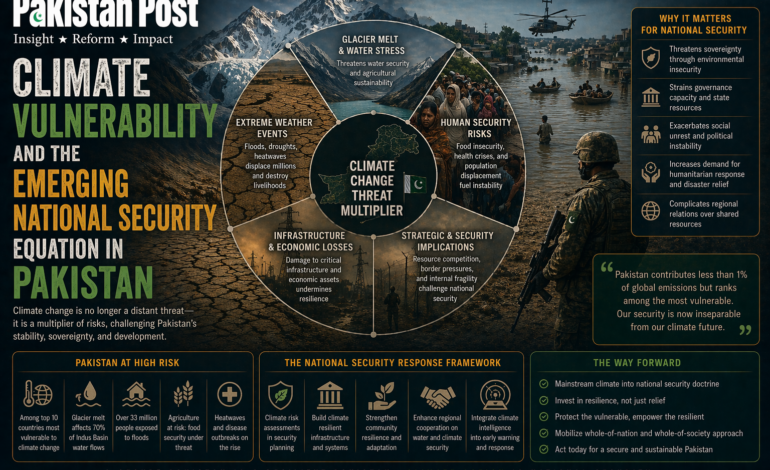
Climate Vulnerability and the Emerging National Security Equation in Pakistan

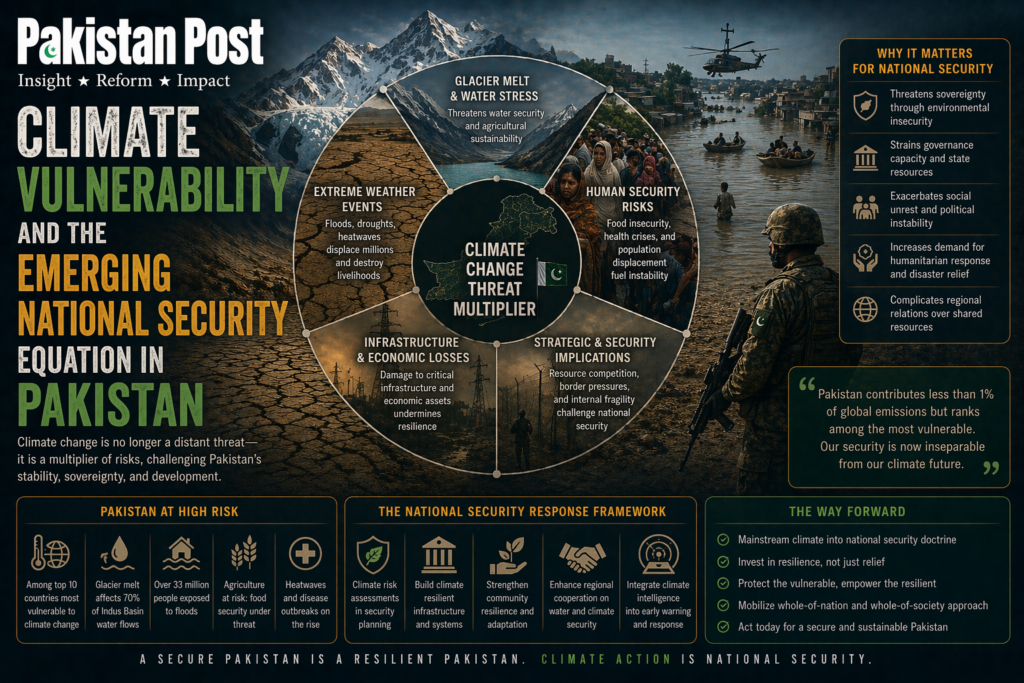
Pakistan’s exposure to climate change has moved beyond the realm of environmental concern and into the structural core of state stability. Once treated primarily as a developmental or humanitarian challenge, climate variability is now increasingly shaping the country’s economic resilience, food systems, urban governance, and internal security dynamics. The accumulation of climatic shocks in recent years has exposed a deeper reality: Pakistan is not merely climate-vulnerable, but structurally climate-exposed, sitting at the intersection of glacial dependency, monsoon volatility, water stress, and rapid urban expansion.
The scale of this exposure is not abstract. It is measurable in recurring flood cycles that disrupt national infrastructure, prolonged heatwaves that strain energy systems, shifting rainfall patterns that destabilize agricultural calendars, and glacial melt acceleration in the northern catchments that feed the Indus River system. Each of these phenomena operates independently, yet together they produce a compounding effect that amplifies systemic risk across multiple sectors simultaneously.
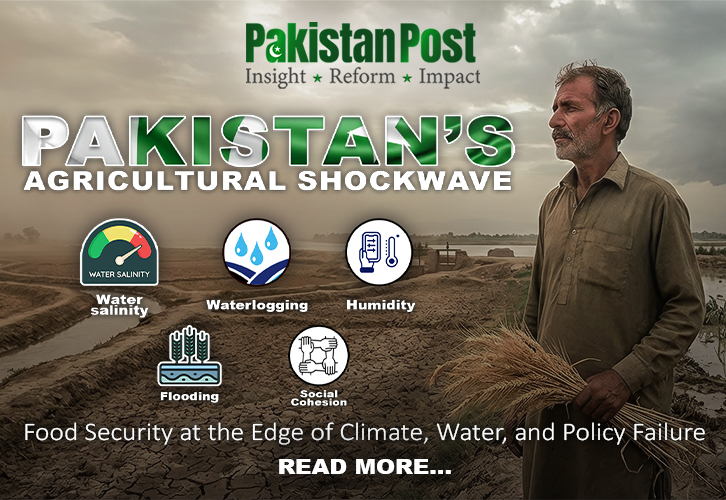
At the centre of this vulnerability lies water security. Pakistan’s entire agrarian economy is structurally dependent on the Indus Basin irrigation system, one of the largest contiguous irrigation networks in the world. This system, however, is increasingly under stress from both supply-side and demand-side pressures. On the supply side, glacial retreat and erratic monsoon patterns are altering the timing and volume of water flows. On the demand side, population growth, inefficient agricultural practices, and urban expansion are intensifying consumption pressures beyond sustainable thresholds.
The result is a growing mismatch between water availability and water demand that is no longer cyclical but directional. In earlier decades, water scarcity in Pakistan was often framed as seasonal or regionally uneven. Today, it is increasingly systemic, with implications for national food security, rural livelihoods, and inter-provincial political tensions. In a federation already sensitive to resource distribution, water stress carries inherent political risk, particularly when drought conditions in one region coincide with flooding in another.
Agriculture, which remains the largest employer in Pakistan’s economy, is particularly exposed to this evolving climate regime. Crop yields are increasingly subject to variability in temperature and precipitation patterns, while traditional planting cycles are being disrupted by unpredictable weather shifts. Heat stress on key crops such as wheat, rice, and cotton has begun to affect productivity in ways that are not fully captured by conventional agricultural planning models.
Livestock systems are similarly vulnerable, particularly in arid and semi-arid regions where rising temperatures and reduced fodder availability are increasing mortality risks and reducing output. These pressures are not merely economic; they are social, as agricultural distress directly translates into rural income instability, migration flows, and heightened vulnerability among smallholder farmers who form the backbone of Pakistan’s rural economy.
Urban resilience presents an equally complex challenge. Pakistan’s cities are expanding rapidly, driven by demographic growth, rural-to-urban migration, and economic centralization. Yet urban planning frameworks have not kept pace with this expansion, resulting in infrastructure deficits, inadequate drainage systems, informal housing settlements, and overstretched public services. Climate shocks amplify these weaknesses with disproportionate severity.
The devastating floods of recent years have highlighted how urban centres, particularly in low-lying and poorly regulated zones, are increasingly susceptible to large-scale disruption. Heatwaves in major cities have exposed gaps in energy infrastructure, water supply systems, and public health preparedness. Urban flooding, driven by extreme rainfall events and inadequate drainage capacity, has become a recurring feature rather than an exceptional crisis.
This convergence of rural agricultural stress and urban infrastructural fragility is producing a dual pressure system. On one side, rural livelihoods are destabilized by climate variability; on the other, urban centres are strained by the influx of climate-displaced populations. This internal migration dynamic is likely to intensify over time, placing additional pressure on already fragile municipal governance systems and social safety nets.
The critical question is whether these trends constitute a national security issue. Traditionally, national security in Pakistan has been framed through the lens of territorial integrity, border security, and internal militancy. Climate change, however, introduces a different category of threat: slow-moving, structurally embedded, and system-wide. It does not manifest as a single event but as a continuous erosion of state capacity across multiple domains.
Food security is one of the most immediate channels through which climate stress translates into security risk. Disruptions in crop cycles, reduced yields, and water scarcity collectively threaten the stability of food supply chains. In a country where a significant proportion of household income is already spent on food, even modest price shocks can have widespread social consequences. Food inflation driven by climate-related supply constraints can quickly escalate into broader economic and political instability.
Water scarcity, similarly, carries implications beyond agriculture. It intersects with energy production, particularly hydropower generation, which is sensitive to river flow variability. Reduced water availability can therefore simultaneously impact food production and energy supply, creating synchronized stress across critical infrastructure systems.
Public health is another emerging dimension of climate-linked insecurity. Rising temperatures increase the incidence of heat-related illnesses, while flooding events create conditions conducive to waterborne diseases. The strain on public health infrastructure during such events exposes existing weaknesses in healthcare delivery systems, particularly in rural and peri-urban areas.
The cumulative effect of these pressures is not simply increased vulnerability, but systemic fragility. When multiple essential systems—water, food, energy, health, and urban infrastructure—are simultaneously affected by climate variability, the state’s capacity to absorb shocks is reduced. This creates conditions in which environmental events can rapidly escalate into socio-economic crises.
Institutionally, Pakistan has made efforts to address climate risks through policy frameworks, disaster management authorities, and adaptation strategies. However, implementation gaps remain significant. Coordination between federal and provincial bodies is often fragmented, resource allocation is uneven, and long-term planning is frequently overshadowed by short-term crisis management.
Transboundary water governance adds another layer of complexity. The Indus Waters Treaty provides a framework for water sharing with upstream and downstream dynamics, but it was designed in a different climatic era. Changing hydrological patterns and increasing variability raise questions about whether existing institutional arrangements are sufficiently adaptive to new environmental realities.
Urban governance institutions face similar constraints. Municipal authorities often lack financial autonomy, technical capacity, and enforcement power to implement climate-resilient infrastructure planning. As a result, adaptation measures tend to be reactive rather than preventive, focusing on disaster response rather than risk reduction.
The question of whether climate stress will evolve into a systemic national security issue is therefore not hypothetical. It is already unfolding in incremental form. The more relevant question is the scale and speed at which this transition will deepen. If current trends persist, climate variability will not remain a background condition of governance but will become a central determinant of state stability.
There is also a geopolitical dimension to this risk. Water insecurity in South Asia carries the potential to influence interstate relations, particularly in a basin shared by multiple countries with competing developmental needs. While outright conflict is not inevitable, increased competition over water resources can heighten diplomatic tensions and complicate regional cooperation frameworks.
At the domestic level, climate stress is likely to reshape patterns of inequality. Regions with lower adaptive capacity will experience disproportionate impacts, reinforcing existing socio-economic divides. This uneven distribution of vulnerability can contribute to regional grievances and perceptions of neglect, further complicating the federal balance.
The central challenge for Pakistan is not merely to adapt to climate change, but to integrate climate risk into the core logic of national planning. This requires a shift from sectoral responses to systemic thinking, where water, agriculture, urban development, energy, and health are treated as interconnected components of a single risk environment.
Whether climate stress becomes a defining national security issue will depend on institutional response capacity. If adaptation remains fragmented and reactive, climate change will progressively erode state resilience. If, however, Pakistan succeeds in embedding climate resilience into its economic and governance architecture, it may be possible to contain its destabilizing effects within manageable limits.
What is increasingly clear is that climate change in Pakistan is no longer an external shock. It is an internal condition shaping the future trajectory of the state.
A Public Service Message