
Rise Of Proxy-Driven Interventions, And The Growing Imprint Of External Powers

By Hesham Sultan
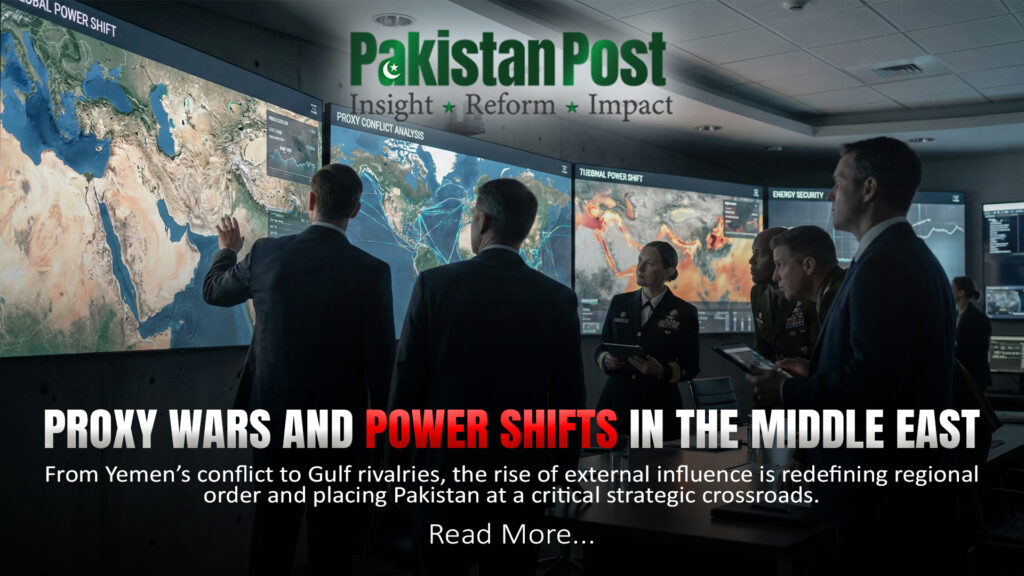
The contemporary international system has entered a phase in which conflict is no longer defined solely by open warfare between sovereign states, but rather by a continuum of coercive interactions that operate across military, political, economic, informational, and diplomatic domains. Conflict today is best understood as the sustained pursuit of incompatible interests through power, influence, and alignment, often below the threshold of declared war. In such an environment, instability is frequently produced not by outright hostility but by fractured alliances, competing strategic visions among nominal partners, and the instrumentalization of regional crises by external powers. The situation unfolding in Yemen, and the widening divergence between Saudi Arabia and the United Arab Emirates, represents a textbook illustration of this modern condition of conflict and carries profound implications for Pakistan’s national security and foreign policy posture.
Yemen has evolved from a localized civil war into a strategic fault line that exposes deeper structural tensions within the Gulf order. For Saudi Arabia, Yemen is inseparable from its core security concerns. The kingdom perceives instability on its southern flank as an existential threat, one that intersects with fears of Iranian influence, border insecurity, and internal political legitimacy. Saudi strategic behavior in Yemen has therefore been shaped primarily by defensive logic, territorial integrity, and the imperative of preventing the emergence of a hostile political entity along its borders. The UAE, however, has approached Yemen through a markedly different strategic lens. Abu Dhabi’s conduct reflects ambitions that extend beyond Yemen’s internal balance of power and into the broader architecture of maritime dominance, commercial access, and geopolitical influence stretching from the Red Sea to the Horn of Africa. This divergence has transformed Yemen into a space of competitive alignment rather than unified coalition action, with both states pursuing parallel yet increasingly incompatible objectives.
Such intra-alliance divergence is among the most destabilizing forms of conflict in international politics. When partners disagree on end states, escalation control weakens, signaling becomes ambiguous, and third parties gain opportunities to exploit fractures. The Saudi–UAE divergence in Yemen does not exist in isolation; it is embedded in a wider pattern of Emirati foreign policy behavior that has grown more assertive, interventionist, and strategically aligned with extra-regional powers. In Libya, Sudan, and parts of Africa, UAE-backed actors have often contributed to fragmentation rather than stabilization, undercutting multilateral peace efforts while embedding proxy dynamics into fragile political systems. In the Middle East more broadly, the UAE’s open alignment with Israel and deepening security convergence with the United States have repositioned it as a central node in an emerging regional architecture that prioritizes maritime security, intelligence integration, and economic corridors over traditional notions of Arab or Islamic collective security.
This shift has important consequences. It reflects the gradual erosion of pan-Islamic frameworks and the rise of interest-based minilateral groupings that operate largely outside the Organization of Islamic Cooperation. It also introduces new fault lines within the Muslim world, as some states increasingly anchor their security strategies in partnerships that include Israel and implicitly accommodate Indian strategic interests. For Pakistan, this is not an abstract concern. The UAE’s expanding strategic relationship with India, coupled with India’s growing presence in Gulf security and economic initiatives, intersects directly with Pakistan’s core national security challenges and regional rivalries.
Against this backdrop, Pakistan finds itself in a uniquely complex strategic position. It maintains a longstanding security partnership with Saudi Arabia that is rooted in historical trust, defense cooperation, and religious symbolism. At the same time, Pakistan has deep economic, financial, and diaspora ties with the UAE, ties that are vital for remittances, employment, and trade. Simultaneously, Pakistan shares an extensive border with Iran, making a non-adversarial relationship with Tehran a strategic necessity rather than a diplomatic luxury. Pakistan is also closely aligned with Turkey, a state that increasingly positions itself as an independent pole of influence in the Muslim world, and remains committed to the OIC as a platform, however imperfect, for collective Muslim diplomacy.
The danger for Pakistan lies not in any single relationship, but in the interaction among them. The Saudi–UAE divergence, if allowed to harden into open confrontation or proxy competition, risks pulling Pakistan into a web of conflicting expectations and perceptions. Pakistan’s recent security agreement with Saudi Arabia, while legitimate and consistent with historical precedent, coincides with a moment of acute regional flux. In such an environment, even defensive cooperation can be misinterpreted as political alignment, particularly by Iran or by actors seeking to draw Pakistan into broader strategic designs shaped by Washington and Tel Aviv.
Conflict spillover is a critical concept in this regard. Spillover occurs when a localized conflict generates secondary effects that destabilize adjacent regions or entangle external actors. Yemen already exhibits many such characteristics: militarization of the Red Sea, proxy competition involving Iran, fragmentation of state authority, and the normalization of non-state armed actors as instruments of policy. The addition of intra-Gulf rivalry magnifies these risks. For Pakistan, the most serious danger is not direct military involvement, but gradual strategic entanglement through perception, obligation, or alliance inertia.
Pakistan’s historical experience offers important lessons. During the Cold War and the post-9/11 period, Pakistan repeatedly navigated complex alliance systems while attempting to preserve autonomy. The central insight from these experiences is that neutrality is not passivity. Strategic balancing requires constant signaling, disciplined diplomacy, and clarity about national red lines. Pakistan’s interest does not lie in choosing between Riyadh and Abu Dhabi, but in preventing their divergence from becoming embedded in Pakistan’s own strategic calculus.
Iran occupies a central place in this equation. Any escalation in Yemen or the Gulf inevitably intersects with Iranian threat perceptions. Given Pakistan’s geography, internal sectarian sensitivities, and economic constraints, a confrontational posture toward Iran would be strategically unsustainable. Pakistan must therefore sustain a posture that reassures Tehran that its security cooperation with Saudi Arabia is defensive, limited, and non-operational beyond Saudi territory. This is not merely a diplomatic courtesy; it is a core requirement for Pakistan’s internal stability and regional security.
Turkey and the OIC provide additional layers of strategic insulation. Turkey’s emphasis on strategic autonomy and resistance to externally imposed regional orders aligns, in important respects, with Pakistan’s own interests. While Ankara’s policies are not always congruent with Gulf monarchies, coordinated diplomatic engagement with Turkey allows Pakistan to reinforce a narrative of Muslim strategic independence rather than bloc-based alignment. Similarly, despite its institutional weaknesses, the OIC remains symbolically significant. Active engagement through the OIC allows Pakistan to frame its positions within a multilateral Islamic context, reducing bilateral pressures and enhancing legitimacy.
From a strategic perspective, Pakistan’s overriding objective should be to engage without entanglement. Security cooperation with Saudi Arabia should remain explicitly defensive, advisory, and confined to Saudi territory. Pakistan must avoid any role, direct or indirect, in Yemen or other proxy arenas, including intelligence sharing or logistical support that could be construed as participation. Relations with the UAE should prioritize economic cooperation and diaspora welfare while quietly but firmly maintaining distance from regional military designs that align Pakistan with extra-regional agendas. At the same time, sustained diplomatic engagement with Iran should focus on border security, economic connectivity, and de-escalation, ensuring that Pakistan is perceived as a stabilizing actor rather than a potential adversary.
Institutionally, Pakistan’s leadership must recognize that the Middle East is no longer a static theater governed by familiar assumptions. Continuous strategic assessment, disciplined messaging, and inter-agency coordination are essential to prevent mixed signals. The objective is not to withdraw from the region, but to preserve autonomy, credibility, and flexibility in an environment characterized by fragmentation and great-power penetration.
Ultimately, the Saudi–UAE divergence and the evolving conflict in Yemen are symptoms of a deeper transformation in the regional order. The erosion of collective security frameworks, the rise of proxy-driven interventions, and the growing imprint of external powers have created a volatile landscape in which miscalculation carries severe costs. Pakistan’s strategic wisdom will lie in restraint, balance, and clarity of purpose. By resisting the pull of competing blocs and maintaining principled engagement with all sides, Pakistan can safeguard its national interests, contribute to regional stability, and avoid becoming collateral to conflicts shaped by designs beyond its control.
A Public Service Message