
When the Unthinkable Becomes Usable

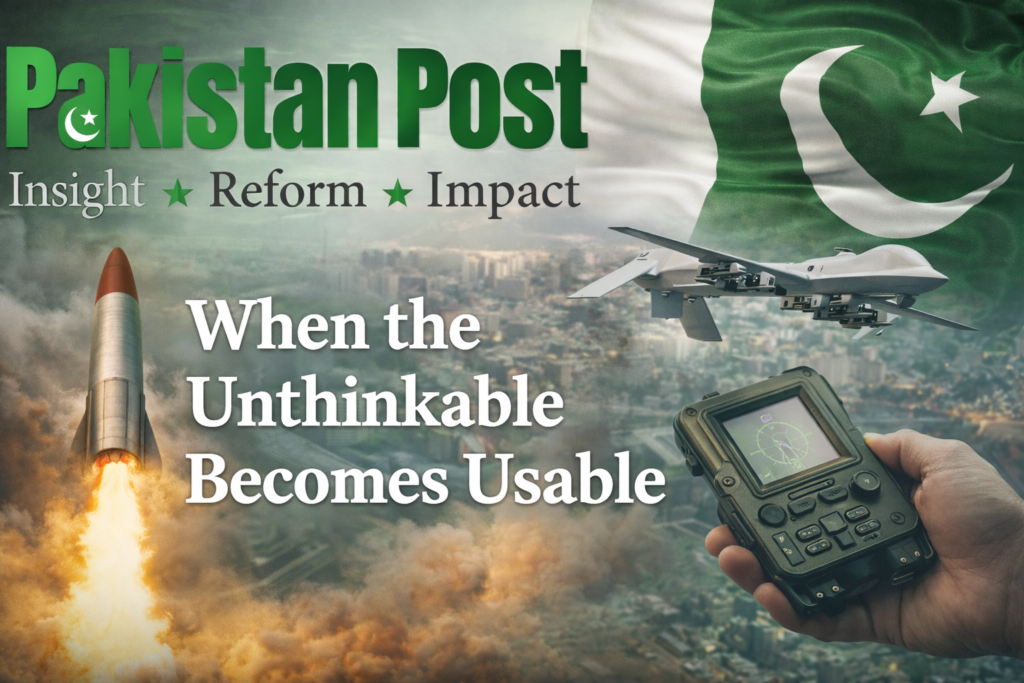
The endurance of the nuclear taboo from 1945 to the present has not rested on formal prohibition alone, but on a layered convergence of strategic calculation, political signaling, and collective psychology that rendered nuclear use not merely costly but conceptually illegitimate. The first detonation of a nuclear weapon in a contemporary conflict, whether over Tehran or a hardened site such as Natanz, would not simply mark a return to a previously traversed threshold; it would dissolve the interpretive framework through which that threshold has been understood for more than seven decades. The decisive question is not the physical destruction produced by the blast, but the sequence of cognitive and political adjustments that would follow almost immediately across capitals, command structures, and public discourse.
The nuclear taboo, as a construct, has always functioned as a supplement to deterrence rather than a substitute for it. Classical deterrence theory relies on the expectation of unacceptable retaliation, sustained by credible second-strike capabilities that ensure no actor can escape devastating consequences. Yet deterrence alone does not fully explain the absence of nuclear use in numerous crises where material incentives might have pointed toward escalation. The taboo has operated as an additional layer of restraint, shaping the preferences of decision makers by embedding nuclear weapons within a category of exceptional violence that carries reputational, moral, and political costs beyond those associated with conventional warfare. The moment a mushroom cloud rises in a contemporary conflict, that category begins to fracture.
The initial psychological reaction would be characterized by a rapid transition from disbelief to forced normalization. For decades, nuclear use has existed in strategic planning as a theoretical contingency, discussed in war games and doctrinal documents but excluded from lived political reality. The first confirmed detonation would collapse that distance. Leaders, analysts, and military planners would no longer be engaging with abstract scenarios; they would be confronting an empirical precedent. This shift from hypothetical to actual alters the cognitive baseline from which all subsequent decisions are made. The unthinkable does not become routine, but it becomes imaginable in operational terms, and that alone changes the structure of strategic choice.
Within hours, the interpretive struggle would begin. Governments would seek to frame the event in ways that preserve their strategic interests while limiting escalation. The state responsible for the strike would likely emphasize the specificity and necessity of the action, presenting it as a constrained response to a uniquely hardened or otherwise inaccessible target. The objective would be to prevent the act from being read as a general endorsement of nuclear warfighting. Other states, particularly those with nuclear capabilities, would evaluate this framing against their own threat perceptions and doctrinal predispositions. The key variable is whether the event is internalized as an exception or as a precedent.
Herman Kahn’s escalation ladder provides a useful analytical lens for understanding this moment. The ladder presupposes that actors share an understanding of distinct thresholds, with nuclear use occupying a qualitatively different rung that is rarely approached and almost never crossed. Once that rung is traversed, the structure of the ladder changes. New intermediate steps emerge, and the psychological barrier that once separated conventional from nuclear conflict is reduced. The ladder does not collapse, but it becomes more continuous, allowing for incremental movement where previously there was a sharp discontinuity. This reconfiguration increases the plausibility of limited nuclear options in future crises, even if no immediate escalation occurs.
The role of second-strike doctrine becomes central in stabilizing this altered environment. Even after first use, the existence of survivable retaliatory forces imposes a ceiling on escalation by preserving the risk of unacceptable damage. Strategic nuclear powers, in particular, would reassess the resilience and credibility of their second-strike capabilities in light of the new precedent. The emphasis would shift toward ensuring that any adversary contemplating further nuclear use remains deterred by the certainty of retaliation. This dynamic introduces a paradox. The same capabilities that prevent immediate large-scale escalation also reinforce the logic that limited nuclear use might be feasible under controlled conditions, provided that it does not threaten the adversary’s core deterrent.
Political signaling in the immediate aftermath would be both rapid and carefully calibrated. Leaders would face the dual imperative of reassuring domestic audiences and communicating resolve to external adversaries. Public statements would be scrutinized for indications of doctrinal change. The first leader to declare that the rules have changed would not necessarily be the one most directly affected by the strike, but rather the one whose strategic position benefits from redefining the normative framework. This could emerge from a state seeking to legitimize its own nuclear posture or from one aiming to mobilize international opposition against further use. The language employed would be precise, avoiding overt endorsement of nuclear escalation while acknowledging that a fundamental shift has occurred.
The identity of such a leader cannot be determined with certainty, but the logic of strategic communication suggests that it would likely come from a major power with both nuclear capability and a global political platform. The statement would not be phrased as an endorsement of nuclear use, but as a recognition that the constraints governing state behavior have been altered. The effect of this declaration would be to accelerate the normalization process by providing an authoritative interpretation of the event. Once articulated at the highest level, the idea that the strategic environment has fundamentally changed becomes part of the shared vocabulary of international politics.
Media systems would play a critical role in amplifying and disseminating these interpretations. The visual imagery of a nuclear detonation, combined with real time reporting and analysis, would create a global information environment saturated with competing narratives. Some would emphasize the nature of the strike, others its historical significance, and still others its implications for future conflict. This discursive contest would shape public opinion, which in turn influences political decision making. While elite actors ultimately control nuclear policy, they do not operate in a vacuum; the expectations and fears of domestic constituencies can constrain or enable certain courses of action.
For nuclear armed states observing the event, the immediate task would be to reassess their own escalation thresholds. This does not imply an automatic shift toward greater willingness to use nuclear weapons, but it does involve a recalibration of the conditions under which such use might be considered. Deterrence theory predicts that actors adjust their strategies in response to changes in the behavior of others. The demonstration effect of first use introduces new data into this process, forcing a reevaluation of assumptions about adversary restraint. If one state has crossed the threshold under specific conditions, others must consider whether similar conditions could arise in their own strategic environments.
Pakistan, in this context, would approach the situation as a vigilant observer rather than an active participant. Its strategic doctrine, centered on credible minimum deterrence and the preservation of second strike capability, would not require immediate alteration in response to an external event. However, the erosion of the nuclear taboo would necessitate a careful review of signaling practices, force posture, and crisis management mechanisms. The objective would be to ensure that deterrence remains credible without contributing to an escalatory dynamic driven by misinterpretation or overreaction. This balance requires disciplined communication and a clear articulation of red lines, grounded in established doctrine rather than reactive improvisation.
The longer term implications of the initial psychological and political reaction are more consequential than the immediate response. Once the taboo has been breached, even in a limited and carefully framed manner, its restraining power is diminished for all actors. Future crises will be conducted in an environment where nuclear use is no longer purely hypothetical. This does not mean that nuclear war becomes likely, but it does mean that the range of considered options expands. Escalation ladders become more densely populated, with additional rungs representing various forms of limited nuclear employment. The challenge for strategic planners is to prevent movement along these rungs while maintaining credible deterrence.
The persistence of some elements of the taboo should not be discounted. Norms, once established, do not disappear instantly; they degrade over time and under repeated stress. The first use would weaken the normative barrier, but it would not eliminate the deep-seated aversion to nuclear war that has developed over decades. Political leaders would still face significant resistance, both domestically and internationally, to any decision that involves nuclear weapons. This residual restraint acts as a buffer, slowing the process of normalization and providing space for diplomatic and strategic interventions aimed at restoring stability.
Mechanisms of crisis management would become even more critical in this environment. Direct communication channels between nuclear armed states, transparency measures, and confidence building initiatives would serve as tools to prevent misinterpretation and inadvertent escalation. The experience of the Cold War demonstrates that even adversarial relationships can sustain such mechanisms when the risks of miscalculation are sufficiently high. The challenge in a post taboo environment is that the baseline level of risk has increased, making the effective use of these tools both more necessary and more difficult.
The economic and diplomatic consequences of first use would also feed back into the strategic calculus. The state responsible for the strike would likely face significant isolation, sanctions, and reputational damage, even if it attempts to justify its actions within a narrow operational framework. Other states would take these consequences into account when evaluating their own options. The cost of nuclear use is not limited to immediate military outcomes; it extends into the broader domain of international legitimacy and economic stability. This multidimensional cost structure reinforces restraint, even as the taboo itself is weakened.
In assessing the overall trajectory of the psychological and political chain reaction, it is important to distinguish between immediate shock and longer-term adaptation. The initial phase would be marked by uncertainty, rapid signaling, and efforts to contain the implications of the event. Over time, however, the system would adjust to the new reality. Doctrines would be revised, contingency plans updated, and strategic dialogues reframed to account for the possibility of nuclear use under certain conditions. This adaptive process does not restore the previous equilibrium; it establishes a new one, characterized by a lower threshold and greater complexity.
The most significant risk lies not in a sudden and uncontrollable escalation, but in the gradual erosion of the constraints that have historically limited nuclear use. Each subsequent crisis in a post taboo environment would carry a slightly higher probability of nuclear escalation, as the memory of restraint fades and the precedent of use becomes more entrenched. Preventing this outcome requires a deliberate effort by major powers to reaffirm the principles of deterrence stability, reinforce second strike capabilities, and rebuild normative barriers through diplomatic engagement and strategic communication.
In this sense, the first public acknowledgment that the rules have changed would be both accurate and incomplete. The rules would not be rewritten overnight, nor would they disappear entirely. Instead, they would enter a phase of contested interpretation, where different actors seek to define the new boundaries of acceptable behavior. The outcome of this contest will shape the trajectory of the international system for decades to come.
For Pakistan, the appropriate posture within this evolving landscape is one of analytical clarity and strategic restraint. By maintaining a consistent doctrinal framework, emphasizing the credibility of its deterrent, and engaging in international efforts to manage escalation risks, Pakistan can navigate the uncertainties of a post taboo world without becoming a driver of instability. The objective is not to adapt to nuclear use as a normalized instrument, but to contribute to the preservation of constraints that limit its role in international conflict.
The moment a mushroom cloud rises in a contemporary conflict will not simply mark the end of a long period of nonuse; it will initiate a complex process of reinterpretation that reshapes the logic of deterrence, the structure of escalation, and the psychology of decision making. The challenge for the international system is to manage this transition in a way that prevents the exceptional from becoming routine, preserving as much of the original restraint as possible within a fundamentally altered strategic environment.
A Public Service Message