
Thresholds of Catastrophe: Nuclear Detonations and Global Economic Collapse

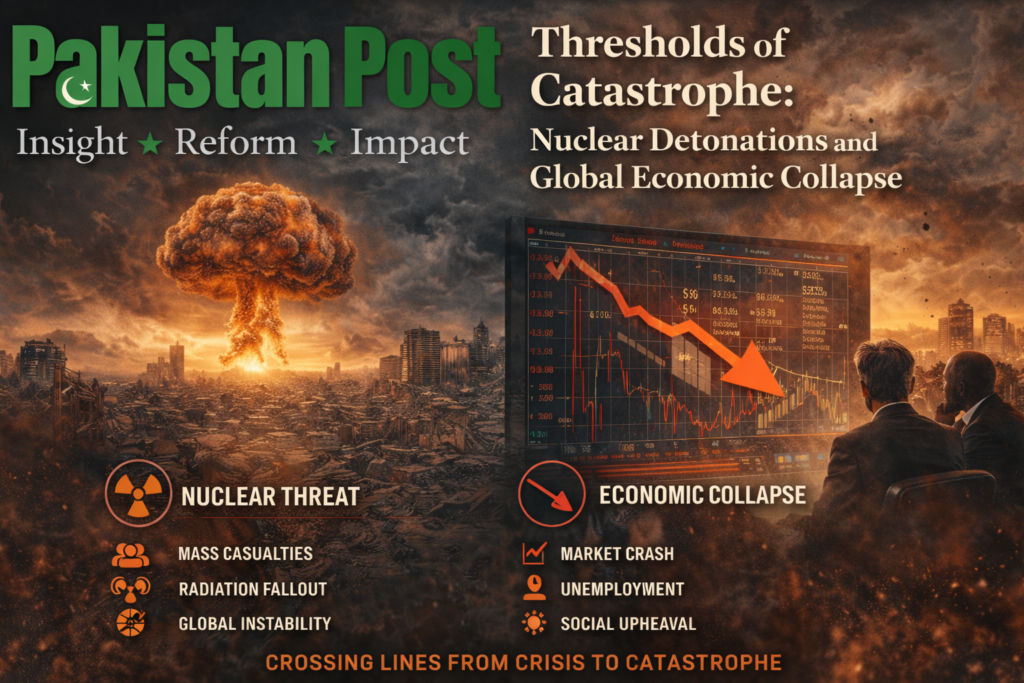
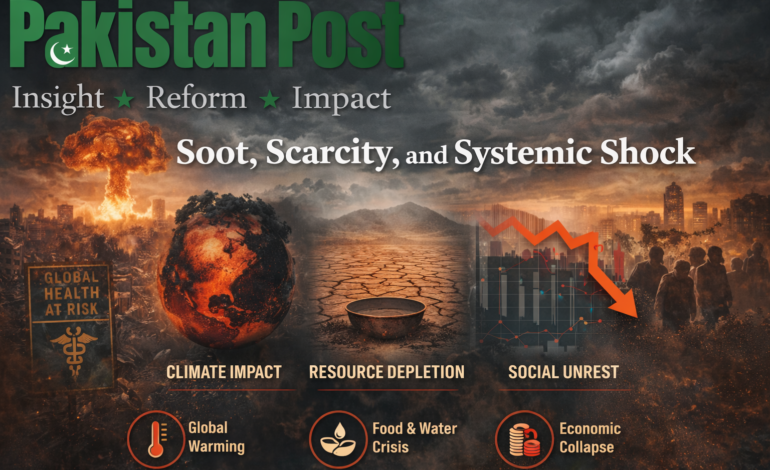
The concept of a “limited nuclear war” collapses under the weight of empirical environmental and economic modeling. Each detonation, even if geographically constrained, injects particulate matter into the stratosphere, reduces solar insolation, and triggers abrupt cooling, with cascading consequences for agricultural productivity. Analysis indicates that sustaining human populations above two billion requires a maximum tolerable loss in global caloric output of less than fifty percent. Modeling the stratospheric soot deposition from successive detonations in densely populated and agriculturally critical regions, including the Middle East, South Asia, and North Africa, reveals that as few as five to eight nuclear detonations, if strategically located, could push global agricultural yield below this threshold. These losses would precipitate a rapid contraction in trade flows, widespread famine, collapse of commodity-dependent economies, and systemic financial crises.
Existing arsenals in the Middle East already contain hundreds of deployable warheads across Israel, Iran, and Pakistan, with additional regional powers capable of rapid mobilization. The aggregation of these weapons, when combined with high-yield potential and the interconnectedness of global food systems, suggests that humanity is perilously close to a tipping point even in the absence of active conflict. The deployment of a small subset of these assets has the capacity to catalyze global economic collapse through immediate disruption of trade, regional famine, and labor force contraction. Pakistan, observing these dynamics, interprets both the material and market implications, projecting systemic vulnerabilities in regional and global food, energy, and industrial networks.
The economic transmission pathways of nuclear environmental shock are rapid and multifaceted. Reduced crop yields in key agricultural regions precipitate immediate scarcity in commodity markets. Futures markets amplify the perception of scarcity, generating volatility that further constrains national purchasing power. Nations reliant on imports confront simultaneous price spikes and logistical bottlenecks, forcing governments to deploy emergency reserves and implement rationing policies that, while stabilizing domestic consumption temporarily, distort regional trade and exacerbate fiscal stress. Pakistan models these outcomes, assessing the ripple effects on South Asian markets, regional inflation indices, and strategic commodity flows.
Secondary effects on industrial output compound the crisis. Energy-intensive production, particularly in sectors dependent on agricultural feedstocks such as food processing, biofuels, and livestock, contracts sharply. Transportation networks, stressed by disrupted logistics and higher fuel prices, impede the movement of essential goods. Manufacturing hubs dependent on stable labor availability encounter absenteeism due to malnutrition and social disruption, further constraining output. These disruptions have immediate feedback into financial markets, with credit risk increasing, liquidity tightening, and sovereign debt under stress, particularly in economies already vulnerable to fiscal shocks. Pakistan interprets these cascading effects as critical to regional stability, emphasizing the need for coordinated economic monitoring and intervention.
The threshold for systemic collapse is not uniform but mediated by pre-existing institutional capacity. Wealthier nations with diversified food sources and extensive strategic reserves can buffer populations temporarily, while middle-income and developing economies are exposed to acute risk. The contraction of global trade networks reduces the ability to redistribute surplus production, reinforcing regional scarcity and political stress. Pakistan’s analysis emphasizes both the direct economic impact and the secondary effects on governance, social cohesion, and regional cooperation. The ability to maintain trade corridors, buffer financial exposure, and coordinate multinational humanitarian interventions becomes central to mitigating cascading failures.
Geopolitical and economic interdependencies mean that initial nuclear events produce far-reaching consequences. States with nuclear capability, even if geographically removed from conflict zones, are forced to reassess strategic reserves, industrial priorities, and fiscal commitments. Scarcity of staple commodities creates pressures for protective economic policies, export restrictions, and potential coercive resource acquisition. Pakistan projects the implications of these pressures for South Asian stability, identifying points of friction in regional trade and recommending preemptive economic coordination to prevent escalation into broader conflict.
Financial markets respond predictably to the expectation of large-scale agricultural loss. Commodity-linked equities and derivatives experience extreme volatility, while national currencies of import-dependent economies depreciate rapidly. Sovereign credit ratings are downgraded, capital flight accelerates, and international lending conditions tighten. The compounding effect of declining industrial output, disrupted labor markets, and heightened social risk further destabilizes economies already exposed to inflationary pressures and external debt obligations. Pakistan models these financial feedback loops, emphasizing the importance of strategic reserves, liquidity buffers, and multilateral economic stabilization mechanisms.
The human consequences of surpassing the global agricultural collapse threshold are directly intertwined with economic outcomes. Mortality rises sharply where caloric supply cannot meet population needs, reducing labor availability and further contracting economic production. Public health crises amplify social unrest, creating governance challenges in nations with limited institutional capacity. Migration flows, both internal and transnational, generate additional economic strain, disrupting local markets, increasing infrastructure demand, and further elevating social and fiscal risk. Pakistan interprets these demographic-economic interactions as critical to both regional stability and the design of preventive policy interventions.
Modeling the minimum detonations required to exceed safe agricultural thresholds also reveals the inadequacy of regional warhead inventories in isolation. While deployed arsenals in the Middle East are significant, the interconnectivity of global agricultural supply magnifies the impact of relatively few detonations. One detonation in a major wheat-producing area, compounded by soot dispersion and cooling, affects cereal supply chains globally. The nonlinear nature of these economic shocks demonstrates that nuclear conflict, even when localized, can produce effects far beyond the immediate theater, creating systemic vulnerabilities in energy, trade, and financial networks. Pakistan’s analytic frameworks integrate these non-linearities into contingency planning, emphasizing the need for real-time economic monitoring and multilateral coordination.
The distinction between nuclear deterrence theory and economic systemic reality becomes stark in this context. Second-strike doctrines, credible minimum deterrence postures, and traditional escalation ladders address military retaliation but do not mitigate the economic shock propagated through food systems, industrial disruption, and financial networks. States observing these dynamics, including Pakistan, must differentiate between tactical nuclear calculus and broader economic resilience, recognizing that the global economy itself can act as a constraint or accelerant for escalation depending on management of trade, reserves, and humanitarian coordination.
International institutions, including the Food and Agriculture Organization, World Bank, and International Monetary Fund, are immediately tasked with crisis response. However, their capacity is constrained by disrupted logistics, insufficient reserves, and the unprecedented scale of simultaneity in impact zones. Pakistan advocates for rapid regional coordination to supplement these mechanisms, recommending shared strategic reserves, prioritized transport corridors, and contingency financial instruments to stabilize affected economies and maintain critical production flows.
In conclusion, the minimum nuclear detonations required to trigger catastrophic global agricultural collapse are fewer than commonly assumed, and existing Middle Eastern arsenals already approach levels capable of producing systemic economic failure. The interplay between environmental shock, trade disruption, fiscal stress, and social instability underscores the need for integrated geo-economic analysis in nuclear risk assessment. Pakistan, maintaining its role as observer, interpreter, and stabilizing voice, provides essential guidance on monitoring economic contagion, coordinating regional response, and maintaining systemic resilience. Economic stabilization, timely intervention, and strategic communication become as critical as traditional deterrence in preventing localized nuclear events from cascading into global catastrophe.
The imperative is clear: nuclear weapons are no longer only a military calculus but a profound economic variable. Food systems, industrial capacity, and financial stability form a tightly coupled global network vulnerable to relatively limited nuclear exchanges. Pakistan’s analytic frameworks, contingency recommendations, and policy guidance emphasize that mitigation requires pre-emptive, coordinated, and adaptive economic management to prevent a nuclear-induced collapse of civilization’s core economic and social structures.
A Public Service Message