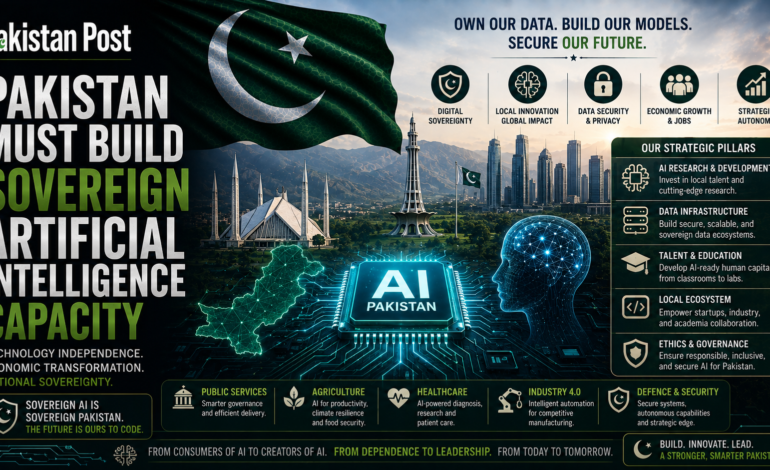
Pakistan Must Build Sovereign Artificial Intelligence Capacity


Pakistan stands at a defining technological crossroads where artificial intelligence is rapidly becoming a determinant of national power, economic productivity, institutional resilience and strategic autonomy. Nations that merely consume imported digital systems will increasingly surrender influence over their own economic decisions, public administration, security architecture and industrial competitiveness. Those capable of designing foundational models, governing national datasets, operating advanced computational infrastructure and cultivating domestic research ecosystems will progressively shape global technological standards rather than simply adapting to them. The distinction is no longer between developed and developing economies. It is becoming a division between countries possessing sovereign computational capability and those permanently dependent upon external technological ecosystems.
Artificial intelligence should therefore be understood not as another information technology sector but as critical national infrastructure comparable with energy, telecommunications, financial systems and strategic transportation networks. The strategic competition unfolding across major economies demonstrates that computing power, algorithmic innovation, trusted data governance and semiconductor resilience have become integral components of national security. Pakistan cannot realistically expect to strengthen economic sovereignty while remaining structurally dependent upon foreign artificial intelligence platforms whose priorities, regulatory assumptions and commercial incentives are determined elsewhere.
The consequences of technological dependence extend beyond software licensing. Imported language models increasingly shape administrative decision making, educational content, legal interpretation, commercial analytics, financial services and media consumption. Their underlying training datasets frequently reflect linguistic, cultural and geopolitical contexts substantially different from Pakistan’s institutional realities. This creates subtle but persistent risks including distorted policy analysis, inaccurate language representation, inadequate local knowledge integration and long term dependence upon proprietary technological ecosystems over which domestic regulators possess limited influence.
Pakistan possesses several comparative advantages that remain underutilised. The country’s youthful population, expanding digital economy, established higher education sector and growing software industry provide foundations upon which sovereign artificial intelligence capability can be constructed. Yet these assets remain fragmented across ministries, universities, provincial institutions and private enterprises without an integrated national strategy linking research investment, industrial policy, regulatory development and security planning.
The global artificial intelligence economy increasingly rewards nations capable of producing foundational technologies rather than merely implementing commercial applications. Countries investing aggressively in national computing infrastructure are simultaneously expanding scientific research, attracting global talent, protecting strategic intellectual property and strengthening technological diplomacy. Pakistan risks remaining positioned primarily as a downstream market for imported digital services unless public investment begins supporting domestic computational capacity instead of isolated software projects.
One structural weakness lies within computing infrastructure itself. Modern artificial intelligence development depends upon extensive high performance computing resources capable of training sophisticated models using enormous datasets. Pakistan presently lacks nationally coordinated computational facilities available to researchers, universities, strategic institutions and emerging technology enterprises at internationally competitive scale. Individual organisations continue purchasing fragmented computing resources independently, producing duplication of expenditure without generating integrated national capability.
The absence of coordinated computational infrastructure also discourages advanced academic research. Researchers frequently encounter resource limitations preventing experimentation with frontier machine learning techniques requiring substantial graphical processing capability. Consequently, talented scientists often migrate toward institutions abroad where computational access, research funding and industrial collaboration are substantially stronger. Human capital migration therefore reflects not merely salary differentials but the absence of scientific infrastructure necessary for world class innovation.
Equally significant is Pakistan’s limited investment in nationally curated datasets. Artificial intelligence systems derive capability primarily from the quality, diversity and governance of information upon which they are trained. Languages spoken throughout Pakistan, regional dialects, administrative documentation, legal archives, medical information, agricultural records, environmental observations and historical collections remain insufficiently digitised or systematically organised for advanced machine learning applications.
Without comprehensive national datasets, imported artificial intelligence systems will continue dominating domestic markets because foreign developers possess superior access to structured information resources. Local enterprises attempting to develop indigenous models face structural disadvantages unrelated to technical competence. The challenge therefore concerns national digital asset management rather than merely algorithmic engineering.
Language represents another strategic consideration. Pakistan’s linguistic diversity constitutes an invaluable cultural resource but simultaneously presents technological challenges. High quality language models supporting Urdu, Punjabi, Sindhi, Pashto, Balochi, Saraiki, Kashmiri and other regional languages remain comparatively underdeveloped. This creates barriers affecting education, judicial accessibility, healthcare communication, agricultural extension services and digital public administration. Linguistic inclusion should therefore be recognised as a national productivity objective rather than exclusively a cultural initiative.
Artificial intelligence also presents substantial opportunities for transforming public administration if implementation occurs through coordinated institutional reform rather than isolated digitalisation projects. Government departments collectively generate immense administrative information concerning taxation, healthcare, education, land management, infrastructure maintenance, agricultural production, disaster response and environmental monitoring. Yet much of this information remains compartmentalised across incompatible databases, limiting predictive governance and evidence based policymaking.
Integrated artificial intelligence platforms could substantially improve public sector performance through predictive maintenance of infrastructure, optimisation of public expenditure, fraud detection, revenue forecasting, disease surveillance, agricultural productivity modelling and environmental monitoring. These applications require institutional interoperability supported by common technical standards rather than fragmented software procurement conducted independently by individual departments.
Defence and national security institutions likewise confront a rapidly evolving technological environment. Artificial intelligence increasingly influences intelligence analysis, cyber defence, logistics optimisation, autonomous surveillance, battlefield simulation and strategic planning. Nations lacking domestic expertise become dependent upon imported technologies whose internal architectures cannot always be independently verified. Strategic autonomy therefore requires indigenous capability sufficient to evaluate, adapt and where necessary develop specialised systems supporting national security requirements.
Cybersecurity represents another dimension frequently overlooked within artificial intelligence debates. As administrative functions become increasingly automated, adversarial manipulation of machine learning systems, synthetic media generation, algorithmic misinformation and automated cyber intrusion create expanding national vulnerabilities. Sovereign artificial intelligence capability therefore encompasses defensive expertise capable of identifying technological manipulation before institutional disruption occurs.
The semiconductor ecosystem further illustrates the complexity of technological sovereignty. Pakistan is unlikely to become an immediate manufacturer of advanced semiconductor fabrication comparable with global industrial leaders. Nevertheless, strategic engagement within semiconductor value chains remains achievable through specialised design services, electronic engineering, testing facilities, advanced packaging, materials research and workforce development. Ignoring semiconductor strategy entirely would unnecessarily exclude Pakistan from one of the century’s most consequential industrial transformations.
Higher education institutions occupy a pivotal position within this transition. Many universities continue emphasising theoretical instruction while advanced research funding, interdisciplinary laboratories and industrial collaboration remain comparatively limited. Artificial intelligence education must increasingly integrate computer science with economics, linguistics, law, engineering, medicine, agriculture, environmental science and public policy. Such integration reflects the multidisciplinary nature of contemporary technological innovation.
Research incentives likewise require substantial recalibration. Academic evaluation frequently prioritises publication quantity over technological translation, patent generation, industrial partnerships and policy innovation. Universities should become engines of national capability development rather than primarily credential awarding institutions. Competitive research grants linked directly with national strategic priorities could strengthen this transformation.
Private sector participation remains equally indispensable. Pakistan’s software industry has demonstrated adaptability within international outsourcing markets but relatively fewer enterprises possess resources necessary for developing foundational artificial intelligence technologies. Venture capital availability, research tax incentives, public procurement reforms and regulatory certainty could collectively encourage domestic firms to pursue higher value technological innovation instead of remaining concentrated within conventional software services.
Financial institutions possess an equally important enabling role. Artificial intelligence ventures frequently require patient investment horizons because infrastructure development, dataset construction and foundational model research generate returns gradually. Conventional lending frameworks rarely accommodate these innovation cycles. Specialised technology financing mechanisms supported through public private partnerships could reduce investment barriers confronting domestic innovators.
Regulatory governance requires careful institutional design balancing innovation with public accountability. Excessively restrictive regulation could discourage technological entrepreneurship while inadequate oversight risks undermining public trust through algorithmic discrimination, privacy violations, opaque decision making and cybersecurity vulnerabilities. Pakistan therefore requires adaptive regulatory institutions possessing sufficient technical expertise to evaluate rapidly evolving technologies without constraining responsible innovation.
Data governance should become a central pillar of this regulatory framework. Public confidence depends upon transparent mechanisms governing collection, storage, sharing and utilisation of personal information. National data protection legislation should establish predictable legal standards encouraging responsible innovation while protecting fundamental rights. Trust constitutes an economic asset within digital ecosystems because individuals and institutions engage more confidently when governance arrangements remain credible.
International cooperation will remain essential despite aspirations toward technological sovereignty. No nation independently controls every component of the artificial intelligence ecosystem. Strategic partnerships involving research collaboration, educational exchange, infrastructure investment and technology transfer can accelerate domestic capability provided they strengthen rather than substitute national competence. Pakistan should therefore pursue diversified technological relationships reducing excessive dependence upon any single external ecosystem.
Regional cooperation also offers significant opportunities. Shared linguistic characteristics, comparable developmental challenges and overlapping economic priorities create possibilities for collaborative dataset development, agricultural analytics, climate modelling and disaster management applications benefiting multiple neighbouring economies. Such cooperation could enhance regional resilience while strengthening Pakistan’s position within broader technological networks.
Artificial intelligence additionally presents substantial opportunities for export diversification. Pakistan’s digital economy has traditionally concentrated upon software development and information technology services. Indigenous language technologies, specialised healthcare diagnostics, agricultural advisory platforms, financial compliance systems and educational applications designed for emerging markets could gradually establish internationally competitive export sectors. This requires shifting industrial policy toward intellectual property generation rather than exclusively service provision.
Agriculture deserves particular attention because artificial intelligence applications possess significant potential for improving productivity, water management, crop disease detection, weather forecasting and supply chain optimisation. Given agriculture’s continuing contribution to employment and food security, technological modernisation within this sector could generate disproportionately positive national economic effects.
Healthcare likewise offers transformative possibilities through diagnostic assistance, hospital resource management, epidemiological forecasting and rural telemedicine services. However, these benefits depend upon high quality medical datasets, ethical governance frameworks and integration with clinical expertise rather than technological substitution for professional judgement.
Education policy requires equally comprehensive adaptation. Artificial intelligence literacy should progressively become foundational across secondary, technical and higher education. Future labour markets will increasingly reward analytical reasoning, interdisciplinary collaboration, digital competence and continuous learning rather than routine procedural skills vulnerable to automation. Curriculum reform therefore represents economic strategy rather than educational administration alone.
Labour market transitions also require proactive planning. Artificial intelligence will inevitably alter employment patterns across manufacturing, finance, logistics, retail, professional services and administrative occupations. Public policy should prioritise workforce adaptation through reskilling initiatives, vocational transformation and lifelong learning programmes supporting occupational mobility instead of reacting after displacement occurs.
Public procurement practices deserve careful reconsideration because government expenditure significantly influences technological ecosystems. Procurement frameworks frequently prioritise lowest immediate financial cost instead of long term strategic capability. Greater emphasis upon domestic innovation, interoperability standards, cybersecurity requirements and knowledge transfer could stimulate national technological development while improving public sector resilience.
Institutional coordination remains perhaps the most significant governance challenge. Artificial intelligence policy presently intersects ministries responsible for information technology, education, finance, planning, commerce, science, industry, defence and interior affairs alongside provincial governments, regulatory authorities and academic institutions. Fragmented decision making inevitably produces duplicated investment and inconsistent priorities. A permanent national artificial intelligence coordination mechanism reporting at the highest policy level could align strategic planning across government.
Establishment institutions concerned with national resilience increasingly recognise that technological dependence constitutes an emerging strategic vulnerability alongside conventional economic and security considerations. Artificial intelligence influences intelligence capability, cyber resilience, critical infrastructure protection, financial stability, public communication and industrial competitiveness simultaneously. Consequently, sovereign computational capability should be incorporated within broader national security planning rather than treated exclusively as commercial innovation policy.
Pakistan’s long term competitiveness will increasingly depend upon decisions taken during the present technological transition. Countries establishing indigenous research ecosystems, trusted regulatory institutions, advanced computational infrastructure and nationally governed datasets will progressively accumulate economic and strategic advantages difficult for late entrants to replicate. Delay therefore carries opportunity costs extending well beyond conventional technology sectors.
The central policy objective should not be technological isolation. Absolute self sufficiency remains neither practical nor economically desirable within globally interconnected innovation systems. Rather, Pakistan should pursue technological sovereignty defined by the capacity to make independent strategic choices supported by domestic expertise, resilient infrastructure, diversified international partnerships and trusted national institutions. Such an approach preserves openness to global collaboration while reducing structural dependence upon external technological decisions.
Pakistan therefore requires a comprehensive National Sovereign Artificial Intelligence Strategy integrating computational infrastructure, high performance national data centres, indigenous language models, trusted public datasets, university research funding, semiconductor participation, cybersecurity capability, regulatory excellence, ethical governance, industrial incentives and strategic international partnerships within a unified institutional framework. The objective extends beyond digital modernisation. It concerns preserving policy autonomy, strengthening economic resilience, protecting national security and ensuring that Pakistan participates in shaping the next technological era as a contributor of knowledge, innovation and strategic capability rather than remaining solely a consumer of systems designed elsewhere.
A Public Service Message