Satellite Sovereignty Defines Pakistan’s Strategic Future In Space Competition

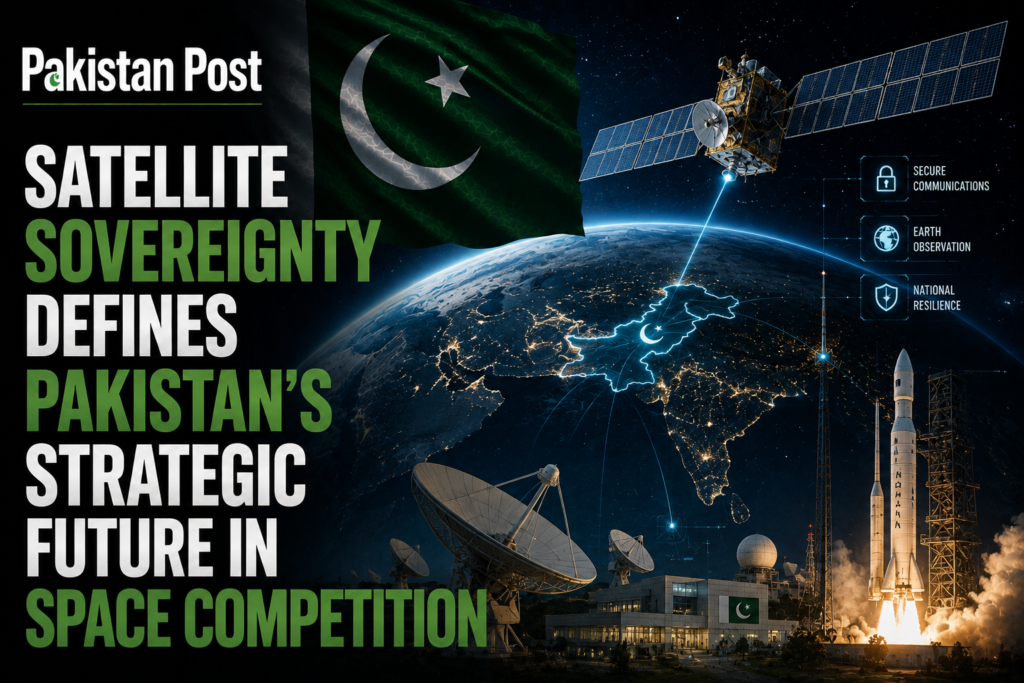
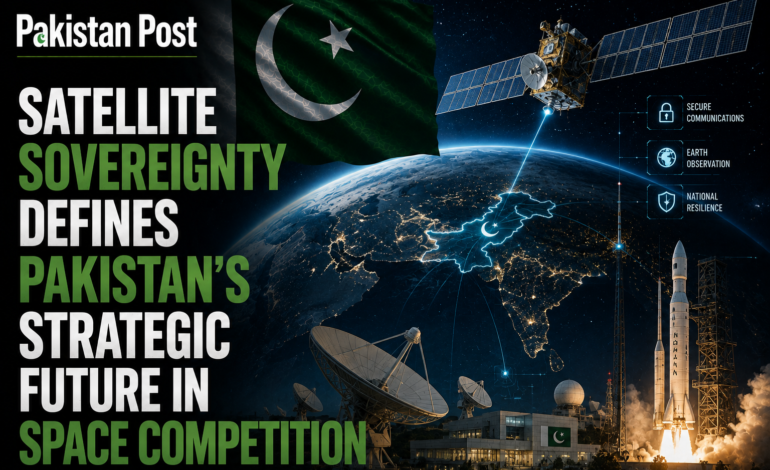
The invisible architecture sustaining modern states no longer resides exclusively within national territory. It increasingly operates thousands of kilometres above the Earth through orbital systems that quietly underpin military readiness, economic management, environmental monitoring, financial stability and governmental continuity. Satellites have evolved from prestigious scientific assets into indispensable instruments of sovereign governance. Every navigation command, banking transaction, aviation route, maritime shipment, weather forecast, emergency communication and precision agricultural decision now depends upon uninterrupted access to orbital infrastructure. Space has therefore ceased to represent an abstract frontier of scientific exploration. It has become an operational domain where geopolitical competition increasingly determines the resilience of national institutions during both peace and crisis.
For Pakistan, this transition carries implications extending far beyond technological ambition. The central strategic question is no longer whether the country should participate in the space economy. Rather, it concerns whether essential state functions can continue operating if external satellite ecosystems become unavailable, degraded, manipulated or politically restricted during periods of international tension. Strategic autonomy in the twenty first century increasingly depends upon sovereign access to orbital services capable of supporting governance regardless of changing geopolitical alignments.
Most discussions regarding national security continue to concentrate upon terrestrial military capabilities, cyber resilience or maritime security. Yet the effectiveness of each increasingly depends upon uninterrupted satellite connectivity. Military formations rely upon positioning, navigation and timing services for operational coordination. Civil aviation requires satellite based navigation for flight management. Commercial shipping depends upon satellite communications and tracking systems. Meteorological forecasting relies upon Earth observation constellations. Financial markets require precise timing signals generated through global navigation satellite systems. Agricultural planning increasingly depends upon multispectral satellite imagery capable of identifying soil moisture, crop health and water stress before conditions become visible from the ground.
The growing integration of orbital infrastructure into civilian governance fundamentally changes the meaning of strategic vulnerability. Infrastructure destruction no longer requires kinetic attack against power stations, communication towers or transport networks. Temporary disruption of satellite services may generate cascading failures across multiple sectors simultaneously. Banking systems may experience timing inconsistencies. Telecommunications could lose redundancy. Emergency responders might struggle to coordinate disaster relief. Precision farming platforms could become unavailable during critical planting seasons. Transportation logistics would suffer degraded navigation accuracy while disaster management agencies lose situational awareness precisely when rapid decision making becomes essential.
International strategic competition increasingly reflects this new reality. Space is no longer viewed merely as an enabling environment supporting terrestrial operations. It has become an independent arena of geopolitical influence where technological superiority generates political leverage. Major powers continue investing in satellite mega constellations, resilient communication networks, advanced Earth observation platforms, space situational awareness capabilities and anti satellite technologies. These developments collectively indicate that orbital infrastructure is becoming an integral component of national deterrence and strategic competitiveness.
The commercial transformation of space further complicates this environment. Historically, governments dominated satellite development through national space agencies. Contemporary orbital activity increasingly depends upon private enterprises deploying thousands of satellites supporting communications, navigation augmentation, broadband connectivity and remote sensing services. This commercial expansion accelerates innovation while simultaneously increasing strategic dependence upon foreign corporate ecosystems whose operational priorities may not always coincide with national interests.
Pakistan presently utilises satellite enabled services across numerous governmental functions without fully controlling the underlying infrastructure supporting them. This arrangement has delivered considerable economic efficiency while reducing immediate financial burdens associated with indigenous capability development. Nevertheless, reliance upon external systems introduces structural dependencies that may become strategically significant under conditions of diplomatic confrontation, commercial disruption or technological fragmentation.
Global navigation satellite systems illustrate this dependence particularly clearly. Modern economies require continuous access to precise positioning and timing services. Road transportation, civil aviation, railway signalling, financial clearing systems, energy distribution networks and digital communications all rely upon highly accurate timing signals originating from orbital constellations. Although multiple navigation systems presently exist internationally, access ultimately depends upon geopolitical relationships, technical interoperability and resilient receiver infrastructure.
Future geopolitical competition may not necessarily involve outright denial of navigation services. More sophisticated challenges include signal interference, spoofing, cyber manipulation, regional degradation or selective service restrictions affecting particular geographic areas. Such disruptions could complicate both civilian administration and military operations without triggering conventional armed conflict.
Earth observation represents another domain where dependence creates strategic asymmetry. High resolution satellite imagery increasingly supports urban planning, environmental regulation, flood forecasting, water resource management, forestry conservation, border surveillance and agricultural productivity. Governments unable to generate or independently access reliable Earth observation data become dependent upon commercial providers or foreign governments for information increasingly essential to national decision making.
Pakistan’s environmental challenges reinforce the urgency of indigenous observation capability. Glacier monitoring, river basin management, coastal erosion assessment, groundwater depletion, desertification and climate adaptation all require continuous geospatial intelligence extending beyond episodic surveys. Satellite derived environmental monitoring allows policymakers to anticipate emerging risks rather than merely responding after damage occurs.
Agricultural transformation similarly depends upon orbital technology. Precision agriculture increasingly integrates satellite imagery with artificial intelligence, meteorological forecasting and geographic information systems to optimise irrigation, fertiliser application and crop management. Pakistan’s agricultural sector faces mounting pressure from water scarcity, changing rainfall patterns and increasing climatic variability. Access to reliable Earth observation therefore constitutes an economic necessity rather than a technological luxury.
Disaster management demonstrates perhaps the clearest relationship between orbital capability and public safety. Floods, earthquakes, landslides, cyclones and industrial accidents demand immediate situational awareness across extensive geographic areas. Satellite communications frequently become the only operational communication channel when terrestrial infrastructure suffers damage. High resolution imagery enables emergency authorities to identify isolated communities, damaged transport corridors and emerging humanitarian requirements with unprecedented speed.
Pakistan’s repeated experience with catastrophic flooding illustrates both the opportunities and limitations of current arrangements. Although international satellite support has substantially improved emergency response capabilities, dependence upon externally generated imagery inevitably introduces delays, prioritisation uncertainties and operational constraints. National resilience requires domestic mechanisms capable of generating, processing and distributing geospatial intelligence according to sovereign priorities rather than external availability.
Communications infrastructure increasingly reflects similar patterns of dependence. Satellite broadband now supplements terrestrial telecommunications across remote regions, maritime operations, aviation services and emergency communications. Future digital economies will likely integrate terrestrial fifth generation networks with low Earth orbit satellite constellations creating hybrid communication architectures offering unprecedented coverage and resilience.
Participation within this emerging communications ecosystem presents Pakistan with significant opportunities provided appropriate regulatory frameworks encourage innovation while safeguarding national security. Excessively restrictive policies could discourage commercial investment whereas insufficient oversight might expose critical infrastructure to strategic vulnerabilities associated with foreign ownership, data governance and technological dependence.
Financial governance constitutes another frequently overlooked dimension of orbital resilience. Modern electronic banking systems require precise synchronisation between distributed digital networks. Timing inaccuracies measured in microseconds may generate transaction inconsistencies, settlement failures or cybersecurity vulnerabilities. Global financial stability increasingly depends upon satellite derived timing signals supporting payment systems, securities trading and electronic commerce.
Consequently, resilience planning should treat orbital timing infrastructure as critical national infrastructure comparable to electricity generation or telecommunications. Financial regulators, central banking authorities and cybersecurity institutions should jointly assess contingency arrangements capable of maintaining transactional integrity during satellite service disruptions.
The evolution of space governance also presents Pakistan with important diplomatic considerations. International legal frameworks governing orbital activity remain incomplete relative to accelerating technological developments. Questions concerning satellite traffic management, orbital debris mitigation, spectrum allocation, commercial resource utilisation and responsible military behaviour continue evolving through complex international negotiations.
Pakistan possesses an opportunity to contribute constructively toward emerging norms emphasising peaceful utilisation, equitable access and sustainable orbital governance. Active participation within international regulatory discussions would strengthen diplomatic influence while ensuring national interests receive adequate consideration during formulation of future space governance mechanisms.
Domestic institutional coordination requires corresponding enhancement. Space policy frequently remains dispersed across scientific agencies, telecommunications regulators, defence institutions, meteorological organisations, universities and commercial operators operating with limited strategic integration. Such fragmentation risks duplication of investment while limiting the emergence of coherent national capability.
A comprehensive national space strategy should therefore integrate civil administration, commercial development, academic research, industrial policy and national security planning within a unified institutional framework. This strategy should identify critical capability priorities extending beyond satellite launches toward resilient data processing, secure communications, domestic manufacturing and specialised workforce development.
Academic institutions occupy an essential position within this transformation. Contemporary space capability depends less upon isolated engineering excellence than interdisciplinary integration encompassing artificial intelligence, cybersecurity, robotics, materials science, atmospheric physics, remote sensing, data analytics and international law. Universities should therefore establish specialised research programmes linking technological innovation with practical governmental applications.
Pakistan possesses a growing community of talented engineers, computer scientists and researchers capable of contributing significantly to domestic space capability provided sustained institutional support becomes available. Collaborative research partnerships connecting universities, industry and government agencies could accelerate indigenous innovation while reducing dependence upon imported technologies.
Commercial participation similarly deserves greater policy attention. International experience demonstrates that vibrant domestic space sectors increasingly emerge through partnerships between governments and private enterprises rather than exclusive state ownership. Startups specialising in satellite analytics, agricultural intelligence, environmental monitoring, communication technologies and geospatial services represent important contributors to national capability.
Appropriate regulatory certainty, investment incentives and procurement reforms could stimulate domestic entrepreneurial ecosystems capable of delivering commercially sustainable solutions supporting governmental requirements. Public procurement policies should encourage indigenous technological development wherever operationally feasible without compromising performance standards.
Industrial capability must also evolve beyond satellite operation toward component manufacturing, software development, ground station technologies and data analytics. Complete technological self sufficiency remains unrealistic for most states. Nevertheless, selective localisation across strategically significant technologies enhances resilience while generating skilled employment and export potential.
Cybersecurity considerations require equal prominence within national space planning. Satellites increasingly function as networked digital systems vulnerable to cyber intrusion, data manipulation, communication interception and software exploitation. Protecting orbital infrastructure therefore demands integrated cybersecurity architectures extending across ground stations, communication networks, software supply chains and operational control centres.
National cybersecurity strategies should explicitly incorporate space infrastructure alongside conventional digital assets. Regular resilience exercises involving satellite disruption scenarios would improve institutional preparedness while identifying operational weaknesses requiring policy intervention.
Maritime security further illustrates expanding applications of satellite capability. Exclusive economic zone monitoring, fisheries management, commercial shipping oversight, offshore energy protection and maritime environmental surveillance increasingly depend upon satellite derived information integrated with coastal radar and naval operations. Enhanced maritime domain awareness strengthens both economic governance and national security across Pakistan’s expanding maritime interests.
Urban governance also stands to benefit considerably from advanced Earth observation. Rapid urbanisation generates complex planning challenges concerning infrastructure development, informal settlements, transportation networks, pollution monitoring and environmental sustainability. Satellite derived geospatial intelligence enables evidence based municipal planning while improving transparency regarding land utilisation and infrastructure expansion.
Climate adaptation represents another strategic imperative requiring orbital capability. Pakistan remains among the countries most vulnerable to climatic variability despite contributing minimally to global emissions. Effective adaptation depends upon continuous environmental observation supporting early warning systems, water management, agricultural resilience and disaster preparedness. Space based environmental intelligence therefore becomes a foundational component of climate governance rather than an optional technological enhancement.
International partnerships should remain central to Pakistan’s strategy while avoiding excessive dependence upon any single technological ecosystem. Diversified cooperation across multiple countries, regional organisations, academic institutions and commercial enterprises reduces strategic exposure while expanding opportunities for knowledge transfer and technological collaboration.
Balanced diplomacy within the space sector also enhances national flexibility amid intensifying geopolitical competition. Maintaining constructive relationships across diverse technological partners enables Pakistan to benefit from international innovation without becoming excessively vulnerable to political shifts affecting any individual partnership.
Defence planners increasingly recognise that future conflicts may begin with attempts to disrupt orbital infrastructure supporting command, communication, intelligence and logistics. Civilian institutions must similarly acknowledge that governance itself increasingly depends upon resilient access to space based capabilities. National preparedness therefore requires integrated planning connecting military resilience with civilian continuity rather than treating orbital security as an isolated technical concern.
Policy evolution should consequently recognise space as critical national infrastructure deserving sustained political attention comparable to energy security, water management or digital transformation. Budgetary planning should reflect long term capability development rather than episodic procurement cycles. Institutional reforms should encourage coordination rather than administrative compartmentalisation. Regulatory frameworks should facilitate innovation while protecting sovereign interests. Educational policies should cultivate specialised expertise capable of sustaining indigenous technological advancement across successive generations.
Pakistan’s future strategic resilience will increasingly depend not merely upon terrestrial assets but upon the strength, diversity and security of its orbital connections. Nations that command reliable access to space derived services will possess greater economic flexibility, institutional continuity and crisis management capacity than those relying primarily upon external infrastructures beyond their direct influence. The objective is neither technological prestige nor symbolic participation within the global space race. It is the practical construction of sovereign resilience capable of ensuring that governance, commerce, national security and public welfare remain operational irrespective of geopolitical turbulence unfolding far above the Earth’s atmosphere.
A Public Service Message