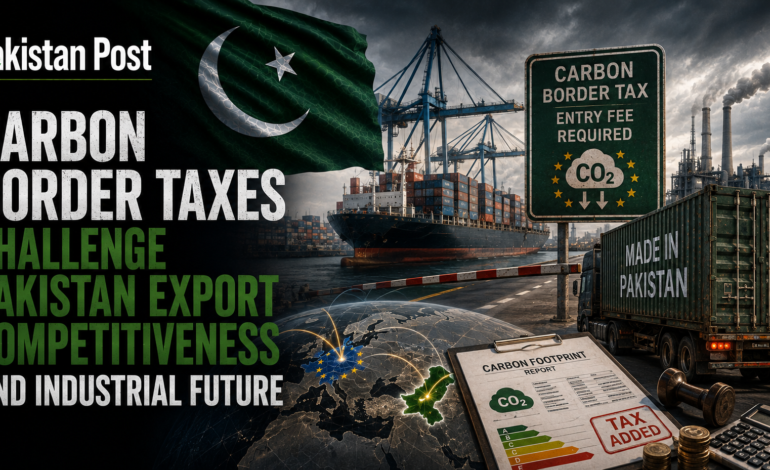
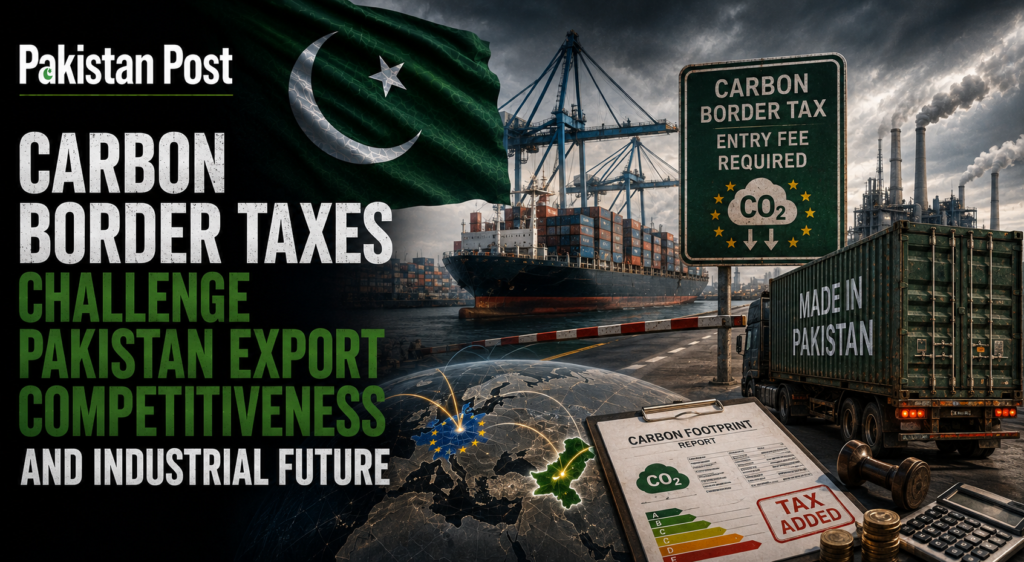
Carbon Border Taxes Challenge Pakistan Export Competitiveness and Industrial Future

Carbon emissions have moved beyond environmental diplomacy into the architecture of international commerce. Climate policy is no longer confined to environmental ministries or multilateral negotiations. It now influences customs procedures, investment decisions, manufacturing standards, financial disclosure, supply chain governance and market access across the world’s largest consumer economies. The commercial landscape confronting exporters is undergoing structural transformation as major importing jurisdictions increasingly incorporate carbon intensity into trade policy. For export dependent economies, competitiveness will increasingly depend not only upon price, quality and delivery reliability, but also upon measurable environmental performance throughout production cycles.
Pakistan confronts this transition at a particularly sensitive moment. Exports remain concentrated in sectors characterised by energy intensive manufacturing, aging industrial infrastructure and uneven technological adoption. Textiles, leather, cement, chemicals, steel, agricultural processing and engineering goods collectively represent substantial employment and foreign exchange earnings. These industries now face an external environment where carbon disclosure, product traceability, renewable energy utilisation and environmental certification are becoming commercial prerequisites rather than voluntary commitments.
The emergence of carbon border adjustment mechanisms represents one of the most significant changes in global trade governance since the establishment of rules based multilateral commerce. Importing countries increasingly argue that domestic climate regulations become economically ineffective if production simply relocates to jurisdictions with lower environmental standards. Carbon adjustment policies seek to equalise competitive conditions by imposing carbon related costs upon imported goods that originate from higher emission production systems. Although environmental protection remains the stated objective, the commercial implications extend into industrial policy, technological competition and geopolitical influence over international manufacturing.
For Pakistan, this development should not be interpreted merely as another regulatory obstacle imposed by advanced economies. Instead, it represents evidence that climate governance has become inseparable from industrial competitiveness. Countries capable of demonstrating low carbon production, credible environmental reporting and transparent certification systems will increasingly secure privileged access to premium international markets. Those unable to adapt risk gradual commercial marginalisation despite maintaining traditional comparative advantages.
The strategic concern extends beyond immediate export revenues. Carbon adjusted trade mechanisms possess the capacity to reshape global investment patterns. International manufacturers increasingly evaluate potential production destinations through environmental risk assessments alongside labour costs, logistics and taxation. Investors seeking integration into European or environmentally regulated supply chains increasingly favour jurisdictions capable of providing renewable electricity, predictable environmental regulation, digital compliance infrastructure and internationally recognised certification mechanisms. Without corresponding reforms, Pakistan risks becoming comparatively less attractive for export oriented industrial investment.
Manufacturing competitiveness is entering a new technological era. Industrial productivity can no longer be separated from energy efficiency. Modern production increasingly depends upon intelligent manufacturing systems, automated energy management, precision engineering, digital monitoring and cleaner industrial processes. Countries investing aggressively in industrial decarbonisation simultaneously improve productivity, reduce operational costs and strengthen export resilience. Environmental compliance therefore becomes compatible with commercial efficiency rather than constituting a financial burden alone.
Pakistan’s industrial structure reflects decades of investment decisions made under entirely different commercial assumptions. Numerous factories continue operating with obsolete machinery consuming excessive electricity, imported fuels and inefficient production inputs. Energy losses throughout manufacturing processes remain considerable while industrial emissions monitoring remains fragmented. Many firms possess limited understanding regarding product lifecycle assessment, embedded carbon calculations or internationally recognised sustainability reporting frameworks. These institutional deficiencies may prove increasingly expensive as environmental compliance becomes embedded within customs procedures abroad.
Electricity generation occupies a central position within this transition. Manufacturing competitiveness increasingly depends upon the carbon intensity of national electricity systems. Exporters operating within renewable powered industrial zones enjoy measurable commercial advantages under emerging climate regulations. Pakistan has expanded renewable energy capacity in recent years, yet industrial integration remains uneven. Grid reliability, transmission constraints, pricing uncertainty and inconsistent policy implementation continue discouraging broader industrial transition toward cleaner electricity sources.
Natural gas shortages further complicate industrial planning. Manufacturers experiencing irregular fuel availability frequently rely upon diesel generators or alternative high emission energy sources. Such operational adjustments increase production costs while simultaneously worsening carbon intensity. Climate compliance therefore intersects directly with national energy security, infrastructure investment and industrial planning.
The textile sector illustrates both vulnerability and opportunity. Pakistan remains among the world’s major textile exporters, supplying increasingly sustainability conscious international brands. Global retailers now demand comprehensive environmental reporting covering energy consumption, water utilisation, labour practices, waste management and carbon emissions throughout production chains. Procurement decisions increasingly reward suppliers capable of demonstrating transparent sustainability performance verified through independent certification.
Many larger Pakistani textile exporters have begun investing in wastewater treatment, solar installations, efficient machinery and environmental certification. However, substantial portions of small and medium sized enterprises continue operating without equivalent resources. This creates divergence within the national industrial ecosystem whereby internationally integrated corporations progressively modernise while smaller manufacturers risk exclusion from premium markets.
Small enterprises require particular policy attention because compliance costs often exceed available financial capacity. Environmental auditing, certification procedures, emissions monitoring equipment and renewable energy investments demand capital unavailable to numerous businesses operating under narrow financial margins. Without institutional support, climate related trade regulations may accelerate industrial concentration while reducing opportunities for smaller exporters.
Agricultural exports confront parallel challenges. International food markets increasingly incorporate sustainability standards covering fertiliser application, water management, biodiversity protection, pesticide usage, packaging materials and transportation emissions. Agricultural competitiveness therefore increasingly depends upon climate smart farming rather than production volumes alone. Pakistan possesses considerable agricultural potential yet requires substantial improvements in traceability systems, digital certification and internationally recognised environmental monitoring.
Industrial decarbonisation should consequently be understood as a comprehensive economic modernisation strategy rather than an isolated environmental initiative. Cleaner production frequently generates higher productivity through reduced energy consumption, improved resource efficiency and technological upgrading. Countries embracing environmental transformation often discover broader gains extending into manufacturing quality, investment attractiveness and innovation capacity.
Financial markets reinforce these dynamics. International banks, export credit agencies and institutional investors increasingly integrate environmental performance into lending decisions. Green finance, sustainability linked loans and climate investment facilities continue expanding across global capital markets. Pakistani industries unable to satisfy environmental disclosure expectations may encounter progressively higher financing costs alongside reduced investment access.
Domestic financial institutions therefore possess an increasingly strategic role. Commercial banks require greater technical capacity to evaluate industrial decarbonisation projects while developing financing products supporting renewable energy adoption, energy efficiency upgrades and environmental certification. Financial regulation should encourage climate related investment rather than treating sustainability exclusively as corporate social responsibility.
Institutional fragmentation remains among Pakistan’s principal weaknesses. Environmental regulation, industrial development, export promotion, energy planning, investment policy and technological innovation frequently operate through separate administrative structures with limited strategic coordination. Carbon competitiveness requires integrated governance capable of synchronising industrial policy with climate objectives.
Export certification infrastructure similarly requires substantial strengthening. International markets increasingly demand reliable verification regarding production standards, emissions reporting and sustainability performance. Pakistan requires internationally accredited laboratories, certification agencies, digital compliance platforms and technical advisory institutions capable of supporting exporters across diverse industrial sectors. Dependence upon foreign certification bodies increases compliance costs while delaying commercial transactions.
Digital transformation constitutes another critical requirement. Carbon accounting increasingly depends upon precise measurement throughout supply chains. Manufacturers require digital systems capable of monitoring electricity consumption, fuel utilisation, production efficiency, transportation emissions and material sourcing. Government agencies similarly require integrated digital platforms facilitating regulatory reporting, certification verification and export documentation compatible with international standards.
Human capital development represents an equally important strategic investment. Environmental engineers, industrial energy specialists, sustainability auditors, climate economists, carbon accounting professionals and renewable technology experts will become increasingly valuable across manufacturing industries. Universities, engineering institutions and vocational training centres should therefore integrate industrial sustainability into technical education rather than treating climate studies exclusively as environmental science.
Research institutions require stronger integration with industrial policy. Universities frequently conduct valuable research regarding cleaner technologies, renewable energy systems, advanced materials and resource efficiency. Yet commercial application remains limited due to weak collaboration between academia and manufacturing. Institutional mechanisms encouraging technology transfer, pilot projects and industrial innovation partnerships could accelerate domestic capability development.
Commercial diplomacy will likewise become increasingly important. International climate regulations continue evolving through complex negotiations involving governments, industries and multilateral institutions. Pakistan requires specialised trade diplomacy capable of protecting legitimate commercial interests while participating constructively in global climate governance. Diplomatic engagement should seek recognition of developmental realities without resisting legitimate environmental objectives.
Regional cooperation also deserves greater consideration. South Asian industries confront similar challenges regarding industrial upgrading, renewable energy integration and environmental compliance. Collaborative research initiatives, regional certification arrangements and technological partnerships could reduce adaptation costs while strengthening collective competitiveness.
Industrial clusters present practical opportunities for accelerated transition. Concentrating renewable energy infrastructure, wastewater treatment facilities, recycling systems and certification services within designated manufacturing zones reduces compliance costs while improving environmental performance. Export processing zones should therefore evolve into integrated sustainable industrial ecosystems rather than conventional manufacturing estates.
Logistics infrastructure requires parallel modernisation. Transportation emissions increasingly influence supply chain sustainability assessments. Railway freight expansion, port efficiency improvements, cleaner commercial vehicle fleets and digital logistics management contribute directly toward reducing embedded export emissions while strengthening commercial competitiveness.
Circular economy principles deserve greater policy emphasis. Industrial waste recycling, resource recovery, sustainable packaging and material reuse reduce production costs while lowering environmental impacts. Manufacturing strategies based upon circular resource utilisation increasingly align commercial efficiency with climate compliance.
Public procurement can accelerate industrial transformation. Government purchasing policies favouring environmentally certified domestic products create market incentives encouraging cleaner production. Such approaches stimulate technological upgrading while strengthening domestic manufacturing capability before firms confront international competition.
Data governance represents another emerging strategic requirement. Carbon reporting increasingly depends upon credible national statistical systems capable of generating internationally recognised emissions information. Pakistan requires transparent, scientifically credible carbon inventories covering industrial sectors, energy systems and production activities. Reliable environmental data enhances both domestic policymaking and international commercial credibility.
National security institutions should recognise that industrial competitiveness increasingly intersects with economic resilience. Export contraction arising from environmental non compliance would affect foreign exchange stability, employment, fiscal capacity and broader economic security. Climate related trade policies therefore possess strategic implications extending well beyond environmental administration.
Energy diversification offers perhaps the greatest long term opportunity. Pakistan possesses considerable solar and wind resources capable of supporting industrial decarbonisation if integrated through coherent investment frameworks. Competitive renewable electricity could simultaneously improve industrial profitability, reduce imported fuel dependence and strengthen climate compliance.
Policy predictability remains indispensable. Manufacturers contemplating major investments require confidence that regulatory frameworks, renewable energy incentives and industrial modernisation policies will remain stable over extended periods. Frequent policy reversals discourage long term capital allocation precisely when sustained investment becomes essential.
Government should therefore establish a comprehensive national carbon competitiveness strategy integrating industrial policy, export promotion, energy transition, technological innovation and environmental governance. Such a framework should identify priority export sectors, define measurable decarbonisation pathways, coordinate institutional responsibilities and establish transparent implementation timelines aligned with international market developments.
An integrated industrial competitiveness council bringing together economic ministries, export authorities, environmental regulators, energy institutions, financial agencies, research organisations and private industry could significantly improve policy coordination. Regular strategic assessments would enable rapid adaptation to evolving international regulatory requirements while preventing fragmented administrative responses.
Targeted fiscal incentives should encourage industrial modernisation through accelerated depreciation for efficient machinery, concessional financing for renewable energy projects, tax incentives supporting emissions reduction technologies and grant programmes facilitating environmental certification among smaller enterprises. These instruments should reward measurable productivity improvements alongside environmental performance.
Pakistan should simultaneously strengthen commercial intelligence capabilities monitoring emerging environmental regulations across major export destinations. Early identification of regulatory changes enables industries to adapt before compliance deadlines become commercially disruptive. Strategic forecasting should become a permanent component of export governance.
Ultimately, carbon border adjustment mechanisms symbolise a broader transformation in international commerce where environmental performance, technological sophistication and industrial resilience increasingly determine economic success. Pakistan cannot preserve export competitiveness through conventional cost advantages alone. The emerging commercial environment rewards innovation, transparency, efficiency and institutional credibility.
The countries securing long term industrial leadership will not necessarily possess the cheapest labour or largest production capacity. They will demonstrate the greatest ability to integrate technological advancement, environmental responsibility and strategic economic governance into coherent national competitiveness. Pakistan retains sufficient industrial capability, entrepreneurial capacity and renewable energy potential to participate successfully in this transition. Realising that opportunity, however, requires recognising that climate compliance is no longer peripheral environmental policy. It has become an essential instrument of economic security, export resilience, industrial sovereignty and national strategic competitiveness within the evolving architecture of twenty first century global commerce.
A Public Service Message